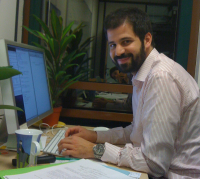
Christoph Koch is an Associate Professor at Technische Universität Wien specializing in databases and artificial intelligence. His research spans database theory, complexity theory, and logic in computer science, with a focus on XML processing, query optimization, and parallel data science techniques. Lead projects: KnowledgeGraph (2020–2028), HINT (2012–2017), Weblearn (2005–2008) Developed the Lixto visual extraction system and contributed to DLV knowledge representation framework Supervised T. Lukasser's diploma thesis on XPath query processing
Sanja Lukumbuzya is a PostDoc Researcher at the Knowledge-Based Systems group (E192-03) of Vienna University of Technology. Her work bridges formal logic and practical data systems, focusing on ontology-mediated data management, description logics, and business process challenges. Research Interests Ontology-Based Data Access (OBDA) Description Logics and Datalog Rewriting Process Mining and Workflow Analysis Hybrid Reasoning Systems Incomplete Data Handling Computational Complexity in Knowledge Bases Affiliations Vienna University of Technology, Austria Researcher in projects KtoAPP (2018–2025) and OMEGA (2017–2022) Publications Trends Her recent work addresses algorithmic complexity in expressive logics (2024), coNP expressiveness in ontology queries (2023), and practical BPM challenges (2023). Earlier studies focused on bounded predicates (2021), hybrid ASP-ontology frameworks (2020), and dishonesty modeling (2018).
Sebastian Skritek is a Senior Lecturer at the Technische Universität Wien in the Department of Databases and Artificial Intelligence. His research primarily focuses on database theory, semantic web technologies, and query processing. Research interests include foundational aspects of database systems, complexity analysis of query languages, and optimization techniques for semantic web applications. His work bridges theoretical computer science with practical database implementations. His publications demonstrate a consistent focus on query evaluation complexity and optimization, particularly in SPARQL and conjunctive query systems. Recent work explores diversity in query answers and tractability boundaries. Supervision includes guiding students in database theory projects and theses. Research projects include 'SEE: SPARQL Evaluation and Extensions' and 'Theoretical Tractability vs. Practical Computation'.
Professor Vassilis Christophides is a Full Professor at the École Nationale Supérieure d'Électronique et de ses Applications (ENSEA), part of the University of Cergy-Pontoise. His research focuses on Machine Learning Systems, Data Science & Big Data Computing, Databases and Semantic Web Systems, and Digital Libraries. He has published over 155 articles in top-tier journals/conferences like ACM SIGMOD and IEEE ICDE. Teaching includes courses such as Machine Learning, Big Data Computing, and Transparency in AI at the undergraduate and master's levels. He actively serves in conference roles (e.g., Tutorial Chair at WISE 2022), steering committees (EDBT Association), and as a reviewer for ERC grants. His work emphasizes ethical AI, explainable systems, and scalable data management across domains like Cultural Heritage and Environmental Sciences. Notable contributions include the BDA 2021 Best Paper Award and leadership in projects like the NOON research group. His work bridges theoretical advancements with real-world applications in data-driven decision-making and system optimization.
Louis Mandel is a Researcher at Inria, specializing in reactive programming languages and probabilistic systems. He co-developed ReactiveML and Q*cert (a verified query compiler), with applications in chatbots and cloud log analysis. His work bridges formal methods and practical tools for embedded systems.
Ruzica Piskac is a Professor of Computer Science at Yale University, leading the Rigorous Software Engineering (ROSE) group. She previously held an Independent Research Group Leader position at the Max Planck Institute for Software Systems (2012–2013) and earned her PhD from EPFL (2011), awarded the Patrick Denantes Prize for her thesis on decision procedures for program synthesis and verification. Her research focuses on improving software reliability and trustworthiness through formal methods, encompassing software verification, automated reasoning, applied cryptography, and code synthesis. Notable honors include multiple Amazon Research Awards, the Yale Ackerman Award, and the Microsoft Research Award. She currently serves as Program Chair for the International Conference on Computer Aided Verification (CAV 2024) and on the Steering Committee for Formal Methods in Computer-Aided Design (FMCAD). Education: PhD in Computer Science (EPFL, 2011), MSc in Computer Science (Saarland University, 2005) Key Projects: ROSE group’s work on legal accountability for automated decisions (soid tool), privacy-preserving model checking, and quantum computing security Professional Activities: Editorial roles for conferences like LPAR, FMCAD, and VMCAI Her research group has graduated five PhD students, four now holding assistant professor roles. Current projects include formal XAI via syntax-guided synthesis, privacy-preserving cryptographic protocols, and quantum circuit vulnerability analysis.
Luís Cruz-Filipe is an Associate Professor at the Department of Mathematics and Computer Science (IMADA) within the Faculty of Engineering at the University of Southern Denmark. His research spans theoretical computer science with a focus on formal methods, programming languages, and distributed systems. He maintains an active research profile with numerous publications in top venues. His research interests primarily center around choreographic programming, formal verification, sorting networks, and logic programming. Cruz-Filipe has made significant contributions to the theoretical foundations of choreographic programming, developing formal frameworks for specifying and verifying distributed communication protocols. His work on sorting networks has advanced the understanding of optimal network structures, while his research in approximation fixpoint theory has provided formal foundations for logic programming semantics. Analysis of his recent publications reveals a strong trend toward formal methods applied to distributed systems, particularly in choreographic programming where he has developed theoretical frameworks, verification techniques, and compilation approaches. His work bridges theoretical computer science with practical implementation concerns, often using proof assistants like Coq to ensure correctness. More recently, he has expanded into sustainability topics with work on green software development. As an academic, Cruz-Filipe has contributed significantly to the theoretical foundations of choreographic programming, producing a cohesive body of work that has helped establish this field. His publications demonstrate a consistent focus on formal methods to address challenges in distributed systems, with increasing attention to practical implementation and verification.
Julián Arenas Guerrero is an Assistant Professor at the Faculty of Computer Science, Universidad Politécnica de Madrid (UPM). He is affiliated with the Ontology Engineering Group (OEG) and participates in the ENTENTE project. His research focuses on Knowledge Graphs, Data Integration, and Semantic Web technologies, with contributions to RML-star mappings, virtual knowledge graph architectures, and scalable knowledge graph materialization frameworks like Morph-KGC. Educational background includes a Computer Science Engineering degree from Universidad Complutense de Madrid (2019) and a Master's in Artificial Intelligence from UPM (2020). Prior to academia, he worked as a Data Scientist at GMV Innovating Solutions. Research interests emphasize declarative data mapping, semantic data integration, and RDF-star technologies. His work addresses challenges in heterogeneous data transformation, ontology-driven systems, and federated query processing. Recent contributions include benchmarks for OBDA systems (LUBM4OBDA) and high-level ontology networks for ICT infrastructures. Publications span 2020-2025 with a focus on advancing semantic web methodologies. No scientific awards explicitly mentioned, but active in international research collaborations through OEG.
Matt Duckham is a Professor in Geospatial Sciences and Director of the Information in Society Enabling Impact Platform at RMIT University. He has held previous academic roles at the University of Melbourne as an Australian Research Council Future Fellow and at the University of Maine's National Center for Geographic Information and Analysis. His work bridges theoretical and applied GIScience, with a focus on AI integration and spatial knowledge infrastructure. Academic Leadership: Director, Information in Society EIP (2021–present); Acting Dean, STEMM Diversity and Inclusion (2020–2021) Research Themes: Geospatial AI, Qualitative Spatial Reasoning, Decentralized Geosensor Networks, Spatial Data Trusts Recent Publications demonstrate his commitment to advancing spatial computing through machine learning integration and explainable AI frameworks. His teaching resources include open-access textbook materials and practical exercises spanning relational spatial databases and data visualization. Professional Contributions include co-founding the Journal of Spatial Information Science and developing open educational resources under a Creative Commons Attribution license. His work addresses critical issues in data ethics , urban resilience , and emergency response systems .
Carsten Binnig is a Professor at Technische Universität Darmstadt, leading research in Data and AI Systems. His work focuses on next-generation data management architectures leveraging modern hardware capabilities like high-speed RDMA networks. Primary research areas include: Distributed database systems for cloud and edge environments AI-driven optimization of query processing Hardware-accelerated data management Stream processing architectures Secure computation in databases Recent publications examine learned cost estimators, RDMA synchronization challenges, and benchmarking frameworks for distributed systems. His group develops novel approaches to optimize database kernels and enhance cloud DBMS security. He contributes to major database conferences including SIGMOD and VLDB, and investigates emerging challenges in LLM-based data engineering.
Ioannis Fudos is Professor and former Chair (2014-2018) of the Computer Science and Engineering Department at the University of Ioannina. He holds a Diploma in Computer Engineering from University of Patras, and MS/PhD degrees in Computer Science from Purdue University. His research spans computer graphics, CAD systems, geometric modeling, animation, and image retrieval. He directs the Computer Graphics Research Group and has secured substantial funding (€2M+) from European and national sources for 17+ projects. His scholarly contributions include publications in top venues (SIGGRAPH, Eurographics, IEEE TVCG) covering rendering techniques, 3D printing quality control, assistive technologies, and cultural heritage digitization. Recent work explores neural rendering transparency methods, wheelchair navigation interfaces, and pedestrian routing algorithms. His laboratory maintains a repository of 3D models for research use.
Walter Binder is a Full Professor in the Faculty of Informatics at the Università della Svizzera italiana (USI). He holds a MSc, PhD, and venia docendi from Vienna University of Technology. Previously, he was a senior researcher at the Artificial Intelligence Laboratory, EPFL. His research focuses on program transformations, virtual execution environments, aspect-oriented programming, profiling, and resource management. Education: MSc from Vienna University of Technology PhD from Vienna University of Technology Venia docendi (Habilitation) from Vienna University of Technology Research Interests: His work spans JVM optimization, parallel computing, and dynamic program analysis. Notable contributions include tools like Renaissance (a JVM benchmark suite), S2S (SQL-to-Stream translator), and Akkaprof (profiler for actor-based systems). He explores topics such as thread management, vectorization, and performance profiling in distributed systems. Articles Trends: Recent work emphasizes JVM performance (e.g., Java Vector API, Native Image optimizations), parallel execution policies (NAS benchmarks), and adaptive runtime systems (e.g., MPR framework). He also investigates big data systems (Spark, Node.js) and runtime verification tools. Grants & Labs: Leads projects on JVM profiling, polyglot runtimes, and large-scale program analysis. His lab develops tools like NodeMOP for Node.js and AccStream for stream processing systems.
Leonard Wörteler is a Researcher at the University of Konstanz's Department of Computer and Information Science, affiliated with the Database and Information Systems group. He joined as a PhD student in 2015 after completing his Bachelor's (2012) and Master's (2015) in Computer and Information Science at the same institution. His research focuses on query optimization, including architectures, parallel heuristic algorithms, and non-relational databases. He has contributed to teaching, including courses on database systems and computer science fundamentals. His research explores advanced optimization techniques, such as neural language models for cardinality estimation and landmark-based algorithms for graph databases. He has published in venues like IDA, DBPL, and SIGRAD, addressing topics ranging from XQuery optimization to real-time transportation visualization. Wörteler's work emphasizes practical implementations, such as optimizing Neo4j's performance through landmark embedding. His contributions bridge theoretical optimization frameworks with real-world applications in databases and data mining.
Hermann Maurer is Full Professor of Computer Science at Graz University of Technology (since 1978), with additional roles as Honorary Visiting Professor at Danube University and Honorary Research Fellow at University of Auckland (till 2012). He has held leadership positions including Dean of Computer Science (2004-2007) and Chair of Informatics Section in Academia Europaea (2007-2012). Key Institutions: Graz University of Technology, Austria-Forum, JOANNEUM RESEARCH, Academia Europaea Academic Honors: Member of Finnish Academy of Sciences, Cross of Honour for Arts and Science (Austria), multiple honorary doctorates Research Focus: Networked Interactive Digital (NID) Books, Austria-Forum (1.1M entries), hypermedia systems, anti-monopoly digital frameworks, and societal impacts of technology. He pioneered second-generation web systems and co-founded conferences like ED-MEDIA and I-KNOW. Key Trends in Publications: Recent works emphasize NID systems, interactive encyclopedias, web reliability, and the future of digital libraries. His research spans e-learning, information integration, and combating web-based plagiarism. Scientific Awards: Honorary Doctorates (St. Petersburg, Karlsruhe, Calgary) AACE Fellowship (2003) Integrata Prize (2000) Enter Prize (1999) Advising & Grants: Supervised over 400 M.Sc. and 50 Ph.D. theses. Led multimillion-dollar projects including Hyperwave AG, COSTOC, and Austria-Forum. His work on optical storage and color-graphic microcomputers (MUPID) exemplifies technological innovation.
Fabio Persia is a researcher affiliated with the University of Naples Federico II , with a focus on Semantic Computing , Multimedia Recommender Systems , and Event Detection in Video Surveillance . His work spans interdisciplinary applications in Healthcare , Robotics , and Social Network Analysis , often collaborating with co-researchers like Daniela D'Auria, Mouzhi Ge, and Giovanni Pilato. His research interests include leveraging Artificial Intelligence and Complex Event Processing to enhance patient monitoring and healthcare systems . He has contributed to frameworks for social sensing , surveillance , and personalized recommendations . Publications highlight his expertise in semantic indexing , multimedia analysis , and intelligent systems . Key works involve AI-driven patient monitoring , risk-aware route planning , and social network behavior modeling . As a co-author in numerous journals and conferences, he has co-edited special issues in the International Journal on Semantic Computing and contributed to Clinical and Collaborative Robotics advancements. His current role remains active, with recent 2025 publications indicating ongoing research.