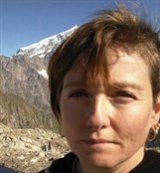
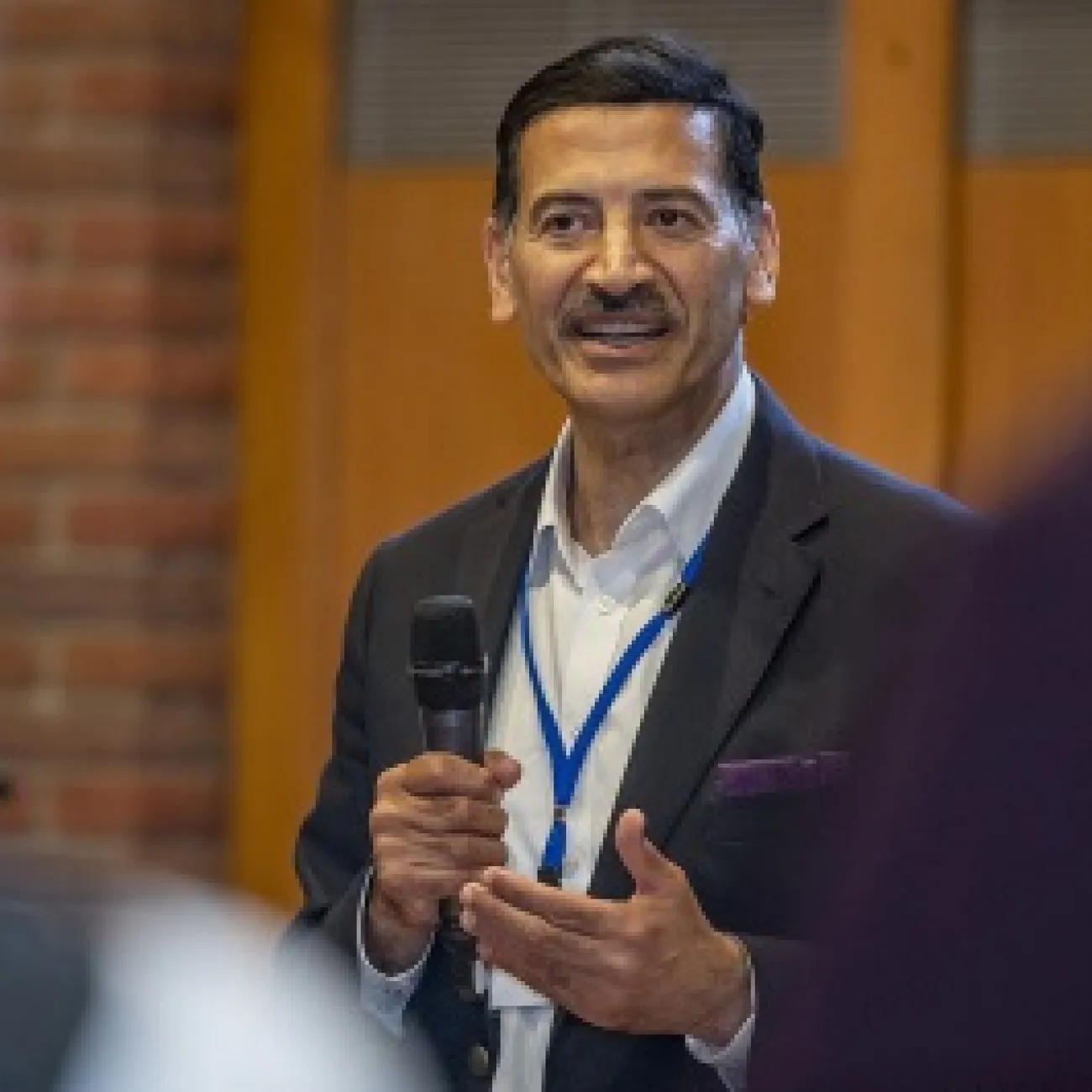
Prof. Dr.-Ing. Richard Membarth is a Research Professor for System-on-a-Chip and AI at the Edge Computing at Technische Hochschule Ingolstadt (THI). He is affiliated with the Hardware-Software Co-Design group and holds a secondary position at the German Research Center for Artificial Intelligence (DFKI) Saarbrücken. Co-creator of DSL frameworks like AnyDSL and Hipacc Key contributor to MetaDL (AI metaprogramming) and PRIME (predictive rendering) His research bridges GPU computing , domain-specific languages , and compiler technology , with recent work on Vulkan SPIR-V compilation and device-driven SpMV algorithms . Notable awards include the HiPEAC Paper Award (2018) and multiple Best Paper Awards for his compiler frameworks.
Rayid Ghani is a Professor at Carnegie Mellon University (CMU), affiliated with both the Machine Learning Department (School of Computer Science) and the Heinz College of Information Systems and Public Policy. He co-leads CMU’s Responsible AI Initiative and leads the Data Science and Public Policy Group and the Data Science for Social Good Program. His work focuses on applying machine learning, AI, and data science to address social and policy challenges in health, criminal justice, education, public safety, workforce development, and sustainability, with an emphasis on fairness, equity, and transparency in AI systems. Education: PhD in Software Engineering PhD in Societal Computing Rayid’s research spans three pillars: (1) building AI systems for human collaboration to improve decision-making, (2) embedding fairness and equity in AI design, and (3) ensuring reliability and resilience of AI systems in dynamic environments. He emphasizes application-grounded experimental design and stakeholder engagement. His recent publications include frameworks for fair ML experimentation, analyses of fairness-accuracy trade-offs, and AI applications in child welfare, public health, and housing policy. He has also contributed to policy discussions, including congressional testimonies on responsible AI procurement. Advising & Grants: Rayid collaborates with governments, NGOs, and academic institutions on projects like eviction prevention, HIV care retention, and bias mitigation in public policy. He advises non-profits and startups on data science strategy and ethics. Labs & Teams: He leads the Data Science and Public Policy Group and the Data Science for Social Good Program at CMU, fostering interdisciplinary collaborations between computer scientists, social scientists, and policymakers.
Professor Matthias Lederer serves as a faculty member at the Weiden Business School of Ostbayerische Technical University Amberg-Weiden, specializing in Business Informatics with a focus on Process Management. His academic position is complemented by extensive industry experience across multiple sectors including IT services, manufacturing, and consulting. Dr. Lederer's research spans four interconnected domains: process analysis and optimization, IT process management, agile process transformation, and didactics for process digitization. His work bridges theoretical frameworks with practical applications, particularly in business process management (BPM), digital transformation, and the integration of agile methodologies into organizational structures. His research demonstrates a clear trajectory toward increasingly sophisticated applications of data science and artificial intelligence in process optimization. Analysis of his recent publications reveals a strong focus on practical implementations of business process management, with particular emphasis on agile transformations, data-driven process design, and the application of AI in business contexts. His work consistently addresses the intersection of academic research and industry practice, with publications appearing in both academic journals and professional conference proceedings. The research demonstrates growing attention to digital platforms, smart manufacturing applications, and sustainable business practices. His scientific recognition includes: Best Program Director award from ISM International School of Management Project Award 'Innovative LernOrte' from OTH Award for Good Teaching from the Bavarian State Ministry Best Paper Award at the 2014 International Conference on Information Systems Multiple professional certifications including Lean Six Sigma Black Belt and OMG-Certified Expert in Business Process Management Professor Lederer has developed significant academic leadership through his role as Chairman of the Institute of Innovative Process Management. His teaching approach integrates practice-integrated methodologies, reflecting his belief in connecting academic concepts with real-world applications. His extensive consulting background with organizations like REHAU AG + Co. and the Bavarian Ministry of Justice informs his academic work and student mentorship.
Michael Fink is a researcher at the Chair of Automatic Control Engineering , Technical University of Munich . He holds an M.Sc. in Electrical Engineering and Information Technology (2020) and a B.Eng. in the same field from Technical University Munich and University of Applied Sciences Landshut (2018), respectively. Research Interests : Model Predictive Control (MPC) with focus on stochastic and robust variants Optimal control strategies for autonomous driving and vertical farming Constraint violation probability minimization in dynamic systems Publications span topics in: Time-optimal MPC for linear systems Stochastic and robust MPC frameworks Learning-based control for greenhouse climate systems Vertical farming optimization Contact: michael.fink@tum.de
Yung-Hsiang Lu is a Professor of Electrical and Computer Engineering at Purdue University's Elmore Family School of Electrical and Computer Engineering. His research focuses on mobile/cloud computing, energy-efficient computing, and image/video processing. He holds a BSEE from National Taiwan University (1992), an MSEE (1996), and a PhD (2002) from Stanford University. Dr. Lu's academic background includes significant contributions to VLSI and circuit design, with primary emphasis on computer engineering. His work spans theoretical and applied domains, including optimizing neural networks for edge devices, securing deep learning models, and leveraging large language models for software development. Recent research trends in his articles emphasize energy efficiency in AI systems, interdisciplinary applications of transformers (e.g., music analysis), and challenges in model interoperability and security. His publications also highlight innovations in global camera networks and real-time visual data analysis. While no specific grants or awards are explicitly mentioned, his extensive list of publications reflects sustained academic engagement. His educational contributions include developing C programming resources and teaching large-scale image processing using global camera networks. Dr. Lu's professional address is at Purdue's Materials and Electrical Engineering Building in West Lafayette, Indiana, where he maintains an active research lab focused on embedded systems and low-power computing innovations.
Dr. Shulin (Stanley) Chen is a Lecturer at the University of Technology Sydney (UTS), specializing in antennas and applied electromagnetics. He holds a PhD from UTS (2019) and has held postdoctoral and visiting scholar positions at UTS and City University of Hong Kong. His research focuses on metasurfaces, reconfigurable antennas, and machine learning-driven design, supported by prestigious awards like the DECRA (2025) and IEEE AP-S Fellowship (2022). He serves as an Associate Editor for IEEE Transactions on Circuits and Systems II and has authored over 75 publications. His work spans advanced beam-forming antennas for 6G, frequency-controlled polarization systems, and intelligent metasurface design. Education: B.S. in Electrical Engineering, Fuzhou University (2012) M.S. in Electromagnetic Field & Microwave Technology, Xiamen University (2015) PhD in Electrical Engineering, UTS (2019) Research Interests: Metasurfaces for electromagnetic wave manipulation Reconfigurable antennas for 6G networks Machine learning in antenna design Joint communication and sensing systems Awards & Grants: DECRA (2025), TICRA-EurAAP Travel Grant (2022) Lead projects on intelligent redirecting surfaces and flood sensing (funded by Telstra, NSW Department of Planning, etc.) Labs & Teams: Active in UTS's Global Big Data Technologies Centre and collaborates with industry partners like XPOWER AI and TPG Telecom.
Sally Paganin is an Assistant Professor of Statistics at The Ohio State University, affiliated with the Department of Statistics within the College of Arts and Sciences. She joined the faculty in 2023 and holds a PhD from the University of Padova (2019). Her research focuses on Bayesian statistics, computational methods, and latent variable modeling, with recent emphasis on genomic data analysis for cancer detection and software development for hierarchical models. Her expertise spans Bayesian nonparametrics, statistical computing, and domain knowledge integration in modeling frameworks. She actively contributes to the NIMBLE project, an R-based platform for hierarchical modeling, and has developed open-source tools like the compareMCMCs package for MCMC efficiency analysis. Dr. Paganin serves as an Associate Editor for the software section of The New England Journal of Statistics in Data Science and previously served as Treasurer of j-ISBA (2021–2022). Her work bridges theoretical advancements with practical applications in healthcare and computational statistics. Key research themes include Bayesian model assessment, latent variable models, and statistical methods for complex data structures. Her publications reflect contributions to MCMC algorithms, semiparametric IRT models, and prior-driven clustering techniques.
Joshua Marshall is a Professor of Electrical & Computer Engineering at Queen’s University, Canada, and Director of the Offroad Robotics research group. He holds a PhD from the University of Toronto and has cross-appointments in Mechanical & Materials Engineering and the Robert M. Buchan Department of Mining. His expertise spans field robotics, autonomous systems, control engineering, and harsh-environment applications in mining, space, and marine domains. He led the Ingenuity Labs Research Institute (2018–2024) and served as a Visiting Professor at Örebro University (2016–17). Dr. Marshall’s work focuses on autonomous vehicle navigation, robotic excavation, and spatiotemporal mapping. He has received the 2025 OPEA Engineering Medal and has commercialized technologies through partnerships with companies like Epiroc and RockMass Technologies. Education: PhD, Electrical & Computer Engineering, University of Toronto (2005) MSc(Eng), Mechanical Engineering, Queen’s University (2001) BSc (Hons), Engineering, (details not specified) Research Interests: Autonomous robotics in mining, space, and marine environments Data-driven control systems and model predictive control Proprioceptive sensing and terrain classification Multi-robot coordination and task planning Underground navigation and SLAM Professional Activities: Senior Member, IEEE Editorial roles: International Journal of Robotics Research , IEEE Transactions on Mechatronics Co-founded the NSERC Canadian Robotics Network (NCRN) Contributions to the IEEE Medal for Environmental & Safety Technologies Committee Labs/Teams: Offroad Robotics Group (Queen’s University) Ingenuity Labs Research Institute (founding Director) Advisor to Queen’s AutoDrive Challenge II Team and aQuatonomous ASV Design Club
Andreas Maier is a Researcher at the University of Hamburg's Faculty of Mathematics, Informatics and Natural Sciences, affiliated with the Computational Systems Biology department. He began his PhD in May 2021 with Cosy.Bio (Center for Systems Biology) at UHH, focusing on drug repurposing projects such as REPO-TRIAL. Previously, he completed a Bioinformatics master's thesis at TUM (Technical University of Munich), developing a web application for analyzing molecular disease networks. His research interests emphasize network medicine, drug repurposing, and computational tools for biomedical discovery. He has contributed to platforms like NeDRex-Web, Drugst.One, and BioCypher, which democratize access to systems medicine workflows. His work bridges heterogeneous data integration, federated learning for rare diseases, and quantum computing applications in genetics. Maier's publications highlight innovations in knowledge graph-based drug discovery, privacy-preserving federated learning, and single-cell network analysis. He actively develops open-source bioinformatics tools to address challenges in disease module identification and patient stratification. His projects align with the REPO4EU consortium and other collaborative initiatives in translational bioinformatics.
Weiwen Jiang is a tenure-track Assistant Professor in the Department of Electrical and Computer Engineering at George Mason University (GMU), affiliated with the College of Engineering and Computing (CEC). He leads the JQub lab, focusing on hardware/software co-design for computing systems, spanning classical (FPGAs, ASICs) and quantum computing applications in AI-driven fields like medical imaging and geophysics. Prior to GMU, he held a postdoctoral position at the University of Notre Dame and earned his PhD in Computer Science from Chongqing University with a joint PhD in Electrical and Computer Engineering from the University of Pittsburgh. His research emphasizes quantum computing, AI accelerators, and domain-specific computing. Notable achievements include the 2025 NSF CAREER Award, ACM Sigda Meritorious Service Award (2024), and IEEE QuantumWeek Best Paper Award (2023). His work is funded by NSF, DoE, ARO, Meta, and Leidos. He co-chaired IEEE QuantumWeek (2023–2025) and created workshops like StableQ at ESWEEK 2023. Key contributions include developing frameworks like QuPAD for quantum learning and JQub's AI-driven geophysical and medical imaging tools. His lab graduated Dr. Yi Sheng (now at University of South Florida) and Dr. Zhepeng Wang (Amazon Applied Scientist). Current research explores quantum machine learning, noise mitigation, and fairness in AI for edge devices.
Lianying Zhao is an Associate Professor in the School of Computer Science at Carleton University and serves as a Director of the Carleton Computer Security Lab (CCSL). His research focuses on low-level platform security, including hardware, firmware, hypervisor, and operating systems, with an emphasis on trusted computing, authentication, privacy preservation, and security metrics. He leads the CCSL research group, collaborating with interdisciplinary teams to address critical security challenges in IoT, cloud systems, and web applications. Education: Not explicitly listed in provided texts. Roles: CCSL Director, Research Supervisor, and Graduate Program Advisor. Dr. Zhao’s work spans hardware security improvements, firmware vulnerability analysis, and user-centric security metrics. Recent research highlights include studies on router configuration habits, tracker detection in web browsers, and CVSS score discrepancies. He has supervised numerous graduate students in cybersecurity domains, contributing to over 30 peer-reviewed publications since 2013. His lab affiliations include CCSL and CISL, where he collaborates on projects such as secure deletion frameworks, TLS validation vulnerabilities, and hybrid decision-making models for cloud security. Current research also explores cross-regional login throttling mechanisms and AI-driven vulnerability detection in embedded systems.
Lucy Bastin is a Professor in the School of Computer Science and Digital Technologies at Aston University, part of the College of Engineering and Physical Sciences. She holds academic roles since 2003, including leadership in the Digital Observatory for Protected Areas (DOPA) project at the European Commission. Her research focuses on biodiversity informatics, remote sensing, and citizen science, with applications in conservation planning and sustainable development. She advises PhD students on topics like GIS, remote sensing, and citizen observatories. Education: BSc Zoology (University of Nottingham), MSc GIS (University of Leicester), PhD in Spatial Population Ecology (University of Birmingham). She also holds a Postgraduate Certificate in Teaching and Learning in Higher Education. Research Interests: Essential Biodiversity Variables, metadata standards for citizen science, uncertainty in conservation models, disease mapping (e.g., MRSA), and environmental policy support. She developed the DOPA toolkit for protected area monitoring and co-authored the Bari Manifesto for biodiversity variables. Key Projects: DOPA Explorer 2.0, FLIERS EU project, EuroGEOSS initiatives Recent Awards: Midlands Women in Tech Finalist (2021), Best Paper Award (2018) Teaching: Software Engineering, Professional Ethics in Computing, GIS modules Labs/Teams: Part of the Computer Science Research Group and Aston Centre for Artificial Intelligence Research and Application. Collaborates with global partners on initiatives like BIOPAMA and the Green Deal Data Space.
Professor Sir Bashir M. Al-Hashimi is currently Vice President (Research & Innovation) at King’s College London and holds the ARM Professorship in Computer Engineering there. He is also a Visiting Professor in Electronics and Computer Science at the University of Southampton. Prior to academia, he worked in the electronics design industry for eight years before joining the University of Southampton in 1999, where he became a personal Chair holder in 2004. His research focuses on energy-efficient computing systems, low-power testing, and energy-harvesting technologies, with a strong emphasis on smart city applications and wearable computing. He has led numerous interdisciplinary projects funded by the EPSRC and industry, including the PRiME Programme Grant and the EPSRC-funded Spatial Computational Learning consortium. He has supervised 45 PhD students and authored/co-authored nearly 400 technical papers, earning eight best paper awards and contributing to five books. His honors include a CBE (2018), knighthood (2025), Fellowship of the Royal Society (2023), and roles on the Research Excellence Framework panels. He founded the Arm-ECS industry-academia center in 2008, promoting energy-efficient computing research.
Dr. Indratmo is an Associate Professor and Chair of the Department of Computer Science at MacEwan University. He holds a PhD from the University of Saskatchewan, an M.Sc. from the University of Manitoba, and a B.Eng. from Petra Christian University. His research focuses on information visualization, human-computer interaction, and social computing, with a particular emphasis on developing tools for analyzing social media data. He has contributed to projects like a visual analytical tool for sentiment analysis in Edmonton's traffic-related social media data and studies on multimedia content effectiveness in communication strategies. Indratmo teaches a range of computer science courses, emphasizing student engagement through transparent pedagogical practices. His work bridges technical innovation with social impact, aiming to enhance communication strategies for organizations through data-driven insights. He has published extensively in journals like Big Data Research and Visual Informatics , and his research spans topics from educational visualization tools to smart mirror applications and geospatial heritage systems. Outside academia, he enjoys outdoor activities in the Canadian Rockies. Notable collaborations include work on stacked bar chart efficacy, web-based course registration models, and exploratory browsing frameworks. His research portfolio demonstrates a commitment to both theoretical advancement and practical applications in computing.
Miguel F. Anjos is Professor and Chair of Operational Research at the School of Mathematics, University of Edinburgh , and holds the NSERC-Hydro-Québec-Schneider Electric Industrial Research Chair on Optimization for Smart Grids at Polytechnique Montréal. He received his B.Sc. (1992), M.S. (1994), and Ph.D. (2001) from McGill, Stanford, and Waterloo respectively. Research Theme Head of Data and Decisions at Edinburgh Founding Director of Trottier Institute for Energy Editor-in-Chief of Optimization and Engineering Research Interests: His work bridges mathematical optimization with smart grid applications , focusing on conic optimization, optimal power flow, demand response, and facility layout. He applies these techniques to energy storage, electric transportation, and industrial systems. Scientific Awards: Méritas Teaching Award (2012) Humboldt Research Fellowship (2009) Queen Elizabeth II Diamond Jubilee Medal (2013) Elected Fellow of EUROPT and Canadian Academy of Engineering Academic Service: Served on Mathematical Optimization Society Council, SIAM Activity Group on Optimization, INFORMS Optimization Society Vice-Chair, and Mitacs Research Review Committee. Hosts benchmark datasets: QAPLIB, FLPLIB, Jones Benchmark.