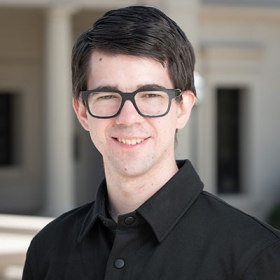
Stephen S. Hudson is an Assistant Professor of Music Theory at Occidental College. He holds a B.A. from the University of California, Davis, and a Ph.D. from Northwestern University. Appointed in 2022, he specializes in metal music studies and R&B/Soul harmony. Education: B.A., University of California, Davis; Ph.D., Northwestern University Hudson’s research focuses on embodied experiences of rhythm, timbre, and song form in metal music, as well as harmonic complexity in R&B and Soul. His work has been featured in Music Theory Spectrum , Metal Music Studies , and Current Musicology . Recent publications include articles on Drake’s harmonic loops and Meshuggah’s groove structures. He is authoring two books: Heaviness in Metal Music (Oxford University Press) and a study of Meshuggah’s riffs (Lever Press). As Vice President of the Pacific Southwest chapter of the American Musicological Society, he advocates for inclusive music theory pedagogy that extends beyond classical traditions. His teaching emphasizes tools for songwriters and producers. Hudson maintains an active interest in classical and baroque cello performance, reflecting his engagement with both historical and contemporary music practices.
Professor Emery Schubert is a distinguished academic at the University of New South Wales, Faculty of Arts and Social Sciences, where he holds a professorship in the School of the Arts & Media. With over 20 years of research experience, he has established himself as a leading expert in the scientific study of music aesthetics and emotion. His educational background includes a PhD in Music, which forms the foundation of his interdisciplinary approach combining psychology, musicology, and cognitive science. Schubert's research expertise spans emotion in music, empirical aesthetics, music health and wellbeing, continuous response to music and dance, cognitive modelling of aesthetic experience, and creativity. Schubert has received significant recognition for his work, being named Individual Leader in Field of Music and Musicology by The Australian's Research magazine in both 2020 and 2022, and ranking among Stanford's World's Top 2% Researchers in 2023. His research has been supported by over AUD$5 million in grant funding, primarily from Australian Research Council schemes. Humanities, Arts & Literature - Individual Leader in Field of Music and Musicology (2020, 2022) Stanford's World's Top 2% Researchers (2023) Excellence in Postgraduate Supervision Award (UNSW Australia) - twice ARC Future Fellowship (4 years) ARC Australian Research Fellowship (5 years) 10th Anniversary Award, European Society for the Cognitive Sciences of Music Professor Schubert maintains an active supervision portfolio, having guided numerous honours and postgraduate students through the Empirical Musicology Laboratory. His teaching portfolio is extensive, covering nearly all music-related courses at UNSW, with particular focus on the psychology of music, music and wellbeing, and music perception. His research group provides students with specialized resources including recording studios, music technology laboratories, and performance spaces.
Prof. Dr. Yavuz Yakut serves as full-time Professor and Head of the Department of Physiotherapy and Rehabilitation at Hasan Kalyoncu University's Faculty of Health Sciences since 2016. Previously, he held academic positions at Hacettepe University from 1985 to 2016, progressing from Research Assistant to Professor, while concurrently serving on national committees including the Ministry of Health and Ministry of Finance Budget Implementation Commissions (1997-2003) and YÖK Physiotherapy Sub-Commission (2013-2016). His educational foundation includes a Bachelor's (1984), Master's (1987), and PhD (1990) in Physiotherapy and Rehabilitation, all completed at Hacettepe University. Yakut's research demonstrates exceptional breadth across rehabilitation science, with concentrated expertise in biomechanics and scoliosis rehabilitation . His work significantly advances neurological rehabilitation for conditions like multiple sclerosis and cerebral palsy, while pioneering applications in burn rehabilitation and orthotics/prosthetics . Recent publications reveal strategic integration of biopsychosocial models and telerehabilitation , particularly addressing pandemic-related challenges and chronic disease management across diverse populations. Analysis of his 2023-2025 publications shows consistent interdisciplinary innovation: validating cross-cultural assessment tools (e.g., Turkish translations of scoliosis and ADL questionnaires), developing novel exercise protocols (dance therapy, cognitive exercise therapy), and investigating rehabilitation responses in complex cases including HIV, rheumatic diseases, and post-earthquake trauma. His methodology frequently combines biomechanical analysis with patient-centered outcomes, demonstrating particular rigor in controlled trials for spinal deformities and burn recovery. His leadership extends beyond direct research through committee roles shaping national rehabilitation policy and educational standards, including his current departmental leadership and recent systematic review on physiotherapy distance education during pandemic disruptions.
Dr. Ava Fatah gen. Schieck is a Professor of Media Architecture and Urban Digital Interaction at The Bartlett School of Architecture, University College London (UCL) , where she has been affiliated since 2001. She teaches in the MSc Architectural Computation program, focusing on embodied interactions and urban digital experiences. Education: ATQ03 - Recognised by the HEA as a Fellow (UCL, 2008) Certificate in Learning and Teaching (UCL, 2007) Master of Science (UCL, 2001) Her research explores the intersection of architecture, digital media, and urban spaces. Key themes include: Mediated spatial experiences in museums and public environments Embodied interactions through dance, movement, and performative design Urban screens and community-centered digital installations Smart city critiques focusing on marginalized communities Pervasive computing's impact on social dynamics Her publication corpus (149+ outputs) predominantly addresses media architecture, HCI, museum technology, and sensory interactions , with recent work emphasizing olfactory interfaces, pandemic urbanism, and heritage digitization. Awards & Honors: Fellow of the Royal Society of Arts (FRSA, 2023) Projects & Grants: As Principal Investigator for the EPSRC-funded 'Screens in the Wild' , she examines networked urban screens for community engagement. She previously led the 'SCREAM' project (UrbanBuzz program) and contributed to EPSRC's 'Urban Design and Pervasive Systems'. She reviews grants for EPSRC, UKRI, SNSF, and other international bodies. She directs research through UCL's Space Research Group and VR Centre for the Built Environment , collaborating globally. As program chair for the Media Architecture Biennale (2012-2020), she fosters interdisciplinary dialogue across architecture, HCI, and interaction design.
Paul D. Miller, known professionally as DJ Spooky, That Subliminal Kid, is a Professor of Music and Mediated Art at The European Graduate School (EGS). Based in New York City, he is an experimental electronic and hip-hop musician, conceptual artist, and writer whose work spans music production, film, multimedia installations, and critical theory. He has released over a dozen albums pioneering 'illbient' and trip hop genres, authored influential books including Rhythm Science and Sound Unbound , and exhibited internationally at venues like the Venice Biennale and Andy Warhol Museum. Education: Bowdoin College: Studied philosophy and French literature; thesis on Richard Wagner's Gesamtkunstwerk as precursor to new media. Research Interests: Miller's work centers on remix culture as a postmodern methodology, exploring intersections of sound, image, and technology. His theoretical framework positions the DJ as a 'post-subjective auteur' who creates meaning through layered connections across time, culture, and media. Key projects include Rebirth of a Nation (reworking D.W. Griffith's film to address racial history) and Terra Nova (Antarctica sound recordings addressing climate change), demonstrating his focus on historical reinterpretation and environmental crisis through digital media. Publications: His 14 scholarly articles (2001-2009) analyze remix as cultural practice across domains from album art history ( The Inner Sleeve ) to Baudrillard's philosophy ( Baudrillard: A Remembrance ). The corpus reveals consistent investigation into how sampling, digital layering, and media archaeology reshape narrative, memory, and cultural identity in the information age. Awards: No scientific awards or fellowships were documented in the source text. Advising and Grants: The source text provides no information regarding students supervised, academic advising, or research grants administered by Miller. Labs and Teams: Miller operates through project-based collaborations rather than fixed labs, forming temporary collectives with institutions like the American Museum of Natural History (for Terra Nova ) and artists including Yoko Ono, Ryuichi Sakamoto, and choreographer Francesca Harper. His 'Unfinished Stories' project with Pulitzer-winning critic Margo Jefferson exemplifies his interdisciplinary approach bridging dance, music, and social commentary.
Steven Devleminck is an Associate Professor in the Department of Computer Science at KU Leuven's Faculty of Engineering Technology, concurrently serving as coordinator of the School of Arts (Associated Faculty) in Brussels. His dual appointment bridges engineering and arts through the Human-Computer Interaction (HCI) group at Group T Leuven Campus and Unit Art & Technology in Brussels, with active membership in DigiSoc – KU Leuven Digital Society Institute. His research centers on human-centered computing and speculative design methodologies , with core expertise in tangible interaction for emotion regulation and multispecies futures. Key themes include biofuturing as co-creative response to climate crises, squeeze-based interfaces for workplace stress, and artistic AI collaborations. His work uniquely integrates computer science with choreography, film studies, and anthropology through projects like “Youth TikTok production as public pedagogy” and “Imagining the Post-Anthropocene in BioFutures Living Lab”. Analysis of recent publications reveals three dominant trajectories: (1) Advancement of squeeze interaction techniques for affective computing, (2) Development of biofuturing frameworks for multispecies speculation, and (3) Critical examinations of AI's role in artistic mediumship. Cross-cutting themes include post-anthropocentric design, climate-responsive technologies, and decolonial approaches to digital pedagogy. Devleminck actively mentors doctoral candidates including Ula Sickle (choreographic exhibitions) and J. Verbesselt (cinema studies), while leading major funded projects such as: Living Corpora (2025-2029): Pioneering human-AI collaboration in digital humanities as Co-promotor Experiential Futuring (2022-2026): Co-creative methodology for social media outage response as Co-promotor Deradicalizing the City (2021-2025): Urban intervention research as Promotor He serves on the Computer Science Department Council and Doctoral Committee for the Associated Faculty of Arts. His laboratory ecosystem spans the HCI Group T Leuven Campus for technical development, Brussels-based Unit Art & Technology for artistic integration, and BioFutures Living Lab for participatory multispecies experimentation. This tripartite structure enables transdisciplinary work connecting squeeze sensor engineering with climate futures speculation and museum interface design.
Alexandra BELIBOU is a PhD Lecturer at the Department of Music Performance and Pedagogy, Faculty of Music, Transilvania University of Brașov. Her work bridges musicology with modern interdisciplinary approaches, focusing on music education technology, therapeutic applications, and 20th-century compositional analysis. She holds a prominent position in advancing digital pedagogy through software integration. Research Interests: Music therapy methodologies emphasizing pluralistic approaches in clinical settings AI applications in music composition and education Analysis of 20th-century composers like Schoenberg, Reich, and Pärt Cultural studies of folk music traditions (e.g., Irish dance music, Romanian psalmic liturgy) Publications Trends: Recent work explores pandemic-era musician well-being, AI-assisted composition tools, and the intersection of music with medicine/physics. Earlier research delves deeply into psalmic text settings across centuries, minimalist techniques, and numerical symbolism in atonal music. Her teaching and research emphasize bridging traditional musicology with emerging technologies, as seen in proposals for software-based creativity workshops and interdisciplinary curricula.
Scott Durbin is an Assistant Professor and Program Coordinator for Music Business at the University of Louisiana at Lafayette , affiliated with the School of Music & Performing Arts . With a career spanning academia and the entertainment industry, he is best known as a co-founder of the Grammy-winning children's band Imagination Movers , which produced a Disney Channel series and earned an Emmy Award for Outstanding Original Song (2008–2009). His academic work focuses on bridging real-world music industry practices with education. Bachelor of Arts (B.A.) , Centenary College of Louisiana (1992) Master of Education (MEd) in Curriculum and Instruction , University of Louisiana at Lafayette (2019) Teacher's Certificate (1994), University of New Orleans Scott's expertise lies in Music Business , Digital Service Providers (DSPs) , Musical Copyright and Rights Management , and Musical Monetization . His research emphasizes Metadata integration for rights tracking and revenue generation, reflecting his industry experience with Disney, Concord Music, and mechanical licensing frameworks. His publications include children's music albums and educational songbooks, showcasing cross-disciplinary impact in Entertainment Industry , Artist Management , and Streaming Revenue Models . These works highlight his role in evolving music industry practices through Digital Distribution and Licensing Agreements . Drs. Chuck and Sue Lein/BORSF Endowed Professorship in Music Management/Business (2015) Rising Star Award , College of Arts (2015) Eminent Faculty Award for Service Leadership (2015) ASCAP Plus Award (2015, 2016, 2019) Daytime Entertainment Emmy® (2008–2009) As a Mechanical Licensing Collective (MLC) Educator Ambassador , Scott shares industry insights on Musical Copyright and Digital Licensing . He teaches courses like MUS 455: Artist Management, Booking, and Touring , leveraging his experience negotiating contracts with Disney and managing large-scale tours.
Anja Kraus is a Professor in Arts and Culture Education at Stockholm University, Department of Teaching and Learning. She has held academic positions at the University of Education Ludwigsburg (2003-2013), Linnaeus University Växjö (2013-2019), and joined Stockholm University in 2018. Her academic journey began with studies in Philosophy and Educational Sciences at Free University Berlin and Arts Education at the University of the Arts Berlin, Germany. Her research focuses on Pedagogical Anthropology, with special emphasis on tacit knowledge, corporeality, aesthetic education, and multimodal learning. She has developed systematic approaches to understanding tacit knowing in educational contexts, particularly examining how corporeality, aesthetic learning, and inclusivity function in schools. Her work bridges phenomenological, ethnographical, and body-phenomenological approaches with practical educational applications. She has made significant contributions to understanding how materiality, performativity, and imaginaries shape educational practices. Her recent publications reveal strong trends in embodiment studies, with particular attention to kinesthetic learning, spatial pedagogy, and the relationship between aesthetics and sustainability. Her work increasingly explores educational practices within the Anthropocene context, examining how arts education can address environmental concerns through embodied approaches. The recurring theme across her publications is the exploration of how tacit knowledge manifests in educational settings and how this understanding can transform teaching practices. As head convenor of the international scientific network 'Tacit Dimensions of Pedagogy,' she has organized numerous workshops and conferences addressing pedagogical terminologies across languages. Her collaborative projects span Scandinavia, Europe, Asia, and North and South America, demonstrating her commitment to transcultural approaches in educational research. Her teaching spans multiple languages (German, English, Swedish, Spanish) and covers diverse areas including Classroom Education, Cultural and Media Education, Sciences of Bildung, Elementary Education, and Vocational Training. Her pedagogical approach emphasizes practice-oriented competence, inclusive school development, and aesthetic learning environments with a comparative perspective.
Emily Cross is a Full Professor at the Department of Humanities, Social and Political Sciences at ETH Zurich, leading the Social Brain Sciences Professorship since spring 2023. She previously held professorships at Bangor University (Wales), University of Glasgow (Scotland), Macquarie University (Australia), and Western Sydney University's MARCS Institute (Australia). Her research centers on how embodied experience shapes social learning and perception across diverse contexts. Key contributions include identifying neural signatures of embodied expertise using dancers, developing embodied neuroaesthetics theory, uncovering neurocognitive foundations of visual learning across lifespans, and pioneering paradigms for human-robot social engagement. Her interdisciplinary approach bridges technology, performing/visual arts, and social sciences to explore experience-dependent plasticity at brain and behavioral levels. Recent publications (2024-2025) demonstrate intense focus on human-robot interaction dynamics, aesthetic movement perception, and context-dependent social cognition. Work increasingly examines self-disclosure mechanisms to robots, cultural influences on robot acceptance, and neural correlates of movement synchrony, reflecting her expanding influence at the neuroscience-robotics intersection. Scientific awards include: Philip Leverhulme Prize for Psychology Jacob Bronowski Award from British Science Foundation Young Talent Award from Dutch Neuroscience Society RoboHub and Insight Analytics top women in robotics listings Australia’s Superstars of STEM (2022) Cross passionately trains next-generation scientists with emphasis on research ethics. Her work attracts major funding from ERC, NIH, Fulbright Commission, ESRC, EPSRC, and UK Ministry of Defence. She serves on UNESCO’s International Bioethics Committee (co-rapporteur for neurotechnology ethics report) and as Associate Editor for International Journal of Social Robotics. She leads ETH Zurich's dynamic Social Brain Sciences group, which embraces interdisciplinarity through research paradigms bridging technology, performing/visual arts, and biological/social sciences, while maintaining active roles in editorial boards and conference committees including Intelligent Virtual Agents and Affective Computing meetings.
Irving Chan Johnson is an Associate Professor in Southeast Asian Studies at the National University of Singapore. A graduate of the Southeast Asian Studies Programme (now Department) in 1996, he earned his PhD from Harvard University in 2004. His academic journey has focused on cultural dynamics of borderland communities, particularly Thai Buddhist communities in Malaysia's Kelantan state, examining how they navigate identity at the intersection of Buddhist and Muslim traditions. Dr. Johnson's research spans social anthropology, visual arts, and cultural studies with particular focus on: Social anthropology of Southeast Asia Visual arts and traditional performance Buddhist communities in borderland regions Cultural identity and marginality Traditional dance and mask traditions in Bali Thai mural painting traditions His scholarly work reveals a consistent thread examining how cultural communities maintain identity through artistic expression, religious practice, and historical narrative. Early publications focused on Malaysian-Thai borderlands, while recent work has expanded to Balinese performance traditions, particularly mask-related arts. His 2013 book The Buddha on Mecca's Verandah represents a significant contribution to understanding cultural identity formation in border regions. As an active cultural practitioner, Dr. Johnson founded Eka Suwara Santhi, Singapore's only Balinese dance group, and volunteers painting Buddhist murals at Wat Uttamayanmuni, a Thai temple in Singapore. His teaching philosophy emphasizes experiential learning, incorporating field trips to Thailand and Bali where students engage directly with cultural contexts through his specialist classes on Thai traditional art (SE3224) and traditional dance in Southeast Asia (SE2224).
Brian Magerko is Professor of Digital Media in the School of Literature, Media, and Communication at Georgia Institute of Technology , where he also serves as Director of Graduate Studies for the Digital Media program and holds an adjunct appointment in the School of Interactive Computing . He directs the Expressive Machinery Lab and has led over $20 million in federally funded research at the intersection of cognition, computation, and creativity. Education Ph.D. Computer Science and Engineering, University of Michigan (2006) M.S. Computer Science and Engineering, University of Michigan (2001) B.S. Cognitive Science (minor Computer Science & Jazz Performance), Carnegie Mellon University (1999) Research Interests Dr. Magerko’s scholarship integrates cognitive science , AI , and computational media to investigate three core themes: (1) social and creative collaboration between humans and AI; (2) design of interactive narrative, music, and arts-based computational experiences; and (3) inclusive STEAM education that leverages personal expression—most notably through the widely-adopted EarSketch platform, which engages learners in computer science via music remixing and coding. Publication Trends Recent publications (2022-2025) reveal a surge in work on generative and co-creative AI systems , AI literacy frameworks , and accessible computing education . Studies span dance improvisation agents (LuminAI), inclusive design for blind and visually-impaired learners, and large-scale evaluations of creativity and learning outcomes in EarSketch classrooms across the United States. Awards & Honors Methods Paper Recognition, ACM CSCW 2022 Best Paper Award, ACM Creativity & Cognition 2021 & 2017 Ivan Allen College Researcher of the Year 2018 NCWIT Engagement Excellence Award 2017 Multiple Best Student Paper Awards (AIED 2021, ICCCI 2021) CETL Thank-a-Teacher Award 2008 Grants & Advising Dr. Magerko has served as PI or Co-PI on numerous NSF, NEA, and private foundation grants totaling more than $20 million. His projects fund interdisciplinary teams of graduate and undergraduate students, post-docs, and external collaborators, producing open-source software, museum installations, and K-12 curricula. Labs & Teams As head of the Expressive Machinery Lab , he mentors researchers creating AI partners for dance, drawing, music, and storytelling. The lab’s artifacts have been exhibited at the Smithsonian, ArtScience Museum Singapore, MoogFest, and other international venues.
Akito Miura is an Associate Professor at the Faculty of Human Sciences of Waseda University , with a career spanning over 15 years in embodied cognitive science and movement research. His work bridges dance science , neuroscience , and biomechanics , focusing on sensorimotor coordination in performing arts and sports. PhD in Academic Studies from the University of Tokyo Research Experience at Waseda University, University of Tokyo, and EuroMov Institute (France) Editorial board member for Journal of Dance Medicine & Science and Advances in Cognitive Psychology Research interests include embodied cognition , rhythmic coordination , and interpersonal motor dynamics , with applications to dance, golf, and violin ensembles. His recent articles examine foot pressure in ballet, auditory-motor synchronization, and groove perception in music. Key awards include the Incentive Paper Award (2024) , Progress in Motor Control Scholarship (2011) , and multiple grants from the Japan Society for the Promotion of Science. He has also contributed to media coverage on rhythm perception in sports and performing arts. Current projects explore machine learning in motor learning, social interaction dynamics, and ACL rehabilitation metrics Professional memberships in the International Association for Dance Medicine & Science and Japan Cognitive Science Society
Lauri Väkevä is a Professor in the Department of Education at the University of Helsinki, specializing in educational sciences with a focus on performing arts, music education, and STEAM pedagogy. He actively supervises doctoral students in the Doctoral Programme in School, Education, Society, and Culture and leads the SKAPA project (2024–2026) on developing study paths in arts education. His research explores the intersection of artificial intelligence, creativity, and multimodal learning environments. Key Affiliations: Department of Education, Sibelius Academy collaboration, Gaudeamus publishing network Research Themes: AI in music education, safe spaces for artistic expression, responsible AI pedagogy, historical evolution of Finnish music institutions Recent Work Highlights : 2025: Generative AI as a Collaborator in Music Education (Action-Network Theory application) 2025: Voicing Responsible AI Pedagogy (Ethical frameworks for arts education) 2024: Changing Role of Sibelius Academy (Historical analysis of Finnish music education) Leadership & Engagement : Project Manager for SKAPA, organizing committee member for the 2024 Ainedidaktinen Symposium, and active participant in AI research events.
Koray Tahiroglu is a University Lecturer at Aalto University's School of Arts, Design and Architecture, specializing in Sound and Music Computing. His work bridges artificial intelligence, digital musical instruments, and embodied interaction, with a focus on deep learning applications in audio synthesis and human-AI creative collaboration. His research explores New Interfaces for Musical Expression (NIME), sonic interaction, and physical computing. He collaborates with SOPI Research Group and Google Brain Team (Magenta) on AI-driven artistic innovation. Recent Publications : 2024 studies on dance-sound cross-correlation and intra-action frameworks; 2023 work on AI-terity and deep learning syllabi; 2022 explorations of GAN synthesis, musical expectations, and lifeworld sonification. Scientific Awards : Co-Creative Artificial Intelligence of Music (2022) 2010 grant for scientific publications and artistic activities 2017 Honorable Mention for mobile cultural heritage research Tahiroglu contributes to digital art education and leads projects at Media Lab Helsinki, advancing sonic interaction and generative audio systems.