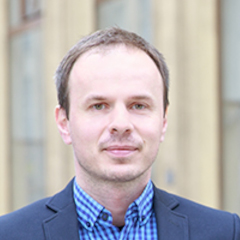
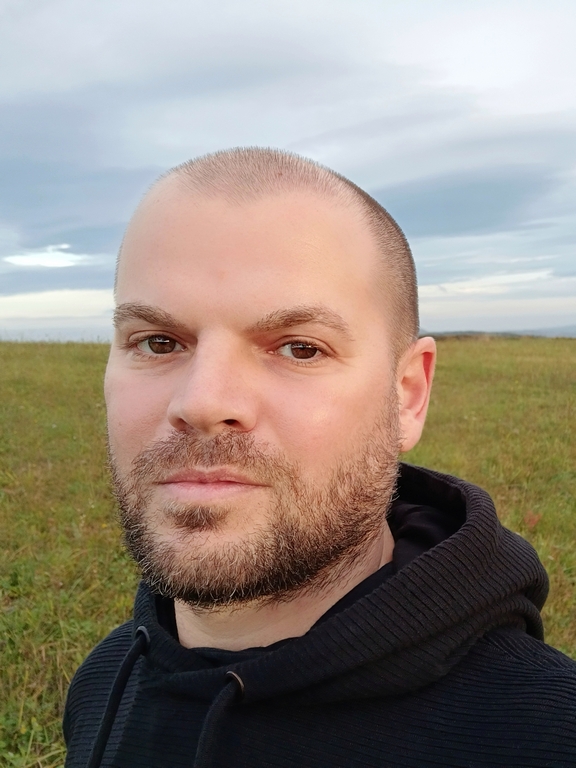
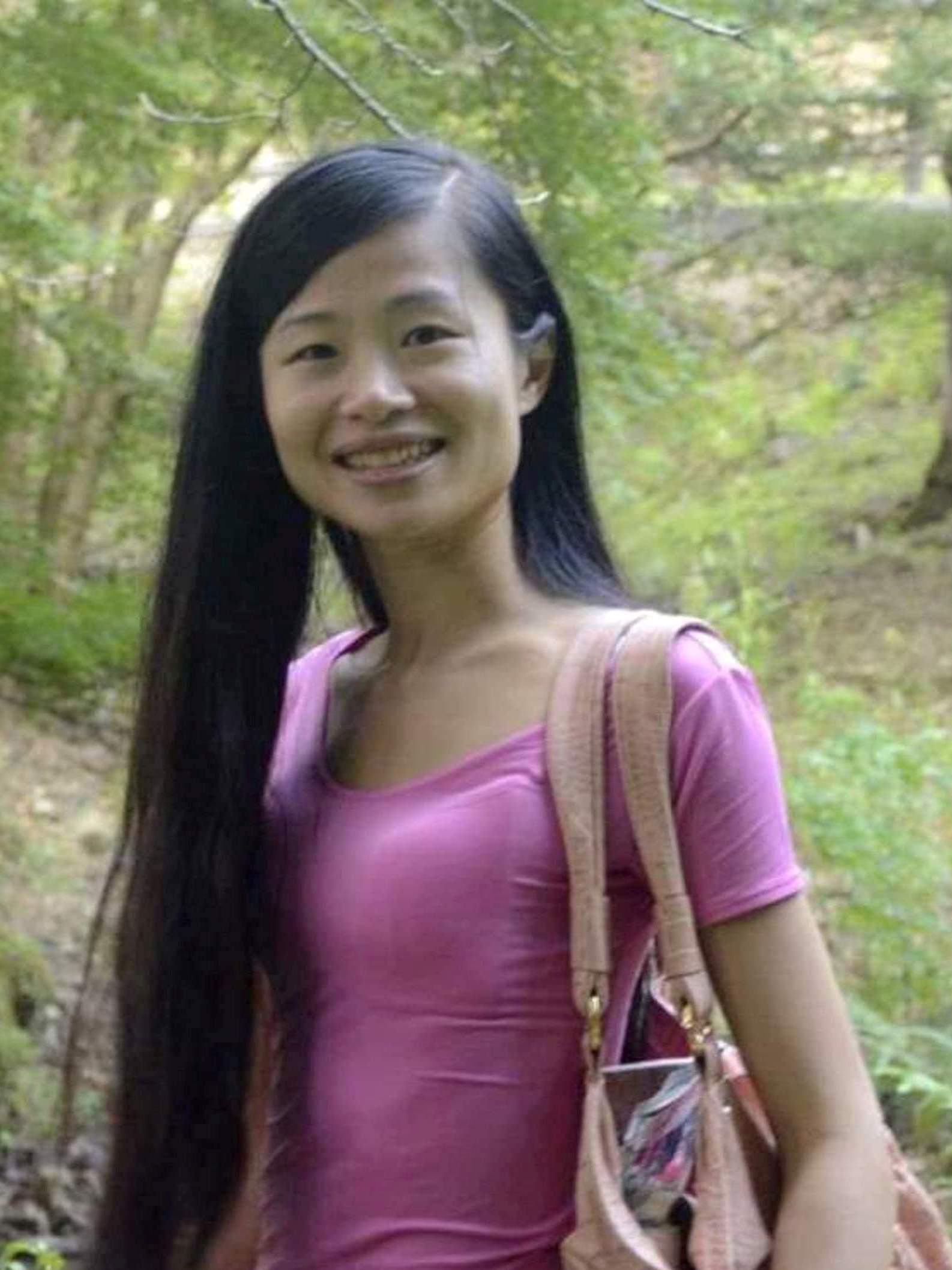
Marcin Wągiel is an Assistant Professor in the Department of Czech Language at the Faculty of Arts, Masaryk University, Brno, Czech Republic. His office is located in building D, room D.413 at Arna Nováka 1, with contact details including phone 549 49 8884 and email marcin.wagiel@phil.muni.cz. His research centers on theoretical and descriptive linguistics with emphasis on Czech language semantics and syntax. Key interests include degree/number constructions, part-whole structures, classifier systems, and temporal-modal interactions in natural language. He employs formal linguistic frameworks to analyze comparative and typological phenomena across languages, particularly within Slavic linguistics. Wągiel actively supervises doctoral research, currently guiding a thesis on temporal-modal semantics. He has secured significant research funding including Czech Science Foundation projects like Classification of classifiers (GA24-10073S, 2024-2026) and Part-whole structures across languages (GA20-16107S, 2020-2023). Additionally, he contributes to Masaryk University's student research programs supporting work in general linguistics, Indo-European studies, narratology, and Baltic studies.
Douglas K. Snyder is a Professor in the Department of Psychological and Brain Sciences within the College of Liberal Arts at Texas A&M University. He previously served as Director of Clinical Training from 1991 to 2012 and has been internationally recognized for his research on marital assessment and outcome research on marital therapy, particularly through his development of the Marital Satisfaction Inventory. Dr. Snyder earned his bachelor's degree from Wittenberg University in 1974, received his doctoral degree from the University of North Carolina at Chapel Hill in 1978, and completed his internship at Duke University Medical Center. Prior to his appointment at Texas A&M, he served on the faculty at Wayne State University in Detroit and at the University of Kentucky in Lexington, where he also served as Director of Clinical Training and Associate Dean in the College of Arts and Sciences. Dr. Snyder's research emphasizes the assessment, treatment, and prevention of couple relationship distress. His work centers on the Marital Satisfaction Inventory, a multidimensional measure of relationship accord now published in several languages and used worldwide. His treatment research focuses on tailoring therapy to specific partner and relationship characteristics by integrating cognitive, behavioral, emotion-focused, and insight-oriented interventions. His specific clinical interests include treating difficult couples with emotional, behavioral, and health problems, with particular attention to military and veteran couples and those dealing with infidelity. Dr. Snyder's recent publications demonstrate continued leadership in couple therapy, with emphasis on evidence-based approaches, treatment of infidelity, military couples, and cross-cultural applications of couple assessment tools. His work spans theoretical advancements and practical clinical applications. Outstanding Research Publication Award, Association for Marriage and Family Therapy, 1991 Professor of the Year Award, Texas Psychological Association - Division of Students, 1993 Award for Distinguished Contributions to Family Psychology, American Psychological Association, 2005 Outstanding Contributions to Science Award, Texas Psychological Association, 2008 Distinguished Alumnae Award, University of North Carolina (Chapel Hill), 2012 Distinguished Psychologist Award for Lifetime Contributions to Psychotherapy, American Psychological Association, 2015 Fellow of the American Psychological Association (Divisions 5, 12, 19, 29, 43) Fellow of the Association for Behavioral and Cognitive Therapies Fellow of the Society for Personality Assessment Dr. Snyder has served as Editor of the Clinician's Research Digest and as Associate Editor for the Journal of Consulting and Clinical Psychology and the Journal of Family Psychology. His research has been supported by the National Institute of Mental Health, with significant focus on military couples and relationship distress. He has developed evidence-based approaches for assessing and treating relationship problems across diverse cultural contexts. Dr. Snyder is affiliated with the Personality Processes research cluster at Texas A&M University, focusing on objective personality assessment and clinical assessment of couples and families. His work bridges research and clinical practice, with emphasis on developing practical assessment tools and treatment approaches for clinicians working with distressed couples.
Professor Kathryn Murphy is an Associate Professor in the Faculty of English Language & Literature at the University of Oxford and a Fellow and Tutor at Oriel College. Her research focuses on seventeenth-century literary and intellectual culture, blending literature, philosophy, theology, and art. She explores the interplay between form (poetic, rhetorical, and artistic) and thought, with a particular interest in essays, still-life painting, and the relationship between form and idea. Her recent projects include a biography of Robert Burton (author of The Anatomy of Melancholy ) and a study of metaphysical prose in the seventeenth century. She has also edited On Essays: Montaigne to the Present and writes essays on art, including analyses of still-life painting and devotional imagery. Her work frequently bridges literary studies and medical humanities, collaborating with the Oxford Health Biomedical Research Centre and the TORCH Medical Humanities Hub. She has curated exhibitions such as Melancholy: A New Anatomy (2021) and is preparing a 2026 exhibition on natural history. Murphy is a series editor for Edinburgh Critical Studies in Renaissance Culture and serves on the editorial boards of Cambridge Quarterly and Edinburgh Critical Studies . She contributes art criticism to Apollo and reviews Czech literature for the Times Literary Supplement . Her research emphasizes interdisciplinary exploration, examining how form—from sentences to paintings—serves as an instrument of thought. Current projects include a book on still-life painting and the immanence of meaning in objects, alongside ongoing studies of attention, distraction, and decision-making in early modern texts.
Przemysław Kordos is a Professor at the University of Warsaw , affiliated with the Faculty of Liberal Arts , where he serves as Coordinator for the Development of the Modern Greek Philology Program . He holds two PhDs in Humanities (2007, 2019) and was awarded the Loukis Papaphilippou Seat of Advancement in Modern Greek scholarship. Education: MA in Ethnology and Cultural Anthropology (University of Warsaw, 2001) MS in Sociology (University of Warsaw, 2002) PhD in Humanities (University of Warsaw, 2007) Second PhD in Humanities (University of Warsaw, 2019) His research interests span: Contemporary Modern Greek and Cypriot literature Polish-Greek cultural relations (philhellenism) Social and ethnographic issues in Greece and Cyprus Travel literature analysis Fantasy literature's cultural implications His scientific work reveals a focus on linguistic assimilation in foreign language learning (via fMRI studies), historical parallels between Polish and Greek independence movements, and critical analyses of Cypriot folk culture's politicization. Key scientific awards include: Loukis Papaphilippou Seat (University of Warsaw) Internships at EKPA and IKY (Greece) Scholarships at IMXA (Greece) and MUNI (Czech Republic) His academic contributions include cataloging 60+ Polish travel accounts to Greece, analyzing the shift from travel literature to tourism discourse, and examining the Hellene-Romios dichotomy's role in modern Greek identity construction.
James Dodd is a Professor of Philosophy at The New School for Social Research, specializing in phenomenology, existential philosophy, and political thought. He holds a PhD from Boston University (1996). His research focuses on Husserl, Heidegger, and Jan Patočka, exploring themes like violence, sacrifice, and the interplay between history and philosophy. Dodd has authored major works including *The Heresies of Jan Patocka* (2023), *Phenomenological Reflections on Violence* (2017), and co-edited *The New Yearbook for Phenomenology and Phenomenological Philosophy* (2015). Education: PhD Philosophy, Boston University (1996) His work bridges philosophical inquiry with interdisciplinary questions, examining how fundamental questions like 'What is truth?' and 'What is the world?' unify diverse academic disciplines. Recent scholarship emphasizes phenomenological approaches to architecture, violence, and political resistance, particularly through Patočka’s lens. He critiques modernity’s ethical and political crises while advocating for philosophy’s role in holistic education. Publications span over 30 years, with notable contributions to Husserl studies, war philosophy, and phenomenological ethics. His 2023 book reinterprets Patočka’s hermeneutics, while 2021 articles analyze war’s philosophical dimensions. Dodd also engages with historical violence, memory, and the lifeworld’s role in scientific understanding. Awards: None explicitly listed Teaching includes courses on phenomenology, early Chinese philosophy, and Nietzsche. He mentors students through independent studies and senior projects, emphasizing critical thinking across disciplines. Dodd’s editorial work amplifies underrepresented voices in phenomenology and political philosophy. Labs/Teams: Collaborates with international scholars on Patočka’s legacy and phenomenological ethics, contributing to Routledge, Springer, and Brill publications. His research group explores interdisciplinary applications of phenomenology in architecture, violence studies, and historical consciousness.
Dr. Milan Balaban is a Scientific Researcher-Historian at the Bata Information Centre, Tomas Bata University in Zlin, Czech Republic. Born in Banja Luka, Bosnia and Herzegovina (1981), he holds a PhD from Masaryk University (Czech Republic), where he focused on Yugoslav-Czechoslovak economic relations (1918–1938). His research emphasizes the history of the Bata Company and transnational economic interactions between Central and Southeastern Europe. He has authored over 20 articles and a monograph, The Bata Company in Yugoslavia (2018). Education: Bachelor's at University of Banja Luka; Master's and PhD at Masaryk University (defended 2015). Research interests include industrial heritage, social welfare systems in company towns, and interwar economic dynamics. His recent work explores Bata's global expansion, labor protests in Yugoslavia, and transnational tourism networks between Czechoslovakia and Yugoslavia. He actively participates in international conferences, presenting on topics like urban heritage of Bata company towns and deindustrialization processes.
Dr. Olga Oleinikova is an Associate Professor and Director of the Social Impact Technologies and Democracy Research Hub (SITADHub) within the School of Communication at the University of Technology Sydney (UTS), Australia. Internationally recognized for her contributions to research and social impact, she has been named among Forbes Top 40 Global Ukrainians and Forbes 30 Under 30 Asia. She was also a finalist for the Australian Council of Humanities, Arts and Social Sciences (CHASS) Future Leader Award. Her educational background includes a PhD in Sociology from the University of Sydney (2016), with prestigious research fellowships at Oxford University's European Studies Centre (2018-2019), Charles University in Prague (2023-2024), and the WZB Berlin Social Science Center (2015). Dr. Oleinikova's research focuses on migration studies (particularly Eastern European migration to Australia), democracy studies, diaspora politics, and social impact technologies. Her work examines life strategies of migrants navigating displacement, democratic performance in Ukraine and Europe, and the intersection of technology and democracy. She has developed a theoretical framework distinguishing between 'achievement life strategies' and 'survival life strategies' among migrants from crisis regimes. Her publication portfolio includes several acclaimed works, with her most recent book 'New Eastern European Migration to Australia: From Ukraine, Czech Republic and Hungary' (Palgrave, 2023) examining new migration patterns. Her research demonstrates consistent focus on Eastern European migration, diaspora politics, and democratic development, with increasing attention to technology's role in democratic processes. Forbes Top 40 Global Ukrainians Forbes 30 Under 30 Asia CHASS Future Leader Award Finalist Visa People's Choice Award Anthill 30 Under 30 Winner Dr. Oleinikova has secured over $3 million in funding for social and commercial initiatives. She serves on several nonprofit boards, acts as an advisor to the Australia-Ukraine Chamber of Commerce, and mentors through the 1991 Open Data Incubator and Future Schools Australia. She founded the SITAD Visiting Fellowship Program, supporting Ukrainian early-career researchers and postgraduate students. Her media reach is substantial, with expert commentary featured in BBC News, Bloomberg, ABC News, CNA, The Conversation, Politico, SBS, and KyivPost, reaching an estimated 9.1 million people. She has delivered more than 30 keynote and invited talks at leading institutions worldwide. SITADHub, which she founded and directs, is a dynamic networked research center with 170 associates across 16 countries actively researching democracy, human-computer interaction, and global mobility, with a focus on Ukraine and broader Eastern Europe. The hub conducts unique research and maintains university partnerships throughout Europe and the Asia Pacific, including with WZB Berlin Social Science Research Centre, University of Oxford, and University of Sydney.
Dr. Jacek Kudera is a post-doctoral researcher in the Department of Phonetics at the University of Trier, coordinator of the LODinG project at the Trier Center for Digital Humanities, and adjunct faculty at WSB Merito University in Wrocław. His work bridges phonetics, Slavic linguistics, digital humanities, and forensic speech science. Education 2022 – PhD, Department of Language Science and Technology, Saarland University, Germany 2019 – MA (Linguistics), Department of Linguistics, Cognitive Science and Semiotics, Aarhus University, Denmark 2015 – Magister (Slavic Philology), Institute of Slavic Studies, University of Wrocław, Poland Research Interests His research focuses on phonetic and prosodic aspects of Slavic languages , cross-linguistic speech perception , forensic automatic speaker recognition , and human-robot interaction . He employs experimental methods such as eye-tracking, articulatory measurements (EMA), and large-scale digital corpora to investigate how speakers of closely related languages understand one another and how machines can replicate or support this process. Publication Trends Across more than 25 peer-reviewed articles (2014-2025), Kudera has consistently explored Slavic intercomprehension , speech technology evaluation , and digital humanities infrastructure . Recent work (2024-2025) targets voice cloning security , linked open data for linguistics , and mismatch conditions in forensic speaker recognition . Scientific Awards & Fellowships Visegrad Fellowship, University of Presov (2025) Erasmus+ Fellowships (Ostrava 2025, Zagreb 2014, Rijeka 2012-2013) NAWA Fellowship, Polish Academy of Sciences (2022) Nordlys Fellowship, University of Eastern Finland (2018-2019) CEEPUS & additional Central-European mobility grants (2014-2018) Projects & Funding Coordinator : “Mismatch conditions in machine speaker identification” (University of Trier Research Fund, 2024-2025) Coordinator : LODinG – Linked Open Data in the Humanities (Trier Center for Digital Humanities, ongoing) Coordinator : “Patterns: Linguistic Creativity and Variation” (Trier Center for Language and Communication, 2022-2024) Member : SFB 1102 “Information Density and Linguistic Encoding” (Saarland University, DFG, 2019-2022) Member : Digital Atlas of Dialects of Bosnia and Herzegovina (2017-2018) Member : CLARIN-PL & European Roadmap for Research Infrastructures (2014-2017) Labs & Teams He conducts research within the Phonetics Team at the University of Trier , collaborates closely with the Trier Center for Digital Humanities , and maintains affiliations with the Phonetics Group at Saarland University and the WSB Merito University in Wrocław.
Jiří Muryc is a researcher at the Department of Slavonic Studies, Faculty of Arts, University of Ostrava. He specializes in Polish-Czech language contact, bilingualism, and sociolinguistic dynamics of the Czech-Polish borderlands. His work spans translation studies, orthographic interference, and linguistic landscapes. Position: Head of Department International Affiliation: Collaborated with Vytautas Magnus University, University of Wrocław, and other institutions His research focuses on multilingual environments, Polish language visibility in Czech public spaces, and cross-border language policy. He explores code-switching, hybrid lects, and ethnolinguistic identity in bilingual communities. Muryc's publications analyze Polish-Czech legal terminology, phraseological dictionaries, and translation challenges between typologically close languages. He emphasizes practical applications in interpreter training and digital language platforms like Polski.info . He supervises theses on topics ranging from Polish literature in Czech translations to Czech-Polish business phraseology and UNESCO heritage linguistics. His projects include Erasmus+ initiatives for Polish language e-learning and sociolinguistic studies of Zaolzie.
Andrew M. Drozd is an Associate Professor of Russian at the Department of Modern Languages and Classics, University of Alabama. He serves as the Russian Program Director and Russian Minor Advisor, specializing in 19th-century Russian literature, Czech-Russian literary interrelations, and Slavic folklore. PhD, Indiana University (1995) Teaches courses: First-Year/Second-Year Russian, Russian Phonetics, Business Russian, Russian Folklore, Dostoevsky, Tolstoy, and Russian Science Fiction His research examines the intersections of Russian and Czech literary traditions during political upheavals, with a focus on Chernyshevskii’s works and their ideological impacts. Recent publications include Modern Czech Literature: Writing in Times of Political Trauma (2025) and co-edited volumes on Russian radicalism and Darwin’s reception in Russia. The 15 most recent articles reveal a trajectory from 19th-century Russian critiques of Darwinism to contemporary Czech literary analysis, spanning dialectology, intertextuality, and ideological narrative structures. Dr. Drozd’s editorial work includes Revisiting Russian Radicals (2024) and Reading Darwin in Imperial Russia (2023), alongside contributions to journals like Slavic and East European Journal and Germano-Slavica .
Michal Bočák is an Associate Professor in the Department of Communication and Media Studies at the Faculty of Arts, University of Prešov in Prešov, Slovakia. He also serves as a visiting lecturer in gender and queer studies at the Department of Journalism, Palacký University in Olomouc, Czech Republic. His academic career includes serving as Vice-Dean for Educational Affairs (2021-2023) and previously as chair of the Department of Communication and Media Studies (2012-2021). Bočák earned his PhD in general linguistics from the University of Prešov in 2008, followed by a habilitation procedure in general linguistics in 2020. His educational background includes an MA in phonetics & media studies from the University of Prešov (2005). His research primarily focuses on media representations of identities, particularly gender and sexuality, discourse theory, and methods of discourse analysis. He has conducted extensive analysis of culinary magazines and television news formats, examining how they construct representations of food, tradition, and national identity. His work bridges semiotics, cultural studies, and media theory, with particular attention to queer theory applications in media analysis. Bočák's publications demonstrate a consistent focus on discourse analysis frameworks, with significant contributions to understanding how media texts construct meaning through intertextuality, representation, and discursive positioning. His work spans traditional media formats like television news to digital spaces including web pornography. As an editorial board member for Media Studies: Journal for Critical Media Inquiry and Jazyk a kultúra [Language and Culture], Bočák actively contributes to scholarly discourse in his field. He is also a member of the Center for Cultural, Media and Communication Studies in Olomouc, Czech Republic. His academic leadership includes serving as Vice-Dean for Educational Affairs and previously as department chair, demonstrating his commitment to academic administration alongside his research and teaching responsibilities. His work editing conference proceedings and academic collections shows his engagement with the broader scholarly community.
Bojan Belić is a Teaching Professor and Languages Coordinator at the Department of Slavic Languages & Literatures at the University of Washington . He specializes in Bosnian, Croatian, Montenegrin, and Serbian language pedagogy, linguistics, and Slavic language curriculum development. Education: Ph.D. in Slavic Linguistics, The Ohio State University (2005) Research Interests: Focus on Slavic languages, language pedagogy, Russian studies, and curriculum design. He coordinates programs in Bosnian, Croatian, Montenegrin, Serbian, Bulgarian, Czech-Slovak, Polish, Romanian, Russian, Slovene, and Ukrainian. Contact: Email: bojan@uw.edu | Office: PDL A-214 | Office Hours: By appointment (Summer 2025).
Dr. Frances Yung is a Postdoctoral Researcher at Saarland University's Department of Language Science and Technology within the Department of Computer Science. She has been affiliated with Prof. Vera Demberg's research group since April 2017 and is currently working on the DFG-funded SFB-1102 project "Information Density and Linguistic Encoding," specifically on project B2 "Cognitive modelling of information density for discourse relations." She is pursuing her habilitation, indicating career progression toward a higher academic position in the German university system. Dr. Yung's research focuses on discourse relations at the intersection of NLP, corpus linguistics, and experimental psycholinguistics. Her work explores how information density affects discourse relation marking through cognitive modeling approaches. She has developed expertise in discourse parsing, resource construction, annotation aggregation, and experimental pragmatics, with particular attention to multilingual aspects of discourse phenomena. Her research combines computational modeling with experimental methods to understand how speakers produce and comprehend discourse relations. Analysis of Dr. Yung's recent publications reveals a strong focus on discourse relation resources, particularly multilingual corpora like DiscoGeM 2.0 covering English, German, French, and Czech. Her work increasingly incorporates crowdsourcing methodologies and examines how large language models can be leveraged for discourse annotation tasks. She has made significant contributions to understanding the challenges of implicit discourse relation annotation and the biases introduced by different task designs in crowdsourcing environments. Active reviewer for major computational linguistics conferences (ACL, EMNLP, NAACL, EACL, COLING, IJCNLP) and workshops since 2016 Served as area chair for Sigdial 2024 Regular service on program committees for discourse-related workshops Dr. Yung has supervised multiple Master's theses on topics related to discourse relations, implicit relation identification, and domain adaptation. Her teaching portfolio includes courses on crowdsourcing linguistic annotations, discourse relations from cognitive and NLP perspectives, and recent advances in discourse processing. She has also served as a teaching assistant for data science and AI courses, demonstrating her commitment to interdisciplinary education at the intersection of computer science and linguistics.
Dorota Piekarczyk is a full Professor at the University of Marie Curie-Skłodowska (UMCS) in Lublin, Poland, affiliated with the Faculty of Languages, Literatures and Cultures. She has served since 2002 and held the position of Deputy Director at the Institute of Polish Philology from 2013-2019. Her research focuses on the intersections of language and cognition, particularly through semantic analysis , pragmatic frameworks , and linguistic worldview studies. She specializes in paratextual elements of publications, examining how covers, blurbs, and series information shape reader expectations and societal knowledge reception. The 2020 monograph on book covers represents her most comprehensive work on paratextual analysis. Her recent publications (2020-2019) investigate paratextual persuasion techniques popular culture integration in science communication publisher-reader dynamics while maintaining long-term contributions to floral categorization studies and cognitive schemata in texts. Scientific achievements include 2014 Prime Minister's Award for 'Metafory metatekstowe' ORCID: 0000-0002-8859-7897 648 total ministerial points across 12 publications
Anis Yazidi is a Professor at Oslo Metropolitan University, affiliated with the Faculty of Technology, Art and Design and the Department of Information Technology. His research focuses on Artificial Intelligence, Machine Learning, Medical Technology, and IoT Security, with a particular emphasis on Applications of AI in Healthcare, EEG Signal Processing, and Digital Transformation. Active research projects include AI Mind (dementia diagnostics), Glycopathology in dry eyes, and Pain and mental distress analysis Completed projects: Digital hate speech analysis, AI in reproductive technology, Nano-antibiotics development His recent publications (2023-2025) demonstrate expertise in: Tsetlin Automaton algorithms for concept learning EEG classification using visibility graphs and vision transformers AI ethics frameworks for medical practice Deepfake detection methodologies Collaborative work spans institutions in Norway, Czech Republic, and international AI research communities.