Johanna Baehr is a researcher at the Chair of Information Security at the Technical University of Munich . Her work focuses on hardware security, reverse engineering, and threat detection. She contributes to academic research and teaching, particularly in the area of IT security fundamentals. Research Interests: Hardware reverse engineering, netlist analysis, hardware trojan identification, and hardware obfuscation. Teaching: Basics of IT security. Recent publications analyze hardware security frameworks, obfuscation techniques, and graph-based partitioning algorithms. Her work addresses vulnerabilities in sequential reverse engineering and cryptographic cores through structural interpretation. She collaborates with colleagues like Alexander Hepp and Georg Sigl on hardware security challenges. Publications: Hardware Honeypot: Setting Sequential Reverse Engineering on a Wrong Track (2024) Fault-Simulation-Based Flip-Flop Classification for Reverse Engineering (2024) Open Source Hardware Design and Hardware Reverse Engineering: A Security Analysis (2022) Post-Quantum Logic Locking (2022)
Kimmo Järvinen serves as a Visiting Professor in the Department of Electronics and Nanoengineering at Aalto University, actively contributing to the Adjunct Professor Asokan N. research group. His institutional affiliation centers on advancing cryptographic solutions for modern security challenges within the university's engineering ecosystem. His research spans cutting-edge cryptography with emphases on hardware security, embedded systems protection, and efficient algorithm design. Järvinen specializes in elliptic curve cryptography implementations, side-channel attack countermeasures, and hardware acceleration techniques for resource-constrained environments like IoT devices. His work bridges theoretical cryptographic constructs with practical hardware deployment, prioritizing both security robustness and computational efficiency in real-world applications. Analysis of his 2014-2018 publications reveals consistent innovation in finite field arithmetic optimization, scalar multiplication efficiency, and physical attack resistance. His research trajectory demonstrates increasing focus on IoT security integration, with significant contributions to FPGA-based cryptographic accelerators and lightweight implementations for constrained devices. Key thematic threads include endomorphism exploitation for performance gains, binary field operation optimization, and protocol-level privacy enhancements for mobile networks. Dr. Järvinen operates within Adjunct Professor Asokan's cybersecurity research collective, which explores hardware-software co-design approaches to cryptographic system vulnerabilities. This team environment fosters cross-disciplinary collaboration on securing next-generation communication infrastructures and embedded platforms.
Rishabh Iyer is an Assistant Professor in the Electrical Engineering and Computer Sciences department at the University of California, Berkeley. His research focuses on developing techniques that enable engineers to build systems with well-understood performance and functionality. Iyer is affiliated with the Networked Systems Lab (NETSYS) at Berkeley and teaches courses such as CS 294-262: Performance Analysis and Optimization of Computer Systems. Dr. Iyer completed his PhD at EPFL in Switzerland and his bachelor's degree at IIT Bombay. His educational background includes: 2023, PhD, Computer Science, EPFL, Switzerland 2017, BTech, Electrical Engineering, IIT Bombay Iyer's research spans multiple areas in computer systems, with a particular focus on performance analysis and optimization. His work draws insights from operating systems, networking, computer architecture, and formal methods. He has developed techniques for creating performance interfaces that allow engineers to reason about system performance before deployment, focusing on areas such as packet processing applications, OS system calls, cryptographic libraries, and specialized hardware accelerators for deep learning. His research also includes work on kernel extensibility through frameworks like KFlex, which improves the flexibility of eBPF extensions in Linux while maintaining negligible performance overheads. Additionally, he has contributed to building reliable and provably correct systems, particularly in the domain of software-defined wide-area networks and network packet-processing applications. Dr. Iyer's publication record demonstrates a consistent focus on performance analysis, system reliability, and network function optimization. His recent work has centered on performance interfaces for various system components, kernel extensions, and validation techniques for software-defined networks. His research has practical applications, with several systems he has helped design being deployed in production at companies such as Meta and Alibaba. Dr. Iyer's contributions to the field have been recognized with several prestigious awards: ACM SIGOPS Dennis M. Ritchie Doctoral Dissertation Award (2023) Eurosys Roger Needham PhD Award Dimitris N. Chorafas Award As an educator, Dr. Iyer teaches courses related to computer systems and performance analysis. He has previously served as a teaching assistant for various computer science courses at EPFL and IIT Bombay. He actively seeks talented and ambitious students to join his research group, encouraging Berkeley students to contact him directly via email and prospective graduate students to mention his name on their Berkeley EECS Graduate Admissions applications.
Dr. Saeed Adelipour is a Research Fellow at Salford Business School, University of Salford, specializing in Multi-Energy Systems and Communities . His work focuses on resilient and sustainable energy communities, particularly vehicle electrification through bi-directional smart charging technologies within the DriVe2X project (funded by EU Horizon Europe and UKRI). He previously held a Postdoctoral Researcher role at Sharif University of Technology, exploring secure multi-party computation for cyber-physical systems with grants from the Iran National Science Foundation (INSF). Education: B.Sc. in Electrical Engineering (Control Systems), Iran University of Science and Technology (2011) M.Sc. in Electrical Engineering (Control Systems), Sharif University of Technology (2013) Ph.D. in Electrical Engineering (Control Systems), Sharif University of Technology (2020) Research interests include Model Predictive Control , Decentralized Control , Privacy-Preserving Computation , and Intelligent Transportation Systems . His publications bridge control systems and cybersecurity , with recent work on secure algorithms for smart grids and electric vehicle integration. He has participated in multiple international conferences including ICEE and UKACC.
Sorin Iftene is a Lecturer at the Faculty of Computer Science, Al.I.Cuza University of Iasi, Romania. His academic work focuses on cryptography, security protocols, and computational number theory. Research interests include cryptographic algorithms, computational number theory, and security protocols. His work leverages number theory to design efficient cryptographic solutions, particularly through the Chinese Remainder Theorem (CRT) and its applications. Publications highlight advancements in CRT-based secret sharing schemes, cryptographic protocols for secure computation (e.g., Yao’s Millionaires’ Problem), and modular arithmetic applications. Key themes include algorithm design, security mechanisms, and mathematical foundations of cryptography. Contact : Office C904, Phone +40 232 201531, Email sorin.iftene@info.uaic.ro .
Carlo Sanna is an Associate Professor at the Department of Mathematical Sciences (DISMA) of Politecnico di Torino, Italy. His research focuses on algebraic and analytic number theory, cryptography, and their intersections, particularly in post-quantum and public-key cryptographic systems. Research Interests : Algebraic Number Theory, Analytic Number Theory, Cryptanalysis, Post-Quantum Cryptography, Public-Key Cryptography, Discrete Mathematics. Teaching : He teaches Linear Recurrences (PhD level) and Advanced Cryptography (Master's level) at Politecnico di Torino, while also lecturing Linear Algebra and Geometry for Aerospace and Management Engineering. Publications : His recent work spans Fibonacci partitions, Lucas sequences, post-quantum cryptographic algorithms, and properties of linear recurrences. Supervised PhD Students : Leonardo Errati (Post-Quantum Cryptography, 2025) Giulia Salvatori (2024) Federico Accossato and Enrico Guglielmino (2022) Giuliano Romeo (2021-2025, p-adic continued fractions) Research Projects : Algebraic Methods in Cryptanalysis (2025-2027, Scientific Director) QUBIP (Quantum-oriented browser updates, 2023-2026, Scientific Head) SERICS Spoke 5 (Cybersecurity, 2023-2025, Scientific Manager) Email : carlo.sanna@polito.it
Roberto Zunino is an Associate Professor in the Department of Mathematics at the University of Trento, specializing in blockchain technologies, formal methods, and distributed systems. His research bridges theoretical computer science with practical cryptographic applications, particularly in Bitcoin and smart contract ecosystems. His research interests focus on blockchain security , smart contract formalization , and probabilistic verification . Key areas include MEV (Maximal Extractable Value) theory, UTXO-based smart contracts, and computationally sound tokenization. His work combines rigorous mathematical modeling with real-world protocol analysis, emphasizing security guarantees through formal methods. Recent publications demonstrate a strong trend toward theoretical foundations of blockchain economics and security. His 15 most recent papers (2020-2025) analyze MEV formalization, Bitcoin contract liquidity, UTXO scalability, and smart contract language design, revealing deep integration of type theory, game theory, and cryptographic primitives. Zunino actively teaches courses including Informatics , Interactive Theorem Proving (using Lean 4), and Computer Tools for Mathematics . His educational focus emphasizes formal verification, imperative programming foundations, and mathematical logic applications in computer science.
Dr. Giulio Malavolta is an Assistant Professor in the Department of Computing Sciences at Bocconi University, where he also serves as a faculty member affiliated with the Bocconi Institute for Data Science and Analytics (BIDSA) and the CIFRA Lab. His research bridges mathematical cryptography, computer security, and quantum computing, supported by grants from the CASA Cluster of Excellence, European Research Council, and Lockheed Martin. Prior to joining Bocconi, he held a tenure-track position at the Max Planck Institute for Security and Privacy and postdoctoral roles at UC Berkeley and Carnegie Mellon University. He completed his PhD in 2019 at Friedrich-Alexander University, earning the prestigious Staedtler-Stiftung Dissertation Prize. Research Focus: Malavolta’s work explores foundational mathematical challenges in cryptography and quantum computing, addressing issues like secure protocols with minimal trust assumptions, post-quantum cryptographic techniques, and algorithmic complexity. His recent research group has been supported by multiple high-profile grants. Teaching: He currently teaches Computer Science II (30540) and Theoretical Computer Science (30516), covering algorithm design, complexity theory, and quantum computing principles. Scientific Recognition: Awards include the ERC Starting Grant, Heinz-Maier Leibnitz Prize, and contributions to leading cryptographic workshops like the IACR Summer School on Post-Quantum Cryptography.
Ahmed Serhrouchni is a Professor at Télécom Paris, affiliated with the Computer Science and Networks (Infres) department. He leads the Specialized Masters® in Design, Network Architecture and Cybersecurity and Cybersecurity and Cyberdefense. His research focuses on cybersecurity, cryptography, blockchain, and IoT security. Research interests include: Secure blockchain applications in healthcare and vehicular networks Lightweight cryptographic protocols for IoT and C-ITS Machine learning for security threats detection (e.g., DNS flooding, Sybil attacks) Anti-jamming mechanisms in vehicular communication PUF schemes resistant to ML attacks Recent publications highlight advancements in blockchain scalability, TLS protocol security, and vehicular network defenses. His work emphasizes practical implementations for 5G, IoV, and secure authentication in distributed systems. He is associated with the Cybersecurity and Cryptography (C²) team and the Information Processing and Communication Laboratory (LTCI).
Paolo Giaccone is a Full Professor at the Department of Electronics and Telecommunications (DET) of Politecnico di Torino. He serves as Course Coordinator for the Master's Degree in Communications Engineering and contributes to teaching in the College of Electronic, Telecommunications and Physics Engineering. His research focuses on cloud computing, 5G networks, programmable data planes, WiFi-based crowd monitoring, and network softwarization . His recent publications highlight edge computing, microservice orchestration, and resource optimization in cloud and network systems. Collaborations with researchers like Carla Chiasserini and Holger Karl dominate his work. He has received honors such as the Open badge Learning to Teach (L2T) and served as Associate Editor for IEEE/ACM Transactions on Networking. He advises PhD candidates including Antonio Calagna and Madhura Adeppady, and leads projects like SmartShires and TrialsNet for next-generation networks.
Robrecht Blancquaert is a doctoral researcher at the Faculty of Engineering Sciences , Vrije Universiteit Brussel , Belgium. His work focuses on optimizing cryptographic algorithms for ARM processors and enhancing cybersecurity in embedded systems. Doctoral Scholarship, Electronics and Informatics Research Interests: Active in domains spanning cryptography , ARM processor optimization , benchmarking , and embedded systems security . His research intersects hardware-software co-design for secure communication protocols. Recent Publication: In 2024, co-authored an article on accelerating Elliptic Curve Cryptography for ARM architectures, addressing efficiency and security trade-offs in resource-constrained environments. Key Research Areas: Cryptographic algorithms, performance optimization, cybersecurity, and hardware-software integration for mobile platforms.
Josep Rafel Pegueroles Valles is a Professor at the Department of Telematic Engineering , Universitat Politècnica de Catalunya . He leads the Information Security Group - Mathematics Applied to Cryptography (ISG-MAK) and has contributed to 174 academic activities, including research projects, conference papers, and technical documents. Education: Ingeniero de Telecomunicaciones (Telecommunications Engineering), Doctorat en Ingeniería Telemática (Telematics Engineering) Research Focus: Cybersecurity, Digital Forensics, Electronic Payments, Communication Networks, and Legal Tech His 15 most recent articles (2023-2025) emphasize cybersecurity in IoMT , MITRE Framework analysis , and digital forensic methodologies . Topics include intrusion detection systems, threat actor attribution, and XSS vulnerability mitigation. Scientific Awards: Premio Accenture al mejor PFC Grants and Projects: Cátedra CARISMATICA (2022) SSADE - Secure Multimedia Access System (2001) Digital Innovation Hub de Catalunya EU-funded projects (2008-2011)
Dr. Tianxiang Dai serves as Assistant Professor in Cyber Security at Lancaster University's Data Science Institute since 2025, following postdoctoral research at Barkhausen Institut in Dresden. His academic credentials include: Dr.-Ing. (Ph.D.) summa cum laude in Computer Science from Fraunhofer SIT/TU Darmstadt, Germany Ingénieur (M.Eng.) in Computer Science from Télécom ParisTech/Eurecom, France B.Eng. in Computer Science from Tongji University, China His research specializes in security evaluations of networked systems including Internet infrastructures, IoT ecosystems, and cellular networks, with parallel expertise in Privacy Enhancing Technologies such as Confidential Computing and advanced cryptographic methods. This dual focus enables comprehensive security analysis across distributed architectures while developing privacy-preserving computational frameworks. His 2024 publications demonstrate significant contributions to secure machine learning, particularly through cryptographic frameworks for training Gradient Boosting Decision Trees. These works integrate Function Secret Sharing and Two-Party Computation to achieve privacy-preserving analytics at scale, reflecting a strategic research trajectory at the intersection of cryptography, network security, and practical machine learning deployment. Scientific Recognition: No specific awards or fellowships documented in source materials Academic mentoring activities and research funding details remain unspecified in available documentation, though his publication record indicates active collaboration with researchers in cryptographic protocol development. His prior affiliation with Barkhausen Institut suggests involvement in security research teams focused on network infrastructure, though current laboratory structures at Lancaster University are not detailed in the provided text.
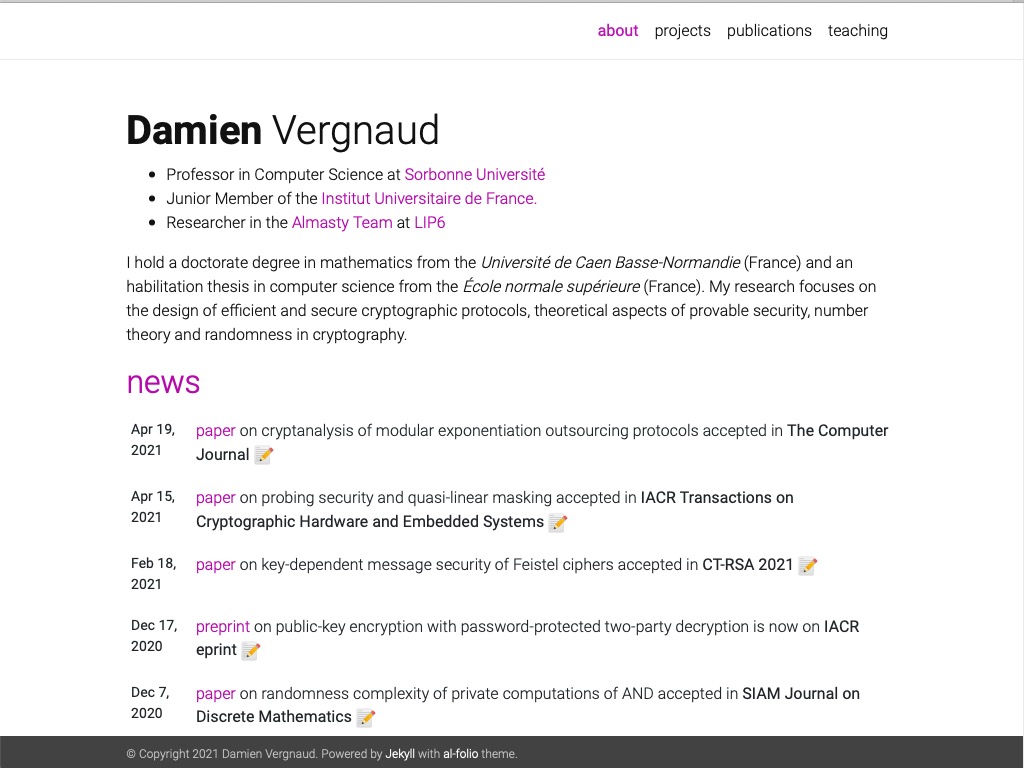
Dr. Damien Vergnaud is a Full Professor at Sorbonne University since September 2017, affiliated with the ALMASTY research team within LIP6 (Laboratoire d'Informatique de Paris 6), the Computer Science department of the Faculty of Science. His office is located at 4 place Jussieu, Paris, France, in Couloir 24-25, Étage 4, Bureau 412. Dr. Vergnaud holds a doctorate degree in mathematics from Université de Caen Basse-Normandie and an habilitation thesis in computer science from École normale supérieure. His research focuses on the design of efficient and secure cryptographic protocols, theoretical aspects of provable security, number theory, and randomness in cryptography. His work spans multiple domains including post-quantum cryptography, zero-knowledge proofs, secure implementation techniques against side-channel attacks, and cryptographic protocol analysis. He actively investigates how quantum computing impacts traditional cryptographic assumptions and protocols, as evidenced by his supervision of PhD students working on quantum-related cryptographic topics. Dr. Vergnaud's recent publications demonstrate a strong focus on post-quantum cryptographic techniques, zero-knowledge argument systems, and secure implementation methodologies. His research output shows consistent collaboration with both academic researchers and industry partners, particularly in practical cryptographic implementations. His work bridges theoretical foundations with practical security considerations, addressing challenges in modern cryptographic systems including resistance to quantum computing threats and side-channel analysis. Dr. Vergnaud actively supervises PhD students, currently mentoring three doctoral candidates and having successfully guided four students to completion in recent years. His supervision spans diverse topics within cryptography, including post-quantum cryptographic techniques, zero-knowledge arguments, secure implementations against physical attacks, and mathematical studies of pseudorandom number generators. He has served on numerous PhD defense committees, indicating his active role in the academic community. Dr. Vergnaud is a member of the ALMASTY research team at LIP6, which specializes in cryptographic algorithms and protocols. The team works on both theoretical foundations and practical implementations of cryptographic systems, with particular emphasis on security against various attack vectors including quantum computing threats and side-channel analysis.
Anna Weichselbraun is a researcher in the Faculty of History and Cultural Studies at the University of Vienna , specializing in the Institute for European Ethnology . Her work bridges political and legal anthropology , linguistic anthropology , and Science and Technology Studies (STS) , focusing on global technology governance through projects like nuclear regulation and cryptocurrency. Education : PhD in Sociocultural and Linguistic Anthropology (University of Chicago, 2016), Postdoctoral Research (Stanford University, 2016-2018), MA and BA in Interdisciplinary Anthropology, Sociology, and Gender/Media Studies (EHESS/ENS and NYU). Research : Explores knowledge practices in institutions like the IAEA, blockchain verification , and language ideologies in AI regulation . Her book manuscript on the IAEA is under review at Cornell University Press. Her recent work examines Large Language Models (LLMs) through language ideologies, funded by an ERC Consolidator Grant submission. She has held fellowships at Stanford and the Berggruen Institute, with field research in Vienna, SF Bay Area, and UN headquarters. Scientific Awards : ERC Consolidator Grant (submitted) Nuclear Security Postdoctoral Fellowship, Stanford University USC-Berggruen Fellowship Anna actively engages in public discourse via Bluesky, advocating against far-right policies in Austria and critiquing technocratic governance. Her publications appear in Cultural Anthropology , PoLAR , and Signs and Society .