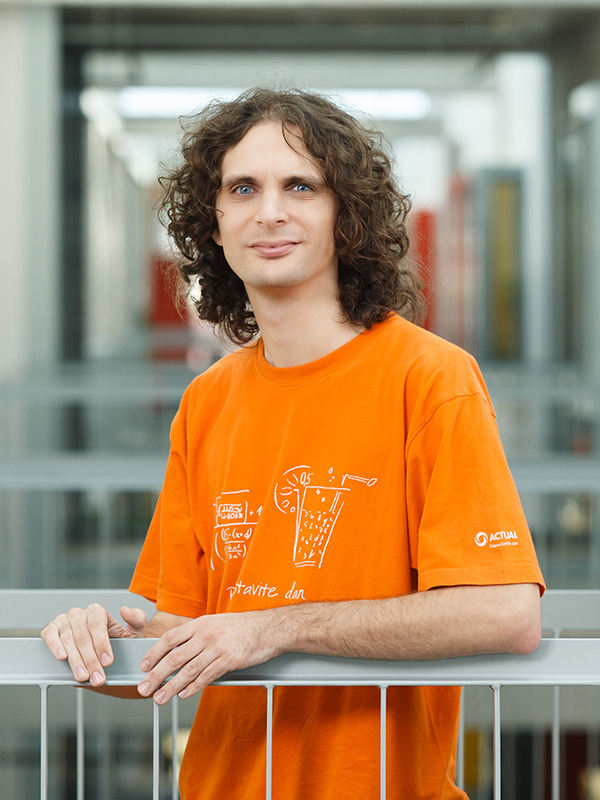
Dan Boneh is a Professor of Computer Science and Electrical Engineering at Stanford University , where he leads the Applied Cryptography Group and co-directs the Stanford Computer Security Lab. His research focuses on applications of cryptography to computer security, including cryptosystems with novel properties, mobile/web security, and cryptanalysis. Recipient of the Gödel Prize, Packard Award, Alfred P. Sloan Award, RSA Award in Mathematics, and five Best Paper Awards Co-director of Stanford Computer Security Lab Active in academic programs through 2025 as Visiting Scientist and Program Organizer Research interests span applied cryptography, secure computation, and blockchain technologies. Recent work includes exploring obfuscation and quantum-resistant cryptographic protocols. Scientific awards: Gödel Prize Packard Award Alfred P. Sloan Award RSA Award in Mathematics Ishii Award Five Best Paper Awards
Nadir Murru is an external researcher and teaching collaborator at the Department of Mathematical Sciences (DISMA) of Politecnico di Torino. He serves as an external tutor for PhD programs in Mathematics and contributes to advanced courses in number theory and cryptography. Research: Cryptography and Number Theory (DISMA) Teaching: Courses on Number Theory, Cryptography, and Post-quantum Cryptography His research focuses on cryptography and number theory, with applications in blockchain technology, cryptanalysis, and algebraic structures. Recent work includes algorithms for p-adic continued fractions and cryptographic uses of Pell hyperbolas. He supervises PhD students such as Leonardo Errati, Giulia Salvatori, and Federico Accossato. His publications span topics like linear recurrent sequences, Pell equations, and post-quantum cryptographic systems.
Assistant Professor at the University of Ljubljana's Faculty of Computer and Information Science (FRI) specializing in theoretical computer science and discrete mathematics. His research bridges cryptography, graph theory, and metric geometry with practical applications in algorithm design and security protocols. Research Focus: Primary interests include cryptography (hash function analysis), graph theory (combinatorial structures, graph databases), and discrete geometry (metric cones, polyhedral combinatorics). His work demonstrates strong interdisciplinary connections between theoretical mathematics and computational problem-solving. Publication Trends: Recent publications reveal a consistent focus on combinatorial structures with applications in both cryptography and geometry. His research combines rigorous mathematical proofs with computational implementations, particularly evident in metric space analysis and graph-theoretical frameworks. Projects: Leads significant open-source initiatives including gap-graphs (computational graph theory) and GraphZOO (graph database), alongside the Kriptogram crypto portal for cryptographic education in Slovene. Teaching: Maintains office hours by appointment with focus on advanced mathematical and cryptographic concepts. Integrates research directly into teaching through computational projects and open-source tools development.
Jian Guo is an Associate Professor (with tenure) at Nanyang Technological University (NTU) in Singapore, affiliated with the School of Physical and Mathematical Sciences and holding a courtesy appointment in the College of Computing and Data Science. His research focuses on cryptography, particularly cryptanalysis, design and implementation of symmetric-key algorithms (hash functions, block ciphers, authenticated encryption), and privacy-preserving technologies. PhD in Mathematical Sciences (2007-2010), supervised by Huaxiong Wang, and BEng in Computer Engineering (2003-2006) with First Class Honors from NTU. Jian leads the Cryptanalysis Taskforce at NTU and has published extensively in cryptography. His work includes breaking the full Kravatte PRF design (FSE 2018 Best Paper) and improving related-key boomerang attacks against AES-256 (ACISP 2022 Best Paper). His research also targets cryptographic standards like SHA-3 and AES Hashing, evidenced by a 2021 eprint preimage attack publication. He has received multiple accolades including the NTU/SPMS Young Researcher Award (2021), Collaborative Research Award (2022), and Accelerating Creativity and Excellence Award (2020). He serves on the IACR Board of Directors (2020-present), chairs major conferences (Asiacrypt 2023, Asiacrypt 2021), and contributes to international standardization efforts (ISO/SC27/WG2, Singapore representative since 2017). As a Principal Investigator, he collaborates with industry partners like LatticeX Foundation (2022-2025) and previously PayPal Inc (2021-2023). He actively mentors PhD and postdoc candidates, with ongoing openings jointly advertised at Wuhan University (2025) and Tsinghua University (2024).
Lakhdar Sais is a Professor of Computer Science at the Centre de Recherche en Informatique de Lens (CRIL), CNRS UMR 8188, at Université d'Artois, Faculty of Jean Perrin Sciences in Lens, France. His research focuses on search and representation problems in Artificial Intelligence, including propositional satisfiability, quantified boolean formulas, constraint programming, knowledge representation and reasoning, data mining, and AI applications in Social and Human Sciences. He has supervised numerous PhD students throughout his career, with recent students including David ING (2021-present) working on migration data knowledge extraction, and previously Ikram NEKKACHE (2021), Sofiane TOUATI (2021), and Kahina BOUCHAMA (2020). His research has been recognized with multiple awards including best paper awards at SAT'11 and ICTAI'2009, and first place in the International SAT 2009 competition. His current research projects include the ANR project HYCI (2023-2026) on Hyper-places, Crises, Migrations and Inequalities, Project ERA (2022-2025) on producing new knowledge in juvenile justice and mental health, and ANR project POSTCRYPTUM (2021-2023) on algebraic cryptanalysis for post-quantum cryptography. He has also edited the Handbook of Parallel Constraint Reasoning (Springer, 2018). Scientific Awards: Best paper award at SAT'11 for 'On freezing and reactivating learnt clauses' Best paper award at ICTAI'2009 for 'Learning for Subsumption' ManySAT - First rank at International SAT 2009 competition (Parallel Track) LySAT - Two bronze medals at International SAT 2009 competition (Sequential Track) ManySAT - First rank at SAT Race 2008 competition Professor Sais has taught numerous courses including Artificial Intelligence, Constraint Programming, Knowledge Representation and Reasoning, Expert Systems, Complexity Theory, Advanced Data Structures, Algorithmics, and Functional Programming. He has served as leader of the inference and decision process research group at CRIL (2002-2013) and as Delegate Director of the CRIL laboratory (2013-2018).
Prof. Dr. Ünal Çavuşoğlu is an Associate Professor at the Department of Software Engineering, Faculty of Computer and Information Sciences, Sakarya University. With a doctorate in chaos-based encryption algorithms (2016) and a master's degree comparing network simulation tools (2014), his research focuses on cybersecurity, machine learning, and chaos theory. He has contributed extensively to intrusion detection systems, IoT security, and cryptographic protocols. Education: Doctorate (2016), Master's (2014), and Bachelor's (2011) in Computer Engineering. Research Interests: Cybersecurity frameworks, machine learning adaptation for threat detection, chaotic encryption, and IoT communication protocols. Recent Work: 2025 publications on homomorphic encryption and LSTM-based intrusion detection demonstrate cutting-edge applications of deep learning in security domains. His 2019-2024 publications reveal a trajectory from foundational chaos theory to applied IoT and cloud security solutions. Key methodologies include genetic algorithms, fractional calculus, and hybrid encryption systems.
Vicente Jara Vera is an Assistant Professor in the Department of Mathematics Applied to Information and Communication Technologies at the Technical University of Madrid. He has been a member of the Biometrics, Biosignals, Security and Smart Mobility Group since April 2018 and is affiliated with the Comprehensive Home Automation Center (CEDINT) since April 2025. His research focuses broadly on cryptography, number theory, and algebra, with expertise in cryptanalysis, historical ciphers, and blockchain technologies. He also investigates biometrics, post-quantum cryptography, and secure systems for smart mobility.
Sona Alex serves as a Postdoctoral fellow within the Department of Information Security and Communication Technology at the Norwegian University of Science and Technology (NTNU), focusing on advanced cryptographic research and security protocol development. Her research portfolio centers on: Structural vulnerabilities in encryption systems Matrix-based randomization techniques for data protection Algorithmic modifications to enhance cryptographic resilience Security evaluation of novel encryption frameworks Current work exemplifies her expertise through critical analysis of the v-MORE scheme, where she identifies theoretical weaknesses and implements practical countermeasures to strengthen encryption integrity. This research directly addresses evolving threats in secure communications infrastructure. While no student supervision or grant activities are documented in available materials, her presentation at DBSec 2025 demonstrates active engagement with the international cybersecurity research community. Laboratory affiliations and collaborative teams remain unspecified in current public records.
Morten Øygarden is a Postdoctoral Fellow in the Department of Cryptography at Simula UiB, a joint research initiative between Simula Research Laboratory and the University of Bergen. His work bridges theoretical cryptography and practical security analysis within Norway's premier cryptographic research environment. His educational background culminates in a 2021 PhD from the University of Bergen with the thesis "Algebraic Cryptanalysis of Cryptographic Schemes with Extension Field Structure", establishing his expertise in algebraic methods for cryptanalysis. Øygarden's research focuses on Algebraic Cryptanalysis , Post-Quantum Cryptography , and Symmetric Cryptography , specializing in vulnerabilities of multivariate systems, code-based schemes, and ring-based primitives. He develops novel Gröbner basis techniques to break cryptographic assumptions underlying quantum-resistant candidates, with direct implications for NIST standardization processes. Analysis of his 2020-2024 publications reveals consistent innovation in algebraic attack methodologies, particularly against arithmetization-oriented primitives for zero-knowledge proofs and MPC-friendly ciphers. His work demonstrates exceptional depth in exploiting mathematical structures of symmetric primitives while advancing post-quantum security evaluations of multivariate and code-based systems. His publication record in top venues including CRYPTO, EUROCRYPT, and the Journal of Cryptology reflects significant contributions to cryptographic science, though specific awards or grant details are not documented in available sources.
Håvard Raddum serves as Chief Research Scientist in the Department of Cryptography at Simula UiB, a joint research entity of Simula Research Laboratory and the University of Bergen. His primary focus involves advancing cryptographic security through algorithm analysis, Fully Homomorphic Encryption applications, and hardware-level attack mitigation. Raddum's research spans cryptography with specialization in security analysis of cryptographic algorithms, practical deployment of Fully Homomorphic Encryption, and physical attacks on hardware implementations. His work addresses vulnerabilities in symmetric ciphers, multivariate schemes, and lattice-based systems through algebraic cryptanalysis, side-channel techniques, and theoretical security proofs. Analysis of his 2019-2025 publications reveals concentrated expertise in cryptanalysis across diverse primitives. Key trends include algebraic attacks on arithmetization-oriented cryptography, side-channel analysis of lightweight ciphers, error detection in lattice computations, and security evaluations of Fully Homomorphic Encryption. His research consistently bridges theoretical frameworks with practical implementation vulnerabilities.
Prof. Dr. Michael Rademacher is a full-time Professor of Embedded Systems and Networks at Hochschule Bonn-Rhein-Sieg (H-BRS) and Research Group Leader of 'Secure Mobile Communication' at Fraunhofer FKIE. His dual affiliation bridges academic research and applied industry solutions, focusing on wireless networks and cybersecurity. Research Focus: Rademacher's work spans wireless communication (5G, LoRaWAN), IoT security, and network protocol optimization. He leads projects like HiLeit, developing satellite-5G hybrid networks for emergency services, and DigitalTwin-4-Multiphysics-Lab for industrial simulations. His lab investigates vulnerabilities in mobile systems while creating tools like Katti for automated web threat detection. Awards & Recognition: VDI Köln Promotion Prize, 1st Place (2014) Best Master's Thesis in Computer Science, H-BRS (2014) AFCEA Bonn Study Award, 1st Prize (2014) Projects & Grants: He directs multiple funded initiatives, including HiLeit (resilient disaster communication) and Cyber Security Learning Lab. His teams develop open-source frameworks like open5Gcube for network testing and publish extensively on TLS optimization and spectrum management.
Prof. Dr. Kerstin Lemke-Rust is a Professor at the Department of Computer Science at Bonn-Rhein-Sieg University of Applied Sciences (H-BRS) and a key member of the Institute for Cyber Security and Privacy (ICSP). Her affiliations include leadership roles in the Gesellschaft für Informatik (GI) and the International Organisation for Cryptologic Research (IACR). Her research spans: Cryptographic algorithm security (side-channel/fault analysis) Blockchain and IoT security Automotive cybersecurity Hardware vulnerability detection She teaches courses in IT Security, Applied Cryptography, and Embedded Systems across bachelor’s and master’s programs. Recent publications (2021-2025) focus on blockchain privacy, side-channel attacks, and hardware security, reflecting her emphasis on real-world cryptographic vulnerabilities. She leads research initiatives at ICSP and collaborates internationally on cybersecurity projects.
Prof. Dr. Klaus Dohmen is a Professor of Mathematics at Mittweida University of Applied Sciences, Faculty of Applied Computer and Biosciences. His academic career includes significant leadership roles such as Dean of Faculty (2006-2009) and Dean of Studies (2015-2021). He maintains active participation in university governance through the Departmental Council for Mathematics since 2018. His research specializes in foundational and applied mathematical disciplines with focus areas including: Discrete Mathematics and Theoretical Computer Science Cryptology and Cryptanalysis (both theoretical foundations and practical applications) Algebraic structures and Number Theory Mathematical Logic and computational theory Professor Dohmen contributes to academic quality assurance as a seasoned accreditation reviewer and program coordinator. He teaches advanced courses in cryptography and discrete mathematics through both traditional and distance learning formats. Contact: dohmen@hs-mittweida.de (Room 6-127).
Visa Vallivaara serves as Master of Science Research Team Leader at VTT Technical Research Centre of Finland, heading the BA6410 CryptoLab. His research directly contributes to cybersecurity advancements under UN Sustainable Development Goals, with expertise spanning post-quantum cryptography, quantum-safe systems, and blockchain security. Research Interests: Vallivaara's work centers on cryptographic resilience against quantum computing threats, specializing in lattice-based signature algorithms and hybrid quantum-classical optimization. His fingerprint analysis reveals dominant expertise in algorithms (100%), cryptography (96%), and quantum cryptography (54%), with significant contributions to blockchain (54%) and security protocols (55%). This positions him at the forefront of Finland's national quantum-safe transition efforts. Publication Trends: Recent outputs (2022-2025) demonstrate a clear trajectory from theoretical foundations to practical implementation. His work bridges NIST PQC standardization with developer adoption challenges, featuring combinatorial optimization frameworks and cryptographic metrics for real-world systems. The 2025 poster on hybrid quantum-classical algorithms represents the cutting edge of his current research direction. Scientific Awards: CyCon 2015 Student Award (2nd place) for cybersecurity research innovation Advising and Grants: Vallivaara has supervised 2 research projects and currently leads Business Finland-funded initiatives including BLimPQC (2025-2028) and Secur-e-Health (2023-2025). His grant portfolio reflects strategic focus on quantum-safe communication requirements and practical implementation frameworks, with active collaboration across Finnish research and industry sectors. Labs and Teams: As leader of BA6410 CryptoLab at VTT, Vallivaara directs Finland's specialized research unit for post-quantum cryptography. The lab produces both theoretical frameworks (e.g., cryptographic metrics) and applied tools (e.g., LOAP blockchain auditing system), maintaining strong connections to national cybersecurity infrastructure development through Business Finland partnerships.
Dr Theodosis Mourouzis serves as an Assistant Professor of Information Management at the University of Nicosia and directs the MSc in Business Intelligence and Data Analytics program within the Department of Information Technologies. Academic Background: PhD in Information Security and Cryptography from University College London (UCL) MSc in Advanced Studies in Mathematics from University of Cambridge BA/MA in Mathematics from University of Cambridge Research Expertise: Dr Mourouzis specializes in information security with deep technical focus on cryptography (including symmetric/asymmetric cryptanalysis) and blockchain ecosystems . His work spans theoretical cryptanalysis of algorithms like GOST and SIMON to practical implementations such as privacy-preserving healthcare blockchain solutions. Current research emphasizes efficient blockchain design and security evaluation frameworks. Publication Trends: His 14 publications (2011-2021) reveal an evolution from foundational cryptanalysis (differential/algebraic attacks on ciphers) toward applied blockchain systems. Key thematic clusters include cryptographic security evaluation (35% of works), blockchain innovation (40%), and authentication systems (25%), demonstrating consistent technical rigor across theoretical and implementation challenges. Academic Leadership: As MSc Director, he oversees program development bridging technical cryptography research with business intelligence applications, indicating strong curriculum design capabilities and industry-academia translation focus.