Eric Roberts is a Professor of Geology and Geological Engineering and Director of the Potential Gas Agency at the Colorado School of Mines. His research focuses on basin analysis, energy exploration, and sedimentary geology with specializations in Mesozoic-Cenozoic basins of Gondwana and North America. He leads projects in U-Pb geochronology, critical minerals exploration, and paleoenvironmental reconstruction through vertebrate paleontology and stratigraphy studies. Roberts' work integrates advanced geochronological techniques with field-based analyses to address questions in paleobiology, resource exploration, and earth system dynamics. Key research themes include: Geochronology of sedimentary and volcanic deposits Paleoclimate reconstruction using paleosols Stratigraphic frameworks for dinosaur fossil records Resource potential of helium/hydrogen reserves Antarctic and African vertebrate paleontology His exploration of hominin burial practices in the Rising Star Cave System has provided critical insights into early human behavior. Roberts' interdisciplinary approach bridges geological, biological, and environmental sciences to advance understanding of Earth's history and resource management strategies.
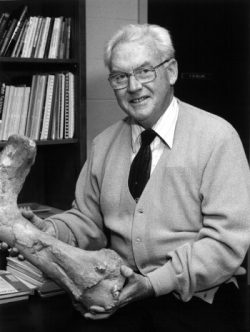
Wann Langston, Jr. (1921-2013) was a distinguished vertebrate paleontologist and Professor at the University of Texas at Austin's Jackson School of Geosciences. He held the position of Curator of Vertebrate Paleontology at the National Museum of Canada (1954-1963) and directed UT Austin's Vertebrate Paleontology Laboratory (1969-1986). His research focused on dinosaurs, Permian amphibians, and crocodilians, with significant contributions to the study of Deinosuchus and Quetzalcoatlus. Education: B.S. (University of Oklahoma), M.S. (University of Oklahoma), Ph.D. (University of California, Berkeley) Langston's career included over 50 years of fieldwork in North America, Canada, and Texas' Big Bend region. He reconstructed iconic fossils like the Quetzalcoatlus skeleton and Deinosuchus skull. His legacy includes over 100 publications, numerous species named in his honor, and major philanthropic contributions to paleontology institutions. Recipient of the Romer-Simpson Medal (2007), his work is featured in museums worldwide. He is remembered for both scientific rigor and humor, famously quipping about a potential 'Homer Simpson Medal' during an award acceptance. Family legacy: Married to Marietta Evans (60 years), father of Karen and Sandra Langston, with two grandchildren. Survived by both daughters and grandchildren.
James M. Clark is the Ronald Weintraub Professor of Biology at The George Washington University's Columbian College of Arts and Sciences. His research focuses on the evolution of extinct land vertebrates, particularly from the Mesozoic Era. He has conducted extensive field work across four continents, leading to numerous significant fossil discoveries in China, Mongolia, Mexico, South Africa, and other locations. Clark received his A.B. from the University of California, Berkeley in 1978, followed by an M.S. from the same institution in 1985. He completed his Ph.D. at the University of Chicago in 1986. His postdoctoral work included positions at U.C. Davis (1987-1989), the National Museum of Natural History (1989-1991), and the American Museum of Natural History (1991-1994). Clark's research program centers on fossil vertebrates from the Age of Dinosaurs, with particular expertise in crocodylomorphs, dinosaurs, pterosaurs, and lepidosaurs. His laboratory addresses evolutionary relationships of these groups and their connections to living relatives. A major focus has been the Shishugou Formation in Xinjiang, China, where his expeditions have uncovered numerous new species including Limusaurus, Guanlong, and Haplocheirus. His work on theropod dinosaurs has significantly contributed to our understanding of the dinosaur-bird transition. Analysis of Clark's recent publications reveals consistent research themes across paleontology, evolutionary morphology, and phylogenetics. His work spans multiple vertebrate groups including dinosaurs, crocodylomorphs, pterosaurs, and lepidosaurs, with a strong geographic focus on Jurassic deposits from China. The publications demonstrate methodological diversity, incorporating field discovery, detailed morphological analysis, phylogenetic studies, and advanced imaging techniques like CT scanning. Clark has mentored numerous graduate students who have gone on to make significant contributions in paleontology, including Jonah Choiniere, Josef Stiegler, and Drew Moore. His research has been consistently supported by major funding agencies including the National Science Foundation and the National Geographic Society, enabling extensive field expeditions and laboratory analyses. He has taught courses in Evolution and Extinction of Dinosaurs, Current Topics in Systematic Biology, Vertebrate Phylogeny, Morphological Systematics, and Foundations of Evolution. Clark's laboratory conducts research through international collaborations, primarily with the Institute of Vertebrate Paleontology and Paleoanthropology in Beijing. His field work has resulted in the discovery of numerous new species across multiple vertebrate groups. Current projects include studying the paleobiology of Limusaurus and the relationships of Bellusaurus, with future work planned in Early Jurassic deposits of South Africa.
Gilbert Price is an Associate Professor in Palaeontology at the University of Queensland, specializing in Cenozoic vertebrate evolution. His research integrates geochronology, taphonomy, and palaeoecology to study megafauna extinctions and ecosystem responses to climate change. Education : PhD from Queensland University of Technology focused on Australian megafauna extinction chronologies. Research Focus : His work examines evolutionary patterns in marsupials, climate-driven extinctions, and hominin dispersals using advanced dating techniques. Fieldwork spans Australia, Sumatra, and Arabia. Publication Trends : Recent articles (2018-2025) show focus on: Pleistocene mammal diversity patterns Hominin dispersal chronologies Pathology in fossil marsupials Bone diagenesis and collagen preservation Taxonomic revisions of megafauna Field Contributions : Key discoveries include Australia's oldest evidence of marsupial diseases, Homo sapiens fossils in Arabia dating to 85,000 years, and new crocodilian taxa.
Prof. Dr. Madelaine Böhme is a faculty member in the Department of Geosciences at Eberhard Karls University Tuebingen , where she leads the Terrestrial Palaeoclimatology work group. She is also affiliated with the Senckenberg Centre for Human Evolution and Palaeoenvironment (HEP) . Her research integrates fossil amphibians and reptiles to reconstruct Miocene climate patterns and paleoprecipitation gradients in Europe. Her primary research interests include: Palaeoclimatology and Neogene environmental dynamics Fossil-based climate reconstruction using herpetofauna Miocene precipitation modeling European biogeography and ecosystem evolution Taxonomy and evolution of vertebrates, especially mammals and reptiles Analysis of her recent publications reveals a strong focus on quantitative paleoclimatic methods, fossil vertebrate assemblages, and large-scale environmental reconstructions across Eurasia during the Neogene. She frequently employs interdisciplinary approaches combining geochronology, sedimentology, and paleontology. Her scientific contributions include key papers on: Miocene 'washhouse' climate in Europe Paleoprecipitation estimation methods Chronology of hominid localities in Bulgaria Evolution and taxonomy of Miocene mammals (rhinos, chalicotheres) New hominid discoveries in Germany She actively supervises PhD and Master’s students, including Panagiotis Kampouridis and Josephina Hartung , and collaborates on international field projects in Bulgaria, Greece, and Germany. She has been involved in major research programs such as the ESF's EEDEN initiative. Her work is supported by institutional affiliations and collaborative grants, though specific grant details are not listed. She leads a research team that includes postdocs, students, and technical staff, and she participates in fossil excavations and collection-based research.
Christopher Brochu is a Professor in the Department of Earth and Environmental Sciences at the University of Iowa, within the College of Liberal Arts and Sciences. His research integrates fossil, morphological, and molecular data to study the evolutionary history of crocodyliforms, including alligators, crocodiles, and their extinct relatives. He is actively involved in paleontological research, focusing on phylogenetics, historical biogeography, and responses to environmental change over geological timescales. His research interests lie at the intersection of vertebrate paleontology, systematics, and evolutionary biology. Dr. Brochu applies phylogenetic methods to analyze biodiversity patterns across deep time, particularly in crocodyliforms, which exhibit low modern diversity but a rich fossil record. His work spans continents and geological periods, with recent studies covering the Late Cretaceous to the Pliocene in North America, Africa, and the Neotropics. He investigates key evolutionary transitions, such as the move from land to water, morphological adaptations, and cryptic species diversity. The recent publications (2019–2020) reflect a strong focus on crocodylomorph evolution, with studies appearing in high-impact journals like PNAS , Journal of Vertebrate Paleontology , and Scientific Reports . These works examine inner ear adaptations, fossil taxonomy, and macroevolutionary patterns, highlighting interdisciplinary approaches combining anatomy, phylogenetics, and geology. The research consistently emphasizes integration of fossil and molecular data to resolve deep phylogenetic relationships. Scientific Awards: Dean’s Scholar, College of Liberal Arts and Sciences, University of Iowa, 2006 Collegiate Teaching Award, College of Liberal Arts and Sciences, University of Iowa, 2005 Romer Prize, Society of Vertebrate Paleontology, 1996 Stoye Award in General Herpetology, American Society of Ichthyologists and Herpetologists, 1996 Dr. Brochu has contributed significantly to mentoring and research funding through his academic roles, though specific students and grants are not detailed. His lab conducts extensive work on fossil crocodyliforms, using morphological datasets and phylogenetic frameworks to explore biodiversity and evolutionary dynamics. He is supported by institutional research facilities such as the Paleontology Repository and Geochemistry Lab at the University of Iowa. His research continues to shape understanding of vertebrate evolution and the interplay between Earth and life sciences.
Dr. Daniela E. Winkler is a Postdoc (Assistant) at Kiel University's Zoological Institute and Museum, working within the Böhmer Group focused on Zoology and Functional Morphology of Vertebrates. She conducts research on dental microwear texture analysis across various vertebrate species, both extant and fossil, to reconstruct dietary patterns and ecological adaptations. Her position includes teaching responsibilities and she is currently working on her habilitation. Dr. Winkler earned her doctorate from the University of Hamburg on the functional morphology of ungulate dentition (magna cum laude). Her academic journey includes postdoctoral research at the University of Mainz (2016-2020) in the ERC project 'Vertebrate Herbivory' with Prof. Thomas Tütken, followed by a JSPS Postdoctoral Fellowship at the University of Tokyo (2020-2022) with Dr. Mugino O. Kubo. Since December 2022, she has been working at Kiel University on her habilitation while serving as an elected member of the CAU Postdocs' Interest Group (2023-2025). Her research primarily focuses on functional morphology and dental wear analyses across diverse vertebrate groups including mammals, lepidosaurs, and archosaurs. Through dental microwear texture analysis, she investigates how wear patterns can reveal information about diet, habitat, and paleoecology. Her experimental approach combines feeding experiments with analysis of collection material, examining both microscopic and macroscopic wear patterns. She is particularly interested in how internal (phytoliths) and external (mineral dust) abrasives affect dental wear formation, and how these patterns can be used for dietary reconstruction in both extant and extinct species. Dr. Winkler has expressed interest in expanding her research to include invertebrate mouthparts, recognizing that all feeding structures show signs of wear. Analysis of Dr. Winkler's recent publications (2023-2025) reveals a strong methodological focus on dental microwear texture analysis (DMTA), with particular attention to instrument comparability and standardization across different optical profilometers. Her work spans diverse taxa including sauropod dinosaurs, crocodyliforms, small mammals, and even invertebrates like crickets, demonstrating the broad applicability of DMTA across vertebrate systems. A significant portion of her research involves controlled feeding experiments with model organisms like guinea pigs and rats to establish baseline relationships between diet composition and resulting microwear patterns, with applications in paleontology, ecology, and evolutionary biology. CAU DenkRaum Fellowship (2024-2026) for interdisciplinary work on 'Energy in the Changing Times and the World' Dr. Winkler serves as an active member of the CAU Postdocs' Interest Group and has been involved in several collaborative research projects. Her teaching responsibilities include practical exercises and lectures in fundamental zoology (biol102), biodiversity identification (biol104), and vertebrate evolution courses (biol-261/biol-261b), including outdoor excursions to locations like the Wadden Sea. She has supervised student research projects within the Böhmer Group and collaborates extensively with researchers across multiple institutions in Germany, Japan, and Switzerland. As part of the Böhmer Group at Kiel University, Dr. Winkler works within a multidisciplinary team that includes Prof. Christine Böhmer, Dr. Ghislaine Cárdenas Posada, and other researchers. Her laboratory work involves advanced imaging techniques and dental microwear texture analysis using optical profilometers, with applications spanning paleontology, ecology, and evolutionary biology. Her research has received media attention including coverage in Spiegel online (October 6, 2024), DER SPIEGEL 41/2024, and Kieler Nachrichten (October 24, 2024).
Randall Irmis is a Professor in Geology & Geophysics at the University of Utah and Curator of Paleontology at the Natural History Museum of Utah since 2009. He was Chief Curator at the museum until 2023. His work integrates high-precision geochronology paleoclimatology vertebrate evolution sedimentary systems analysis to study Earth-life interactions during the Paleozoic and Mesozoic. His research focuses on Triassic non-marine ecosystem transitions dinosaur origins and diversification Gondwana paleobiogeography geochemical fingerprinting of fossils Carnian Pluvial Episode impacts synapsid-crocodylomorph evolution using fieldwork, core analysis, and multi-proxy datasets. Recent publications analyze Triassic tetrapod community evolution ankylothecodonty in Silesauridae Carnian paleoclimate in Argentina U-Pb zircon geochronology ochrostratigraphic uncertainties early pterosaur-dinosaur precursor relationships across North and South America, Japan, and China. Teaching activities include PhD/MSc thesis supervision Paleontology special topics courses Field geology instruction . Major grants from the National Science Foundation and Bureau of Land Management fund his work on Grand Staircase-escalante fossil protection Colorado Plateau coring projects Triassic impact event analysis Paleotropical climate calibration .
Attila Ősi is a Professor at the Department of Palaeontology, Institute of Geography and Earth Sciences, Eötvös Loránd University (ELTE), Budapest. He serves as a lecturer at multiple affiliated institutions including the Center of Earth Sciences and Dinoszaurusz Kutatócsoport (Dinosaur Research Group). Institute of Geography and Earth Sciences, ELTE Department of Palaeontology, ELTE Center of Earth Sciences, ELTE Dinoszaurusz Kutatócsoport (Dinosaur Research Group) His research focuses on Mesozoic vertebrates, particularly dinosaurs, pterosaurs, and crocodyliforms, with expertise in dental wear analysis, skeletal reconstruction, and biogeography. He investigates niche partitioning, jaw mechanics, and the evolution of feeding adaptations in archosaurs. Recent publications highlight his work in dental microwear patterns in theropods and ornithopods (2022-2025), discovery of new insect species in Cretaceous amber (2023), and paleoecological analysis of vertebrate assemblages from Iharkút and Transdanubian regions (2021-2022). His studies integrate sedimentology, geochemistry, and histology to reconstruct Mesozoic ecosystems.
Jorgo Ristevski is an Honorary Fellow at The University of Queensland's School of the Environment. His research focuses on crocodylian evolution, morphology, and paleontology, particularly in Australasia. He holds a PhD from UQ's School of Biological Sciences (2022), specializing in Cenozoic crocodylian diversity. His work combines anatomical analysis with phylogenetic and biogeographic approaches to understand predator evolution and extinction dynamics. Key research areas include the systematics of Mekosuchinae, neuroanatomical adaptations in extinct crocodylians, and the ecological roles of prehistoric Australian fauna. Notable contributions include describing new species like Baru's 'cleaver-headed' crocodile and revising the Plio-Pleistocene genus Pallimnarchus. Publications span peer-reviewed journals (e.g., Papers in Palaeontology , Scientific Reports ), conference presentations on topics like Trilophosuchus rackhami's paleoecology, and a comprehensive doctoral thesis. His work bridges paleontology with modern ecological frameworks to explore faunal turnover processes.
Alan H. Turner is Professor & Chair at the Department of Anatomical Sciences, Renaissance School of Medicine, Stony Brook University. His research focuses on phylogeny, systematics, and anatomy of crocodylomorphs and theropod dinosaurs, with emphasis on body size evolution in archosaurs and theoretical issues in historical biogeography. He employs fieldwork-oriented, specimen-based approaches combined with quantitative phylogenetics and comparative methods. Education : PhD, Columbia University (2008) M.Phil, Columbia University (2006) MS, University of Iowa (2004) BS, University of Cincinnati (2001) Dr. Turner's work spans theoretical and empirical studies, including analyses of Mesozoic notosuchian crocodyliforms and early eusuchians, and investigations into theropod miniaturization linked to feather and flight evolution. His lab collaborates on projects involving CT scanning, histological analysis, and model-based tools for paleontological data.
Thomas J. Smith is a Stipendiary Lecturer in Earth Sciences at the University of Oxford and a Postdoctoral Research Assistant affiliated with Exeter College. His research focuses on computational palaeobiology, integrating traditional methods with simulation tools to address gaps in the fossil record. Current research priorities include the Bivalve-Brachiopod transition, the Cambrian explosion, and eukaryotic morphological disparity. He holds a PhD in Geology from the University of Bristol (2018-2022), supervised by Professors Philip C. J. Donoghue and Davide Pisani, alongside an MSci in Marine Biology (First Class) from the University of Southampton (2012-2016). His teaching spans palaeobiology, marine biology, and R programming. Smith develops novel analytical techniques such as TREvoSim v3, an individual-based evolutionary simulation tool. His work highlights how fossilization biases affect disparity analyses and explores ecosystem engineering impacts via eco-evolutionary simulations. Recent studies reveal functional convergence in crocodile-line archosaurs and demonstrate how phylogenetic sampling influences morphological disparity interpretations. His research bridges computational modeling with empirical paleontological data, addressing foundational questions in macroevolutionary patterns and processes.
Dr. Paul Sereno is a distinguished paleontologist at the University of Chicago with a career spanning decades of groundbreaking discoveries across multiple continents. His research focuses on vertebrate paleontology, dinosaur evolution, and saharan paleoenvironments, with particular emphasis on the interplay between terrestrial ecosystems and climate change over geological time. Sereno leads a vibrant research group through his Fossil Lab, which is relocating to a 6,000-square-foot facility in Washington Park. Key research areas: Spinosaurid adaptations to aquatic environments Saharan paleoecology and "Green Sahara" transitions Dinosaur origins and morphological evolution Crocodyliform diversity and terrestrial adaptations Early human settlements in Africa Selected publications reveal his team's focus on Cretaceous ecosystems in Africa, particularly examining predator-prey dynamics and environmental changes that shaped evolutionary trajectories. His scientific outreach includes National Geographic documentaries and public exhibits like "Spinosaurus: Lost Giant of the Cretaceous" and "Dinosaurs of the Sahara". Sereno also mentors graduate students including Evan Johnson-Ransom, who studies spinosaurid head and neck morphology. Expedition leadership has been a hallmark of his career, with major field campaigns in: Niger (multiple decades of Saharan discoveries) Argentina (1988, 1991 expeditions) Morocco (1995) Tibet (2006) India (2001) China (2001) Collaborative networks span universities, museums, and research institutions worldwide. His lab includes: Tyler Keillor (Fossil Lab Manager) Erin Fitzgerald (Fossil Preparator) Lauren Conroy (Graphic Artist) Jessica Schwartz (Project Manager) Nena Connelly-Smoleniec
Yohan Pochat-Cottilloux is a postdoctoral researcher at the University of Warsaw, specializing in paleobiology and evolutionary studies of crocodylomorphs. His research focuses on phylogeny, endocranial structure analysis, and geochemical proxies for understanding organismal lifestyles. He has conducted extensive work on Mesozoic and Cenozoic reptiles, particularly in Morocco, Thailand, and Madagascar. Education & Projects: PhD at Université Claude Bernard Lyon 1 (France) on terrestriality evolution in altirostral crocodylomorphs, supported by the ANR SEBEK grant. Current postdoctoral research on Miocene vertebrates from the Paratethys region under the NCN OPUS-24 grant. Research Interests: Paleoneurology and anatomical adaptations in crocodyliforms. Geochemical analysis (isotopes, histology) to reconstruct paleoecology. Systematics and evolutionary relationships of extinct crocodylomorph groups. Grants & Collaborations: ANR SEBEK (PhD funding). NCN OPUS-24 (current postdoctoral project). Collaborations with institutions like CNRS, Muséum national d'Histoire naturelle (Paris), and international teams. Labs/Teams: Involved in the Vertebrate Paleobiology research group, focusing on morphological and geochemical studies of fossil reptiles.
Nicolás Campione serves as Senior Lecturer in Palaeobiology within the School of Environmental and Rural Science at the University of New England (UNE), Australia. His academic career bridges traditional paleontological practices with quantitative techniques to explore biological patterns in the fossil record, with particular expertise in dinosaur body size evolution, dental morphology, and Mesozoic vertebrate ecosystems. Dr. Campione's research interests focus on understanding anatomical variation through time, combining field-based studies with morphometric and phylogenetic analyses. His primary research areas include Palaeontology, Mesozoic studies, Vertebrate Paleontology, Dinosauria, and Quantitative Palaeobiology. Current projects investigate dinosaur body size estimation, dental evolution for dietary reconstruction, and vertebrate diversity across multiple Australian and Canadian formations including the Griman Creek, Winton, and Wapiti Formations. His recent publications reveal strong trends in quantitative paleobiology, with particular emphasis on morphometric approaches to dinosaur anatomy, body mass estimation methodologies, and the evolutionary patterns of both terrestrial and marine vertebrates across major extinction events. The research demonstrates increasing integration of digital methods and cross-taxon comparisons in paleontological analysis. Australian Research Council (ARC) Discovery Early Career Research Award (2019-2024) - Revealing the diets of dinosaurs through the complexity and shape of teeth [AUD 370,000] Tasmanian Museum and Art Gallery (TMAG) Jayne Wilson Bequest Bursary (2023-Present) - Revealing the Early Triassic Vertebrates of Tasmania [AUD 5,000] Australian Nuclear Science and Technology Organisation (ANSTO) Australian Synchrotron (2024) - Early Triassic Vertebrates of Australia Dr. Campione supervises multiple graduate students working on diverse projects including ornithopod evolution, microvertebrate analysis, shark paleontology, and tyrannosaurid dental growth. He leads field programs in Boreal Alberta, Australia's mid-Cretaceous sites, and Early Triassic locations in Tasmania. As Chair of Australasian Palaeontologists and Editor of Paleobiology, he maintains significant professional engagement within the paleontological community.