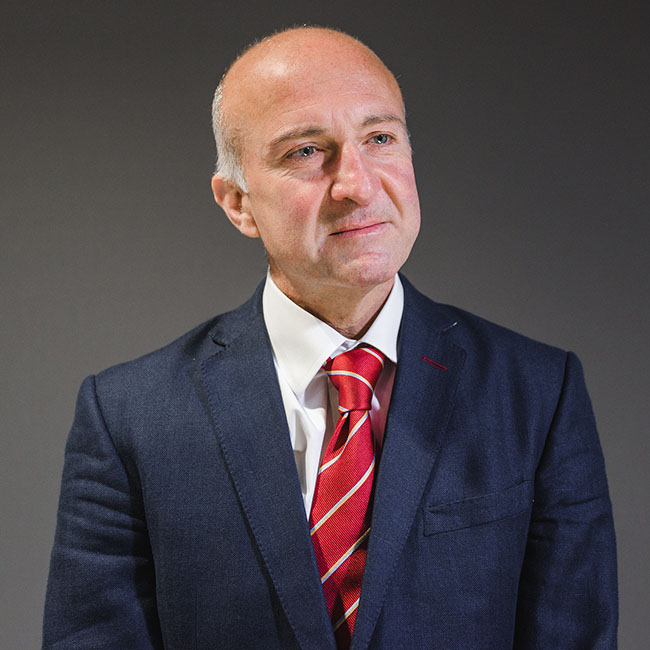
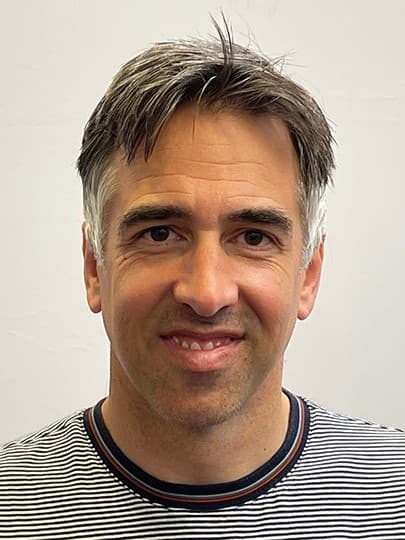
Dr. Rene Ferdinands is a Lecturer at the University of Sydney's School of Health Sciences, specializing in sports biomechanics, particularly in cricket and golf. He leads research programs focused on optimizing techniques and minimizing injury risks, such as lumbar load analysis in fast bowlers and spin bowling biomechanics. His work includes developing 3D models for analyzing bowling actions and spin delivery mechanics. Education: MSc and PhD from the University of Waikato. Research Themes: Cricket biomechanics, golf swing dynamics, equine biomechanics, and injury prevention. Professional Roles: Editor of the Cricket Coaching Information service for the International Society of Biomechanics in Sports, Honours Committee Member. His research interests span biomechanical analyses of sports techniques, including the development of smart cricket balls for performance assessment and injury mitigation. Key contributions include refining bowling action legality criteria and advancing understanding of lumbar kinetics in elite athletes. He actively supervises Honours and PhD students in biomechanics research across cricket, golf, and other sports. Notable grants include studies on hydration status in cricket performance (2008), lumbar injury prevention (2013), and biomechanical modeling of fast bowling (2009). His work bridges applied research with practical applications in sports technology and athlete development. Dr. Ferdinands collaborates with the Biomechanics Research Team at the University of Sydney, focusing on innovative tools like smart balls and advanced motion analysis techniques to improve sports performance and safety.
Habib Ullah is an Associate Professor in Data Science at the Norwegian University of Life Sciences (NMBU), Norway, where he conducts research at the intersection of computer vision and machine learning. He is affiliated with the Institute of Data Science under the Faculty of Science and Technology. He has previously held academic positions at COMSATS University Islamabad, Pakistan, and the University of Ha'il, Saudi Arabia, and served as a postdoctoral researcher at The Arctic University of Norway. Educational Background: PhD in Information and Communication Technology (Computer Vision), University of Trento, Italy (2011–2015) MSc in Electronics and Computer Engineering, Hanyang University, South Korea (2007–2009) BSc in Computer Systems Engineering, NWFP University of Engineering and Technology, Pakistan (2002–2006) Habib Ullah's research is primarily focused on computer vision and machine learning, with applications in aquaculture, agriculture, and human behavior analysis. He investigates underwater fish feeding sounds using audio classification, develops zero-shot learning models for recognizing unseen classes, and applies deep learning to detect stress in salmon via skin dot patterns. He also explores AI-driven controlled environment agriculture, leveraging sensors and automation for optimal crop growth. His work emphasizes practical AI solutions for real-world challenges in environmental and biological domains. The recent publications highlight a strong trend in leveraging deep learning for zero-shot and semi-supervised learning, particularly in computer vision tasks such as sea ice classification, crowd anomaly detection, and agricultural monitoring. His research spans remote sensing, biomedical signal processing, and human activity recognition, demonstrating interdisciplinary versatility. The keywords reflect a focus on robust feature representation, knowledge transfer, and model generalization. Scientific Awards and Funding: Industrial PhD grant 'Advancing Controlled Environment Agriculture AI' from The Research Council of Norway (Project number 354125, 2 million NOK, 2024) Team member (Coordinator-Participant) in the Battery Cell Assembly Twin (BatCAT) project funded by Horizon Europe (7 mEuro, 2023–2027) Development of an AI-Based Image Analysis System for Monitoring Plant Status (Funding: 1.8 mNOK, starting 2025) Habib Ullah actively supervises PhD projects and contributes to academic service through editorial and organizational roles. He has served as an Associate Editor for IEEE Access, Guest Editor for MDPI Remote Sensing, and Editor of the Springer book Machine Learning Techniques and Sensor Applications for Human Emotion, Activity Recognition, and Support (ML-SHEARS) . He has also been a Track Chair and Program Committee Member for several international conferences, reflecting his leadership in the academic community. His research is supported by significant grants and collaborative projects, indicating strong institutional and international engagement. He is involved in multiple research teams and projects, including the BatCAT project on battery manufacturing and AI applications in controlled environment agriculture with RIFT LABS AS. His lab work integrates deep learning, sensor fusion, and data analytics for environmental and biological monitoring systems.
Tim Woodman is a Professor in Sport & Exercise at the School of Psychology and Sport Science , Bangor University. He is a leading expert in Performance Psychology , focusing on personality, stress, anxiety, and risk-taking in elite sports. His groundbreaking theory positions risk as central to human development and performance. Research Interests : Narcissism, anxiety-performance relationships, risk-taking behavior, athlete mental health, agentic emotion regulation. Scientific Contributions : Over 150 peer-reviewed publications, including 2025 studies on cricket mental health, coach support dynamics, and pressure training methodologies in elite sports. Projects : Leads the North West Air Ambulance performance psychology initiative and collaborates with Manchester City Football Club on personality-climate change research. Teaching & Supervision : Accepts PhD students interested in risk-taking, personality, and performance psychology topics.
Simon Shibli is Professor of Sport Management and Head of the Sport Industry Research Centre (SIRC) at Sheffield Hallam University. A Chartered Management Accountant (CIMA), his research examines finance and economics in sport, including elite sport performance, economic impact of major events, and sport participation analysis. He directs SIRC, a £1m business unit, and has authored textbooks on sport economics and facility management. Current projects include evaluations for Sport England, UK Sport, and international comparisons of elite sport systems. Key contributions: National Benchmarking Service for Sport England Economic impact studies for The Open Golf Championship International comparative analysis of elite sport policies (SPLISS)
Simon Chadwick is a Professor of Sport and Geopolitical Economy at Skema Business School in France. He specializes in the intersection of sports, geopolitics, and economic transformation in the Middle East, particularly focusing on Gulf states' strategic investments in global sports ecosystems. His research examines how nations like Saudi Arabia and Qatar leverage sports to diversify economies, enhance soft power, and address unemployment. Key themes include the commercialization of football leagues, privatization of sports clubs, and the role of multinational corporations in shaping regional sports markets. Chadwick’s recent articles analyze the Gulf’s pursuit of the 2036 Olympics, the integration of esports into national strategies, and the challenges of building fan loyalty in the Saudi Pro League. His work also explores the economic implications of acquiring European football clubs and the long-term sustainability of Gulf-led sports initiatives. He has contributed to debates on 'sportswashing' and argues that Gulf investments extend beyond PR to systemic economic restructuring. His insights are frequently cited in analyses of Saudi Vision 2030 and its sports-related giga-projects like Neom and Diriyah.
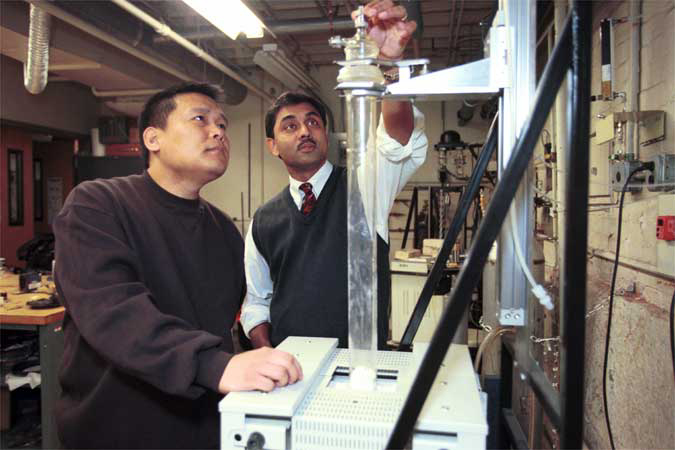
Soumendra N. Basu is a Professor of Mechanical Engineering and Associate Division Head of the Division of Materials Science and Engineering at Boston University. He earned his Ph.D. in Materials Science from MIT in 1989 and an M.S. in Materials Science from Case Western Reserve University. Basu leads two research labs and one undergraduate lab, focusing on materials degradation, coatings, and interface stability. High Temperature Oxidation Laboratory : Investigates oxidation behavior up to 1,600°C using advanced equipment. Microscopy Laboratory : Prepares electron-transparent samples for TEM analysis. Undergraduate Materials Laboratory : Trains students in metallography and materials testing. His research spans environmental barrier coatings for silicon-based ceramics, plasma-sprayed thermal barrier coatings , and photonic materials like InGaN alloys. He studies microstructural evolution, defect analysis, and degradation mechanisms under extreme conditions. Recent work includes modeling residual stresses and optimizing coatings for durability. Scientific Collaborators include: MIT Lincoln Labs Boston University colleagues: M. Gevelber, D. Wroblewski, V.K. Sarin UCLA's V. Gupta Basu has advised numerous graduate students, including Guosheng Ye and Dharanipal Doppalapudi , and his labs have received funding from NSF, DOE, and LANL. He also contributes to cricket, having won the MVP trophy for the Melbourne Cricket Club.
Andy Stevens is a Senior Lecturer in Sport Management at the University of Winchester. His career includes roles as a consultant to the Football Association (FA), focusing on five-a-side football and futsal development, including strategies for the FA Futsal League and facility strategies. He has authored numerous reports for the SportBusiness Group and contributed to Sport Business magazine, specializing in venue and event management. His research explores sport industry strategy, management, and performance, with notable work on sport governance and facility development. His publications span academic journals, industry reports, and conference presentations, addressing topics like sport venue optimization, sustainability, and global sport events as soft power tools. He has advised organizations such as the Anschutz Entertainment Group and Disability Sport England (now Activity Alliance), contributing to event calendars including the London Wheelchair Marathon. His work bridges academic research and practical industry challenges, emphasizing adaptability and innovation in sport management.
Judith Risse is a Postdoctoral Researcher in the Bioinformatics (BIF) department at Wageningen University & Research. Her work focuses on genomic and evolutionary studies, including phylogenomic analysis of plant development, insect adaptation, and microalgal biotechnology. She has contributed to projects involving genome sequencing, transcriptome analysis, and nanopore technologies. Education: Completed her PhD in Bioinformatics (2014) under Prof. Bisseling and Dr. Leunissen, focusing on text-mining for metabolic pathway reconstruction. Research Interests: Floral development in Asteraceae, evolutionary adaptation in insects (e.g., field crickets), and genomic mechanisms of stress tolerance in microalgae. Her work integrates computational biology with experimental genomics. Publications: Key contributions include studies on dandelion floral genetics (2023), great tit genome inversion analysis (2023), and microalgal thermotolerance (2022). She has also published on cricket genomics (2020) and viral photosynthesis interactions (2022). Projects: Led a PhD project on text-mining applications in metabolic pathway analysis. Currently involved in collaborative projects on plant and animal genomics. Labs/Teams: Active in the BIF group at Wageningen, collaborating with institutions like St Andrews University and the Netherlands Institute of Ecology.
Dr Martin Toms is Associate Professor of Global Sport Education & Coaching and Head of Global Engagement at the School of Sport, Exercise and Rehabilitation Sciences, University of Birmingham. He is an expert in youth sport, talent identification and development, and sport education from international and socio-cultural perspectives, with extensive collaborations in India and with the PGA of GB&I. Education: BA (Hons) Sport Science and English Literature, University of Surrey, 1993 MPhil Youth Sport & Education, University of Brighton, 1997 Cert Ed (Post-Secondary Education), University of Plymouth, 2000 PhD Youth Sport Talent & Developmental Socialisation, Loughborough University, 2005 Dr Toms' research focuses on youth sport in international contexts—especially India—talent development, socio-cultural dimensions, grassroots sport, and sport education programs. His work emphasizes cultural and cross-cultural understanding in sport systems. He has edited key texts such as the Routledge Handbook of Golf Science and Sports Science in India: Practice and Perspective , and his recent publications reflect a strong trend in athlete development pathways, talent systems, and critical analyses of sport policy and practice globally. Scientific Awards and Recognition: Fellow of the Higher Education Academy (FHEA) Dr Toms actively supervises doctoral and postgraduate students on topics including talent identification in Indian sport, elite cricket development, and professional journeys in golf. He has secured research funding and consultancy projects in China and Europe and is an adjunct Professor at the University of Regina, Canada. He plays a key role in transnational education and has served as Emeritus Editor-in-Chief of the International Journal of Golf Science and co-editor of the European Journal for Sport & Society . He is also a board member of the World Scientific Congress of Golf. Labs and Research Teams: While not tied to a specific lab, Dr Toms leads global engagement initiatives and collaborates with international institutions and research networks focused on sport development, talent systems, and educational reform in sport.
Adam Kelly serves as Associate Professor of Sport and Exercise and Course Leader for the Professional Doctorate in Sport (DSport) at Birmingham City University's Faculty of Health, Education and Life Sciences. He directs the BCU Research for Athlete and Youth Sport Development (RAYSD) Lab and holds accreditations as Senior Fellow of the Higher Education Academy (SFHEA), BASES CSci, and FA UEFA A Licenced Coach. His educational foundation includes a PhD from the University of Exeter, built upon seven years as Head of Academy Sport Science at Exeter City Football Club following his non-league playing career. Professor Kelly's research critically examines organizational structures in youth sport to optimize athlete development pathways and foster inclusive environments. His work spans cricket, rugby, soccer, squash, and swimming, with emphasis on talent identification systems, relative age effects, and equity in sport. International collaborations with partners like Queen's University (Canada) and global sports organizations drive practical applications for evidence-based policies. Analysis of his 100+ publications reveals sustained focus on relative age effects across sports (2022-2025), evolving toward actionable interventions like birthday-banding and flexible chronological approaches. Recent work increasingly addresses inclusivity for underrepresented groups in cricket/soccer and post-pandemic adaptation strategies. His scientific recognition includes: Senior Fellow of the Higher Education Academy (SFHEA) Professor Kelly mentors four embedded PhD students (Shanmugaratnam, Lux, Shafi, Green) within FIFA/ECB/KNVB projects while having graduated five PhDs now in prominent roles. His £1m+ research funding supports industry-academia partnerships that transform talent development practices globally. The RAYSD Lab under his leadership facilitates transnational knowledge exchange through initiatives like the HELS Go Abroad Scheme, connecting UK students with Canadian researchers while driving real-world impact through projects like the BESTA Cricket Partnership and KNVB Relative Age Solutions.
Sam Allen is a Senior Lecturer in Sports Biomechanics at Loughborough University's School of Sport, Exercise, and Health Sciences. He is affiliated with the National Centre for Sport and Exercise Medicine (NCSEM) and specializes in biomechanical research related to sports performance and injury prevention. His academic journey includes a BSc from the University of Birmingham (2000), an MSc from Loughborough (2004), and a PhD in triple jump simulation (2009). Education: BSc Sport and Exercise Sciences, University of Birmingham, 2000 MSc Sports Biomechanics, Loughborough University, 2004 PhD in Computer Simulation of Triple Jump, Loughborough University, 2009 Research focuses on biomechanics of running, sprinting, and jumping, with an emphasis on injury mechanisms, muscle morphology, and performance optimization. Notable areas include sex differences in biomechanics, hamstring injury prevention, and neuromechanical adaptations during exercise. Publications highlight advanced topics like machine learning for injury prediction, force-velocity relationships in sprinting, and biomechanical modeling of prosthetic limbs. His work bridges theoretical simulations and practical athletic performance improvements. No scientific awards are explicitly mentioned. Advising and grants sections remain unreported in the provided text. He is associated with the Lifestyle for Health and Wellbeing and Sport Performance research groups. Labs/teams: Active contributor to NCSEM and biomechanics research teams at Loughborough University.
Allen J. Moore is a Distinguished Research Professor in the Department of Entomology at the University of Georgia's College of Agricultural & Environmental Sciences. His work bridges evolutionary biology, genetics, and behavioral ecology with a focus on understanding the molecular and genetic mechanisms underlying complex social behaviors in insects. Moore's research program centers on the evolution of parental care and social behavior, primarily using burying beetles (Nicrophorus species) as model organisms. His work integrates quantitative genetics, molecular biology, and behavioral ecology to investigate how indirect genetic effects shape coevolutionary dynamics between interacting individuals. A significant portion of his recent research examines the role of DNA methylation, particularly Dnmt1, in reproductive processes and behavioral plasticity across insect species. His approach combines field observations with molecular techniques to address fundamental questions about how genes and environment interact to produce adaptive behaviors. Analysis of Moore's recent publications reveals a strong trajectory toward understanding the epigenetic regulation of social behavior. His work demonstrates how molecular mechanisms like DNA methylation interact with environmental factors to influence parenting strategies, reproductive timing, and kin recognition. The research spans multiple insect systems including burying beetles, crickets, and whiteflies, providing comparative insights into the evolution of social behavior across diverse taxa. Moore maintains active collaborations within the University of Georgia, particularly with Patricia Moore in the Entomology department, as evidenced by their joint research on DNA methylation in insects. His lab appears to train graduate students and postdoctoral researchers, contributing to the next generation of evolutionary biologists while advancing our understanding of how complex social behaviors evolve and are maintained in natural populations.
Peter Allen is a Professor of Optometry and Visual Science at Anglia Ruskin University, affiliated with the Vision and Eye Research Institute and directing the Vision and Hearing Sciences Research Group . His expertise spans refractive error development , vision in sports , visual stress , and physical activity’s impact on wellbeing . He collaborates internationally (UK, Australia, Netherlands, US, Germany) and serves as an assessor for the College of Optometrists . Education : PhD in Optometry (Anglia Ruskin University), BSc (Hons) in Ophthalmic Optics (City University) Research interests include myopia progression , visual function in specialist populations , tinnitus therapy , and Paralympic sports classification . Recent publications focus on myopia management , digital interventions for tinnitus , and vision-related athletic performance . Awards include the Neil Charman Medal (2013), a landmark optical research honor. Allen supervises postgraduate projects on topics like sport-specific vision classification and color optimization in cricket , with active recruitment in vision loss and depression . He has secured grants from organizations including NIHR-EME (£1.25M+) for myopia research and Agitos Foundation for Paralympic classification studies .
Dr. Christine Kiesmüller is a researcher at the University of Warsaw’s Faculty of Biology, affiliated with the Institute of Evolutionary Biology and the PARADIVE group. Her work focuses on arthropod evolution and predator-prey interactions in fossil records. She holds a PhD focused on functional adaptations of predatory insects and their prey, building on earlier studies in developmental biology and paleontology. Her research combines morphological analysis with phylogenetic comparisons to infer ancient behaviors from fossils, such as ‘frozen behavior’ preserved in amber. Kiesmüller has contributed to studies on Cretaceous insect larvae, mantis lacewing pupae, and predator-prey dynamics in amber deposits, with publications in iScience , Swiss Journal of Palaeontology , and others. She collaborates widely with institutions like the Palaeo-Evo-Devo Network and maintains active profiles on ResearchGate and Google Scholar.
Indrabati Bhattacharya is an Assistant Professor in the Department of Statistics at Florida State University. Their research focuses on advanced statistical methodologies including dynamic treatment regimes, machine learning applications in healthcare, and Bayesian asymptotics. Bhattacharya’s work emphasizes nonparametric Bayesian approaches for addressing partial compliance in sequential decision-making frameworks and developing robust quantile regression techniques. Key research areas include: Quantile Regression and Shape-Restricted Inference Bayesian Nonparametric Methods for Multivariate Analysis Optimization of Dynamic Treatment Regimes in Clinical Trials Development of Marginal Structural Models for Sequential Treatment Decisions Recent contributions highlight Bayesian Q-learning algorithms for policy optimization under partial compliance scenarios, as well as innovative Gibbs posterior frameworks for multivariate quantile inference. Bhattacharya has also applied Bayesian techniques to sports analytics, notably exploring the Duckworth-Lewis method in cricket. Current research trends emphasize integrating machine learning with Bayesian statistical theory to address complex real-world problems in healthcare and decision science. No academic awards or grants are explicitly listed in available materials.