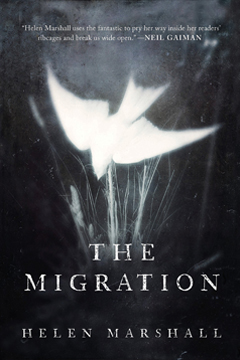
Associate Professor Helen Marshall is a writer, editor, and book historian affiliated with the University of Queensland’s School of Communication and Arts. She holds academic positions in the Faculty of Humanities, Arts and Social Sciences and is affiliated with the Centre for Critical and Creative Writing, the Research Centre in Creative Arts and Human Flourishing, and the Centre for Digital Cultures & Societies. Her research bridges creative practice and scholarship, focusing on weird fiction, Gothic traditions, and medieval publishing cultures. Her work explores how speculative narratives address trauma, legacy, and societal change through interdisciplinary projects funded by institutions like the Defence Science Technology Group. Marshall’s creative works include award-winning short story collections (e.g., Hair Side, Flesh Side and Gifts for the One Who Comes After ) and novels like The Migration . She has collaborated with organizations such as CERN and the UK Ministry of Defence to apply narrative techniques to complex challenges like future threat prediction and technology foresight. Her academic projects include analyzing Stephen King’s Carrie and medieval manuscripts, as well as leading initiatives like the “Wish You Were Here” community storytelling project. Key honors include the World Fantasy Award, British Fantasy Award, and Shirley Jackson Award. Her recent work emphasizes creative foresight methodologies, exploring how speculative fiction can address global crises and technological innovation. Grants include a $260,000 project on AI innovation and a $89,097 study on Web 3.0 impacts.
Marie Bengtsson is an Associate Professor at Linköping University (LiU), affiliated with the Business Administration division (FEK) within the Department of Management and Engineering (IEI). Her research focuses on interdisciplinary intersections of design, engineering, and organizational practices, particularly addressing long-term decision-making, organizational routines, and transitions between physical and digital prototyping in industries like aerospace. She explores methods for evaluating novel ideas and managing large-scale organizational changes, such as agile methodologies and roadmapping processes. Dr. Bengtsson teaches in Linköping’s MSc programs, including Strategy and Management in International Organizations (SMIO), Design, and Engineering. She emphasizes challenge-based learning, collaboration with industry partners, and theoretical foundations. She has contributed to the SUGAR Network for Innovation and Stanford’s ME310 Global Teaching Team, fostering international educational initiatives. Her work integrates practical industry insights with academic rigor, evidenced by her research on Saab’s military aircraft development and Ericsson’s agile transformation. Her research has examined the fast fashion industry’s scaling strategies and the aerospace sector’s digital prototyping advancements. Current projects include educating systems engineers through designerly thinking frameworks and exploring hybrid educational platforms for diverse learners. She actively engages in interdisciplinary projects, reflecting her commitment to bridging theoretical knowledge with real-world applications. Bengtsson’s teaching and research highlight innovation, sustainability, and organizational adaptability. She collaborates across academic and corporate boundaries to address challenges in project management, knowledge creation, and future-oriented decision-making.
Michael Omansky serves as an Associate Professor in Felician University's School of Business and Information Sciences, teaching graduate-level MBA courses including Capstone Experience, Innovation & Adaptation, and Entrepreneurial Marketing. Previously, he held teaching positions at Manhattan College, Ramapo College, Daemen College, and Baruch College. His academic credentials include: MBA from Columbia Graduate School of Business and Information Sciences BS in Economics from the Wharton School, University of Pennsylvania Professor Omansky's research centers on practical business applications, with emphasis on marketing innovation and entrepreneurial leadership. His work bridges theoretical frameworks with real-world implementation, particularly in product repositioning, disruptive technologies, and opportunity identification within constrained markets. He examines how executives can leverage synergies across organizations to drive revenue growth while maintaining long-term market viability. His 12 publications (2011-2016) reveal consistent thematic focus on actionable business strategies, with recurring exploration of blue ocean/red ocean dynamics, leadership traits, and marketing opportunity validation. The 2016 book Marketing Explained So Simple Even a CEO Can Understand It exemplifies his approach to demystifying complex concepts for executive audiences. At Felician University, Professor Omansky teaches specialized MBA courses spanning entrepreneurship, international management, healthcare business dimensions, and new product development. His industry experience directly informs curriculum development, particularly in competency-based MBA programming and real-world case studies derived from entertainment and consumer products sectors.
Dr. Antonius van den Broek is a Lecturer and Programme Director at the Institute for Design Innovation, Loughborough University in London. He specializes in the intersection of design and business, focusing on the communicative role of design in strategy and management. Previously, he worked in the design industry for over a decade across Europe and the US, collaborating with clients such as Björk, MTV, and Red Bull. Education: MSc in Design Management (University of Salford), PhD in Design (London College of Communication, University of the Arts London) in collaboration with Westminster Business School Research interests include: Management and strategy in design firms Visuals and aesthetics in organizational contexts Design-driven intrapreneurship Institutional logics in design practice His methodological approach combines ethnography, computational linguistic analysis, and empirical studies in creative sectors and public service organizations like the United Nations. He teaches modules on Design Innovation, Research Methods, Foresight and Strategy, and Design for Experiences.
Hazel Bruce is a Lecturer in Textile Art at Belfast School of Art, Faculty of Arts, Humanities & Social Sciences, Ulster University. She serves as Learning and Teaching Coordinator for Belfast School of Art and is joint Course Director of Textile Art, Design and Fashion specializing in embroidery and textile art. As a Senior Fellow of the Higher Education Academy and member of the Centre for Higher Education Research and Practice, she contributes significantly to art education at Ulster University. Hazel Bruce's educational background includes: Graduation from Manchester Polytechnic in 1990 Postgraduate qualifications in Applied Arts Postgraduate qualifications in Museums Studies Postgraduate qualifications in Higher Education Hazel Bruce is a practicing textile artist since 1990, with research interests centered on the impact of limitations on art practice and the importance of compositional space. Her work represents a response to research into Basic Design, an approach to art education developed in Art Colleges between the 50's and 80's. As a member of the 62 Group of Textile Artists since 1991, she has developed expertise in textile techniques, embroidery, and contemporary art practice, with growing interest in sustainable development applications within art education. Her artistic output demonstrates consistent international engagement, with exhibitions across Europe, North America, and Asia. The trajectory of her work shows evolving focus from technical textile artistry to conceptual explorations of space, limitations, and historical interpretation, culminating in recent projects examining sustainable development and community engagement through art. Hazel Bruce's recognition includes: Collaborative Award for Teaching Excellence 2017 Finalist As Learning and Teaching Coordinator for Belfast School of Art, Hazel Bruce plays a significant role in curriculum development and educational leadership. Her research activities include funded projects such as the Textile Inspired Roof Top Garden in Belfast City Centre (2022-2023), demonstrating practical applications of textile design principles in urban ecology. Her conference participation spans from 1991 to projected events in 2025, indicating sustained scholarly engagement. Hazel Bruce collaborates extensively on projects connecting textile art with community engagement, historical interpretation, and sustainable development. Her recent work with the Islandmagee Witches exhibition demonstrates her commitment to using art as a medium for historical understanding and public engagement. Her involvement in projects like the Textile Inspired Roof Top Garden shows innovative applications of textile principles to urban ecology and sustainability challenges.
Dominique Vian serves as Associate Professor at SKEMA Business School in Sophia Antipolis since 2011, specializing in Strategy, Innovation & Entrepreneurship within the institution's research ecosystem. His academic journey includes a PhD in Management Sciences from Telecom ParisTech (2010), complemented by degrees in Information Systems Management from IAE Nice (1987) and Applied Computer Science from Côte d'Azur University (1985). Doctorate in Management Sciences, Telecom ParisTech (2010) Diploma of Specialized Higher Studies, IAE Nice (1987) Master's Degree in Applied Computer Science, Côte d'Azur University (1985) Postgraduate in IT Management, SKEMA Business School (1987) Vian's research centers on effectuation theory - developing practical methodologies like ISMA360 and FOCAL that transform entrepreneurial decision-making under uncertainty. His work uniquely bridges cognitive science with systemic approaches, examining how entrepreneurs conceptualize resources to navigate complex environments. Recent publications demonstrate application of these frameworks to societal challenges including pension reforms, urban riots, and geopolitical conflicts, revealing how effectual logic enables opportunity identification within chaotic systems. His 15 most recent publications reveal a clear trajectory from theoretical development (2022) toward real-world implementation across business and societal domains (2023-2024). This evolution shows increasing focus on systemic interventions where effectual principles address multi-stakeholder complexities in innovation policy, leadership development, and crisis management - particularly evident in his analyses of Chinese innovation systems and generative AI's creative limitations. Vian actively supervises doctoral research at Université Côte d'Azur, currently co-directing N. Farrugia's dissertation. His industry experience informs practical grant applications where effectual methods have been implemented across sixty incubators, technology parks, and corporate innovation programs worldwide. As co-director of the SKEMA Centre for Global Risks and contributor to the Transformation Research Center, Vian leads initiatives exploring how effectual logic enables organizations to navigate VUCA environments. His teams develop tools for systemic opportunity mapping that help entrepreneurs and policymakers transform constraints into strategic advantages through resource-driven innovation.
Kristy Armitage is a Postdoctoral Research Fellow at the School of Psychology , Faculty of Health, Medicine and Behavioural Sciences , The University of Queensland (UQ). Her research focuses on metacognition, cognitive offloading, and children's problem-solving strategies, particularly in the context of digital tool usage. Bachelor (Honours) of Psychology, The University of Queensland Doctor of Philosophy in Psychology, The University of Queensland Armitage investigates how children develop awareness of their cognitive limits and employ creative strategies to overcome these challenges. Her work also explores the cognitive consequences of growing up in the digital age, including interactions with computers, smartphones, and tablets. Recent publications examine social offloading, collaborative cognition, and external problem-solving techniques in developmental contexts. She contributes to fundamental developmental psychology through empirical studies on cognitive strategies and participates in applied research about technology's impact on cognition. Her work, published in journals like Developmental Psychology and Child Development , reveals patterns in children's spontaneous use of external tools and social interactions to enhance cognitive performance. Armitage is currently funded by the Australian Research Council (ARC) Discovery Projects (2025-2028) for research on children's foresight capacities. She is available for supervision and actively participates in the Early Cognitive Development Centre at UQ.
Derek Gladwin is an Associate Professor in the Department of Language and Literacy Education (LLED) at the University of British Columbia's Faculty of Education. He also holds affiliate positions with the Institute for Resources, Environment and Sustainability (IRES), Clean Energy Research Centre (CERC), Master of Educational Technology (MET) program, Master of Arts in Children's Literature (MACL), and Interdisciplinary Studies Graduate Program (ISGP). Gladwin has held visiting research positions at Concordia University, University of Galway, University of Amsterdam, University of Edinburgh, Trinity College Dublin, and Utrecht University, demonstrating his international scholarly impact. Associate Professor, Department of Language and Literacy Education Affiliate Faculty, Institute for Resources, Environment and Sustainability Co-Founder, Systems Beings Lab Co-Founder, Transdisciplinary Collaborative PhD in Energy Transition Senior Editor, Environmental & Sustainability Education, Oxford Research Encyclopedia of Education Gladwin's research explores transformative educational approaches to address complex societal challenges, particularly focusing on literacy for energy transition, socio-ecological awareness, and regenerative learning models. His work spans environmental and ecological literacy, systems literacy, energy literacy, complexity education, and transdisciplinary approaches. He examines how narrative, language, and literacy can empower individuals and communities to engage with environmental challenges through storytelling, arts-based practices, and decolonizing pedagogies. His research is characterized by its transdisciplinary nature, bridging humanities, environmental studies, and educational theory to create practical applications for societal transformation. His recent publications reveal a strong focus on systems thinking in education, energy transition literacy, and transdisciplinary approaches to complex societal problems. The trend shows increasing emphasis on practical applications of educational theory to address climate challenges, with particular attention to indigenous perspectives, community engagement, and the role of narrative in shaping energy futures. His work consistently connects theoretical frameworks with actionable educational practices, demonstrating how literacy development can serve as a catalyst for societal transformation in the face of environmental crises. Visiting Educational Scholar, Utrecht University (2023) Wall Scholar, Peter Wall Institute for Advanced Studies (2022-2023) Sustainability Fellowship, UBC (2018-2021) Banting Postdoctoral Fellowship (2017-2018) Governor General's Academic Gold Medal Award (2014) Gladwin has secured significant research funding including SSHRC Insight Grants, Canada First Research Excellence Fund projects, and UBC Sustainability grants. His Systems Beings Lab fosters collaborative research on complexity education, while his Transdisciplinary Collaborative PhD program creates pathways for doctoral students to engage directly with energy transition challenges. He has developed innovative educational models that bridge academic research with community action, particularly in the areas of energy literacy and climate education. His work with international youth on energy futures demonstrates his commitment to global educational initiatives that address shared environmental challenges. The Systems Beings Lab, which Gladwin co-founded with Naoko Ellis, serves as a transdisciplinary research collective focused on systems and complexity education at UBC. This lab creates conditions for exploring how educational approaches can help learners navigate complex societal transitions. Additionally, his work with the Transdisciplinary Collaborative PhD program creates unique opportunities for doctoral students to experience educational theory, training, programming, and internships with partners in industry, government, and civil society to co-create systems change collaboratively.
Joanne Anderton is a Casual Senior Research Assistant at the School of Languages and Cultures , The University of Queensland . She holds a PhD in Creative Writing from the School of Communication and Arts, The University of Queensland (2025), focusing on speculative fiction memoir. Her research bridges creative writing and futures studies, emphasizing speculative fiction's role in technology foresight and complex systems analysis. Education : PhD (2025) - The University of Queensland Joanne's work explores technology foresight , creative futurism , and digital humanities . She develops frameworks for integrating speculative fiction into scenario planning and ethical technology analysis. Her publications highlight collaborative research methods and the intersection of narrative and innovation. Recent publications span themes like creative foresight , complex systems analysis , and Web 3.0 implications . These include journal articles, research reports, and a book co-authored with colleagues from The What If Lab. She has contributed to projects such as the Ursula Project and What IF Consortium , focusing on participatory futures research and digital delivery of creative foresight workshops. Joanne collaborates with institutions including the Defence Science Technology Group and The What If Lab . Her work emphasizes interdisciplinary approaches, combining literary techniques with technological foresight to address societal and ethical challenges in emerging technologies.
Lisa Bennett is an Associate Professor at Flinders University in the College of Humanities, Arts and Social Sciences . She specializes in Creative Writing and English , with a focus on Old Norse-Icelandic literature , Viking Age studies , and speculative fiction . PhD in Old Norse literature from Flinders University (2011) BA (Honours) in English Literature from Flinders University (2004) BFA (Honours) in Painting/Photography and English Literature from University of Ottawa (2001) Her research spans creative practice , cultural memory , and genre fiction , with a particular interest in Viking women and their representation in literature. Recent publications include interdisciplinary work on technological foresight and narrative methodology . She has received multiple awards including: Aurealis Awards for Best Collection (2011) and Best Novella (2021) World Fantasy Award finalist CHASS Award for Excellence in Teaching (2022) Lisa also contributes to ABR as a reviewer and regularly appears on ABC Radio National 's 'The Bookshelf'. She actively supervises students in science fiction , myth and magical realism , and life writing .
Steve Tighe serves as a Lecturer in Strategic Foresight at the University of New South Wales (UNSW) and is the founder of Chasing Sunrises , a strategic foresight consultancy established in 2007. His expertise spans scenario planning, organizational strategy, and strategic foresight tools such as horizon scanning, trends analysis, and backcasting. Qualifications: Master of Science in Strategic Foresight from Swinburne University (Australian Foresight Institute, 2004) Roles: National Foresight Manager at Foster's Group (2004-2007), Professional Speaker on future strategy (since 2005) Research and Practice: Steve specializes in designing innovative strategies for public and private sectors through scenario planning, emphasizing collaboration, co-creation, and strategic creativity. His work integrates futures thinking with practical organizational applications. Scientific Recognition: His book Rethinking Strategy has received international acclaim and demonstrates his thought leadership in scenario planning methodologies.
Associate Professor Sandra Peter is Director of Sydney Executive Plus and an Associate Professor at the University of Sydney Business School . She is also a member of The Net Zero Institute . Her work centers on the intersection of emerging technologies, AI, and their strategic implications for business and society, with a focus on ethical governance and future-readiness. Education: PhD in Social Sciences MA/MPhil in Organisation and Strategy BSc (Hons) in Economics and International Relations Research Interests: Sandra’s research explores how organizations and leaders can engage productively with the future, particularly in the context of AI and digital transformation. Her work spans algorithmic fairness, AI ethics, the future of work, open education, and the societal impact of emerging technologies. She actively contributes to public discourse through media commentary and thought leadership. Publications & Contributions: Her recent work emphasizes the human-like qualities of AI, the ethical risks of generative systems, and the evolving role of AI in creative and professional domains. She has co-authored influential reports such as The 2025 Skills Horizon and has been widely cited in major media outlets for her insights on AI, leadership, and the future of work. Advising & Grants: She currently supervises research students including Stefanie Knippschild (working on algorithmic fairness in employment) and Belinda Wang (on responsible AI use in organizations). She has also led educational innovation grants, including a 2013 project on formative feedback in flipped classrooms. Leadership & Outreach: As Director of Sydney Executive Plus , Sandra leads executive education initiatives designed to equip leaders with the skills needed to navigate technological disruption. She co-hosts The Future, This Week and The Unlearn Project podcasts, and is a frequent contributor to The Conversation , AFR , and ABC .
Katja Becker is a Professor of Media- and Interface Design at Westfälische Hochschule, specifically within the School of Computer Science and Communication (Informatik und Kommunikation) in Gelsenkirchen, Germany. Her academic career focuses on the intersection of design, technology, and intercultural communication. Becker's research interests span multiple domains of design and technology: Design Thinking and Creative Methodologies Visual Communication and Interface Design Gender Perspectives in Digital Design Intercultural and Global Design Approaches Extended Reality Applications in Education Participatory Design with Diverse Communities Her scholarly work demonstrates a strong commitment to applying design principles to address global challenges through intercultural collaboration. Becker has developed innovative frameworks like the Global Intercultural Project Experience (GIPE) that connect students across continents to solve real-world problems. Her research particularly emphasizes inclusive design practices that consider gender perspectives and cultural diversity in the development of digital artifacts and interfaces. Becker has collaborated extensively with international partners, particularly with researchers at Namibia University of Science and Technology, indicating a strong commitment to global perspectives in design education. Her work with primary school students on extended reality escape rooms shows her dedication to making advanced design concepts accessible to younger audiences. Her scientific contributions include exploring the social significance of gender codes in web design and developing tools for futures literacy through the concept of "xtopias." These works reflect her interdisciplinary approach that bridges design theory with practical applications in education and social contexts.
Adel El-Huni serves as Adjunct Faculty at Minneapolis College of Art and Design (MCAD), leveraging a globally spanning career across private, public, and social sectors in the Middle East, Africa, Europe, and North America. Education: Master of Public Affairs (MPA), Humphrey School of Public Affairs, summa cum laude Research Focus: His work integrates human-centered design with socioeconomic development, emphasizing DEI-driven innovation in fintech, digital transformation, and circular economy systems. He pioneers cross-sector applications of emerging technology in healthcare and future foresight methodologies to address refugee crises and youth unemployment. Key Awards: Leadership Accelerator at Rare with Google for underrepresented talent in creative/tech sectors Aspen Ideas Festival Scholar (2018) for refugee-focused initiatives Prince Al-Waleed Bin Talal Philanthropy Fellowship (2010) Initiatives: Co-founded SEED Entrepreneurship Center tackling youth unemployment in MENA/Africa via lean methodologies; catalyzed Palmwood (IDEO/Dubai Future Foundation joint venture) for public policy innovation through design thinking. Regularly consults for Facebook, IDEO, EY, and Dubai government on social impact strategies and financial inclusion.
Fernando Galdon is a design practitioner, researcher, and educator at the Royal College of Art (RCA), where he serves as a Lecturer in the School of Design, specifically within the Innovation Design Engineering department. He co-leads Innovation Design Engineering modules on Transdisciplinary Practices and Regenerative Practices (SuperGreen), as well as cross-college units AcrossRCA and the Grand Challenge. His work brings together design, computer science, neuroscience, philosophy, and sociology, with a focus on investigating the social, technological, and political implications of designing trust. Dr. Galdon holds an impressive educational background: BA in Product Design from London Metropolitan University MSc in Cognitive Computing from Goldsmiths, University of London MRes Design from Goldsmiths, University of London PhD in Design from the Royal College of Art His research spans multiple disciplines, exploring how design can reconfigure processes and systems of production to question the social, cultural, ethical, and political contexts in which they operate. Galdon has coined novel categories to address contemporary issues in design practice and research, including Deep products, Object-Oriented-Upcycling, Exology, Synthetic consequential reasoning, Pluripolar knowledges, Biopoiesis: PolyGenetics, Counterism, and Exo-Aesthetics. His work has been published and presented internationally at prestigious institutions including MIT, the University of Cambridge, the University of Manchester, and Harvard. Analysis of Galdon's recent publications reveals a strong focus on trust design, sustainable practices, and the philosophical underpinnings of design research. His work bridges theoretical frameworks with practical applications, particularly in the areas of AI ethics, sustainable product design, and design education for the 21st century. A notable trend is his development of conceptual frameworks like 'Deep products' and 'Counterism' that challenge conventional design paradigms and offer new approaches to complex societal challenges. Among his recognitions is the Art and Humanities Research Council Studentship, which funded his MRes work on the Design Programme at Goldsmiths. Art and Humanities Research Council Studentship Dr. Galdon consults internationally for institutions and government on the future of design practice, design education, and research. His work 'A design history of COVID-19' was a research-on-the-moment initiative supported by the AHRC Research for change initiative. He is also involved in the IMPACT collaboration module between the RCA, Imperial College London, and Westminster City Council, which approaches smart cities from a human-centered perspective. Additionally, he is part of the International Upcycling Research Network, a UKRI AHRC Research Network Project. He actively participates in the academic community as a peer reviewer for major design conferences including DRS2024 and IADRS2023, and serves on the Educational Development Board at READ Spain.