Dimitrios Skalkos serves as a Professor at the Department of Chemistry, University of Ioannina, holding the specific title of Professor of Innovation Management in Food Businesses. His office is located in building X2, room X2-206c on the Ioannina Campus (45110 Ioannina), and he leads the Food Chemistry Laboratory. He earned his Basic Degree in Chemistry from the University of Ioannina (1980-1985) followed by a Doctoral Degree from the University of Toledo, USA (1986-1989) with dissertation research on "Di- and Tetrahydroporphyrins: Syntheses and Antitumor Activities". Skalkos's research spans Food Business Management, Food Innovation, and Innovation Management, with specialized focus on Innovation & Entrepreneurship, Aromatic Plants, Innovative Foods, and Strategic Marketing. His work bridges academic research with industry applications in food systems, emphasizing Greek agricultural products and pandemic-era consumer behavior. His 36 publications (2020-2024) reveal strong trends in post-pandemic food innovation, consumer perception of traditional Greek foods, functional food development (particularly olive oil, cheese, and grape by-products), and sustainable agri-food supply chains. Key thematic clusters include traceability systems, bioactive properties of novel foods, and economic impacts on food choices. He has actively supervised Master's and PhD students through departmental presentations, directed 23 research programs, and organized 15 seminars and conferences. His laboratory website ( https://foods.chem.uoi.gr ) showcases ongoing food chemistry innovations.
Gianluca Iaccarino is a Professor of Mechanical Engineering at Stanford University and the Robert Bosch Chairholder. He serves as Director of the PSAAP Center and leads large-scale computational research initiatives in uncertainty quantification, exascale computing, and multiphysics simulations. His academic journey includes a PhD in Mechanical Engineering from Politecnico di Bari (2005), postdoctoral work at Stanford's Center for Turbulence Research, and progression from Research Engineer to full Professor. Education : PhD (Politecnico di Bari), MS/BS in Aeronautical Engineering (University of Naples) Research : Computational engineering, turbulence modeling, uncertainty quantification, biomedical fluid dynamics, and exascale-ready algorithms Publications : 15+ recent articles focus on turbulence modeling, data-driven simulations, and uncertainty quantification across diverse applications in aerospace, biomedical, and energy systems Awards : PECASE (2010), APS Fellow (2019), multiple best paper awards (AIAA, ASME), Terman Fellow (2007) Students : Advises doctoral and master's students in mechanical engineering and computational methods Leadership : Director of PSAAP Center (2014-present), Chair of Mechanical Engineering Department (2024-present)
Rachit Agarwal is an Associate Professor in the Department of Computer Science at Cornell University, with research focusing on systems, networking, and theoretical problems arising in practical systems. He leads a research group working on resource disaggregation, host architecture, secure cloud storage, and datacenter design. PhD in Computer Science, Cornell University Undergraduate, IIT Kanpur His research spans three major directions: Resource Disaggregation (with $3M NSF and Google awards), Host Architecture (exploring terabit interconnects), and PANCAKE (secure oblivious cloud storage with $1M NSF award). He also contributed to foundational work in Near-optimal Datacenter Design and Data Plane Monitoring . Awards include the Sloan Fellowship, NSF CAREER, IRTF Applied Networking Prize, and multiple best paper awards. His recent publications focus on host network architecture, congestion control, oblivious data access mechanisms, and secure cloud storage systems. He has advised multiple Ph.D. and postdoctoral researchers who now hold faculty positions at leading institutions. Sloan Research Fellowship NSF CAREER award Kavli Fellowship IRTF Applied Networking Research Prize SIGCOMM Best Student Paper Award Usenix Security Distinguished Paper Award Tau Beta Pi Professor of the Year 2025 Rachit has advised numerous students including current Cornell advisees like Midhul Vuppalapati, Shreyas Kharbanda, and Omar Eqbal. Former advisees include Saksham Agarwal (UIUC), Qizhe Cai (UVA), and Mina Tahmasbi Arashloo (University of Waterloo). His research is supported by large NSF grants and industry awards, with deployments in real-world systems and open-source contributions.
Prof. Matthias Nießner is a Professor at the Technical University of Munich, leading the Visual Computing Lab. His research intersects computer graphics, vision, and AI, focusing on 3D reconstruction, semantic understanding, and AI-driven video synthesis. He holds a PhD from the University of Erlangen-Nuremberg (2013) and was a Visiting Assistant Professor at Stanford University (2013–2017). Notable awards include the ERC Starting Grant (2018), Nvidia Professorship Award, and Eurographics Young Researcher Award (2019). His work has been featured in mainstream media and led to startups like Synthesia Inc. Research spans Gaussian splatting, neural radiance fields, and generative AI for 3D avatars. Over 150 publications include SIGGRAPH, CVPR, and ECCV, with best paper awards. Projects like Face2Face and ScanNet have driven innovation in facial reenactment and 3D scene datasets. Education: PhD in Computer Science, University of Erlangen-Nuremberg (2013) Diploma in Computer Science, University of Erlangen-Nuremberg (2010) Research Interests: 3D digitization, neural rendering, generative AI, non-rigid reconstruction, and applications in AR/VR. Awards: ERC Starting Grant (2018) Nvidia Professorship Award (2018) Google Faculty Award (2018) SIGGRAPH Best Emerging Tech Award (2016) Grants: Over €1.5M from ERC and industry partnerships. Labs/Teams: Visual Computing Lab at TUM and Synthesia Inc. (co-founder). Key projects include ScanNet (large 3D indoor dataset), Face2Face (real-time facial reenactment), and Gaussian-based 3D avatars. Current work focuses on diffusion models, neural radiance fields, and AI-generated media detection.
Anette Mikes is an Associate Professor of Accounting at the University of Oxford’s Saïd Business School and a Hertford College Fellow. She specializes in risk management, corporate governance, and sustainability, with a focus on the intersection of ethics and organizational control systems. Her research explores how risk frameworks shape corporate decision-making, particularly in climate change and decarbonization contexts. Education: PhD in Accounting from the London School of Economics (2005) Pre-doctoral work in the City of London (2006–2007) studying Chief Risk Officer roles Research Interests: Behavioral approaches to risk management Management control systems for sustainability Ethics in corporate governance Decarbonization strategies in heavy industries Her 2012 Harvard Business Review article (with Robert Kaplan) on risk frameworks remains influential, while her documentary on the Kursk submarine disaster highlights crisis management failures. Awards: 2025 Honorary Doctorate from Uppsala University 2017 ACA Prize for Risk Management Contributions 2014 Global Risk Forum Film Award Key Contributions: Co-developed Harvard’s Risk Management executive program Leads research on ‘Values at Risk’ and corporate purpose Published widely on climate risk governance and ethical leadership Her recent work emphasizes decarbonization strategies and moral accountability in business, bridging accounting practices with environmental and ethical imperatives.
Richard M. Murray is the Thomas E. and Doris Everhart Professor of Control and Dynamical Systems and Bioengineering at the California Institute of Technology (Caltech). He holds a B.S. from Caltech (1985), M.S. from UC Berkeley (1988), and Ph.D. from UC Berkeley (1990). He has served in academic roles from Assistant Professor (1991–1997) to his current endowed professorship. He chaired the Engineering and Applied Science division (2000–2005) and Biology and Biological Engineering (2020–2024). His research focuses on feedback control in biological and autonomous systems, synthetic cells, and networked control systems. Collaborators include experts in robotics, synthetic biology, and systems biology. Key awards include the IEEE Control Systems Award and election to the National Academy of Engineering. His educational contributions span courses on control systems, robotics, and bioengineering. Current research projects include the Developer Cell initiative (Sloan Foundation), layered testing for autonomous systems (AFOSR), and microbiome-based environmental solutions (CHARMME, ARO). He advises numerous graduate students and postdocs, with notable alumni in academia and industry. Labs include facilities in Keck and Steele laboratories at Caltech. His work bridges control theory, synthetic biology, and autonomous systems to address societal challenges like environmental monitoring and safe autonomy.
Gary Fedder is the Howard M. Wilkoff Professor of Electrical and Computer Engineering at Carnegie Mellon University (CMU), with courtesy appointments in Biomedical Engineering, Mechanical Engineering, and Robotics. He serves as Faculty Director of the Manufacturing Futures Institute (MFI) and previously held roles such as Vice Provost for Research and Interim CEO of the Advanced Robotics for Manufacturing (ARM) Institute. Fedder’s research focuses on MEMS, advanced manufacturing, and implantable microsystems. He earned his B.S., M.S., and Ph.D. in EECS from MIT and UC Berkeley, respectively. Education: Ph.D., Electrical Engineering and Computer Science, UC Berkeley (1994) M.S., Electrical Engineering and Computer Science, MIT (1984) B.S., Electrical Engineering and Computer Science, MIT (1982) Research Interests: Microelectromechanical systems (MEMS), digital twins, aerosol jet printing, stretchable electronics, and manufacturing innovation. His work integrates MEMS with CMOS processes, emphasizing low-cost, high-performance systems. Key Contributions: Co-founded the ARM Institute; developed MEMS-based sensors and actuators; pioneered methods for manufacturing innovation through projects like America Makes. His research spans over 300 publications and 21 patents. Awards: IEEE Fellow (2007), Ross Tucker Award (1993), NSF CAREER Award (1996), and leadership roles in Manufacturing USA initiatives. Leadership & Outreach: Directed the Institute for Complex Engineered Systems and led national initiatives to advance U.S. manufacturing competitiveness. Active in editorial roles for journals like IoP Journal of Micromechanics .
Anthony Rowe is the Siewiorek and Walker Family Professor of Electrical and Computer Engineering at Carnegie Mellon University (CMU) and a Chief Scientist at Bosch Research. His primary affiliation is with the CyLab and the Wireless, Sensing and Embedded Systems (WiSE Lab) at CMU. He specializes in networked embedded systems, sensor networks, and extended reality (XR) technologies. His research emphasizes energy-efficient sensing, real-time localization, and XR integration with physical systems. Research Focus: His work spans XR systems (e.g., AR/VR edge networking in ARENA), mmWave radar for sensing (e.g., tire wear monitoring via Osprey), distributed edge computing (Silverline), and low-power wide-area networking (OpenChirp). Recent efforts include AI-integrated XR platforms (XaiR) and radar tomography (DART). Grants & Projects: Leads the CONIX Research Center ($27.5M NSF/DARPA grant), Bosch-funded edge computing projects, and DOE initiatives on microgrids. Notable projects include ARENA (XR edge architecture), GridBallast (smart grid control), and rural microgrid deployments in Haiti. Awards: Best Student Paper (ISMAR 2024), Best Paper (IPSN 2020), and the Steven J. Fenves Research Award (2015). Recognized for innovations in localization (MobiCom 2021), radar (ICRA 2023), and energy systems (BuildSys 2010). Teaching: Teaches courses on embedded systems (18-349/18-449), real-time systems, and mixed reality (18-453). Courses emphasize hands-on design and real-world applications. Labs & Teams: Directs the WiSE Lab, collaborating with Bosch Research and industry partners. The lab develops open-source frameworks like ARENA and OpenChirp, and contributes to standards for edge computing and sensing.
Tomas Palacios is a Professor of Electrical Engineering at the Massachusetts Institute of Technology (MIT) , where he directs the Center for Graphene Devices and 2D Systems and leads the Microsystems Technology Laboratories (MTL). His research focuses on pushing the boundaries of microelectronics through novel semiconductor materials and device architectures, including Gallium Nitride (GaN) and 2D materials like graphene and molybdenum disulfide (MoS2). Professor, MIT Electrical Engineering and Computer Science Director, MIT Center for Graphene Devices and 2D Systems Clarence J. LeBel Professor, MIT Faculty Director, Northeast Microelectronics Internship Program (NMIP) Research Interests span multiple cutting-edge domains: High-frequency electronics (>300 GHz) for 6G and quantum applications High-voltage power devices (600V–10kV) for energy conversion Post-silicon logic devices using 2D materials High-temperature electronics (e.g., Venus rover applications) Distributed neural networks on large-area 2D materials Graphene-based biosensors and chemical detection systems Scientific Contributions include: Double recipient of the IEEE George Smith Award for groundbreaking GaN transistor work Co-invented first MoS2 electronic circuits Developed world’s first Wi-Fi-to-electricity conversion antenna Led MIT’s Microsystems Technology Laboratories since 2021 Advising Philosophy emphasizes cross-layer expertise, with students gaining experience from materials synthesis to system-level prototyping. His lab has incubated startups like Vertical Horizons , focused on GaN power devices for AI and EVs.
Anca Dragan is an Associate Professor in the Department of Electrical Engineering and Computer Sciences at the University of California, Berkeley, where she runs the InterACT Lab focused on algorithms for human-AI and human-robot interaction. Currently on leave from Berkeley, she leads AI Safety and Alignment at Google DeepMind, overseeing safety for Gemini models and preparing for future advancements. Dragan has been a co-PI of the Center for Human-Compatible AI and served on the steering committee for the Berkeley AI Research (BAIR) Lab. B.Sc. in Computer Science from Jacobs University Bremen, Germany Ph.D. from Carnegie Mellon University Dr. Dragan's research focuses on enabling AI agents to work effectively with, around, and in support of people. Her work bridges robotics, machine learning, and game theory to create systems that better understand human preferences and coordinate with users. Key areas include AI alignment (ensuring AI does what people actually want), learning reward functions from diverse human feedback forms, and developing algorithms for human-AI collaboration across domains like autonomous vehicles, brain-machine interfaces, and recommender systems. Her research emphasizes maintaining uncertainty about human preferences and accounting for the plurality of human values. Dr. Dragan's recent publications reveal a strong focus on addressing fundamental challenges in AI safety and alignment. Her work spans theoretical foundations of reward learning, practical implementations for human-AI coordination, and critical examinations of limitations in current approaches. There's a clear trajectory toward more robust, safe, and value-aligned AI systems that can handle complex human preferences while avoiding both present-day harms and potential catastrophic risks. IEEE RAS Early Academic Career Award in Robotics and Automation (2021) McEntyre Award for Excellence in Teaching (2020) PECASE (Presidential Early Career Award for Science and Engineering) (2019) Sloan Fellowship (2018) NSF CAREER Award (2017) Okawa Foundation Award (2017) MIT Tech Review 35 Innovators Under 35 (2017) Multiple best paper awards at top robotics and AI conferences Dr. Dragan has mentored numerous successful students who have gone on to faculty positions at MIT, Stanford, CMU, and Princeton, as well as industry roles at DeepMind, Waymo, and Meta. Her advising philosophy emphasizes both technical rigor and consideration of broader societal impacts. She has secured significant research funding including NSF CAREER, ONR Young Investigator, and Okawa Foundation awards, supporting work on human-AI interaction and alignment. Dragan has also consulted for Waymo for six years, helping develop roadmaps for deploying increasingly learning-based safety-critical systems. Dr. Dragan leads the InterACT Lab at UC Berkeley, which has produced influential work on Cooperative Inverse Reinforcement Learning, Inverse Reward Design, and other foundational concepts in human-AI interaction. The lab's research has significantly shaped the field of AI alignment, with applications spanning autonomous vehicles that coordinate with human drivers, brain-machine interfaces that adapt to user needs, and language models that better understand human preferences. Current work focuses on scaling safety approaches as AI capabilities advance, ensuring alignment keeps pace with technological progress.
Asaf Cidon is an Associate Professor at Columbia University, jointly affiliated with the Department of Electrical Engineering and Computer Science, and a member of the Data Science Institute. His research focuses on software systems , storage , large-scale machine learning , and cybersecurity . Stanford University - PhD in Electrical Engineering Stanford University - MS in Electrical Engineering Technion - BS in Computer and Software Engineering His work in distributed storage systems has been commercialized by companies such as Facebook, Tibco, and Rubrik. He has led projects like Sentinel and Forensics during his industry career. Recent publications highlight advancements in software-based radiation protection (ASPLOS'26), PCIe pooling with CXL (HotOS'25), and AI phishing detection (IMC'25). These reflect his expertise in system architecture , security , and networking . Scientific recognitions include best paper awards at OSDI, Usenix Security, CIDR, and ATC, along with NSF CAREER and ARO Young Investigator Awards . His papers Cookie Monster (SOSP'24) and Chablis (CIDR'24) received notable accolades. He has mentored numerous PhD and Master's students , including Edward Guo, Harry Wang, and Teng Jiang, many of whom now hold roles at Google, Meta, Amazon, and academic institutions. His lab at Columbia is actively recruiting CS and EE PhD students. Prior to Columbia, he founded and led the startup Sookasa to acquisition and served as Senior Vice President of Email Protection at Barracuda Networks , managing a $200M business with 100 engineers.
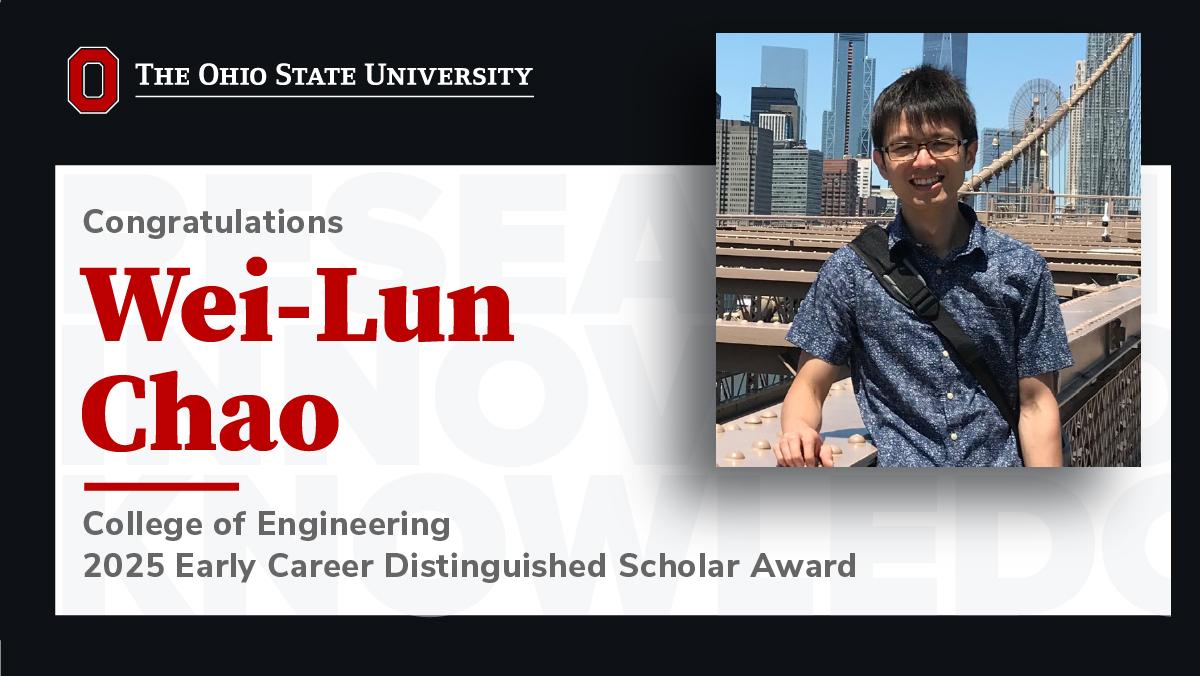
Wei-Lun (Harry) Chao is an Associate Professor in the Department of Computer Science and Engineering at the Ohio State University (OSU), College of Engineering. Promoted to this role in May 2025, he is also an Innovation Scholar and Distinguished Assistant Professor of Engineering Inclusive Excellence. His work spans machine learning, computer vision, and their applications in autonomous driving, healthcare, biology, and natural language processing. Research Focus: Machine learning with imperfect data, interpretable and personalized learning, robust perception for autonomous systems, and visual recognition in real-world scenarios. Awards: 2025 OSU Early Career Distinguished Scholar Award, CVPR Best Student Paper Award (2024), CSE Faculty Teaching Award (2024), Lumley Research Award (2023). Grants: Funded by NSF, NIH, ONR, Cisco, AWS, and Google. Notable Research Trends: The 15 most recent articles highlight his work on vision foundation models, federated learning, diffusion models for biological species generation, interpretable vision transformers, and robust perception systems for autonomous driving. Key subfields include sparse autoencoders, 3D object detection, semi-supervised learning, and anomaly detection in scientific domains. Scientific Awards: 2025 Early Career Distinguished Scholar Award (OSU) CVPR Best Student Paper Award (2024) CSE Faculty Teaching Award (2024) Lumley Research Award (2023) Mentoring & Grants: As an advisor for the OSU Buckeye AutoDrive Team and AI Club, he mentors graduate and undergraduate students. His research is supported by major grants from NSF, NIH, ONR, and industry partners like Cisco and Google.
Mathieu Salzmann is a Senior Scientist and Lecturer at École Polytechnique Fédérale de Lausanne (EPFL), affiliated with the Computer Vision Laboratory (CVLAB) in the School of Computer and Communication Sciences (IC). He also holds a courtesy appointment with the EPFL College of Humanities and serves as Deputy Chief Data Scientist at the Swiss Data Science Center (SDSC). He has held concurrent roles in teaching units including SIN, SODH, and SSC, reflecting his interdisciplinary engagement. His research focuses on the intersection of machine learning and computer vision, particularly in deep learning for 2D and 3D visual scene understanding, efficient and robust models, domain adaptation, and interpretable AI. These interests are evident across his extensive publication record in top-tier venues. His recent publications (2023–2024) show a consistent trend in advancing deep learning methods for visual recognition, with strong representation at CVPR, ICCV, ECCV, ICML, ICLR, and NeurIPS. Topics include domain generalization, 3D understanding, model robustness, and multimodal learning, often with applications in real-world systems. His editorial roles as Associate Editor for IEEE TPAMI and Action Editor for TMLR further highlight his leadership in the field. Area Chair: ICML 2023, CVPR 2023, ICCV 2023, NeurIPS 2023, AAAI 2024, ECCV 2024 Associate Editor: IEEE Transactions on Pattern Analysis and Machine Intelligence (TPAMI) Action Editor: Transactions on Machine Learning Research (TMLR) Mathieu Salzmann has supervised numerous PhD students at EPFL, both current and past, including Bouquet Yann Yanis, Javed Saqib, Li Shuangqi, and others. He has also been involved in research grants and collaborative projects, such as his work with S. Süsstrunk and R. Baroni on comics reconfiguration. His part-time role as Senior GNC Engineer at ClearSpace (2020–2024) illustrates his applied research engagement in aerospace systems. He is actively involved in EPFL’s data science and AI research ecosystem through SDSC and multiple labs.
Fadel Adib is an Associate Professor with Tenure at MIT, holding a joint appointment in the MIT Media Lab and the Department of Electrical Engineering and Computer Science (EECS). He leads the Signal Kinetics research group at the Media Lab and is the founder and CEO of Cartesian Systems. His work focuses on novel wireless technologies for sensing and connectivity in challenging environments, including underwater communication, health monitoring, and robotics. Education: B.Sc. from American University of Beirut (2011), M.Sc. and Ph.D. in Computer Science from MIT (2013 and 2016), where he won best thesis awards. His research has led to startups such as Cartesian Systems and Emerald Innovations, addressing applications in climate monitoring, healthcare, and logistics. Research Interests: Underwater backscatter networking, batteryless systems, non-line-of-sight perception, RFID localization, and wireless health monitoring. His innovations include the first battery-free underwater camera and systems for contactless vital signs monitoring. Awards: Sloan Research Fellowship (2021), NSF CAREER Award (2019), ACM SIGMOBILE Rockstar Award (2022), and Technology Review 35 Under 35 (2014). Grants: ONR Young Investigator Award, Google Faculty Research Award. Teams: Signal Kinetics research group at MIT Media Lab. Labs and Projects: Focus on cross-disciplinary initiatives such as wireless mapping (Cartesian Systems), underwater-to-air communication, and implantable medical devices.
Insup Lee is the Cecilia Fitler Moore Professor in the Department of Computer and Information Science and Director of the PRECISE Center at the University of Pennsylvania's School of Engineering and Applied Science. He holds a secondary appointment in the Department of Electrical and Systems Engineering and the Perelman School of Medicine’s Department of Biostatistics, Epidemiology, and Informatics. IEEE TCCPS Distinguished Leadership Award (2023) Fellow of the AAAS (2022) Test of Time Award, Runtime Verification (2019) Fellow of the ACM (2017) Best Paper Awards at IEEE ICPS, ACM/IEEE ICCPS, and MEMOCODE His research focuses on cyber-physical systems , real-time and embedded systems , safe autonomy , and internet of medical things , with applications in healthcare and connected systems. He advises PhD students including Eric Lu, Kaustubh Sridhar, Sooyong Jang, and Jean Park (co-advised with Kevin Johnson). Recent publications address safety monitoring for learning-enabled systems, model-free control synthesis using reinforcement learning, and multilingual toxicity guardrails for large language models. His team collaborates with institutions like Hillrom and Penn Nursing to optimize medical device usage in clinical settings.