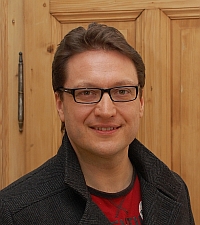
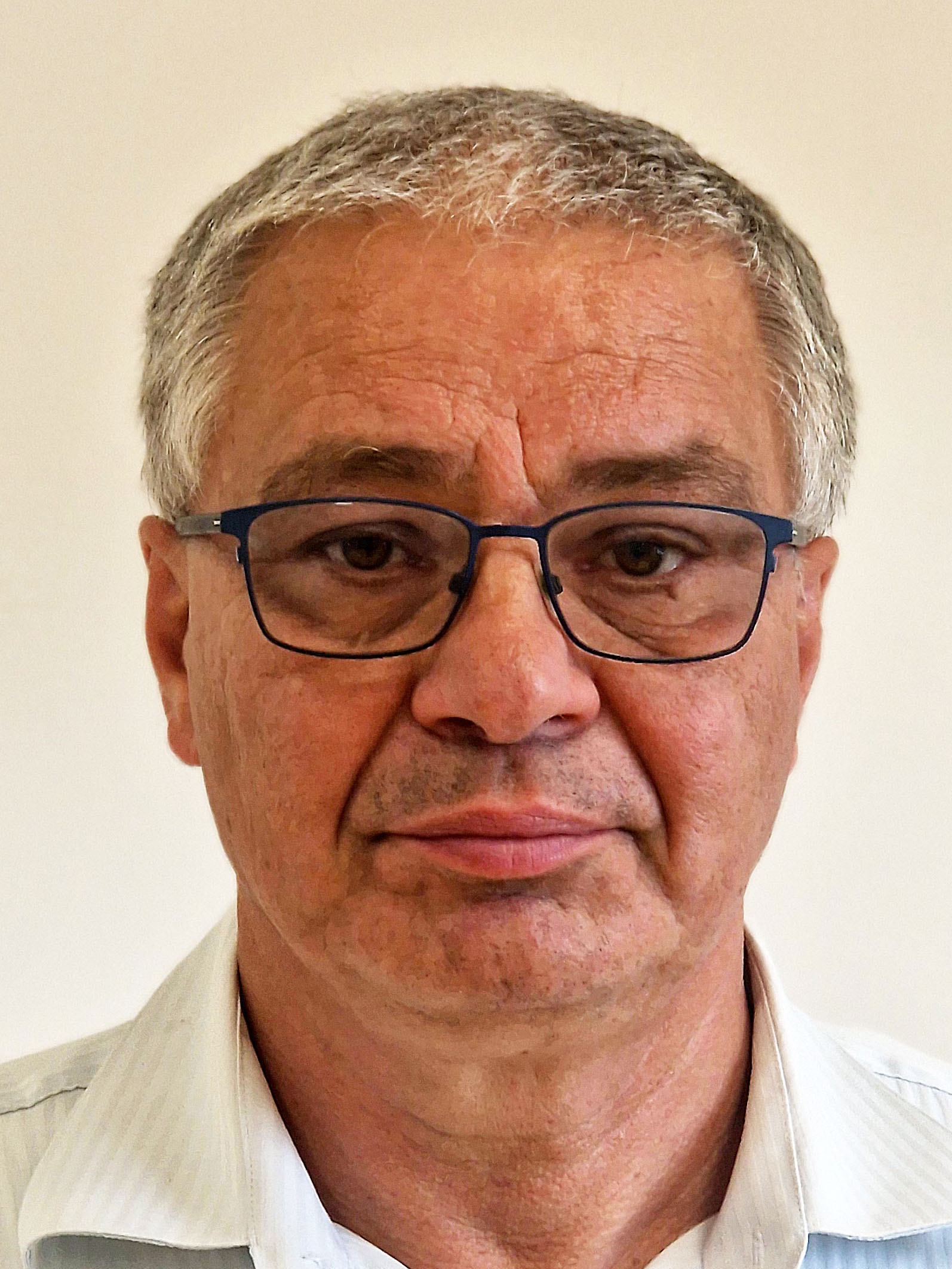
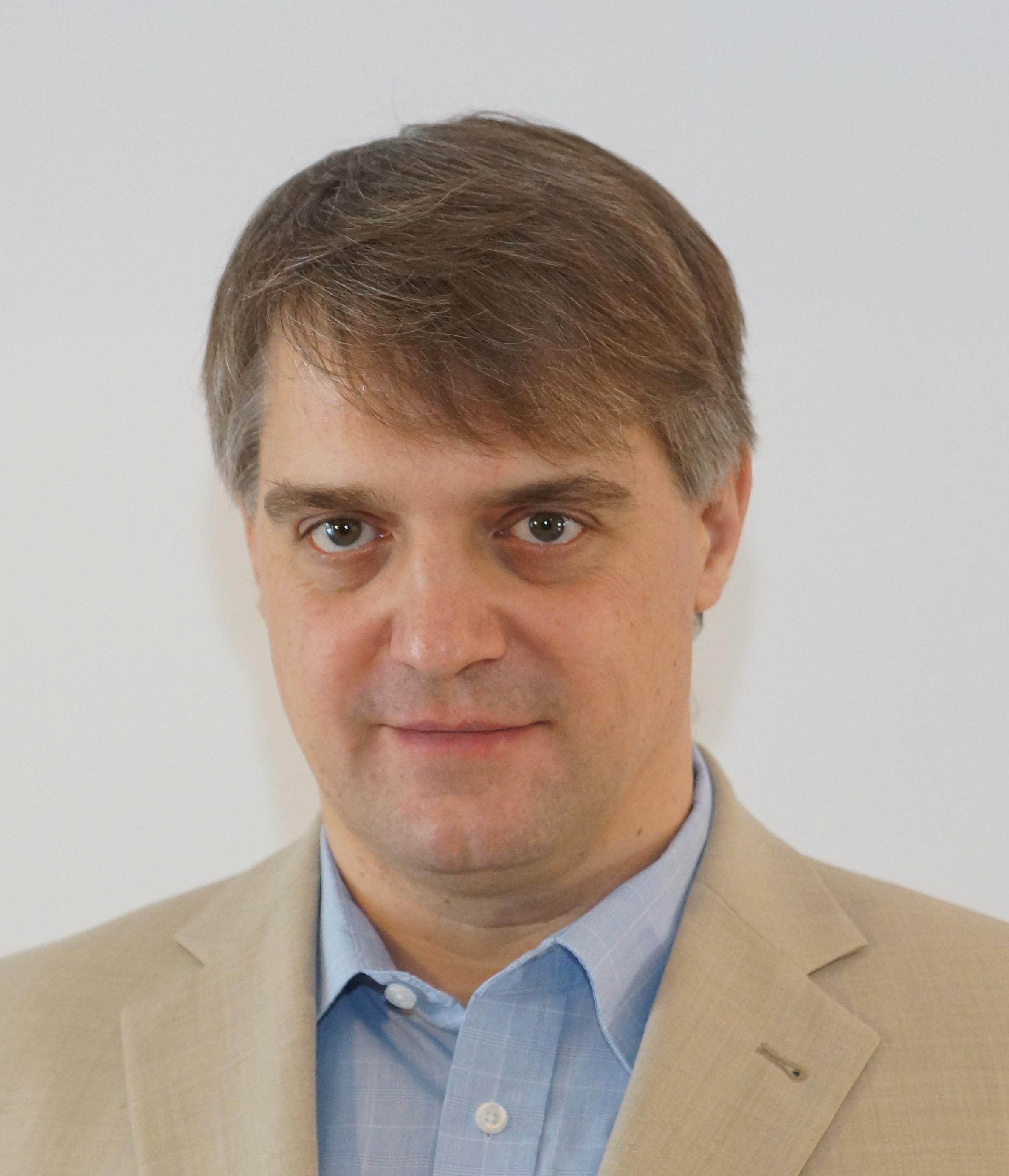
Dr. Jakub Yaghob is a researcher at the Faculty of Mathematics and Physics , Charles University , specializing in computer science and parallel computing. He teaches advanced programming topics including Compiler Principles , Parallel Programming , and Cloud Computing . Research Interests : Parallel data stream processing, virtualization technologies, semantic web infrastructures, and performance optimization Teaching : Advanced C++ programming, virtualization administration, and computer systems architecture Technical Expertise : Design of parallelization frameworks, astrophysical data analysis, and hybrid CPU-GPU systems His publications focus on: Optimizing stream data processing across distributed architectures Developing domain-specific languages like Bobolang Performance evaluation in educational programming contexts Applications of parallel computing in astrophysics
Zbyněk ŠÍR is an Associate Professor at the Mathematical Institute within the Faculty of Mathematics and Physics at Charles University in Prague . He specializes in Computer-Aided Geometric Design (CAGD) , Differential Geometry , and the History of Geometry , with a focus on Pythagorean Hodograph curves and their applications in geometric modeling. Education: 1989: Graduated from Gymnázium J. K. Tyla, Hradec Králové 1993: DEA (Diplôme d'Études Approfondies) in Algebra and Geometry, University Pierre et Marie Curie (Paris VI) 1995: Master's in Mathematics (Riemannian Geometry, Representation Theory), Charles University 2002: PhD in Mathematics (History of French Geometry), Charles University & Université Pierre et Marie Curie 2012: Habilitation in Mathematics (Geometry and Topology), Charles University His research spans theoretical and applied geometry, including Pythagorean Hodograph curves , rational curves , and historical mathematical texts . Recent work focuses on rotation-minimizing motions , framing motions , and complex quaternions for minimal surfaces. Collaborations with researchers like Carlotta Giannelli, Lucia Sacco, and Bert Jüttler highlight interdisciplinary applications in robotics, aerospace, and computational geometry. ŠÍR teaches courses in Geometric Modeling and Mathematical Education , emphasizing the use of tools like Mathematica for visualizing curves, surfaces, and geometric transformations. His teaching integrates theoretical concepts (e.g., Frenet frames, projective geometry) with practical applications (e.g., CNC manufacturing, 3D reconstruction).
Pavel Parízek is an Associate Professor at the Department of Distributed and Dependable Systems, Faculty of Mathematics and Physics, Charles University, Czech Republic. His research focuses on developing methods and tools for program analysis, verification, and debugging, particularly for large multi-threaded programs. He emphasizes techniques that efficiently detect bugs with minimal false positives. Research interests include static and dynamic analysis, concurrency bug detection, formal methods, and scalable verification. Key software tools developed include BUBEN (library abstractions for bug detection), JPF-Inspector (debugger for Java Pathfinder), and PANDA (predicate abstraction tool). Recent publications highlight advancements in partial order reduction, dynamic analysis frameworks for C#/.NET, and automated library abstractions. His work bridges theoretical formal methods with practical software engineering challenges. Teaching includes courses on program analysis, formal foundations of software engineering, and software development tools.
Jan Kofroň is an Associate Professor in the Department of Distributed and Dependable Systems at the Faculty of Mathematics and Physics, Charles University in Prague, Czech Republic. His research focuses on program verification, static analysis, and software reliability. His educational background includes a Ph.D., as indicated by his title. He maintains an active research profile with numerous recent publications in top venues. Professor Kofroň's research interests span several key areas in software engineering and formal methods. He specializes in interpolation-based code model checking, static analysis of programs, system behavior models and verification, and programming language semantics. His work bridges theoretical foundations with practical applications in software development. His recent publications demonstrate strong focus on verification techniques for complex software systems, particularly in the areas of Horn clause solving, program comprehension using computational notebooks, and uncertainty-aware self-adaptive cyber-physical systems. His research shows consistent contributions to both theoretical foundations and practical applications of program analysis. Professor Kofroň actively leads and participates in multiple research projects including the current AIDE project (Advanced Analysis and Verification for Advanced Software) and past projects such as SNAPPY, ROBUST, Weverca, Q-ImPrESS, SOFA 2, and ASCENS. He teaches courses related to Java programming, Python programming, program semantics, and mobile devices programming. He maintains an open-door policy for student consultations, requesting students email him to arrange meetings rather than maintaining fixed office hours. His department maintains active GitHub presence, contributing to open-source projects related to software verification and analysis tools.
Martin Kruliš is an associate professor in the Department of Distributed and Dependable Systems at the Faculty of Mathematics and Physics, Charles University , Prague, Czech Republic. His primary roles include research, teaching, advising, and leading projects that bridge high-performance computing, GPU programming, and self-adaptive systems. Education: While exact details of his own degrees are not provided, Dr. Kruliš’s extensive publication record and faculty position at Charles University indicate advanced training in computer science with specialization in parallel and distributed computing. Research Interests: High-Performance GPU Computing: Deep investigation into CUDA kernel optimization, memory bandwidth utilization, and workload dispatching for massively parallel accelerators. Self-Adaptive & Self-Optimizing Systems: Designing ensemble-based abstractions that integrate machine-learning estimators to enable runtime adaptation in component architectures. Parallel Algorithms & Data Structures: Development of cache-friendly, SIMD-aware, and GPU-accelerated algorithms for clustering, dimensionality reduction, and similarity search. Software Engineering for Parallelism: Creation of C++ libraries, DSLs (e.g., Bobolang), and educational tools (ReCodEx) that simplify parallel programming and automated evaluation. Publication Trends: Across 2011–2025, Kruliš’s articles reveal a clear trajectory from foundational GPU-accelerated indexing and multimedia retrieval toward sophisticated self-adaptive systems that leverage machine learning. Recent works (2023–2025) increasingly focus on integrating LLMs and neural networks into compiler and runtime optimization loops, reflecting a convergence of AI and systems research. Scientific Awards & Recognition: No specific awards or fellowships are mentioned in the provided text; however, sustained publication in top-tier venues (JPDC, IPDPS, Euro-Par, SEAMS) and active involvement in program committees and tool development indicate strong peer recognition. Teaching & Student Supervision: Teaches Programming in Parallel Environment (NPRG042) , Advanced Programming in Parallel Environment (NPRG058) , Computer Systems (NSWI170) , and Software Projects . Supervises numerous bachelor’s and master’s theses; exact student names are not listed in the text. Labs, Projects & Tools: ReCodEx: A widely used platform for semi-automated evaluation of programming assignments at Charles University. Simdex: A modular simulator of the ReCodEx backend that enables realistic experimentation with self-adaptive job dispatching and machine-learning controllers. Active contributor to open-source repositories on GitHub, focusing on GPU kernels, benchmarking frameworks, and educational tooling.
Professor Jaromír Antoch is a distinguished faculty member at the Department of Probability and Mathematical Statistics within the Faculty of Mathematics and Physics at Charles University in Prague. His office is located in Karlín at Sokolovská 83, Prague 8, in room K 154 (2028) on the 1st floor. Institution: Charles University, Faculty of Mathematics and Physics Department: Department of Probability and Mathematical Statistics (KPMS) Office: K 154 (2028), 1st floor, Karlín, Sokolovská 49/83, Prague 8 Contact: Phone (+420) 221 913 275, Email: Jaromir.Antoch@mff.cuni.cz Professor Antoch's research spans multiple areas of statistics with particular emphasis on robust statistical methods, change point detection, regression analysis, and ROC curve analysis. His work demonstrates strong theoretical foundations with practical applications across various domains. He has made significant contributions to the development of robust statistical techniques that can handle outliers and non-standard data distributions. His publication record shows a consistent trajectory of scholarly work focused on methodological advancements in statistical theory. His research on change point detection in panel data represents cutting-edge work in time series analysis, while his investigations into genetic algorithms for variance calculation over interval data demonstrate innovative computational approaches to statistical problems. The recurring theme throughout his work is the development of robust statistical methods that maintain validity under non-ideal data conditions. Professor Antoch has been actively involved in the ROBUST conference series, which focuses on robust statistical methods, serving in organizational and presenting capacities across multiple years from at least 2004 through 2016. This demonstrates his standing within the international statistical community and his commitment to advancing the field of robust statistics. As an educator, Professor Antoch supervises academic work and maintains an active teaching schedule at Charles University. His involvement in conference organization and scholarly presentations indicates his commitment to mentoring students and colleagues in the field of statistics.
Václav Hlaváč is a Professor of Engineering Cybernetics at the Czech Institute of Informatics, Robotics and Cybernetics (CIIRC), part of the Czech Technical University in Prague (CTU). He serves as Head of the Department of Robotics and Machine Perception, Deputy Director of CIIRC, and holds roles in university governance. His work bridges academic leadership with cutting-edge research. PhD in Control Engineering (CTU, 1987) Professor at CTU (1998–present) Founder of the Center for Machine Perception (1996) Research Interests Hlaváč specializes in: Computer Vision – 3D scene reconstruction, video sequence analysis, and image processing Pattern Recognition – Statistical and structural methods, ordinal classification Autonomous Robotics – Manipulation of soft materials and industrial applications His recent work focuses on robotic cable segmentation , digital twins for manufacturing, and event camera technology . Publications span journals like Information Sciences and IEEE Robotics and Automation Letters , with over 18,000 Google Scholar citations. Scientific Awards Research fellowship, Institute of Control Problems (Moscow, 1986) Research fellowship, University of Sussex (1989) Visiting professorships at TU Vienna (1993, 1995) Teaching & Publications He authored the textbook Image Processing, Analysis, and Machine Vision (4th ed, 2015) and maintains teaching resources in English and Czech . His Center for Machine Perception has been active since 1996.
Antonin Kucera is a Professor at the Faculty of Informatics , Masaryk University, Czech Republic. His work focuses on stochastic processes, probabilistic systems, Markov decision processes, stochastic games, infinite-state systems, and applications of game theory in security and operational research. He has led multiple research projects funded by institutions like the US Army Research Office and the Czech Science Foundation. Research Interests : Stochastic processes, probabilistic verification, infinite-state systems, multi-objective optimization, game theory, and security applications. Projects : Leading studies on adversarial security patrolling, probabilistic systems analysis, and game-theoretic verification. Past projects include European Network for Game Theory (COST) and Institute for Theoretical Computer Science. Advising : Mentored 13 PhD/Master's students, including Tomáš Brázdil, Petr Novotný, and Jan Křetínský. Teaching : Courses on Petri Nets, Semantics of Programming Languages, and Mathematical Logic.
Assoc. Prof. Bronislav Chramcov, Ph.D. is an academic at the Institute of Informatics and Artificial Intelligence within the Faculty of Applied Informatics at Tomas Bata University in Zlín, Czech Republic. His career spans over two decades, focusing on control algorithms, simulation of production systems, and applied research in business contexts. Education: Associate Professor (2016), Faculty of Applied Informatics, Tomas Bata University Ph.D. in Technical Cybernetics (2006), Faculty of Applied Informatics, Tomas Bata University B.Sc. in Teaching of Specialized Subjects (2006), University Institute, Tomas Bata University Eng. in Automation and Control Technology (1998), Faculty of Technology in Zlín, Brno University of Technology Research Interests: Dr. Chramcov specializes in control algorithms for heat production and distribution , discrete systems simulation , and optimization of production processes . His work bridges theoretical modeling with industrial applications, particularly in energy efficiency, logistics systems, and strategic knowledge transfer. He has contributed to projects involving robotic protection of hydroponic greenhouses and innovation in electronic textbooks. Scientific Awards: Dean's Honorary Recognition (2014, 2018) for contributions to the Faculty of Applied Informatics Leadership and Contributions: Dr. Chramcov has held significant administrative roles, including Vice-Dean for Creative Activities and Doctoral Studies (2014–present), Deputy Head of the Institute of Informatics and Artificial Intelligence (2008–present), and Chairman of the Academic Senate (2006–2014). He has supervised over 57 B.Sc. theses and 43 Ing. (Master's) theses and actively participates in doctoral defense committees.
Assoc. Prof. Zdenka Prokopová serves as Associate Professor at the Institute of Computer and Communication Systems within the Faculty of Applied Informatics at Tomas Bata University in Zlín, where she has held continuous academic appointments since 2001 following prior positions at Brno University of Technology and Slovak Technical University. Her academic credentials include: 2008-present: Habilitation in Machine and Process Control, Tomas Bata University 1990-1994: Doctoral studies in Technical Cybernetics, Slovak Technical University 1983-1988: Ing. in Automated Control Systems, Slovak Technical University 1979-1983: Secondary education at Gymnasium Šafárikovo Her research spans contemporary database architecture and business intelligence systems alongside software project complexity estimation, building upon earlier foundational work in industrial control systems involving dynamic modeling and algorithm development for chemical production environments. This dual expertise bridges theoretical computer science with practical engineering applications. She maintains active institutional engagement through membership on the Faculty Disciplinary Committee, Study Programs Council, and Doctoral Program Council for Engineering Informatics while conducting regular student consultations on Wednesdays. Her international research profile includes significant collaborations with French institutions (CNRS Toulouse, Nancy) and the University of Birmingham through EU programs like INCO Copernicus and TEMPUS.
Roman Šenkeřík is an Associate Professor at the Department of Informatics and Artificial Intelligence within the Faculty of Applied Informatics at Tomas Bata University in Zlín (TBU Zlín). He serves as the Head of the Artificial Intelligence Laboratory (AILab) and has been actively involved in interdisciplinary research at the intersection of AI and complex systems. Specializes in evolutionary algorithms, neural networks, and hybridization of soft-computing techniques Focuses on optimization of process control using AI and development of metaheuristics Key interests include chaos theory, cryptology, and cybersecurity applications His research spans data mining, high-performance computing, and synthesis of complex systems. He has supervised over 80 bachelor's and master's theses and guided multiple doctoral students to successful completion. Scientific Awards: Best paper award at AETA Conference (2018) Best paper award at CISIM Conference (2014) Best paper awards at Nostradamus Conferences (2012, 2013) Best paper award at PCO Conference (2010) Prof. Šenkeřík has participated in numerous international collaborations through Erasmus and other mobility programs, including extended internships at University of Maribor (Slovenia) and Strathclyde University (UK). He is a Senior Researcher at CEBIA-Tech Regional Research Centre and has contributed to multiple EU-funded projects.
Ing. Pavel Navrátil, Ph.D. is an Assistant Professor at the Faculty of Applied Informatics , Tomas Bata University in Zlín, affiliated with the Institute of Automation and Control Engineering . His work focuses on control systems, optimization, and simulation of industrial processes. Education: Ph.D. in Technical Cybernetics (2004), Ing. in Automation and Control Technology (2000) Research Interests: Pavel specializes in Multivariable Control Systems , Time Delay Systems , and Energy Optimization . His work applies mathematical modeling and simulation to solve complex problems in industrial automation, district heating, and automotive control systems. He also contributes to Computer-Aided Control Education through innovative low-cost laboratory devices. Publications Trends: His articles emphasize Simulation (6 papers), Optimization (5 papers), and Control Systems (12 papers). Key subfields include Time Delay Stability Analysis , Heat Source Modeling , and Educational Technology Development . Labs & Teams: He works within the Institute of Automation and Control Engineering , collaborating with researchers like Libor Pekař and Jaroslav Balátě on control theory and industrial applications.
Adam Viktorin is an Assistant Professor at the Faculty of Applied Informatics, Tomas Bata University in Zlín, Czech Republic, where he is affiliated with the Institute of Informatics and Artificial Intelligence. He has held this position continuously since 2019, with his current appointment starting in 2021. His educational qualifications are as follows: Ph.D. in Engineering Informatics, Tomas Bata University in Zlín (2015-2021) M.Sc. in Computer and Communication Technologies, Tomas Bata University in Zlín (2013-2015) B.Sc. in Information and Control Technologies, Tomas Bata University in Zlín (2010-2013) Vocational degree from Vsetín Secondary Technical School (2005-2009) Dr. Viktorin's research focuses on Artificial Intelligence with specialized expertise in Adaptive strategies for the Differential Evolution algorithm and Data mining. His work advances evolutionary computation techniques for optimization problems and develops data mining methodologies for complex dataset analysis, contributing to computational intelligence and applied informatics. No scientific awards are documented in the available records. While the text references project outputs and publications, specific details about academic advising, student supervision, or research grants are not provided. His active research engagement is evident through ongoing project involvement and scholarly output. Dr. Viktorin maintains professional visibility through Twitter ( @AdamNimbleGuy ) and is accessible via email aviktorin@utb.cz during scheduled consultation hours on Tuesdays from 12:00-13:00.