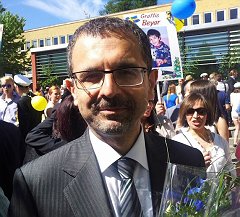
Delladetsimas Pavlos is a Professor of Urban Geography, Planning, and City Safety at the Department of Geography , Harokopio University. Holding a PhD in Spatial Planning from the National Technical University of Athens (NTUA), he has led postgraduate programs on disaster impacts and spatial development since the 1980s. His office is located in the new wing of the department at 70 El. Venizelou, Athens. Educational Background: Degree in Architecture, Universita Degli Studi di Firenze (1978) Diploma in Development Planning, University College London (1979) MPhil in Town Planning, Bartlett School (1981) PhD in Spatial Planning, NTUA (1991) Research Focus: Pavlos specializes in urban resilience, disaster management, and spatial policy systems. His work bridges land policy, vulnerability analysis, and state governance, with comparative studies on Mediterranean and European cities. Article Trends: His recent publications examine the governance of urban commons (2025), culture-driven development (2024), and flood risk policy (2019). Earlier works analyze seismic safety planning (1997-2010), shopping mall regulation (2008-2013), and economic crisis impacts on urban planning (2016).
Michelakakis Nikolaos is a Professor in the Department of Economics at the University of Piraeus , affiliated with the School of Economics, Business and International Studies . He holds a Ph.D. in Algebraic Geometry from University College London, an M.Sc. in Algebraic Topology from Purdue University, and a B.Sc. in Mathematics from the University of Athens. Education: Ph.D., Algebraic Geometry, University College London M.Sc., Algebraic Topology, Purdue University B.Sc., Mathematics, University of Athens His research spans Financial Mathematics , Mathematical Economics , and Algebraic Geometry , with a focus on spatial competition models, taxation frameworks, and geometric structures. He has authored 12 publications in top journals and received research funding from the Onassis Foundation , SERC UK , and the European Union . Key trends in his 2014–2016 work include applications of game theory to vertical mergers and spatial duopoly , while his 1996–2006 mathematical research explores toric varieties , Kähler manifolds , and Picard groups . The University of Piraeus Department of Economics, ranked among Greece’s top two in ARWU, supports his work through research seminars and collaboration with international institutions like the Institut Fourier . He teaches undergraduate courses in Mathematics I , Mathematical Economics , and Dynamic Systems , and contributes to the Department’s Postgraduate Program in Applied Public Economics & Policy . His office hours are scheduled for both Winter and Spring 2024–2025 semesters.
Evangelos Markakis is a Professor at the Department of Informatics of the Athens University of Economics and Business (AUEB), where he has been a faculty member since February 2009. His academic journey includes a postdoctoral position at the University of Toronto (2005-2006) and the Center for Mathematics and Informatics (CWI) in the Netherlands (2007-2008), as well as a Visiting Professorship at Stanford University during the spring semester of 2014. Since February 2023, he has also been a research associate at the Archimedes Unit of the Athena Research Center. Dr. Markakis received his PhD in Informatics (2005) from the Georgia Institute of Technology, USA, with his thesis titled "Algorithmic Aspects of Game Theory and Microeconomics." His advisor was Richard Lipton. Prior to that, he earned his bachelor's degree in 2000 from the National Technical University of Athens (NTUA). His research focuses on the intersection of Theoretical Computer Science and Algorithmic Game Theory, with emphasis on the design and analysis of algorithms, mechanism design, and applications concerning fair allocation of goods, game-theoretic study of blockchain technology, and electoral systems. His work bridges theoretical foundations with practical applications in computational economics and social choice theory, addressing fundamental problems with real-world implications for market design and resource allocation. Analysis of his recent publications reveals a strong research trajectory in fair division problems, particularly for indivisible goods, where he has made significant contributions to envy-free allocation criteria like EFX and GMMS. His work spans algorithmic aspects of voting systems, liquid democracy, blockchain participation games, cost-sharing mechanisms, and equilibrium computation in strategic games. This demonstrates a consistent pattern of addressing complex computational problems with theoretical rigor while maintaining practical relevance. Recipient of the best student paper award for "On the Core of the Multicommodity Flow Game" at ACM Conference on Electronic Commerce (EC) 2003 Dr. Markakis has supervised numerous PhD and Master's students in the Department of Informatics at AUEB. His research has been funded by national and European research programs, and he has served on the management committee of European academic networks focused on game theory and social choice theory. His collaborative work spans multiple institutions and involves interdisciplinary approaches to solving complex computational problems. He is an active member of the Theory Group within the Department of Informatics at AUEB, which specializes in theoretical computer science and algorithmic aspects of game theory. His current research activities include exploring the game-theoretic foundations of blockchain technology and developing novel algorithms for fair division problems with practical applications in resource allocation and market design.
Ioannis Milis is a Professor at the Department of Informatics, School of Information Sciences and Technology, Athens University of Economics and Business (AUEB). He holds a PhD in Computer Science from AUEB (1989) and a BS in Electrical Engineering from Democritus University of Thrace (1983). As a Marie Curie fellow, he conducted post-doctoral research at LRI Orsay, INRIA-Sophia Antipolis, and NTUA (1992-1996). Education: BS, Electrical Engineering, Democritus University of Thrace (1983) PhD, Computer Science, Athens University of Economics and Business (1989) His research focuses on algorithms and complexity, particularly exact and approximation algorithms for optimization problems in computer/communication systems, combinatorial optimization, graph theory, and game theory. He is a member of AUEB's Theory Group. The recent articles span areas like Scheduling MapReduce jobs , Densest k-subgraph algorithms , Bin packing with colocations , and Speed scaling for lateness minimization . These works emphasize theoretical computer science, optimization, and energy-aware computing. He has contributed to organizing major conferences including the Athens Colloquium on Algorithms and Complexity (ACAC) , ISCO Symposia , and APEX Workshops . His involvement in program committees and research projects under Greek national programs (PENED, HRAKLEITOS II) and AUEB's Basic Research Funding Program highlights his academic leadership. As a teacher, he has delivered courses on Algorithms , Design and Analysis of Algorithms , and Advanced Algorithms at both undergraduate and postgraduate levels at AUEB.
Dimitris G. Sotiropoulos is a researcher at the Department of Mathematics, University of Patras . His work spans optimization , numerical analysis , and machine learning , with a focus on developing advanced algorithms for nonlinear systems , neural network training , and global optimization . Key research contributions include: Innovations in BFGS and conjugate gradient methods for large-scale optimization. Applications of interval arithmetic to discrete minimax problems and parameterized equations. Hybrid genetic algorithms for global optimization of multimodal functions. His publications (1997–2010) reflect expertise in computational mathematics and algorithm design , with applications in biomedical data classification and computational geometry. Articles emphasize memory efficiency , nonlinear programming , and validated numerics . Collaborations include researchers in optimization theory , neural networks , and numerical methods across multiple Greek institutions.
Parosh Aziz Abdulla is a Chaired Professor at the Department of Information Technology, Uppsala University, Sweden. He is a prominent researcher in the field of theoretical computer science with a focus on formal methods, concurrency, and program verification. His work bridges theoretical foundations with practical applications in software and hardware verification. Professor Abdulla's primary research interests include Concurrency, Distributed Systems, Program Verification, Model Checking, Automata, and Logic. His work spans both theoretical aspects of computer science and practical verification techniques for concurrent and distributed systems. He has made significant contributions to the understanding of memory models, particularly in the context of modern architectures like x86 with persistent memory. His research has evolved from foundational work on infinite-state systems to practical verification techniques for concurrent programs and string constraints. Professor Abdulla has served on numerous program committees for top-tier conferences including PLDI, POPL, CAV, CONCUR, and TACAS, demonstrating his standing in the research community. He has been PC co-Chair for TACAS'11 and has contributed to many other conferences over the years. As an advisor, Professor Abdulla has supervised numerous PhD students to completion, with graduates working on topics ranging from verification of networks of communicating processes to caches, transactions, and memory models. His students have gone on to successful careers in academia and industry. Professor Abdulla maintains an active research agenda, with recent work focusing on verification of quantum circuits, efficient linearizability monitoring, and verification under Intel-x86 with persistency. His research continues to address fundamental challenges in program verification while adapting to new computing paradigms and hardware architectures.
Tobias Grosser is an Associate Professor in the Department of Computer Science and Technology at the University of Cambridge. His research focuses on compiler technology, programming language design, and performance programming, with applications spanning hardware design, climate science, and quantum computing. He leads a research group developing innovative compiler frameworks and tools that bridge theoretical foundations with practical applications. Dr. Grosser completed his undergraduate studies in Computer Science at the University of Passau in Germany and pursued his PhD at École Normale Supérieure Paris as a Google PhD Fellow. Prior to joining Cambridge, he served as a Reader at the University of Edinburgh and held an Ambizione Fellowship at ETH Zurich. His research program centers on rethinking performance programming by re-connecting developers and compilers. He aims to make compilation more modular, predictable, automatic, and trustworthy while bringing open-source compiler innovation to increasingly diverse targets from GPUs to FPGAs and custom hardware. His work spans multiple domains including polyhedral compilation, constraint solving, quantum computing, and hardware design automation. Dr. Grosser is particularly interested in breaking down barriers between compilers and programmers by enabling their interaction through the programming language environment. His recent publications demonstrate a strong focus on compiler infrastructure development, particularly around the MLIR framework. He has pioneered work on Presburger arithmetic optimization with the FPL library, developed new intermediate representations for hardware description and quantum computing, and created tools for compiler education and prototyping like xDSL. His research shows a consistent theme of creating practical, high-performance compiler technologies that address real-world challenges across multiple domains. HiPEAC Technology Transfer Award 2021 for "Fast linear programming through transprecision computing on small and sparse data" OOPSLA 2021 Distinguished Paper Award for "FPL: Fast Presburger arithmetic through transprecision" Dr. Grosser actively mentors PhD students and postdoctoral researchers, currently supervising a team of over a dozen researchers working on various aspects of compiler technology. His group collaborates with industry partners including ARM and Xilinx, and maintains strong ties with the LLVM and MLIR open-source communities. He has secured funding for multiple research projects including work on verified compilation with Lean-MLIR, quantum compiler development, and hardware design automation. His research group operates at the intersection of multiple projects including Open-Source Electronic Design Automation, Seamless design of Smart Edge Processors, Lean-MLIR for verified compilation, FPL for fast Presburger arithmetic, and compilation frameworks for quantum computers. They maintain strong community engagement through regular Compiler Social events in Cambridge and active participation in LLVM developer meetings.
Aarti Gupta is a Professor in the Department of Computer Science at Princeton University, where she conducts research in formal verification, program analysis, and automated decision procedures. She has made significant contributions to the field of system analysis and verification, with her work being applied in industrial settings. Before joining Princeton, she led research in systems analysis and verification at NEC Labs America. Dr. Gupta received her PhD in Computer Science from Carnegie Mellon University. Her academic journey has positioned her as a leading figure in formal methods and verification techniques. Her research focuses on two main areas: theoretical foundations and practical applications. Foundations include formal methods, model checking, program analysis, automated synthesis, and SAT/SMT solvers. Applications span verification of software, hardware, networks, and distributed systems. Gupta's work bridges the gap between theoretical advances and real-world implementation, with particular emphasis on developing techniques that scale to handle complex industrial systems. Gupta's recent publications demonstrate a clear trajectory toward more modular, scalable, and practical verification techniques. She has increasingly focused on network verification, with several papers addressing the challenges of verifying distributed network control planes. Her work also shows growing interest in hardware verification, particularly for Systems-on-Chip (SoCs), and the intersection of formal methods with neural networks. A notable trend is the development of techniques that combine symbolic reasoning with learning approaches to improve verification scalability. Dr. Gupta has received numerous prestigious awards for her contributions: ACM Fellow (2017) - for contributions to system analysis and verification techniques and their transfer to industrial practice PLDI 2023 Distinguished Paper Award for "Synthesizing MILP Constraints for Efficient and Robust Optimization" IEEE ICNP 2022 Best Paper Award DATE 2021 Best Paper Award (Track D) ACM TODAES 2020 Best Paper Award IEEE Micro Top Pick 2018 Honorable Mention Dr. Gupta has advised numerous graduate students and postdoctoral researchers, including current PhD candidates Divya Raghunathan, Akash Gaonkar, Deyuan He, and Dexin Zhang. Among her former students are Timothy Alberdingk Thijm and Lauren Pick. She has also mentored postdoctoral fellow Grigory Fedyukovich and visiting student Yueling Zhang. Her research has been supported by significant grants that have enabled her to lead projects such as SyLVer (Synthesis, Learning, and Verification) and network verification initiatives in collaboration with researchers like Dave Walker and Ryan Beckett. Dr. Gupta leads the SyLVer research group at Princeton, which focuses on developing techniques that improve the scalability of algorithmic verification by combining deductive learning with learning on data and examples. Her group collaborates extensively on network verification projects, particularly through the Minesweeper initiative with Dave Walker and Ryan Beckett, and on Instruction Level Abstraction (ILA) for System-on-Chip verification in collaboration with Sharad Malik's group.
Hernán Ponce de León is a Principal Software Systems Research Engineer at Huawei Dresden Research Center (DRC) with an affiliation at Bundeswehr University Munich. His work focuses on the intersection of programming languages, security, and formal methods, particularly in developing automatic tools to verify low-level code correctness, security, and performance on emerging architectures. His research interests span Software Verification , Programming Languages , and Memory Models , with particular emphasis on weak memory consistency verification. He has made significant contributions to the field through the development of the Dat3M verification framework, which supports multiple memory models including C11, LKMM, Power, ARM, and others. Dr. Ponce de León has served on program committees for major conferences including PLDI, POPL, ECOOP, and OOPSLA, demonstrating his active engagement in the academic community. His work has been recognized with multiple SVCOMP medals and a Distinguished Paper award at OOPSLA 2022. Gold and Silver Medal @ SVCOMP 2025 Gold Medal (x2) @ SVCOMP 2024 Gold Medal @ SVCOMP 2023 Distinguished Paper @ OOPSLA 2022 As maintainer of the Dat3M verification tool, he leads a team of developers working on advancing state-of-the-art techniques for memory model verification. His recent publications focus on static analysis of memory models, SMT encodings, and consistency theories, demonstrating his continued leadership in this specialized research area.
Anna Roussou serves as Professor of Linguistics at the Department of Philology, University of Patras since 2012, specializing in theoretical syntax and its interfaces. Her academic journey includes faculty positions at Bangor University (1992-1998) and University of Cyprus (1998-2001) before her current appointment. Her research focuses on Theoretical Linguistics with expertise in syntax, morphology, and semantics. Key research areas include complement clauses, complement markers, questions, empty subjects, transitivity, voice alternations, grammaticalization, and psycholinguistics. Her methodological approach combines theoretical analysis with comparative and diachronic perspectives. Her publication profile shows consistent output in high-impact venues with a clear trajectory toward increasingly complex syntactic phenomena. The articles demonstrate specialization in Greek syntax while maintaining cross-linguistic relevance, particularly in Balkan and Indo-European languages. Recent work shows expansion into markedness theory and complexity metrics. Academic Visiting Fellow, MIT Linguistics and Philosophy (1997, 2009) Honorary Research Fellow, UCL Linguistics (2006-2007) Visiting Professor, University of Florence (2018) Lewis-Gibson Research Fellow, Cambridge Centre for Hellenic Studies (2022) British Academy Academic Visiting Fellow, University of Cambridge (2013) Roussou has held significant administrative roles including Vice-Rector for Academic Affairs at University of Patras (2010-2013), Vice-President for Research at Hellenic Open University (2017-2019), and Director of the Greek Language and Culture Laboratory (2016-2022). She served on the National Council for Research and Innovation (2016-2019) and Lifelong Learning Council (2013). She directed the Greek Language and Culture Laboratory at University of Patras from 2016-2022, which focused on theoretical and applied linguistics research with emphasis on Greek language structure, acquisition, and teaching methodologies. The laboratory fostered collaborations between theoretical linguists and language educators.
Maria Drakaki is Professor of Humanistic Engineering and Dean of the School of Science and Technology at the International Hellenic University. She also serves as Director of the Institute for Refugee Flows and Crisis Management of the University of Macedonia, and leads multiple postgraduate programs including the MSc in Environmental Management and Sustainability and the MSc in Humanitarian Logistics and Crisis Management. Dr. Drakaki earned her Ph.D. in Physics from the University of Texas at Austin (1992), an M.Sc. in VLSI System Design from the University of Westminster (2004), and a B.A. in Physics from the Aristotle University of Thessaloniki (1986). Her academic career progressed from research positions at the Aristotle University of Thessaloniki to faculty roles at various Greek institutions before her current position. Her research focuses on humanitarian engineering, AI methods for disaster management, humanitarian logistics, decision support systems, and supply chain management. She has pioneered approaches that combine advanced computational techniques with humanitarian applications, particularly in crisis response and management. Her work bridges the gap between traditional engineering disciplines and humanitarian practice. Analysis of her recent publications reveals a strong trend toward applying artificial intelligence, particularly machine learning and natural language processing techniques, to humanitarian challenges. Her research spans disaster response, migration management, supply chain resilience during crises, and community-based partnerships for resilience building. She has increasingly focused on social media analysis for disaster management and the application of transformer models for consequence identification from accident narratives. Fulbright Scholar Best paper award at the International Conference on Information Systems Architecture and Technology (2017) Humanitarian Engineering Lectureship award from UT Austin (2024) Dr. Drakaki supervises 4 PhD candidates and has participated in numerous European research projects including the European Qualifications – Refugees and Recognition 4 (EQUAL), Transforming Graduate Education for Green and Sustainable Future (T-Green), and the Humanitarian Engineering project with UT Austin. She serves on editorial boards including as Associate Editor for the Data Analytics for Social Impact Section of Frontiers in Big Data. She directs the Institute for Refugee Flows and Crisis Management and has established strong research collaborations across Europe.
Dimitrios Fotakis is a Professor at the School of Electrical and Computer Engineering at the National Technical University of Athens (NTUA), where he has been serving since February 2009. He also collaborates with the "Archimedes" research unit as an experienced researcher since 2023. His academic journey includes previous positions as a Senior Research Scientist at Yahoo Research (2017-2019), Assistant Professor at the University of the Aegean (2004-2009), and Postdoctoral Researcher at the Max-Planck Institut für Informatik (2001-2003). National Technical University of Athens (2009-present): Professor "Archimedes" Research Unit (2023-present): Collaborating Senior Researcher Yahoo Research (2017-2019): Senior Research Scientist University of the Aegean (2004-2009): Assistant Professor Max-Planck Institut für Informatik (2001-2003): Postdoctoral Researcher Education: He holds a Diploma (1994) and a PhD (1999) from the Department of Computer Engineering and Informatics at the University of Patras, Greece. Dimitrios Fotakis specializes in Theoretical Computer Science with a focus on Algorithmic Game Theory and Approximation Algorithms. His research centers on the algorithmic properties of congestion games, the design of approximate mechanisms without monetary exchanges, and direct algorithms with emphasis on service location problems. His work has produced significant results including optimal algorithms for service location problems, potential functions for generalizations of congestion games, and optimal approximate truth-based mechanisms. With over 120 publications in major international conferences and journals and more than 3,000 citations according to Google Scholar, his research has had substantial impact in the field. His recent publications (2023-2025) demonstrate a continued focus on cutting-edge topics at the intersection of algorithms, game theory, and machine learning. These works span diverse areas including learning-augmented algorithms, graph neural networks, facility location problems, mechanism design, opinion dynamics, and fairness in ranking systems. The breadth of his research shows his ability to bridge theoretical computer science with practical applications in energy systems, social networks, and AI ethics. Teaching: Professor Fotakis teaches courses including Algorithms and Complexity, Discrete Mathematics, Computer Programming, Algorithmic Game Theory, Network Algorithms and Complexity, and Convex Optimization with Applications in Machine Learning. Research Leadership: He has served as Principal Investigator for several significant research projects including BALSAM (Beyond Worst-Case Analysis in Approximation Algorithms and Mechanism Design, 2019-2023), LEADAlgo (Learning-Augmented and Data-Driven Online Algorithms, 2020-2022), and Selfish Resource Allocation through Game Theoretic Models (2009-2021). He has also contributed as a Senior Researcher to multiple THALES projects through the years. Mentorship: Professor Fotakis has supervised numerous PhD students who have gone on to prestigious postdoctoral positions at institutions including MIT, Stanford, Yale, and UT Austin. His academic lineage extends through many successful students now working in top universities and research institutions worldwide.
Cristian Cadar is Professor of Software Reliability in the Department of Computing at the Faculty of Engineering, Imperial College London. He leads the Software Reliability Group, focusing on automatic techniques for increasing the reliability and security of software systems. His research has significant impact in both academia and industry, particularly through the development of widely-used tools. His educational background includes a PhD in Computer Science from Stanford University, and undergraduate and Master's degrees from the Massachusetts Institute of Technology. Cristian's research primarily focuses on software reliability, security, and verification. His work spans symbolic execution, fuzzing, compiler testing, and automated techniques for finding and fixing software bugs. He has pioneered practical, scalable solutions that address real-world software challenges, with particular emphasis on security-critical applications. His research integrates formal methods with practical engineering approaches to create tools that are both theoretically sound and practically useful. Analysis of his recent publications reveals a strong focus on improving fuzzing techniques, enhancing symbolic execution systems, and developing better methods for compiler and infrastructure testing. His work consistently bridges the gap between theoretical foundations and practical implementation, resulting in tools that have substantial real-world impact. EuroSys Jochen Liedtke Award HVC Award BCS Roger Needham Award ACM SIGOPS Hall of Fame Award ACM CCS Test of Time Award ERC Consolidator Grant EPSRC Early-Career Fellowship Cristian has advised numerous PhD and Master's students, contributing significantly to the next generation of software engineering researchers. His research has been supported by prestigious grants including an ERC Consolidator Grant and an EPSRC Early-Career Fellowship. He has held leadership positions in major conferences, serving as Program Co-Chair for ESEC/FSE 2022 and General Chair for ISSTA 2021, demonstrating his standing in the research community. He leads the Software Reliability Group at Imperial College London, which maintains an active research agenda in software testing and verification. The group's work on KLEE and related tools continues to influence both academic research and industrial practice in software reliability engineering.
Dr. Panagiotis Repoussis serves as Associate Professor of Operations Research and Supply Chain Management at the Department of Marketing and Communication within the School of Business at Athens University of Economics and Business (AUEB). Previously, he held positions as Assistant Professor at Stevens Institute of Technology and visiting Lecturer at the University of Piraeus and Bayes School of Business at City University of London. His academic foundation includes a Diploma in Chemical Engineering from the National Technical University of Athens (2002), followed by graduate studies at Imperial College London and AUEB where he completed his doctoral dissertation in November 2008. His educational trajectory reflects a strategic shift from chemical engineering to operations research specialization. Dr. Repoussis specializes in Operations Research with concentrated expertise in Supply Chain Management , Vehicle Routing and Scheduling , and Production Systems Optimization . His research integrates mathematical modeling with computational intelligence to solve complex combinatorial optimization problems across logistics networks, manufacturing operations, and transportation systems. Key methodological contributions include advanced algorithms for dynamic scheduling under uncertainty and real-time decision support frameworks. Analysis of his 15 most recent publications (2019-2025) reveals a strong research trajectory toward Industry 4.0 applications, with increasing focus on IoT/AGV integration in manufacturing, disruption-resilient logistics, and robust optimization under stochastic conditions. Vehicle routing problems remain his dominant research theme, now extended to cross-docking operations, profit-oriented routing, and humanitarian logistics contexts. As principal investigator, Dr. Repoussis has secured research funding from NSF, EU programs, non-profit organizations, and private sector partners across Europe and North America. His academic service includes editorial board membership for Transportation Research Part E and Advances in Operations Research, leadership roles in the Hellenic Operational Research Society and Production and Operations Management Society, and organization of major conferences including Odysseus and MathSports. His professional activities demonstrate deep engagement with both theoretical advancements and practical implementations, particularly through development of decision support systems for waste management, healthcare logistics, and energy-aware production scheduling. Current initiatives emphasize the convergence of prescriptive analytics with emerging digital technologies in operational planning contexts.
Constantinos Petropoulos serves as an Associate Professor in the Department of Mathematics at the University of Patras, specializing in the Division of Statistics, Probability and Operational Research. He maintains an active academic position with regular office hours and teaching responsibilities. His academic credentials include a Ph.D. (2002) and B.Sc. (1995), both obtained from the Department of Mathematics at the University of Patras, demonstrating his longstanding affiliation with the institution. Dr. Petropoulos' research focuses on advanced statistical methodology, particularly in Statistical Inference, Improved Estimators and Confidence Intervals, Parameter Estimation under Constraints, Multivariate Statistical Analysis, and Statistical Data Analysis. His work contributes to theoretical and applied statistical science. He teaches undergraduate courses including Statistical Inference I and II, Stochastic Processes, and Nonparametric Statistics across different semesters, plus Methods for Statistical Data Analysis for the MSc in Computational and Analytical Statistics in Data Science program. His office is located in Room 214 on the 2nd Floor of the Building of Biology/Mathematics, with office hours held Tuesday through Thursday from 14:00-15:00. His professional work is documented through scholarly platforms including Google Scholar, MathSciNet, and Zentralblatt MATH.