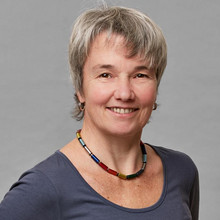
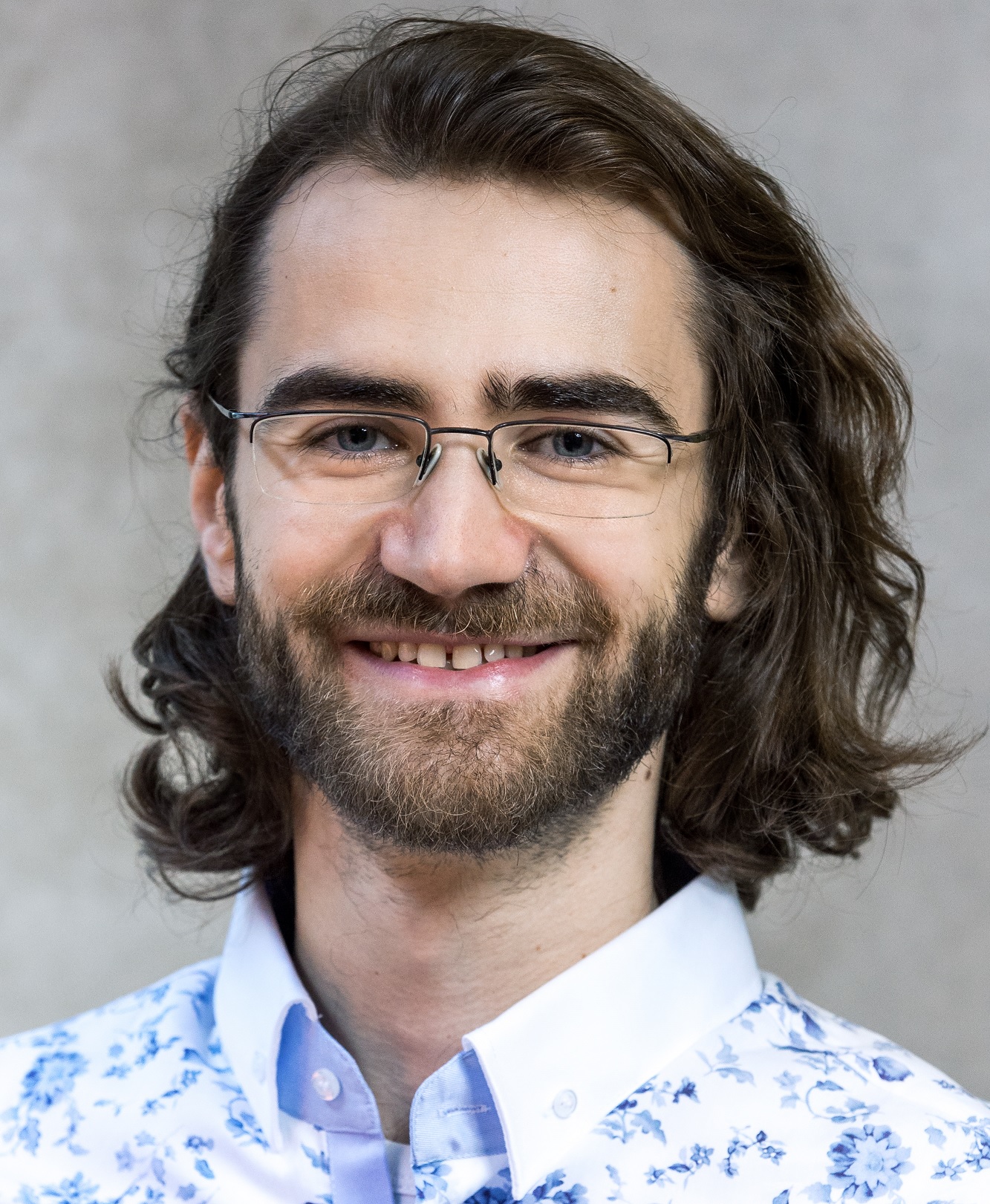
Professor Silke Ruwisch is a faculty member in the Faculty of Education at Leuphana University Lüneburg, where she holds the Chair of Mathematics and its Didactics. She has held academic positions at TU Dortmund University, Justus Liebig University Giessen, and the University of Cologne. Doctorate in Mathematics Education (Dr. rer. nat.) from Justus Liebig University Giessen (1998) Master's in Sociology (1990) and Practical Computer Science and Applied Mathematics (1997) Diploma in Remedial and Special Education (1989) Her research focuses on early mathematical learning, including spatial imagination, reasoning and argumentation in elementary school geometry, stochastic reasoning, and inclusive mathematics teaching. She develops learning environments and investigates conditions promoting or hindering mathematical knowledge construction in preschool and elementary school children. As a supervisor, she has guided doctoral students such as Imke Ahrens, Dana Farina Weiher, Stephanie Schmid, Marieke Vogt, and others, covering topics ranging from estimation strategies to spatial perspective-taking and additive word problems. She is based at the Institute for Mathematics and its Didactics (IMD) at Leuphana University, located at Universitätsallee 1, C16.012, Lüneburg, Germany.
Dr. ir. Janneke Bolt is a Researcher at the Department of Information and Computing Sciences , Faculty of Science , Utrecht University . Her work focuses on Bayesian networks , probabilistic graphical models , and independence relations in Artificial Intelligence and Data Science . She has published extensively on topics such as probabilistic independence , loopy propagation , and sensitivity functions . Her recent research includes self-adhesivity in lattices of abstract conditional independence models and Bayesian network applications in medicine . Collaborators include L.C. van der Gaag and S. Renooij . Research Areas: Bayesian Networks Probabilistic Inference Independence Relations Machine Learning Uncertainty Quantification Medical AI Recent Publications (2025-2014): Self-adhesivity in Lattices (2025) Bayesian Networks in Medicine (2024) Semi-Graphoid Rule Generalizations (2023) Lattice-Based Independence Representations (2020) Multi-Dimensional Bayesian Classifier Tuning (2016) Collaborations: L.C. van der Gaag S. Renooij J. de Bock A. Hommersom
Dr. Yuliya Lierler is a Professor in the Department of Computer Science at the University of Nebraska Omaha's College of Information Science & Technology. She has been a faculty member since 2012, reaching the rank of full professor, and was appointed to the Cheryl Prewett Diamond Professorship in 2020. Her work focuses on artificial intelligence, particularly in knowledge representation, automated reasoning, and declarative problem solving. PhD in Computer Science (University of Texas at Austin, 2010) Dr. Lierler's research bridges logic programming with practical AI applications, including natural language understanding, constraint satisfaction, and SMT-based solvers. She is a co-director of the NLPKR lab and has authored over 70 peer-reviewed publications in venues like Artificial Intelligence Journal and AAAI. Her contributions include open-access textbooks and tools like text2alm for semantic information extraction. Her recent publications explore advancements in answer set programming (ASP) semantics, automated reasoning frameworks, and hybrid knowledge representation systems. She has served as program co-chair for major conferences like ICLP (2022) and PADL (2017), and received awards such as the IS&T Outstanding Research Award (2024). Dr. Lierler also mentors students and leads initiatives in teaching innovation through online education and professional development programs. Mentor of the Year Award, Aksarben Foundation (2025) IS&T Outstanding Research and Creativity Award (2024) Best Student Paper Award (with Amelia Harrison, 2016) Dr. Lierler contributes to academic service through leadership roles in international conferences and program committees. Her lab, NLPKR, focuses on integrating natural language processing with formal logic, while her teaching emphasizes formal methods and AI foundations.
Jens Behley is a Lecturer (Privatdozent) at the Institute of Geodesy and Geoinformation, University of Bonn, where he actively teaches graduate courses in robotics and computer vision while leading cutting-edge research in 3D perception. His work bridges theoretical advances with real-world agricultural and automotive applications, focusing on robust algorithms for unstructured environments. Behley's research centers on 3D point cloud processing, semantic segmentation, and SLAM systems, with specialized expertise in agricultural robotics for crop phenotyping and autonomous vehicle navigation. He develops novel techniques for plant organ-level analysis, fruit shape completion, and radar-based localization, emphasizing solutions that function under real-field conditions with sensor noise and dynamic changes. His methodologies frequently integrate deep learning with geometric computer vision to achieve precision in challenging outdoor settings. Analysis of his recent publications reveals a dominant trend toward neural implicit representations (e.g., Gaussian Splatting) and diffusion models for 3D scene understanding, alongside continued innovation in LiDAR processing for agricultural robotics. Key thematic clusters include plant phenotyping (18% of recent work), neural mapping techniques (24%), and robust sensor fusion for autonomous systems (31%), with growing emphasis on generative models for data synthesis. Scientific Awards Outstanding Reviewer at IEEE Robotics and Automation Letters (RA-L), 2024 Outstanding Reviewer at European Conference on Computer Vision (ECCV), 2024 Best Agri-Robotics Paper Award for “BonnBeetClouds3D...” at IROS, 2024 Best Paper Award in Workshop “Agricultural Robotics for Sustainable Futures” at IROS, 2024 Best Paper Award Second Place in Workshop “AI and Robotics For Future Farming” at IROS, 2024 Outstanding Reviewer at CVPR, 2024 Finalist Best Paper Award in Service Robotics at ICRA, 2024 Best Paper for “KISS-ICP...” by RA-L, 2023 Honorable Mention for “High Precision Leaf Instance Segmentation...” by RA-L, 2023 Outstanding Reviewer at CVPR, 2023 Outstanding Reviewer at ECCV, 2022 Finalist IROS Best Paper Award on Agri-Robotics, 2022 Outstanding Reviewer at RA-L, 2022 Outstanding Reviewer at ICRA, 2022 Outstanding Reviewer at ICCV, 2021 Faculty Award for Geodesy from Agricultural Faculty of University of Bonn, 2021 Outstanding Reviewer at CVPR, 2021 Finalist Best System Paper at RSS, 2020 Diplomarbeitspreis der Bonner Informatik Gesellschaft e.V., 2009 Behley actively mentors students through advanced coursework including “Machine Learning for Robotics and Computer Vision” and “Techniques for Self-Driving Cars,” though specific advisees aren't documented. His research is supported by extensive collaborations with Prof. Cyrill Stachniss's robotics group at Bonn, with publications appearing in top venues like RA-L, ICRA, and CVPR. Current projects focus on neural scene representations for agricultural robotics and robust localization in changing environments, with datasets like BonnBeetClouds3D establishing new benchmarks in plant phenotyping.
Ondrej Majer is a Senior Researcher at the Department of Logic, Institute of Philosophy, Academy of Sciences of the Czech Republic. He holds a Doctor of Natural Sciences (RNDr.) degree in Game Theory and a Candidate of Sciences (CSc., equivalent to PhD) in Logic. Education : Faculty of Mathematics and Physics, Charles University in Prague (Theoretical Cybernetics, Mathematical Informatics and Control Theory, 1986); Faculty of Music and Drama, Charles University in Prague (Game Theory); Institute of Philosophy, Academy of Sciences of the Czech Republic (Logic, CSc.) Areas of interest : game theory, dynamic logic, counterfactual logic, modal logic, fuzzy logic, and fundamentals of probability Majer has delivered over 50 lectures at international conferences, including key presentations on epistemic logics, paraconsistent reasoning, and many-valued logics. His research focuses on integrating logical frameworks with probability theories to model uncertainty and inconsistency in information systems. He has participated in 16 national and international projects, including grants from GAČR (Czech Science Foundation), DFG (Germany), and FWF (Austria). Notable projects involve reasoning with graded properties, paraconsistent epistemic logics, and modeling vague quantifiers in mathematical fuzzy logic. Majer has collaborated extensively, publishing two-layered logics, truth-maker semantics, and belief function models over non-classical logics. His work bridges formal logic, philosophical inquiry, and computational reasoning.
Dr. Emir Demirović is an Assistant Professor in the Department of Computer Science at Delft University of Technology (TU Delft), The Netherlands. He leads the Constraint Solving ("ConSol") research group and co-directs the Explainable AI in Transportation Lab ("XAIT") as part of Delft AI Labs. Prior roles: Postdoc at University of Melbourne (2017-2020), PhD at Vienna University of Technology (2017) Collaborations: Civil Engineering, QuTech, and industry partners Funding sources: Dutch national funding agency, TU Delft, VoestAlpine Research Focus: Constraint programming and combinatorial optimisation Explainable AI methods for decision-making systems Integration of optimisation with machine learning Robust/resilient optimisation for industrial applications Optimal decision trees with dynamic programming Quantum computing scheduling techniques Scientific Contributions: Pioneered "Pseudo-Boolean Reasoning" for algorithm certification Developed "Blossom" algorithm for optimal decision trees Advances in "Predict+Optimise" frameworks Created Pumpkin constraint programming solver Bridge between SAT/CP and Machine Learning Awards: First Place, MaxSAT Evaluation 2018+ First Place, ROADEF/EURO 2012 Adoption of methods in Google OR-Tools Collaborations: Research visits to EPFL, ANITI/CNRS, CUHK, Monash University, TU Wien Participated in Dagstuhl seminars, Lorentz workshops, and Simons-Berkeley programme
Björn Ommer is a full Professor at Ludwig Maximilian University of Munich (LMU) where he heads the Computer Vision & Learning Group. Previously, he was a full professor at Heidelberg University and served as a director of the Interdisciplinary Center for Scientific Computing (IWR) and the Heidelberg Collaboratory for Image Processing (HCI). He is affiliated with multiple prestigious institutions including the Bavarian AI Council, ELLIS unit Munich, the Helmholtz Foundation, and the Munich Center for Machine Learning (MCML). Dr. Ommer received his PhD from ETH Zurich where he was awarded the ETH Medal for his dissertation 'Learning the Compositional Nature of Objects for Visual Recognition.' After completing his doctoral studies, he held a post-doctoral position in the Computer Vision Group of Jitendra Malik at UC Berkeley. His primary research interests span all aspects of semantic image and video understanding based on deep machine learning, with particular emphasis on generative approaches for visual synthesis (including Stable Diffusion), invertible deep models for explainable AI, deep metric and representation learning, and self-supervised learning paradigms. His work has significant interdisciplinary applications in digital humanities and neurosciences. His extensive publication record demonstrates a clear progression toward increasingly sophisticated generative models, culminating in the development of Stable Diffusion. His recent work focuses on improving diffusion models, exploring flow matching techniques, and developing more controllable generative systems with applications across multiple domains. German AI-Prize 2024 Technology-Prize of Eduard-Rhein-Foundation 2024 Nominated for German Future Prize of the President of Germany ELLIS Fellow ETH Medal for Dissertation Best Paper Award at CVPR'21 AI for Content Creation Workshop Professor Ommer serves as an associate editor for IEEE T-PAMI and has held significant leadership roles in major computer vision conferences including program chair for GCPR and Senior/Area Chair for CVPR, ICCV, ECCV, and NeurIPS. He delivered the opening keynote at NeurIPS'23 and has supervised numerous PhD students who have gone on to positions at leading technology companies including Amazon, Facebook, and Apple. His research group is located in downtown Munich and actively recruits talented students and researchers for cutting-edge work in computer vision and machine learning.
Joseph Fong is an Assistant Professor at the University of Tennessee Health Science Center (UTHSC), affiliated with the Hamilton Eye Institute-Downtown in Memphis, TN. He holds appointments in both the Department of Ophthalmology and Department of Neurology , reflecting his clinical and research focus at the intersection of vision science and neurological disorders. Medical Degree: University of Tennessee Health Science Center (UTHSC) Internship: Internal Medicine at University of Arkansas for Medical Sciences Residency: Ophthalmology at University of Arkansas for Medical Sciences Fellowship: Neuro-Ophthalmology at University of Oklahoma Health Sciences Center Dr. Fong's research focuses on neuro-ophthalmology , particularly ocular manifestations of neurological diseases, diagnostic innovations using artificial intelligence, and complex ocular trauma management. His work spans both clinical and translational research including: AI-assisted diagnosis of corneal, glaucomatous, and neuro-ophthalmic conditions Unusual ocular trauma patterns (e.g., TASER injuries, fiberglass foreign bodies) Neurological-ophthalmology overlaps like crossed-quadrant hemianopsia Innovative surgical approaches for strabismus and retinal disorders Pediatric ocular emergencies (e.g., fungal keratitis, foreign body removal) His publication record demonstrates expertise in diagnostic innovation, particularly through evaluating AI tools like ChatGPT for ophthalmic diseases, while maintaining clinical focus on rare ocular pathologies across all age groups.
Mayank Kejriwal is a Research Assistant Professor in the Department of Industrial and Systems Engineering at the University of Southern California (USC) and a Research Lead at the USC Information Sciences Institute (ISI). His work focuses on applying AI technologies for social good, particularly through knowledge graphs and neuro-symbolic AI. Education: PhD in Computer Science, University of Texas at Austin Research Interests: Dr. Kejriwal's primary research is in knowledge graphs (KG), neuro-symbolic AI, and complex systems. He explores how AI can address real-world issues such as human trafficking, crisis response, and healthcare. His work bridges theory and application, combining symbolic reasoning with modern machine learning techniques. He is also active in computational social science, network science, and AI ethics, with a strong emphasis on human-centered computing. Scientific Awards: USC Graduate Student Mentorship Award (2021) AAAS Early Career Award for Public Engagement with Science Finalist (2021) Yahoo! Faculty Research Engagement Program Recipient (2019) Copper Black Award for Creative Achievement, Mensa Foundation (2019) Key Scientific Challenge Award, Allen Institute for AI (2018) International Best Dissertation Award, Semantic Web Science Association (2017) Grants & Funding: His research has been funded by DARPA, corporate sponsors, and philanthropic organizations. He has led multiple projects under the MEMEX and other federal programs aimed at AI for social impact. Teaching & Mentorship: He teaches courses such as ISE 540: Text Analytics and ISE 599: Applied Predictive Analytics. He has received the USC Graduate Student Mentorship Award for his dedication to student development.
Dr. Niki Pfeifer , a leading figure in formal epistemology and probability logic, is currently a Professor at the Department of Philosophy, University of Regensburg . His interdisciplinary work bridges logic, philosophy, and psychology, focusing on reasoning under uncertainty. Education : First PhD in Psychology (2006, University of Salzburg, Austria); Second PhD in Philosophy (2012, Tilburg Center for Logic and Philosophy of Science, Netherlands); Habilitation in Philosophy (2024, University of Regensburg, awarded 2025 Habilitation Prize). Research Areas : His work explores coherence-based probability logic, connexive principles, probabilistic argumentation, and cognitive foundations of reasoning. He investigates how humans interpret conditionals, syllogisms, and counterfactuals under uncertainty. Awards : Habilitation Prize 2025 by the University Foundation Pro Habilitatione Key roles in European Science Foundation (ESF) and DFG-funded projects. Funding : Projects supported by the German Research Foundation (DFG), Alexander von Humboldt Foundation, Austrian Science Fund (FWF), and BMBF.
Alison Wylie is a Professor in the Department of Philosophy at the University of British Columbia's Faculty of Arts, where she holds a Canada Research Chair (Tier 1) in Philosophy of the Social and Historical Sciences. She also serves as Associate Faculty in UBC Anthropology. Her interdisciplinary work bridges philosophy, archaeology, and science studies through the UBC-based Indigenous/Science project. Dr. Wylie's educational background includes a Ph.D. in Philosophy from Binghamton University (1982) and a B.A. in Philosophy & Sociology from Mount Allison University (1976). Her research centers on how inquiry succeeds under non-ideal conditions, with specialization in philosophy of the social and historical sciences; feminist philosophy of science; history and philosophy of archaeology; and ethics issues in the social sciences. She focuses on evidence, objectivity, values in science, and accountability, with recent work exploring collaborative practices inspired by Indigenous knowledge systems. Her case-based approach examines how archaeological practice embodies methodological wisdom that's rarely made explicit. Analysis of her recent publications reveals a consistent focus on evidential reasoning in archaeological practice, with increasing attention to collaborative and Indigenous approaches to knowledge production. Her work demonstrates how philosophical analysis of archaeological practice can yield insights applicable across scientific disciplines, particularly regarding how values shape scientific inquiry while maintaining objectivity. Major Awards and Honors: Canada Research Chair in Philosophy of the Social and Historical Sciences, Tier 1 (2018-2023) Australian Academy of the Humanities, Corresponding Fellow (elected 2019) 2013 Distinguished Woman Philosopher of the Year, Society for Women in Philosophy 2008 Patty Jo Watson Distinguished Lecturer, Archaeology Division, American Anthropological Association 1995 Presidential Award, Society for American Archaeology, for contributions to the Committee for Ethics in Archaeology Professor Wylie has delivered numerous prestigious lectures including the AAAS Sarton Memorial Lecture (2020), Saunders Lecture (2019), and APA Dewey Lecture (2017). She has been instrumental in developing frameworks for understanding how situated knowledge and collaborative practices enhance rather than compromise scientific objectivity, particularly through her work on standpoint theory and evidential reasoning in archaeology. Her research program includes significant engagement with the Indigenous/Science project at UBC, where she explores collaborative approaches to knowledge production that respect diverse epistemic traditions while maintaining rigorous standards of evidence and reasoning.
Philippe van de Calseyde is an Assistant Professor in Organizational Behavior at the Eindhoven University of Technology (TU/e), affiliated with the Human Performance Management group within the Department of Industrial Engineering and Innovation Sciences. He specializes in judgment and decision-making research. Research Focus : Decision time signaling, interpersonal trust dynamics, and behavioral consequences of financial safeguards Publications : Published in Organizational Behavior and Human Decision Processes , Journal of Experimental Social Psychology , and Journal of Behavioral Decision Making Key Findings across publications reveal: Decision time affects expectations of others' morality and cooperation levels Generalized trust creates reputational trade-offs between sociability and competence Insurance policies paradoxically increase betrayal probability in trust games Victim insurance status reduces punishment severity recommendations Educational Contributions : Teaches Behavioral Operations Management , Work & Organizational Psychology , and AI System Design .
Jesse Thomason is an Assistant Professor at the Thomas Lord Department of Computer Science, University of Southern California (USC), where he leads the GLAMOR Lab. His research focuses on grounding language in multimodal observations and robotic systems, particularly through language-guided robotics, vision-and-language navigation, neurosymbolic AI, and sign language processing. Assistant Professor, USC (2021–present) Research Interests: Robotics, AI, NLP, Multimodal Interaction, Accessibility Recent publications span topics like language-robotics integration , model collapse in synthetic data , and sign language knowledge graphs . He has received best paper awards at robotics and AI workshops. Teaching includes graduate courses in NLP and deep learning. Notable recent work includes: ReWiND (CoRL 2025): Language-guided reward modeling for robot policies PSALM-V (arXiv 2025): Neurosymbolic planning with LLMs ASL Knowledge Graph (NAACL Findings 2025): Linguistic-infused ASL models Awards: Best Paper, OODWorkshop@RSS25 Best Paper (2nd Place), InterAI@Ro-MAN 2024
María Esther Carrizosa Prieto is a Professor in the Private Law Department at Universidad Pablo de Olavide, specializing in Labour and Social Security Law. She leads the research group "Citizenship in the Company: Fundamental Rights in the Workplace" and is affiliated with the Doctoral Program on Welfare State and Social Rights. She earned her doctorate from Universidad Pablo de Olavide in 2007 with a thesis on "Freedom of Association Rights and Principle of Equality," supervised by Dr. Fermín Rodríguez-Sañudo Gutiérrez. Professor Carrizosa's research focuses on labor law, social security systems, and fundamental rights in the workplace. Her work examines how legal frameworks adapt to contemporary challenges including digital transformation, atypical work arrangements, and disability inclusion. She has conducted extensive research on telework regulation, particularly analyzing Ibero-American approaches during and after the pandemic. Her scholarship also addresses employment policies, vocational guidance systems, and the protection of vulnerable workers including those with disabilities or health conditions. Her recent publications reveal a strong focus on the intersection of labor law and digital transformation. She has examined telework regulation across Ibero-American countries, analyzed Spain's approach to remote work, and studied the implications of digital monitoring on workers' privacy. Additionally, she has investigated how social protection systems respond to atypical work arrangements and how vocational guidance can enhance employability in the digital age. Her work consistently connects theoretical legal analysis with practical policy recommendations. Professor Carrizosa has made significant contributions to understanding collective bargaining in Andalusia, the regulation of fixed-term contracts in Spain, and the integration of transversal competencies in university education to improve graduate employability. Her research often bridges legal scholarship with educational innovation, as seen in her work on gamification in legal education and flexible learning approaches.
Bin Hu is an Assistant Professor in the Department of Electrical and Computer Engineering at the University of Illinois at Urbana-Champaign, affiliated with the Coordinated Science Laboratory. His research bridges control theory and machine learning, focusing on certifiable robustness of AI models, generative AI for control, and control-theoretic analysis of optimization algorithms. PhD, Aerospace Engineering and Mechanics, University of Minnesota (2016) Postdoctoral Research, Wisconsin Institute for Discovery, University of Wisconsin-Madison (2016-2018) B.Sc, Theoretical and Applied Mechanics, University of Science and Technology of China (2008) M.S., Computational Mechanics, Carnegie Mellon University (2010) His work spans machine learning control , robust neural network design , and policy optimization , with recent emphasis on adversarial attacks in LLMs and stability analysis using control tools. His publications highlight integration of Lyapunov theory , semidefinite programming , and reinforcement learning for control problems. NSF CAREER award (2021) Amazon Research Award (2020, 2024) O. Hugo Schuck Best Paper Award (2024) AFOSR grant for control verification (2023) Bin Hu has advised students like Xingang Guo and led research projects on Lipschitz neural networks , policy gradient methods , and LLM-based control engineering , while teaching courses such as Digital Signal Processing , Control Systems , and advanced topics on the interplay between control and machine learning.