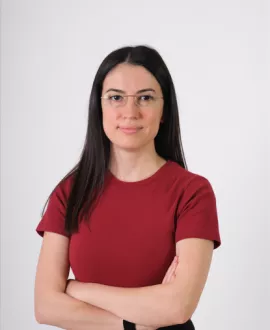
Assoc. Prof. Dr. Serkan Arıkan is a faculty member at Boğaziçi University's Faculty of Education, Department of Mathematics Education. His research focuses on educational measurement, computerized adaptive testing, non-routine problem solving, and large-scale assessment frameworks like PISA and TIMSS. He has developed psychometric tools for STEM competency evaluation and conducted bias detection studies in international exams. Education : PhD in Secondary Science and Mathematics Education (METU, 2010), Postdoc (Tilburg University, 2015) Awards : Outstanding Achievement in Teaching Award (2021-2022) Research Trends : His recent work includes psychometric validation of self-compassion scales, extending the Community of Inquiry framework for technology integration, and adaptive test design using multiple matrix sampling. He investigates how socioeconomic factors, item bias, and emotional skills intersect with academic performance. Projects : Leads TÜBİTAK-funded AI-based test design and computerized adaptive mathematics test initiatives. Conductor of Boğaziçi University Adaptive Testing Laboratory.
Prof. Dr. Nuri Dogan is a Professor at Hacettepe University, Faculty of Education, Department of Educational Sciences, where he serves as Head of the Department of Educational Sciences since 2021 and previously as Head of the Department of Measurement and Evaluation in Education since 2019. He earned his BA (1996), MA (1999), and PhD (2002) from Hacettepe University's Department of Educational Measurement and Evaluation. After working as a research assistant (1998-2002) and lecturer (2003-2010), he became an Associate Professor in 2011 and a full Professor in 2016. He conducted post-doctoral research at University of Massachusetts-AMHERST under Ronald K. Hambleton in 2014-2015 with a TÜBİTAK scholarship. His research focuses on educational measurement and evaluation, psychometrics, test development, classical test theory, item response theory, and computerized adaptive testing. He teaches courses on measurement and evaluation in education, test development, scaling techniques, classical test theory, psychological foundations of measurement, research techniques, computerized measurement applications, and various other topics related to educational assessment. His extensive body of work demonstrates strong expertise in educational assessment methodologies, with particular emphasis on the technical aspects of measurement and evaluation. Dogan's publication record shows a clear progression from foundational work in classical test theory to more sophisticated applications in computerized adaptive testing and multistage testing. His recent work (2023-2024) reveals a strong focus on practical applications of measurement theory in large-scale assessments like PISA, with increasing integration of data mining and machine learning approaches. His research spans both theoretical psychometrics and practical applications across various educational contexts. Scientific Awards: TÜBİTAK scientist support program (BİDEP) scholarship for post-doctoral research at University of Massachusetts-AMHERST Prof. Dogan has supervised 55 graduate students (28 master's and 27 PhD candidates) whose research spans educational measurement, psychometrics, test development, and various applications of assessment methodology. His research projects include significant work on computerized adaptive testing, multistage testing, measurement invariance, and large-scale international assessments like PISA. He has received multiple research grants from TÜBİTAK and other national and international funding bodies. Prof. Dogan also chairs the Board of Directors of the Association for Measurement and Evaluation in Education and Psychology (EPODDER) and has been actively involved in numerous national and international research projects related to educational assessment and measurement.
Merve Şahin Kürşad is an Assistant Professor at TED University, Faculty of Education, Department of Educational Sciences. She actively teaches courses on Measurement and Evaluation in Education, Research Methods in Education, and 21st Century Skills for Teachers. Her work spans both undergraduate and graduate programs, including non-thesis master's programs in Educational Institutions Management. 2023-2025: Teaching Measurement and Evaluation in Education (ED 301), Research Methods in Education (ED 302, EDUC 204), and 21st Century Skills for Teachers (ED 350). 2023-2024: Advising Graduation Project (MEI 590) for the Non-Thesis Master's Program. Her research focuses on psychometrics, computerized adaptive testing, and educational assessment. Recent publications analyze item parameter drift, test equating, and metacognitive awareness in education. Her scholarly contributions include empirical studies on missing data techniques, validity/reliability frameworks, and adaptive testing efficiency. These works intersect with quantitative research methodology and educational technology. For communication, she uses merve.kursad@tedu.edu.tr and is based in Room F121 at TED University.
Nuri Doğan serves as an Assistant Professor in the Department of Educational Sciences at Mehmet Akif Ersoy University's Faculty of Education. His scholarly work focuses on advanced methodological approaches in educational measurement and assessment. His research spans six key areas: Educational Measurement (primary focus) Psychometrics (specializing in scale validation) Computerized Adaptive Testing systems Large-Scale Assessment analysis (particularly PISA) Test Validity and Reliability frameworks Statistical modeling for educational data Recent work emphasizes Likert-scale optimization, differential item functioning, and multistage testing design. Analysis of his 15 most recent publications reveals strong emphasis on computational psychometrics, with 70% involving simulation studies or advanced statistical modeling. His work consistently addresses practical measurement challenges in Turkish educational contexts while contributing to international methodological discourse. No scientific awards or honors are documented in available records. Doğan maintains active research collaboration with scholars across Turkish universities but shows no current supervision of graduate students based on publication records. His work demonstrates independent scholarly productivity without documented grant funding, as indicated by 'Proje Sayısı 0' in institutional metrics. He operates without a dedicated laboratory, conducting research through departmental resources within the Faculty of Education.
Olcay Yılmaz is an Assistant Professor and Vice Dean at the Faculty of Education, TED University. He holds a PhD in Psychological Counseling and Guidance from Hacettepe University. His academic roles include teaching courses such as Career Counseling Theories & Practice, Psychological Testing, and Research Methodology. He has served in the Turkish Land Forces (1997-2012) and contributed to elite athlete development projects (2013-2015). His research focuses on career counseling methodologies, psychological assessment tools, and cultural adaptation of tests. Current Position: Assistant Professor & Vice Dean Department: Department of Educational Sciences, Guidance and Psychological Counseling Institution: TED University Education: Bachelor’s: Turkish Land Forces School (System Administration Sciences) Master’s: Hacettepe University (Psychological Counseling & Guidance) PhD: Hacettepe University (Psychological Counseling & Guidance) Research Interests: Personality traits in career selection Scale development for vocational assessment Focus on cultural validity of psychological instruments Application of AI in career guidance systems Sports psychology applications in elite athlete development Recent Publications Trends: His 2020-2023 articles emphasize digital transformation in counseling, cross-cultural assessment challenges, and neurocognitive aspects of career decision-making. He frequently publishes in education policy and psychometric methodology domains. Professional Memberships: Turkish Counseling and Guidance Association Network for Innovation in Career Guidance and Counselling in Europe (NICE)