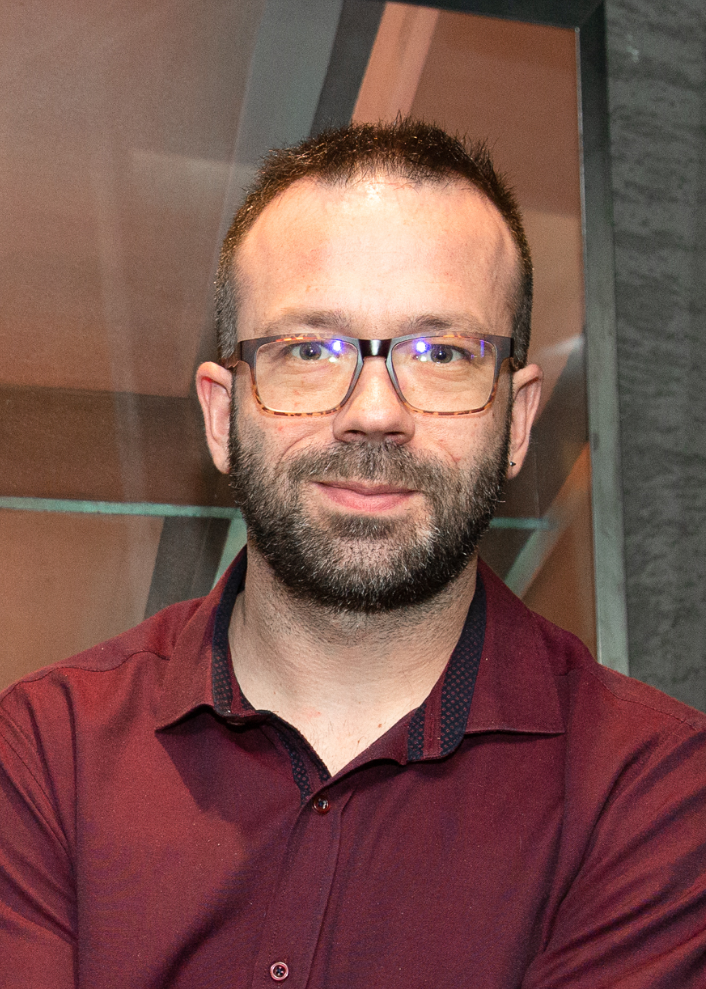
Panagiotis E. Hadjidoukas is an Adjunct Assistant Professor at the Department of Computer Science, University of Ioannina, Greece. He currently holds a Visiting Scientist position at IBM Research Zurich. His work bridges parallel computing with applications in medical physics, computational biology, and high-performance numerical optimization. His research focuses on parallel and distributed computing, runtime support for parallel programming models, and thread libraries. He has contributed to hybrid programming frameworks and task-parallelism deployment in multicore environments. The articles in his portfolio highlight a strong trend in Monte Carlo simulations applied to radiation biology, parallelization techniques for hierarchical data clustering, and performance optimization in multicore systems. His work often integrates OpenMP and hybrid MPI/OpenMP models for distributed computing. He has developed notable software projects like PSthreads (a runtime library for lightweight threads) and UthLib (a portable non-preemptive user-level threads package).
Dimitrios Dechouniotis is an Assistant Professor at the Department of Electrical and Computer Engineering within the School of Electrical and Computer Engineering at the University of Patras . His career spans roles in academia, research institutions, and public administration. 2004: Diploma in Electrical Engineering (University of Patras) 2006: MSc in Automation Systems (NTUA) 2014: PhD in Electrical and Computer Engineering (University of Patras) His research focuses on Systems & Control Theory , Cyber-Physical Systems , Robotics , Cloud Computing , and 5G Communications . Recent publications highlight work in edge computing , network slicing , and resource orchestration for IoT and robotics applications. He has participated in over 10 national and European research projects related to telecommunications and Industry 4.0. His technical contributions include frameworks for edge-cloud continuum orchestration , blockchain-based slice orchestration , and energy-aware resource allocation , with a strong emphasis on system modeling and control-theoretic approaches. Contact: dechouniotis@uop.gr | Office: Building Z, 2nd Floor
Professor Kyriazis Demosthenis serves as a Professor in the Department of Digital Systems at the University of Piraeus and currently holds the position of Vice-Chancellor for Research and Lifelong Learning. His academic career spans over two decades with significant contributions to service-oriented architectures and cloud computing. His educational background includes: Diploma in Electrical and Computer Engineering from the National Technical University of Athens (NTUA) in 2001 Interdepartmental postgraduate diploma in "Techno-Economic Systems" in 2004 (NTUA, National Kapodistrian University of Athens, University of Piraeus) PhD in Electrical and Computer Engineering from NTUA in 2007, specializing in Service-Oriented Architectures Professor Kyriazis focuses on service-oriented, distributed and heterogeneous systems with particular expertise in software technologies and data analysis. His work bridges theoretical frameworks with practical implementations in cloud infrastructure management. His research has evolved to address emerging challenges in virtualization technologies for high availability of cloud computing infrastructures and management techniques in Internet of Things environments. He has demonstrated leadership in European research initiatives, coordinating multiple projects and serving in prominent research groups including the Future Internet Architecture Board and Cloud QoS&SLAs. His work has practical applications across multimedia, virtual reality, and health domains. Throughout his career, Professor Kyriazis has participated in numerous European and Greek research projects including BigDataStack, CrowdHEALTH, MATILDA, 5GTANGO, CYBELE, ORBIT, VISION Cloud, IRMOS, and 4CaaSt. His research leadership extends to coordinating relevant European projects in the IoT and cloud computing domains.
Petros Maragos is a Professor at the National Technical University of Athens (NTUA) in the School of Electrical and Computer Engineering, where he directs the Division of Signals, Control and Robotics. He founded the Computer Vision, Speech Communication & Signal Processing Lab (1999) and the Hellenic Robotics Center of Excellence (2025). His research spans signal processing, computer vision, robotics, and machine learning, with 450+ publications and leadership in 50+ EU/Greek/US projects. Education includes a Dipl.Ing. from NTUA (1980), M.Sc./Ph.D. from Georgia Tech (1982/1985), and faculty positions at Harvard University (1985-1993) and Georgia Tech (1993-1998). Research Focus: Multimodal perception, nonlinear systems, assistive robotics, and deep learning. Recent work integrates tropical geometry with neural networks, robotic healthcare applications, and sign language technologies. Articles emphasize neural architectures, real-world robotics, and AI for social good. Awards: IEEE Fellow (1995), EURASIP Fellow (2010) IEEE W.R.G. Baker Prize (1995) NSF Presidential Young Investigator Award (1987-1992) CVPR/PETRA Best Paper Awards (2022-2025) Advising & Grants: Supervised 30+ PhDs and 130+ Master's students. Secured funding from EU Horizon 2020, NSF, and Greek national programs for projects like i-Walk (robotic mobility) and e-Prevention (mental health monitoring). Labs: Leads NTUA's Intelligent Robotics Lab and co-founded the Robotics Institute at Athena Research Center, focusing on human-robot interaction and perception systems.
Giorgos Stamou is a Professor at the School of Electrical and Computer Engineering, National Technical University of Athens (NTUA), and a Visiting Professor at the MIT Sloan School of Management and MIT Open Learning. He directs the Artificial Intelligence and Machine Learning Systems Laboratory (AILS Lab) and has been a senior researcher at the Institute of Communications and Computer Systems (2000-2008) and an academic visitor at Oxford University (2011-2012). His research spans Deep Learning , Explainable AI , and Knowledge Representation , with a focus on Large Language Models and Multimodal Learning . He has coordinated over 60 funded projects and published 150+ papers. Recent work highlights trends in LLM Evaluation , Gender Bias Mitigation , and Multimodal Music Analysis , reflecting his interdisciplinary approach to AI challenges. Stamou has served on steering committees for W3C working groups (Rule Interchange Format, Web Ontology Language) and contributed to cultural heritage metadata enrichment through the CrowdHeritage projects. He founded NTUA's MSc program in Data Science and Machine Learning (2018-2022) and has organized conference tracks on riddle-solving frameworks and hallucination detection.
Mattia Fazzini is an Assistant Professor in the Department of Computer Science & Engineering at the University of Minnesota's College of Science and Engineering. His primary academic appointment focuses on software engineering research and teaching, with active involvement in major conferences including ASE, ISSTA, ICSE, and MOBILESoft where he has served in leadership roles such as General Co-chair (MOBILESoft 2023) and Program Committee Co-chair. His research centers on software testing, maintenance, and security , with particular emphasis on mobile applications. Key research themes include: Developing techniques for automated Android testing and maintenance Addressing API compatibility issues across Android versions Creating tools for test oracle generation and bug reproduction Investigating security vulnerabilities in mobile ecosystems Optimizing test suites through test double analysis His recent publications (2021-2025) reveal strong focus on Android-specific challenges, with recurring themes in compatibility testing, automated test generation, and security analysis. Over 60% of his work involves tool development for practical testing scenarios, particularly targeting mobile platforms. Notable recognitions include: IEEE TCSE Distinguished Paper Award (2024) for work on test suite optimization ACM Distinguished Paper Award (2022) for COVID-19 app analysis As an educator, he advises multiple PhD and Master's students while teaching undergraduate and graduate courses including CSCI 3081W (Program Design) and CSCI 5802 (Software Engineering II). His service contributions span conference organization (MOBILESoft, ISSTA, ICSE) and extensive program committee work across top software engineering venues. He leads research projects focused on practical testing solutions with real-world applicability in mobile software development.
Işıl Dillig is an Associate Professor of Computer Science at the University of Texas at Austin, where she leads the UToPiA research group. Her academic career spans over a decade of significant contributions to programming languages research, particularly in program analysis, verification, and synthesis. Dr. Dillig received all her academic degrees (BS, MS, and PhD) from Stanford University before joining the faculty at UT Austin. Her educational background established the foundation for her innovative research approach that bridges theoretical computer science with practical applications. Her research focuses on developing techniques to make software systems more reliable, secure, and easier to build through advanced program analysis, verification, and synthesis methods. She has pioneered approaches that combine symbolic reasoning with machine learning to tackle complex software engineering challenges across multiple domains including security, databases, and programming language theory. Her work demonstrates exceptional depth in creating practical tools that address real-world software development problems while maintaining strong theoretical foundations. Analysis of Dr. Dillig's publication record reveals a consistent trajectory of innovation in program synthesis, with recent work expanding into neurosymbolic approaches that bridge neural networks with formal methods. Her research shows strong connections between theoretical foundations and practical applications, particularly in security-critical systems, database technologies, and blockchain applications. The evolution of her work demonstrates increasing sophistication in handling complex program structures while maintaining practical usability. Dr. Dillig has received prestigious recognition for her research contributions: Sloan Fellowship NSF CAREER award As a dedicated educator and research leader, Dr. Dillig has served in significant roles including Program Chair for PLDI 2022 and Steering Committee member for PLDI. She has mentored numerous students through her UToPiA research group, guiding research in program synthesis, verification, and analysis. Her work has been supported by substantial research grants that have enabled innovative projects at the intersection of programming languages and security. Dr. Dillig leads the UToPiA (UT Austin Programming, Languages, and Analysis) research group, which focuses on developing novel techniques for program analysis, verification, and synthesis. The group maintains strong collaborations with industry partners and academic institutions worldwide, translating theoretical advances into practical tools that address real software engineering challenges.
Gilbert Bernstein is an Assistant Professor in the Computer Science & Engineering department within the College of Engineering at the University of Washington. His research bridges computer graphics and programming languages, with a focus on high-performance domain-specific languages. Previously, he was a post-doctoral scholar at UC Berkeley and MIT working with Jonathan Ragan-Kelley, and received his PhD from Stanford University under Pat Hanrahan. His research interests span Computer Graphics, Programming Languages, High-Performance DSLs, Physical Simulation, Geometry & Topology, Differentiable Programming, Hardware DSLs, Tools for Artists, Fabrication, and Human-Computer Interaction. Bernstein develops languages and compilers that enable efficient computation for creative applications, physical simulations, and graphics rendering systems. His recent publications reveal strong trends in differentiable programming for graphics applications, domain-specific languages for hardware acceleration, and computational approaches to traditional crafts like quilting and knitting. His work consistently combines formal language theory with practical applications in graphics and fabrication. Bernstein actively mentors students across multiple institutions including current advisees Felix Hahnlein (UW Postdoc), Ryan Zambrotta (UW PhD), Haoran Peng (UW PhD), and previous students including Alex Reinking (UC Berkeley PhD 2022, now at Qualcomm) and MacKenzie Leake (Stanford PhD 2021, now at Adobe Research). His lab works on diverse projects including debugging CAD programs, compilers for finite element methods, semantics for knitting machines, algebraic scheduling of tensor programs, and exocompilers for hardware accelerators. Bernstein also collaborates on DSLs for networking, Counterstrike bots, gradient-based optimization, memory management, hardware design, and garment design tools.
Laura Dietz is a tenured Associate Professor in the Department of Computer Science at the University of New Hampshire, where she leads the TREMA lab. Her academic journey began with a PhD from the Max Planck Institute for Informatics in Saarbruecken, Germany (2011), followed by postdoctoral positions at the University of Massachusetts Amherst (2010-2015) and University of Mannheim (2015-2016). Her educational background includes PhD studies at both the Max Planck Institute for Informatics (2007-2011) under Prof. Gerhard Weikum and Prof. Tobias Scheffer, and earlier research at Humboldt University in Berlin. She has built a distinguished career bridging theoretical computer science with practical applications in information retrieval and machine learning. Dietz's research primarily focuses on the intersection of information retrieval, natural language processing, and knowledge graphs, with a parallel research initiative in watershed data science. She is particularly known for her work on entity-aspect linking, complex answer retrieval, and the vision of automatic Wikipedia construction. Her approach integrates fine-grained knowledge annotations with text understanding to create comprehensive information systems that go beyond traditional 10-blue-links search paradigms. In watershed data science, she applies similar machine learning techniques to environmental data streams, focusing on solute transport analysis during storm events. Her recent publications reveal a strong trend toward fine-grained semantic understanding, particularly in entity-oriented search tasks. She has pioneered methods for entity-aspect linking that significantly improve retrieval accuracy by capturing different contexts in which entities appear. Her work increasingly integrates knowledge graphs with neural architectures, showing sophisticated understanding of how to leverage both structured and unstructured information for better search experiences. Best paper award at JCDL 2018 for work on entity-aspect linking NSF CAREER Award (2019-2023) for "Utilizing Fine-grained Knowledge Annotations in Text Understanding and Retrieval" OSSI Award 2013 from UMass ICB3 for open-source hardware/software Dietz actively mentors PhD and Masters students through the TREMA lab, with current research focusing on entity ranking, topic extraction, conversational search, and watershed forecasting. Her grant portfolio includes the NSF CAREER award and funding from the Northeast Big Data Innovation Hub for forecasting salinity in rivers during storm events. She has also coordinated the TREC Complex Answer Retrieval track (2017-2019), creating important benchmarks for the IR community. The TREMA lab (Text Retrieval, Entity Modeling, and Applications) serves as the hub for Dietz's research activities, bringing together students and collaborators to work on cutting-edge problems in information access. The lab's work spans both theoretical contributions to information retrieval and practical applications in domains ranging from environmental science to scientific publication analysis.
José Fragoso Santos is an Assistant Professor in the Department of Computer Science and Engineering at Instituto Superior Técnico, University of Lisbon, and a member of INESC-ID where he conducts research as part of the SAT group. His research focuses on embedding formal methods into software development processes, with particular emphasis on JavaScript program analysis and verification. His educational background includes: PhD in Computer Science from University of Nice Sophia Antipolis (2014) Master's degree in Information Systems and Computer Engineering from Instituto Superior Técnico, Universidade de Lisboa (2008) Dr. Santos' research centers on JavaScript verification, symbolic execution, and secure information flow. He led the development of JaVerT, the first separation-logic-based tool for JavaScript analysis and testing, which has gained significant interest from both industry and academia. His work bridges theoretical formal methods with practical applications, particularly in web security and program analysis. He has made substantial contributions to understanding JavaScript semantics, symbolic execution techniques, and secure information flow in web applications, with publications in premier venues like PLDI, POPL, and ECOOP. His recent publications demonstrate a strong focus on symbolic execution for JavaScript and related languages, with applications in web security and program verification. The research shows progression from foundational work on information flow security to advanced techniques like compositional symbolic execution and multi-language analysis platforms. His work on JaVerT and Gillian has established significant research directions in program analysis for dynamic languages. His notable scientific achievements include: Facebook research award for the JaVerT project Dr. Santos has supervised numerous graduate students on projects related to JavaScript verification, symbolic execution, web security, and formal methods. His research has practical applications, as evidenced by the collaboration with Amazon R&D engineers to verify critical components of the AWS Encryption SDK using JaVerT. He has served on program committees for major conferences including PLDI, OOPSLA, and IJCAI, demonstrating his standing in the programming languages community. As a member of the SAT group at INESC-ID, Dr. Santos collaborates with researchers working on formal methods, program verification, and software security. His current projects include extending JavaScript symbolic execution to Web Workers, developing formal semantics for JavaScript regular expressions, and creating first-order solvers for program analysis. He continues to push the boundaries of what's possible in JavaScript program analysis and verification.
Mayur Naik is the Misra Family Professor in the Department of Computer and Information Science at the University of Pennsylvania's School of Engineering and Applied Science. He holds office in Room 642B, Amy Gutmann Hall and maintains an active research program focused on the intersection of programming languages and artificial intelligence. Before joining UPenn, he was faculty at Georgia Institute of Technology and a researcher at Intel Labs, Berkeley. Naik received his PhD in Computer Science from Stanford University in 2008 under Alex Aiken, a Masters from Purdue University in 2003 under Jens Palsberg, and a Bachelors from BITS Pilani in 1999. He grew up in Goa, India. His primary research interests center around neurosymbolic programming, which combines symbolic reasoning with machine learning to create more accurate, interpretable, and domain-aware AI systems. His group develops language design, learning algorithms, and compiler optimizations in this space, with their most mature effort being the Scallop neurosymbolic programming language and compiler toolchain. He also conducts research in trustworthy AI for healthcare applications and AI-enabled programming tools that improve programmer productivity. Analysis of his recent publications shows a strong trend toward neurosymbolic programming frameworks (Scallop, TorchQL), LLM-assisted program analysis (IRIS), and applications of these techniques to security, healthcare, and computer vision. His work consistently bridges theoretical foundations with practical implementations, often releasing open-source systems. Misra Family Professor (endowed chair, effective July 2024) Multiple distinguished paper awards (PLDI 2019, FSE 2015, PLDI 2014) Test-of-Time Paper Awards (FSE 2013, FSE 2012, EuroSys 2011) His student Elizabeth Dinella won the 2025 ACM SIGSOFT Outstanding Dissertation award Naik has advised numerous PhD students who have gone on to faculty positions at top institutions including Peking University, University of Toronto, Ashoka University, Bryn Mawr College, and Johns Hopkins University. His research is supported by grants from NSF, Google, Amazon, and other industry partners. His lab maintains active collaborations with clinicians and bioinformatics researchers to apply neurosymbolic programming to healthcare problems. His research group, which includes current PhD students and postdocs, develops practical open-source systems and applies them to diverse domains including computer vision, cybersecurity, medicine, and bioinformatics. The group maintains strong industry connections with Google, Microsoft, Amazon, and other tech companies.
Dr. Georgios Drakakis serves as Professor of Information Technology at the American College of Greece (Deree) since 2018, concurrently holding the position of Chief Executive Officer at Purposeful, an in silico drug repurposing company. He is a Research Area Leader within the Research, Technology & Innovation Network (RTIN) focusing on cheminformatics and bioinformatics. His educational background includes: PhD in Cheminformatics from University of Cambridge (2011-2015) MSc in Advanced Biological Sciences (Bioinformatics) from University of Liverpool (2009-2010) MSc in Computer Science from Trinity College Dublin (2008-2009) BSc in Computer Science from Aristotle University of Thessaloniki (2003-2007) Dr. Drakakis' research centers on applying machine learning and artificial intelligence to drug discovery, repurposing, and computational toxicology. His work bridges cheminformatics, bioinformatics, and data science to develop predictive models for compound mechanism of action, cytotoxicity, and polypharmacological effects. Recent efforts include computational approaches for identifying drug candidates against emerging pathogens like SARS-CoV-2. His publication record features 13 journal articles and 2 book chapters in high-impact venues including ACS Chemical Biology and Journal of Chemical Information and Modeling, with consistent focus on translational computational methods. Notable recognition includes: Engineering and Physical Sciences Research Council Doctoral Prize As an educator, he teaches Machine Vision and Semantic Web for the MSc in Data Science program, and Data Mining for the BSc in Information Technology program. His leadership in RTIN's Cheminformatics & Bioinformatics Research Area demonstrates commitment to advancing computational approaches in pharmaceutical sciences. His dual role as academic and CEO reflects strong industry-academia integration in his career trajectory.