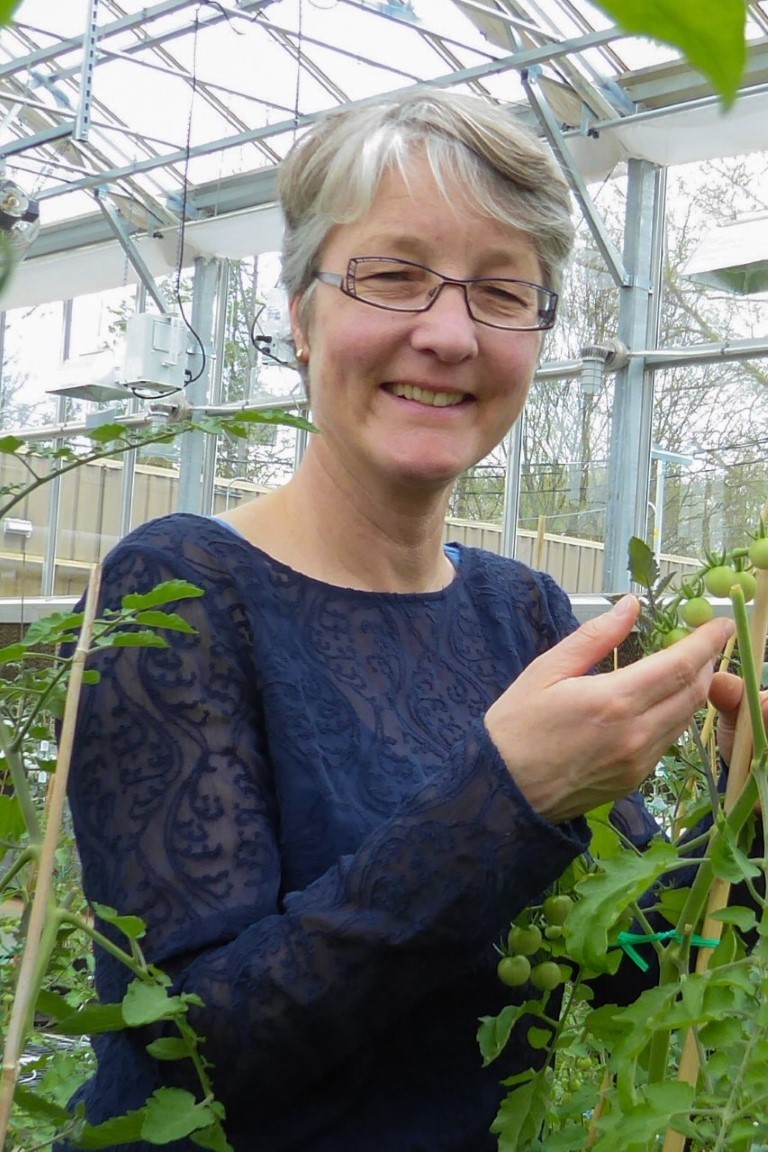
Esther van der Knaap is a Professor at the University of Georgia within the College of Agricultural & Environmental Sciences. She is affiliated with the Horticulture department and the Institute of Plant Breeding, Genetics and Genomics (IPBGG) . Her research focuses on molecular mechanisms regulating tomato fruit shape and size, with applications in crop improvement and climate resilience. Education: Ph.D. in Genetics, Michigan State University (1998) B.S./M.S. in Plant Pathology, Wageningen University (1990) Dr. van der Knaap’s work explores fruit development genetics in Solanaceous crops. She investigates structural genomic variants , gene regulatory networks , and metabolic pathways to enhance agricultural productivity. Her studies span tomato domestication , stress adaptation , and flavor preservation . Recent publications highlight advances in CRISPR-based gene editing , cell segmentation technology , and methyl salicylate metabolism . Her team’s tomato genome analyses reveal insights into domestication history and yield optimization , funded by NSF and USDA grants. She leads the Esther van der Knaap Lab at UGA’s Center of Applied Genetic Technologies (CAGT). Collaborative efforts include the CAES Vegetables Team and The Plant Center .
Dr. Siddhartha Bhattacharyya is a Professor in the Department of Computer Science and Engineering at Christ University, Bangalore, with expertise spanning hybrid intelligence, quantum computing, and multimedia data processing. He has authored/edited 65 books and published over 300 research articles, focusing on interdisciplinary applications of machine learning and computational methods. Editorial Board Member, PeerJ Computer Science Holder of two PCT patents Active in academic leadership (organizing conference committees) His research integrates Artificial Intelligence , Computer Vision , and Quantum Computing to solve complex problems in education, healthcare, and environmental monitoring. Recent work includes multimodal student learning assessment, gas plume detection, and Metaverse applications. He leads an active academic lab focused on hybrid intelligence systems and their practical implementations. Key trends in his publications include: deep learning architectures for computer vision (YOLOv7, CNN-Transformer), quantum-inspired algorithms for graph coloring and bioinformatics, and educational technology innovations for remote learning environments. His work bridges theoretical advancements with real-world applications across diverse domains.
Dr. Helia Farhood is an Honorary Senior Research Fellow at the School of Computing, Macquarie University, specializing in Artificial Intelligence, Machine Learning, and Image Processing with applications in educational technology and object recognition. Her academic qualifications include a PhD in Computer Systems and Artificial Intelligence from the University of Technology Sydney (awarded November 2021) and a Master's degree in Computer-AI from Amirkabir University of Technology (Tehran Polytechnic, awarded September 2013). Dr. Farhood's research spans interdisciplinary AI applications, with significant contributions in student outcome prediction using generative adversarial networks, explainable AI through LIME heatmaps, and image-based storytelling systems. Her work integrates machine learning with educational data mining to enhance creativity assessment and learning analytics, while maintaining strong technical focus on 3D reconstruction and object recognition. Analysis of her 16 publications (2020-2025) reveals three dominant research trajectories: (1) AI-driven educational analytics for student performance prediction, (2) advanced image processing techniques for object recognition and 3D reconstruction, and (3) systematic reviews establishing methodological foundations in presentation attack detection and image-based storytelling. Her recent work increasingly emphasizes explainability and ethical considerations in AI deployment. Dr. Farhood has participated in externally funded research projects, including the 2022 project "Estimating the Number of Tyres in Stockpiles" (October-December 2022). No information is available regarding students she has advised. No information is available about specific research laboratories or teams led by Dr. Farhood.
Irfan Essa is a Professor at the School of Interactive Computing , Georgia Institute of Technology, and serves as Senior Associate Dean in the College of Computing. He leads the Interdisciplinary Research Center for Machine Learning at Georgia Tech (ML@GT) and holds a Senior Staff Research Scientist position at Google Inc. His academic journey includes a Ph.D. from MIT (1994) and prior research faculty roles at MIT Media Lab (1988-1996). Research Focus : Computer Vision, Machine Learning, Robotics, Computational Journalism, and Human-Computer Interaction. Leadership : Co-founded ML@GT, Adjunct Faculty at Carnegie Mellon's Robotics Institute. Essa’s research explores Generative AI , Computational Video , Wearable Computing , and Vision-Language Models . His work impacts areas like Autonomous Systems , Video Analysis , and Social Computing . Recent projects include end-to-end trainable frameworks for Image Retargeting (HALO) and Video Generation (VideoPoet), emphasizing content-structure preservation and zero-shot capabilities. His 15 most recent publications (2023-2025) span CVPR , NeurIPS , ICML , and ECCV , focusing on Generative Media , Diffusion Models , and Human Activity Recognition . Notable contributions include Text-Free Diffusion , Wearable-Based Activity Recognition , and Layered Transformation Architectures . Awards : NSF CAREER, IEEE Fellow, Best Paper Awards at ICML 2024 and ICLR 2023. Students : Advisees include Varun Agrawal, Aneeq Zia, Unaiza Ahsan, and Daniel Castro Chin. Labs/Teams : Affiliated with ML@GT, Georgia Tech's Center for Experimental Research in Computer Systems (CERCS), and Google Research.
Shinhan Shiu is a Professor at the Department of Computational Mathematics, Science and Engineering and holds a secondary appointment in Plant Biology at Michigan State University. His research integrates computational approaches with plant genetics to understand genome evolution, stress biology, and gene regulation. Department of Computational Mathematics, Science and Engineering, Michigan State University Plant Biology, Michigan State University Molecular Plant Sciences Program, Michigan State University Genetics & Genome Sciences Program, Michigan State University Cell & Molecular Biology Program, Michigan State University Shiu's research focuses on genome evolution, stress biology, and the application of machine learning in predictive plant biology. His work explores how genetic and environmental information translate into phenotypes and leverages computational methods to improve genomic prediction and understanding of plant stress responses. Recent publications highlight the use of machine learning in identifying stress-related genes, modeling transcriptional responses to environmental stimuli, and developing computational tools for plant phenotyping. His lab emphasizes collaborative and inclusive training of future scientists, with a focus on interdisciplinary communication and critical thinking. Red Cedar Distinguished Professor, Michigan State University The Shiu Lab fosters an energetic, collaborative environment and engages in outreach to promote science education. The team develops software tools and resources for plant genomics, with applications in agriculture and evolutionary studies.
He Kong is an Associate Professor at Southern University of Science and Technology (SUSTech), affiliated with the School of Automation and Intelligent Manufacturing, where he also serves as Deputy Director of the SUSTech Institute of Robotics. Previously, he was an Assistant Professor in the Department of Mechanical and Energy Engineering at SUSTech from January to May 2022. Prior to joining SUSTech, he was a Research Fellow at the Australian Centre for Field Robotics, University of Sydney (2016-2021), and at Cranfield University's Advanced Vehicle Engineering Centre (2015-2016). He received his Ph.D. in Electrical Engineering from the University of Newcastle, Australia (2014), M.E. in Control Science and Engineering from Harbin Institute of Technology (2010), and B.E. in Electrical Engineering and Automation from China University of Mining and Technology (2004). His research focuses on robotic intelligent perception and decision making, robot audition, optimal filtering and estimation, and advanced control methods. Specifically, he works on active multi-mode perception, parameter calibration of robot audition systems, optimal filtering under unknown inputs, and fully actuated system approaches. His work has significant applications in precision agriculture, environmental monitoring, and robotic inspection of hazardous industries such as chemical and mining operations. His recent publications reveal a strong emphasis on multi-modal perception systems, particularly combining visual and auditory sensing for robotic applications. His research shows a progression from theoretical control methods toward practical implementations in field robotics, with increasing focus on real-world applications in agriculture and hazardous environments. Finalist for Youth Author Prize, IFAC Workshop on Robot Control (2019) Fifth China Robotics Academic Annual Conference Best Poster Award (2024) 14th International Conference on Indoor Positioning and Indoor Navigation Best Paper Award (2024) The Equity Scholarship, Council of International Students Australia (2011) Outstanding Postgraduate Students Award, Harbin Institute of Technology (2010) Professor Kong actively supervises numerous PhD and Master's students and has established a productive research group focused on active intelligent systems. His laboratory is equipped with advanced facilities including over 30 motion capture systems, Unitree humanoid robots, robot dogs, wheeled mobile robots, and custom-developed platforms like Cubli and acoustic perception systems. He serves on editorial boards for several prestigious journals including IEEE Robotics and Automation Letters and IEEE Sensors Letters, and has been an Associate Editor for major robotics conferences such as IEEE ICRA and IEEE/RSJ IROS.
Aaron Etienne is an Assistant Professor in the Department of Applied Sciences, Technology and Education at Utah State University's S.J. & Jessie E. Quinney College of Agriculture & Natural Resources. His research focuses on integrating technology with agricultural practices to enhance safety, efficiency, and sustainability in farming operations. Located at the ASTE facility in Logan, Utah, Dr. Etienne investigates critical areas including lone worker safety systems, precision agriculture technologies, and automation solutions. Research Focus Areas: Agricultural Safety Innovation: Development of wearable devices and response systems for lone agricultural workers, incident database creation, and geospatial risk analysis. Precision Agriculture: UAV-based weed detection using deep learning, crop management systems, and sensor technology integration. Agricultural Automation: Grain handling robotics, machinery network systems (CAN-bus), and efficiency optimization technologies. His recent publications (2019-2025) demonstrate consistent focus on technology-driven solutions for agricultural challenges. Safety research dominates his recent output (7 publications), followed by automation (4) and precision agriculture (4). Key technological themes include deep learning applications, sensor systems, and geospatial analysis. Notably, 9 of 15 recent publications involve empirical validations or system developments, reflecting a strong applied research approach.
Christian Germain is a Professor of Computer Science at Bordeaux Sciences Agro, an engineering school specializing in agronomy. He focuses on information technologies and their applications to agriculture and environmental science, conducting research in image analysis at the IMS laboratory. His work spans remote sensing, embedded agricultural imaging, and digital tool development for vineyards. Key Roles: Co-holder of the AgroTIC business chair (29 corporate sponsors), Scientific Director of DigiLab (open platform for wine-growing experiments). Research Themes: Remote sensing, agricultural imaging systems, covariance pooling in machine learning, and texture analysis for material science. His recent publications highlight collaborations with industry and academic partners, emphasizing applications in vineyard health monitoring, carbon composite modeling, and vine disease detection. Germain’s team utilizes CNNs, Gaussian mixture models, and SAR imaging techniques to advance agricultural and materials engineering. He has contributed to international conferences and journals, integrating computational methods with real-world agricultural challenges, including proximal sensing for crop management and 3D microstructure simulation.
Dr. Tomislav Medić is a Lecturer and PostDoc at the Department of Civil, Environmental and Geomatic Engineering, ETH Zurich. His research focuses on advanced geospatial technologies, particularly terrestrial laser scanning (TLS) applications in deformation monitoring, sensor calibration, and precision agriculture. MSc in Geodesy and Geoinformation, University of Zagreb, Croatia PhD in Geodesy, Bonn University (IGG), Germany Dr. Medić’s research spans geomatics, remote sensing, and sensor engineering. Key areas include TLS radiometric calibration, point cloud processing for 3D displacement analysis, and multispectral LiDAR applications in agriculture. He contributes to improving geodetic measurement accuracy through innovative calibration strategies. His recent publications emphasize TLS integration with RGB data for geomonitoring (2025), hyperspectral scanning for fruit quality assessment (2024), and calibration field design for panoramic scanners (2023). Articles demonstrate expertise in error modeling, multi-sensor fusion, and environmental monitoring applications. At ETH Zurich’s Geosensors and Engineering Geodesy (GSEG) group, he leads the Alpine Measurement Lab collaboration project. He also participates in PhenoRob, a cluster of excellence in robotics and phenotyping for sustainable crop production at Bonn University.
Dr. Michał Chromiak is an Assistant Professor at the Department of Cybersecurity and Computational Linguistics , part of the School of Mathematics, Physics and Computer Science at Maria Curie-Skłodowska University . With a PhD in Computer Science from the Polish Academy of Sciences and dual MSc degrees in Mathematics and Computer Science, he focuses on understanding the chaos in data through research in Machine Learning, Deep Learning, and Software Engineering. PhD in Computer Science (Polish Academy of Sciences) MSc in Mathematics and Computer Science His scientific activity spans cross-domain feature transfer in computer vision (e.g., DINOv2, MAE), reinforcement learning (e.g., Decision Transformer), and neural architecture analysis (MLP-Mixer, Transformers). He actively shares insights through his blog, covering topics like Attention Mechanisms , Self-Supervised Learning , and Sequence Modeling . Dr. Chromiak serves on the Program Committee for ECAI 2024 and maintains a strong online presence via ORCID , GitHub , and LinkedIn . Contact for teaching matters: chromiakm@office.umcs.pl . Consultations available via MS Teams on Thursdays 15-17:15 and Fridays after 15:00.
Kaan UYAR is an Assistant Professor in the Department of Software Engineering at Near East University since March 2023, with continuous academic service at the institution since 1993. His career progression includes roles as Lecturer in Electrical and Electronic Engineering (1995-2000), Dr (2006-2007), Assistant Professor in Computer Engineering (2008-2011, 2013-2023), and administrative positions including Vice-Chair of Computer Engineering (2007-2010) and Chair of Information Systems Engineering (2011-2013). His extensive educational background includes: BSc in Electrical and Electronics Engineering from Anadolu University (1992) MA in International Relations from Near East University (1994) Pedagogical formation from Ataturk Teacher Training Academy (1996) BA in Public Administration from Anadolu University (1998) MSc in Computer Engineering from European University of Lefke (1999) PhD in Computer Engineering from Near East University (2006) Uyar's research spans artificial intelligence , systems and control , engineering education , and e-government , with emphasis on practical applications of computational intelligence. His work demonstrates deep integration of deep learning for medical image analysis and neuro-fuzzy systems for forecasting, applied to critical domains including cancer diagnosis, disease outbreak prediction, and accessibility compliance. Analysis of his 2018-2024 publications reveals three dominant research trajectories: (1) web accessibility assessments across Cyprus, Ethiopia, and the EU focusing on government, health, and retail sectors; (2) medical diagnostics using AI for lung, colon, and breast cancer detection; and (3) forecasting systems for public health (measles) and agriculture (food security) using adaptive neuro-fuzzy techniques. His regional focus on Cyprus and Ethiopia highlights contextualized problem-solving. Uyar maintains active professional engagement through membership in the IEEE and Cyprus Turkish Chamber of Electrical Engineers , reflecting his commitment to engineering standards and academic discourse within regional and international communities.
Jos Van Orshoven is a full Professor at KU Leuven's Faculty of Bioscience Engineering within the Department of Earth and Environmental Sciences. He serves as Division Head of the Spatial Information Processing Division (SADL) and leads subdivisions for Ground for GIS and Earth Observation, while holding membership in Leuven One Health Institute and the Departmental Council for Earth and Environmental Sciences. His research spans Geographic Information Systems, remote sensing, and spatial analysis applied to environmental challenges. Key interests include climate-resilient land management, urban green space planning, forest dynamics under climate change, soil carbon monitoring, and socioeconomic disparities in environmental exposure. His work integrates drone and satellite technologies (Sentinel-2, VNIR/SWIR/LWIR) with spatial optimization for sustainable resource allocation. Recent publications reveal strong trends in climate adaptation (forest composition shifts, drought impacts on orchards), green infrastructure health benefits (3-30-300 rule evaluations), and precision environmental monitoring (radiocaesium transfer meta-analyses, soil carbon mapping). His team develops innovative methods like YOLOv8 tree detection for quantifying visible green space and spatial optimization for sediment loss minimization through afforestation. Radiocaesium soil-to-plant transfer meta-analysis (2025) Atlantic lowland forest climate vulnerability assessment (2025) Urban green space accessibility disparities research (2025) Agrovoltaics site suitability framework (2025) Soil carbon monitoring via Sentinel-2 (2024) He actively supervises research through multiple grants as promotor/co-promotor, including EU-funded projects on digital twins for sustainable cities (2024-2027), climate resilience networks (2023-2027), and drone remote sensing training (2022-2024). His teaching portfolio covers Geographic Information Systems, Geospatial Technologies, and Forest/Nature Landscape Planning across undergraduate and graduate bioscience engineering programs. His research group operates within KU Leuven's Spatial Information Processing Division, collaborating with international networks on the Omo-Turkana Basin management, Burundian land degradation monitoring, and Flemish urban green space initiatives. Current work focuses on scaling forest growth models for climate change predictions and optimizing spatial remediation strategies for radiologically contaminated soils.
Svend Christensen is a Professor at the Department of Plant and Environmental Sciences, Faculty of Science, University of Copenhagen. He has held prominent positions at the Danish Institute of Agricultural Sciences (now Aarhus University), the University of Southern Denmark, and the University of Copenhagen. For 16 years, he served as a professor and head of the Department of Plant and Environmental Sciences with more than 500 employees. Currently, he is a full professor in Crop Science and Technologies. Education: Ph.D., The Royal Veterinary and Agricultural University, 1993 M.Sc. Agr., The Royal Veterinary and Agricultural University, 1988 Svend Christensen's research focuses on establishing the scientific foundation needed to transform agricultural systems to address the dual challenges of feeding a growing global population and preserving the planet's ecological balance. His work explores the interactions between crops and their environment, utilizing advanced technologies such as biologicals, breeding, remote sensing, AI, and robotics to promote sustainable farming practices. He is particularly known for his significant contributions to understanding crop-weed competition and developing weed sensing and site-specific weed management technologies that have advanced precision agriculture globally. His recent publications demonstrate a strong trend toward integrating cutting-edge technologies with traditional agricultural science. The research shows increasing sophistication in plant phenotyping, with a particular emphasis on high-throughput systems, hyperspectral imaging, and AI-driven analysis. There's a clear interdisciplinary approach connecting plant science, data science, and engineering to develop innovative solutions for crop management, disease resistance, and resource efficiency in agricultural systems. Notable Projects: MATRIX project funded by the Novo Nordisk Foundation Nordic Public Private Partnership Plant Phenotyping Project Professor Christensen actively leads several high-impact collaboration platforms including Crop Innovation Denmark (involving four breeding companies and two universities), the Nordic-Baltic Plant Phenotyping Network (with more than 15 breeding companies, universities, and research organizations), and the Plant Biologicals Network (comprising more than 20 members from industries and universities in Denmark and Sweden). His leadership extends to numerous professional activities including service on the Danish Research Council for Technology and Production (2007-2013), coordination of the Collaborative Working Group on 'ICT and Robotics in Agriculture' under the European Commission, and participation in various expert groups related to agricultural technology and policy development.
Søren Ingvor Olsen is an Associate Professor in the Department of Computer Science at the University of Copenhagen's Faculty of Science. His research focuses on Image Analysis, Computational Modelling, and Geometry within the broader field of Computer Science. He maintains an active research profile with numerous publications and collaborations across various application domains. Dr. Olsen received his academic training at the University of Copenhagen, where he earned both his Master's degree in 1984 and his PhD in 1988, both from the Department of Computer Science. His academic career at the same institution began as an Assistant Professor from 1988-1991, followed by his promotion to Associate Professor. He served as Head of the Department from 1996-1999 and has held various significant roles including Visiting Professor at University Blaise-Pascal in France (2006) and involvement with the E-Science Center at the Faculty of Science (2008). Professor Olsen's primary research areas span 3D Computer Vision, Image Analysis, and Pattern Recognition. His work is characterized by its interdisciplinary nature, combining theoretical foundations with practical applications. Recently, he has focused on applying computer vision techniques to real-world problems such as railway sign detection, agricultural weed mapping using drone technology, and automation in food processing industries. His research bridges the gap between fundamental computer vision algorithms and their implementation in diverse industrial settings, demonstrating strong translational research capabilities. Analysis of his recent publication record reveals a strong trend toward applying computer vision and machine learning techniques to environmental monitoring and precision agriculture. His work demonstrates expertise in drone-based imaging systems, deep learning for object detection, and the development of practical solutions for agricultural and transportation infrastructure challenges. The interdisciplinary nature of his research is evident in collaborations spanning environmental science, agricultural engineering, and transportation systems. Throughout his career, Professor Olsen has contributed significantly to academic development, notably being responsible for the creation and accreditation of a cross-faculty bachelor's program in Science and IT in 2009. While specific grant information isn't detailed in the available materials, his extensive publication record and international collaborations suggest successful research funding throughout his career. His work appears to involve substantial student mentorship, though specific advisees aren't named in the provided information. Professor Olsen's research appears to be conducted through the Image Analysis group within the Department of Computer Science at the University of Copenhagen. His work with drone technology and agricultural applications suggests collaborations with agricultural research institutions and potentially industry partners in the railway and food processing sectors. The practical orientation of his recent work indicates strong connections between his academic research and real-world industrial applications.
Ross Greer is an Assistant Professor in the Department of Computer Science & Engineering at the University of California Merced. He leads the Mi³ Lab, focusing on machine intelligence, human-agent interaction, and safe autonomous systems. Education : B.S. and B.A. in EECS, Engineering Physics, and Music from UC Berkeley (2015), M.S. in Electrical & Computer Engineering from UC San Diego (2018), Ph.D. in Electrical & Computer Engineering at UC San Diego (2021) under Mohan Trivedi and Shlomo Dubnov. His research explores computational intelligence for open-world adaptability, robustness to rare events, and safety in chaotic environments. Key applications include autonomous driving, driver state analysis, trajectory prediction, and AI-assisted musical creativity. Recent publications emphasize vision-language models, active learning for 3D object detection, and safety metrics. Awards include the 2024 Interdisciplinary Research Award, Henry Booker Award for Ethical Engineering, and multiple best poster/grand prizes. Scientific Awards : 2024 Interdisciplinary Research Award 2024 Henry Booker Award for Exemplary Ethical Engineering Postdoctoral Networking Fellowship (Germany's Academic Exchange Service) Grand Prize (AWS Automotive Day competition at IEEE Intelligent Vehicles Symposium, 2023) Best Poster Awards (2021/2023 Jacobs Research Expo) He also co-authored the textbook Deep and Shallow: Machine Learning in Music and Audio (Chapman & Hall, 2023) and serves as a music director for UCSD's Symphonic Student Association and UC Merced's marching band.