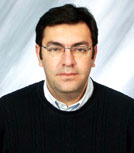
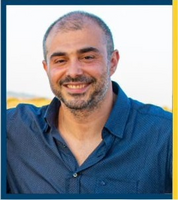
George Goumas is a Professor at the Department of Information Technology and Computers within the School of Electrical and Computer Engineering at the National Technical University of Greece. His teaching focuses on core computer science topics including operating systems, parallel processing, and network computing. He coordinates the following courses: Computer Operating Systems (Undergraduate - 6th Semester) Operating Systems Laboratory (Undergraduate - 7th Semester) Parallel Processing Systems (Undergraduate - 9th Semester) Advanced Computing Systems: Code Optimization Techniques for Multiprocessor Architectures (Postgraduate - Winter Semester) Parallel Computing Architectures for Machine Learning (Interdisciplinary) Parallel Network Computing (Cross-Departmental) His research interests align with his teaching responsibilities, emphasizing high-performance computing systems and software optimization techniques for modern architectures.
Petros Marangos is a Professor of Electrical and Computer Engineering at the National Technical University of Athens (NTUA), affiliated with the Department of Signals, Control and Robotics. He holds leadership roles as Director of the NTUA Lab on Intelligent Robotics and Automation and the newly launched Hellenic Robotics Center of Excellence. His career includes professorships at Harvard University (1985–1993) and Georgia Tech (1993–1998), alongside visiting positions at MIT, UPenn, and USC. He has supervised over 30 PhD students, 10 postdocs, and 130 MEng/MSc students. Research Interests: His work focuses on computer vision, image processing, speech and language processing, robotics, machine learning, and nonlinear systems. He has authored/co-authored over 400 publications, earning prestigious awards such as the IEEE Fellow (1995) and EURASIP Fellow (2010). Grants & Leadership: As Principal Investigator or Scientific Director, he has led over 50 projects, including EU Horizon 2020 initiatives like EASIER and SoftGrip. He co-founded the CVSP Lab and served as director of the NTUA Division of Signals, Control and Robotics for a decade. Awards & Recognition: Notable honors include the IEEE SPS Senior Best Paper Award (1994), the IEEE W.R.G. Baker Prize (1995), and election as IEEE Life Fellow (2023). Teaching: Teaches courses such as Computer Vision, Signals and Systems, Robotics, and Nonlinear Systems at NTUA, building on his extensive academic experience at Harvard and Georgia Tech. Lab Leadership: Directs the CVSP Lab and Robotics Lab at NTUA, advancing interdisciplinary research in perception, interaction, and automation.
Prof. Georgios Matsopoulos is a Professor at the Department of Information Transmission Systems and Materials Technology, School of Electrical and Computer Engineering, National Technical University of Athens (NTUA). He holds a Master's in Biomechanics and a PhD from the University of Strathclyde, Glasgow. As Director of the Biomedical Technology Laboratory, his expertise spans biomedical informatics, medical imaging, and healthcare data systems. His research focuses on diagnostic support systems, medical data fusion, biosignal processing, and AI-driven health technologies. Education: Bachelor's: School of Electrical & Computer Engineering, NTUA Master's: Biomechanics, University of Strathclyde PhD: University of Strathclyde Research Interests: Development of decision support systems, medical imaging analysis, health information systems, and AI applications in healthcare. He emphasizes large-scale medical data processing, radiomics, and clinical decision frameworks. His over 300 publications (2025-2021) highlight advancements in AI-driven diagnostics, medical robotics (e.g., HERON ontology), and telehealth systems. He leads projects like TeleRehaB DSS for stroke rehabilitation and the Retention project for heart failure monitoring. Grants/Projects: Extensive experience in managing research programs across public and private sectors, including EU-funded initiatives in medical AI and robotics. Labs & Teams: Oversees the Biomedical Technology Laboratory, focusing on translational research in biomedical engineering and digital health.
Panagiotis Tsanakas is a Professor of Computer Engineering at the National Technical University of Athens (NTUA), serving as Dean of the School of Electrical and Computer Engineering. He holds a PhD in Computer Engineering from NTUA (1988) and has extensive academic experience in parallel computing, medical informatics, and IoT applications. His work includes co-authoring seven textbooks on computer systems and supervising eight doctoral dissertations. Prof. Tsanakas has led major national and EU projects like EuroHPC and GRNET, managing Greece's academic networks and supercomputing infrastructure (ARIS). He pioneered systems like Eudoxus (textbook distribution), ZEUS (secure e-voting), and DIAVLOS (webcasting). His professional roles include Board membership of EuroHPC and leadership in GRNET, contributing to €60M annual savings through tech optimization. Research focuses on high-performance architectures, cloud systems, and AI in healthcare. He has published over 100 papers and actively teaches courses like Digital Health Technologies and Computer Architecture. His projects emphasize medical informatics, telemedicine platforms, and IoT-enabled health monitoring.
Professor Vassilios Loukopoulos holds a faculty position at the Department of Theoretical and Mathematical Physics, Astronomy and Astrophysics, University of Patras, since 2021. Previously, he served as Associate Professor (2016-2021), Assistant Professor (2011-2016), and Lecturer (2007-2011). He teaches courses in Fluid Mechanics, Computational Physics, and specialized MSc topics like Simulation Techniques for Physical Systems. His research focuses on computational fluid dynamics, magnetohydrodynamics, and numerical methods for fluid flow problems, with emphasis on nanofluids and biomedical applications. Collaborations include Max Planck Institute (Germany), KAUST (Saudi Arabia), and EPFL (Switzerland). He serves on editorial boards of journals like Mathematical Problems in Engineering and ISRN Mathematical Physics . Research interests span numerical solutions of Navier-Stokes equations, thermal convection in nanofluids, and biofluid mechanics under magnetic fields. He has developed meshless computational methods for complex fluid dynamics problems. Recent publications explore magnetohydrodynamic flows in porous media and transient bioheat transfer modeling. His work integrates advanced numerical techniques with applications in astrophysical fluid dynamics and medical physics. Education Progression : Professor: University of Patras (2021–present) Associate Professor: University of Patras (2016–2021) Assistant Professor: University of Patras (2011–2016) Lecturer: University of Patras (2007–2011) Grants and collaborations involve institutions like KAUST and the Institute of Chemical Engineering Sciences (Greece). His research team actively publishes in top journals like Journal of Computational Physics and Physics of Fluids , with a focus on developing innovative numerical frameworks for multiphysics problems.
Kalogeraki Vasiliki serves as an Associate Professor at the Department of Informatics within the School of Information Sciences and Technology at Athens University of Economics and Business (AUEB). Her academic journey includes foundational education at the University of Crete followed by doctoral studies at a prestigious American institution. Her educational background demonstrates a strong foundation in computer science and engineering disciplines. She earned her Bachelor's degree in Computer Science from the University of Crete, followed by a Master's (M.Sc.) in Computer Science from the same institution, and completed her Doctorate (Ph.D.) in Electrical and Computer Engineering from the University of California, Santa Barbara. Professor Kalogeraki's research spans multiple domains within computer science, with particular emphasis on networking, distributed systems, and information systems. Her work intersects with data science applications and electrical engineering principles, reflecting the interdisciplinary nature of modern computer science research. The Department of Informatics at AUEB maintains active research in numerous cutting-edge areas including network music performance, data spaces, telepresence technologies, and delay-tolerant networks. Her office is located at Troias 2, 5th floor, office 509, and she maintains a professional web presence at http://pages.cs.aueb.gr/~vana/. The Department of Informatics at AUEB is recognized as the top computer science department in Greece, ranking 78th in Europe according to CSRankings over the past decade.
Ioannis Marias is an Assistant Professor at the Department of Informatics, School of Information Sciences and Technology, Athens University of Economics and Business (AUEB). He holds a Diploma in Computer Engineering and Informatics from the University of Patras and a Doctoral Degree in Informatics and Telecommunications from the University of Athens. His office is located at Troias 2, 4th floor, office 405, and he can be reached at marias@aueb.gr or +30 210 8203 931. Dr. Marias' research focuses on network and computing security, privacy in mobile and pervasive computing, security and trust for the Future Internet including the Internet of Things, security & trust infrastructures, privacy and traceability of mobile objects, anonymity architectures, and security in wireless networks. His work addresses critical challenges in information security, particularly in the context of emerging network architectures and mobile environments. His publication record demonstrates significant contributions to security and privacy research, with a focus on information-centric networking, publish-subscribe architectures, SIP security, and wireless network security. Recent publications show a strong emphasis on privacy-preserving techniques, trust management frameworks, and security solutions for emerging network paradigms like the Future Internet and IoT. Dr. Marias has been involved in several major research projects including FP6-IST STREP SCIER, FP6-COOP SPIDER, FP7-ICT PSIRP, and FP7-ICT EuroNF NoE ASPECTS. He serves as a member of the Advisory Board for ICT Trust and Security (RISEPTIS) and the EC Future-Internet Cluster, demonstrating his leadership in the European research community. In teaching, he offers courses including Network and System Security, Applied Cryptography for the MSc in Information Systems, and Information Systems Organization at the undergraduate level. His educational background and research expertise provide students with valuable insights into both theoretical foundations and practical applications of information security.
Togantzis Maria is a Researcher affiliated with the Athens University of Economics and Business (AUEB) , specifically within the Sector of Computer Systems and Communications and its Department of Computer and Communications Systems . She is also a member of the Greek Institute of Public Administration . Her office is located at 12 Kodrigtonos Str., 1st floor, and her contact email is mst@aueb.gr . Her research interests align with computer systems, communications, and their applications in public administration. Further details about her work can be explored via her webpage at http://niovi.aueb.gr/~mst/index.htm .
Emmanouil Zachariadis is an Associate Professor in the Department of Management Science and Technology at the Athens University of Economics and Business (AUEB), affiliated with the School of Business Administration. He holds a Chemical Engineering degree from the National Technical University of Athens (NTUA) and an MSc in Computing Science from Imperial College London. His doctoral research focused on computational optimization for operational research problems at NTUA's Department of Chemical Engineering. His research emphasizes mathematical programming, logistics optimization, supply chain environmental impact reduction, and operational management. He has published 26 high-impact articles in Management Science and Operations Research, with over 1,200 Scopus citations. His work includes European and national research programs on distribution networks, transportation, and sustainable supply chains. Teaching awards include recognition for courses like Optimization Methods in Management Science (2021-22) and Large Scale Optimization (2020-21 to 2022-23). His research collaborations span cross-docking strategies, vehicle routing, and wildfire evacuation planning. He contributes to academic service via curriculum development and interdisciplinary projects.
Georgios Atsalakis is an Assistant Professor at the School of Production Engineering and Management, Technical University of Crete. He holds an office at Δ5.007 in the DPEM Building, Ground Floor. His academic work focuses on applying neuro-fuzzy systems to diverse forecasting challenges in economics, finance, and engineering. His research integrates computational intelligence with real-world applications such as stock market trends, energy prices, and commodity demand, emphasizing predictive modeling and decision-making frameworks. Education details are not explicitly listed, but his academic affiliation and publications suggest expertise in computational methods and applied economics. His work often bridges theoretical models with practical industry needs, such as optimizing tourism services or analyzing cryptocurrency markets. Research Interests: Development of neuro-fuzzy models for economic forecasting Computational intelligence in financial markets Energy and environmental policy analysis Supply chain dynamics and demand prediction Algorithmic trading and market volatility analysis His articles span over two decades, showcasing a consistent focus on predictive systems for complex systems. Recent trends include integrating neuro-fuzzy techniques with macroeconomic cycles and policy impact analysis. Notable contributions include frameworks for Baltic Dry Index forecasting and Bitcoin price modeling. No academic awards are listed in the provided materials. He advises no students explicitly mentioned, though his affiliations suggest involvement in academic supervision through the School's programs. He is likely associated with the university's Production Systems and Decision Sciences laboratories, contributing to interdisciplinary research initiatives.
Dr. Maria Bakatsaki is Laboratory Teaching and Research Staff (EDIP) at the School of Production Engineering and Management, Technical University of Crete (TUC). She teaches courses including Management Systems, Technoeconomic Studies, Human Resource Management, and Computational Mechanics. Her academic journey includes a B.Sc. (1992), M.Sc. (1999), and Ph.D. (2018) from TUC’s PEM School. Her research focuses on Management of Business Processes, Organizational Behavior, Sustainability Leadership, and Responsible Consumption & Production. Since 1993, she contributed to TUC’s administrative structures, managing research projects and establishing offices like the Technology Transfer Office. She organized international conferences and events, transitioned to online education during the pandemic, and completed certifications such as MIT’s Neuroscience for Business program (2022). She is affiliated with the CoMecO Laboratory and actively engages in interdisciplinary research. Her professional development includes training in Offshore Structures (2023), SDG12 (2021), and Project-Based Learning (2023). Key research themes include Work-Life Balance, Eco-Intelligence, and soft aspects of sustainability. Her publications span entrepreneurship, disaster management, and venture capital in Greece.
Fafalios Pavlos is an Assistant Professor at the School of Production Engineering and Management of the Technical University of Crete. His research focuses on knowledge graphs, ontology management, semantic interoperability, and data integration. He has organized international workshops such as BeyondFacts on computational methods for online discourse analysis. Pavlos's work bridges computer science with domains like digital humanities, maritime history, and food science, emphasizing the application of semantic technologies for interdisciplinary challenges. His academic background includes significant contributions to semantic web technologies, entity linking, and fact-checking systems. Pavlos collaborates on projects like ClaimsKG and FastCat, advancing methods for analyzing historical and archival data. He has published extensively on topics ranging from ontology governance to knowledge graph applications in earthquake data modeling and circular economy analysis. Recent trends in his research include enhancing semantic interoperability across heterogeneous datasets and developing frameworks for robust claim validation in online discourse. His work often integrates machine learning with traditional information retrieval techniques to address real-world data challenges.
Nikos Giatrakos is an Assistant Professor at the School of Electrical and Computer Engineering (ECE) of the Technical University of Crete. His primary research focuses on Big Data Management, Real-Time Analytics, and distributed systems. He holds a PhD in Computer Science from the University of Piraeus (2012), an MSc from Athens University of Economics and Business (2007), and a Diploma in Computer Science from the University of Piraeus (2006). His research interests include Big streaming Data & Real-Time Analytics , Distributed/Decentralized Big Data Processing , Federated Machine Learning , Edge-to-Cloud Data Management , and Complex Event Processing . He has contributed to EU projects as a key investigator and received the Best Demo Award in ACM CIKM 2020 for innovative work in streaming analytics. Notable research trends in his articles emphasize real-time resource optimization (e.g., tumor simulations over HPC), adaptive event forecasting , and distributed systems for large-scale data processing. His work bridges theoretical algorithms with practical implementations, such as the SuBiTO framework for neural learning and the FERARI system for multi-cloud event processing. Awards : Best Demo Award (ACM CIKM 2020) Key Projects : EU-funded initiatives on extreme-scale analytics and federated learning Grants : Contributions to multi-site and cross-platform analytics research He leads efforts in extreme-scale analytics-as-a-service (e.g., the INFORE approach) and has developed tools like SheerMP for scalable streaming services. His work often addresses challenges in edge computing , IoT workflows , and geospatial event detection over maritime or movement data.
Niki Vazou is an Associate Research Professor at the IMDEA Software Institute. She holds a Ph.D. from UC San Diego, where she co-developed Liquid Haskell, a refinement type checker for Haskell programs. Her research focuses on refinement types and their application in verifying real-world properties of programs. In 2022, she received the prestigious ERC Starting Grant CRETE to advance this research. She delivered a lecture titled 'Practical Program Verification with Refinement Types' on July 18, 2024, at the TU of Crete's Science Building 145Π42. Her work bridges theoretical foundations with practical verification tools, emphasizing automated methods for ensuring software correctness. Key honors include the ERC Starting Grant CRETE, which supports her exploration of refinement types in verifying complex software systems. Niki’s contributions to formal methods and type systems have significant implications for improving software reliability, particularly through her ongoing work with Liquid Haskell and related technologies.
Professor Euripides G.M. Petrakis serves as a Professor and Laboratory Director at the Technical University of Crete (TUC) within the School of Electrical and Computer Engineering. He has been a faculty member since 1999 and has directed the Intelligent Systems Laboratory since 2006. As a Senior Member of IEEE, he maintains an active research profile with over 175 publications and more than 4,000 Google Scholar citations. Education: Ph.D. in Computer Science (1993), University of Crete B.Sc. in Physics (1985), National University of Athens Professor Petrakis' research spans Cloud Computing, Internet of Things, Semantic Web, and Computer Vision. His work has evolved from early computer vision and image databases to modern information systems, semantic web technologies, and most recently cloud computing and IoT applications. His research demonstrates consistent innovation across multiple computing domains with practical implementations in healthcare, security, and smart systems. His recent publications reveal a strong focus on IoT architectures, cloud/fog computing optimization, semantic service descriptions, and real-time video processing with Apache Flink. The research shows increasing integration of blockchain for security, advanced scheduling algorithms for microservices, and semantic approaches to improve interoperability in distributed systems. Scientific Recognition: Best paper award at AINA 2024 TUC Excellence Award 2022 Keynote speaker at EIDWT-2025 Ranked in top 2% of scientists worldwide (Stanford rankings 2021-2023) Professor Petrakis has supervised numerous graduate students, resulting in over 120 co-authored papers. He has successfully secured substantial research funding, attracting more than 2.5 million euros for TUC through multiple EU and Greek government projects. His grant portfolio includes leadership roles in Horizon 2020, FP7, and national research initiatives spanning border surveillance, smart farming, healthcare systems, and semantic web technologies. As Director of the Intelligent Systems Laboratory, he leads research in cloud computing, IoT, semantic web, and computer vision. The lab has produced multiple system prototypes including IntelliSearch, Semantic Similarity tools, MedSearch, and WebSummarization systems. Current research directions focus on secure federated architectures for IoT, advanced service description frameworks, and real-time video analytics in distributed environments.