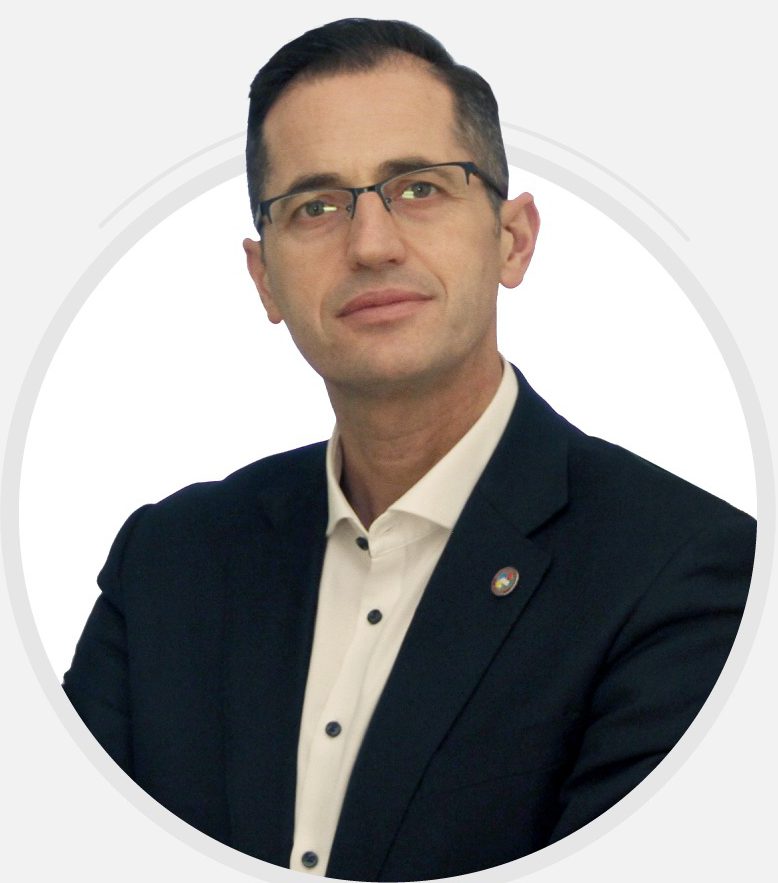
Dalibor Radovanović is a researcher at Singidunum University , affiliated with the Faculty of Business Informatics . His work spans cybersecurity, blockchain technologies, and their applications in business and IoT systems. Education: Doctoral Dissertation (2016, Singidunum University) Master's & Basic Studies (Faculty of Business Informatics) Secondary Education: ETŠ Nikola Tesla Research Interests include: Security frameworks for IoT and blockchain integration Smart card and wireless network vulnerabilities E-governance and corporate IT audit methodologies Machine learning applications in cybersecurity Environmental performance optimization in agribusiness Publication Trends reveal a focus on blockchain (2022), cybersecurity (2009-2022), and IT governance (2010-2017). His work bridges theoretical analysis with practical implementations in Serbia's digital economy. Collaborations with scholars like Marko Šarac and Saša Adamović highlight interdisciplinary approaches to securing financial systems, educational institutions, and industrial IoT applications.
Nebojša Bačanin Džakula is an academic affiliated with Singidunum University's Faculty of Mathematics, specializing in Computer Science. He earned his PhD in 2015 with a thesis on improving swarm intelligence metaheuristics for global optimization. His research focuses on AI-driven solutions for cybersecurity, energy forecasting, and optimization algorithms. He has authored/co-authored books on cloud computing and web programming. His work bridges metaheuristics with machine learning, addressing challenges in IoT security, renewable energy prediction, and healthcare diagnostics. He actively contributes to conferences like Sinteza and IEEE events, emphasizing practical applications of AI and optimization in real-world scenarios. Education: Completed doctoral studies at the Faculty of Mathematics (2009–2015). Extensive industry certifications include Microsoft, CompTIA, and Oracle credentials, enhancing his technical expertise. Research Interests: Develops hybrid models combining metaheuristics (e.g., PSO, GA) with deep learning for tasks like intrusion detection, price forecasting, and medical diagnostics. Specializes in optimizing neural networks and feature selection using advanced algorithms. His work often addresses societal challenges in sustainability, cybersecurity, and healthcare. Recent Publications: Focus on AI-driven solutions for IoT security, renewable energy prediction, and medical diagnostics (e.g., Parkinson’s detection via LSTM networks). His articles appear in prestigious journals like Engineering Applications of Artificial Intelligence and Applied Soft Computing.
Sebastian Pokutta is a Professor at Technische Universität Berlin, Vice President at the Zuse Institute Berlin (ZIB), and Chair of the Cluster of Excellence MATH+ and MODAL. His research lies at the intersection of Artificial Intelligence, Optimization, and Machine Learning, with applications in sustainability, quantum computing, and mathematical discovery. Research Interests: Development of novel optimization algorithms, particularly Frank-Wolfe and Conditional Gradient methods. Integration of machine learning with decision-making and combinatorial optimization. AI for Science (AI4Science), including applications in quantum mechanics and ecology. AI and creativity, human-AI co-creativity, and social science modeling using multi-agent LLMs. His recent publications (2025) demonstrate a strong focus on scalable optimization, interpretability, and algorithmic foundations. The work spans theoretical advances in convergence analysis, practical implementations in Julia (FrankWolfe.jl), and real-world deployments in biomass estimation and quantum certification. Scientific Awards: Gödel Prize (2023) STOC Test of Time Award (2022) Science Prize of the Association for Pediatric Orthopedics (2025) Google Research Awards (2021, 2020) NSF CAREER Award (2015) He advises a vibrant research group, with former students and postdocs securing faculty positions at institutions like Inria, Carlos III University, and James Madison University. His group has received funding from Google, DFG, and Math+, and he leads major collaborative efforts such as the Thematic Einstein Semester on Mathematical Optimization for Machine Learning. Labs and Teams: Interactive Optimization and Learning Lab at TU Berlin and ZIB. Leadership in MODAL and MATH+ research clusters, fostering interdisciplinary collaboration in mathematical optimization and AI.
Sebastian U. Stich is a tenured Professor at CISPA Helmholtz Center for Information Security and a member of the European Lab for Learning and Intelligent Systems (ELLIS). His research focuses on optimization for machine learning, collaborative learning (distributed, federated, and decentralized methods), efficient optimization techniques, adaptive stochastic methods, and privacy/security in machine learning. Recent appointments include ERC Consolidator Grant 2024 for the CollectiveMinds project. Key contributions in federated/decentralized learning, uncertainty estimation, and communication-efficient optimization. Active in workshop organization, including the Optimization for Machine Learning workshop at NeurIPS 2024. Teaching modern optimization methods at Saarland University (2023-2025). His work has been recognized with awards such as the Google Research Scholar Award (2023) and Meta Privacy-Enhancing Technologies Award (2022) . His research group includes postdocs Dr. Anton Rodomanov and Dr. Rotem Mulayoff, and PhD students Xiaowen Jiang and Yuan Gao.
Prof. Blerim Rexha is a full professor at the University of Prishtina's Faculty of Electrical and Computer Engineering, Kosovo. With a Ph.D. in Computer Engineering from Vienna University of Technology (2004), he has led research in cybersecurity, blockchain, machine learning, and electronic voting systems. His teaching portfolio includes data, computer, and internet security courses. Education : Ph.D. in Computer Engineering (Vienna), Electrical Engineer MSc (Prishtina), specialized certifications in software engineering, biometrics, and .NET programming. His research spans cybersecurity (DDoS mitigation, face authentication attacks), blockchain applications (electronic voting bridges, transaction privacy), and machine learning integration (boosted trees for intrusion detection, LSTM for vulnerability scanning). He has contributed to cloud security through novel encryption methods and AI-driven attack detection. Recent publications focus on energy efficiency in cloud vs on-premises systems, XGBoost/CatBoost/LightGBM comparisons for network security, and blockchain bridges for e-voting. His work has addressed privacy preservation in video data, SMS encryption, and eID card pseudo-profiles. Awards include the 2024 Marin Barleti Prize for academic contributions and Best Paper Awards in election security (2015) and Kosovo website vulnerabilities (2013). Honors : Marin Barleti Prize (2024) Cyber Security Ambassador (2018) ICT Academician of the Year (2016) Best Paper Awards (2015, 2013) As academic advisor to the KosovaCyberTeam , he mentors students like Korab Keqekolla and Abian Morina. His leadership extends to Kosovo's Cyber Security State Training Center curriculum development and jury roles in Albanian ICT Awards .
Yannic Maus is a University Professor at the Faculty of Computer Science and Biomedical Engineering at Graz University of Technology (TU Graz), Austria, where he heads the newly founded Institute of Algorithms and Theory (established in 2025). He also serves as co-leader of one of the five fields of expertise at TU Graz (FoE Information, Communication & Computation). His academic journey includes: PhD in Computer Science from University of Freiburg, Germany (2014-2018) MSc in Mathematics from RWTH Aachen, Germany BSc in Mathematics and Computer Science from RWTH Aachen, Germany (with a year at National University of Singapore) Professor Maus specializes in theoretical computer science and algorithm design, with a particular focus on distributed computing. His research spans distributed graph algorithms, efficient algorithms, data structures, complexity theory, and geometric algorithms. He approaches problems with both theoretical rigor and practical applications in mind, seeking clean mathematical solutions to questions motivated by real-world systems. His recent publications show a strong focus on distributed and parallel algorithms, particularly in graph theory. The research trends include distributed graph coloring, symmetry breaking, vertex cover problems, and massively parallel computing models. His work often bridges theoretical computer science with practical distributed systems considerations, with applications to large-scale networks and highly parallel systems. Professor Maus has received numerous accolades for his research: 2020 Principles of Distributed Computing Doctoral Dissertation Award Wolfgang-Gentner-Nachwuchsförderpreis 2019 GI Dissertationspreis 2018 Best Paper Awards at SIROCCO 2016, DISC 2016, and DISC 2017 Professor Maus actively mentors PhD students and has secured significant research funding, including FWF grants P36280-N (2023-2027), DOC 183 (2024-2028), I6915 (2024-2028), and FFG grant No. 59263962. His research group maintains strong international collaborations with institutions across Germany, Finland, Iceland, Israel, and beyond, providing students with opportunities for international research visits. He leads the Algorithms & Complexity research group at TU Graz, which includes PhD students Manuel Jakob, Florian Schager, Malte Baumecker, and Kritika Kashyap, as well as postdoc Tijn de Vos. The group is actively involved in theoretical computer science research with a focus on distributed and parallel algorithms, particularly for large-scale networks and highly parallel systems.
Marina Milovanović is a Professor at the University of Singidunum, Faculty of Informatics and Computing, Department of Mathematics. She holds dual doctoral degrees from the Faculty of Science, University of Kragujevac (Department of Mathematics, 2014) and Faculty of Entrepreneurial Business, Union University (2008), along with Master's and Bachelor's degrees from the Faculty of Mathematics, University of Belgrade (2000-2005 and 1995-2000 respectively). Faculty of Science, University of Kragujevac, Department of Mathematics (PhD, 2014) Faculty of Entrepreneurial Business, Union University (PhD, 2008) Faculty of Mathematics, University of Belgrade (Master's, 2000-2005) Faculty of Mathematics, University of Belgrade (Bachelor's, 1995-2000) Svetozar Marković High School, science and mathematics major (1991-1995) Professor Milovanović specializes in Mathematics Education and Educational Technology, with particular expertise in interactive multimedia applications for teaching mathematics. Her research consistently bridges theoretical mathematics with practical educational technology solutions, evolving from traditional multimedia approaches to incorporating cutting-edge AI and machine learning techniques. She has authored multiple books including 'Interactive multimedia in mathematics teaching' (2015) and collections of solved mathematics problems for entrance exams. Her recent publication record through 2025 demonstrates active engagement in interdisciplinary research, particularly at the intersection of educational technology, artificial intelligence, and practical applications in fields ranging from software engineering to medical diagnostics. Her work shows a clear trajectory from foundational educational technology research toward more sophisticated AI-enhanced learning systems. Professor Milovanović has made significant contributions to semantic web applications in education, particularly through Moodle LMS enhancements, and has explored SCADA applications in industrial contexts. Her collaborative research spans multiple countries and institutions, reflecting an international scholarly network. She has extensive experience developing computer tools for engineering education and has published on diverse topics including petroleum industry processes, environmental management, and financial mathematics. Her work demonstrates consistent application of computational approaches to solve domain-specific problems across multiple disciplines.
Marko Tanasković is a researcher at Singidunum University's Faculty of Informatics and Computing, specializing in control systems, robotics, and electrical engineering. He holds a PhD from ETH Zurich (2015) in Information Technology and Electrical Engineering, following degrees from University of Belgrade (BEng, 2009) and ETH Zurich (MEng, 2011). His research focuses on adaptive control systems, machine learning applications in engineering, and sensorless motor control. Key contributions include: Development of predictive algorithms for traffic systems and industrial automation Innovations in rotor orientation determination for PMSM motors Integration of AI in fraud detection and building climate control Recent work includes a 2024 study on wearable health monitoring devices and a 2022 paper on drone forensics. He has authored/co-authored over 15 peer-reviewed articles and holds patents in motor control technologies. Current affiliations include Singidunum University's Department of Electrical Engineering and Collaboration with ETH Zurich alumni networks. Active in international conferences such as Sinteza and IEEE events.
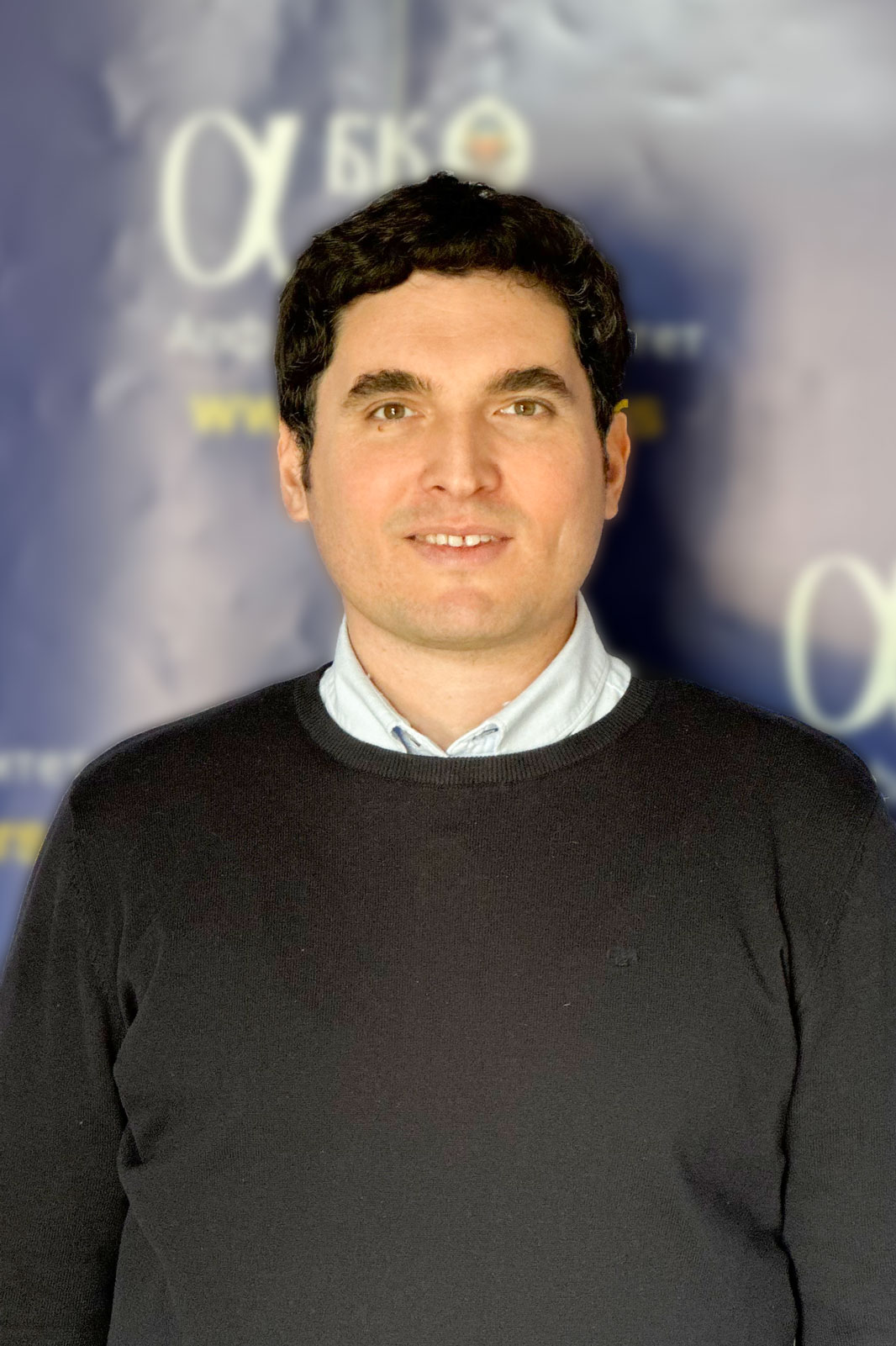
Milan Brkljač is an Assistant Professor at Alfa BK University, affiliated with the Faculty of Finance, Banking and Auditing. He holds a PhD from the University of Novi Sad (2021), with research focused on marketing, consumer behavior, and sharing economy dynamics. His professional journey includes roles at NIS GAZPROM NEFT, Digipuls d.o.o., and the University of Modern Business in Belgrade. Education: BSc/MSc from University of Novi Sad (Faculty of Economics in Subotica), PhD (2021) on 'Determinants of Intentions to Use Sharing Economy Services among the Millennial Generation'. Research Interests: Marketing strategies in digital age, consumer decision-making, sharing economy, blockchain applications in agriculture, and CSR in banking. He has conducted study visits to TU Munich and DAAAM International Vienna, and holds certifications in Digital Marketing (Google Ads) and ECDL. Awards: Ministry of Education Scholarship (2008-2010), FESTO Scholarship (2018), and first prize for promotional video (2010). Active in professional communities like Serbian Marketing Association (SeMa). Grants/Advising: Multiple academic publications, involvement in employer branding and talent recruitment studies. Fluent in English and German, with piano skills from Isidor Bajić Music High School.
Aleksandar Jevremović is a Full Professor at the Faculty of Informatics and Computing, Singidunum University (Belgrade, Serbia), and holds multiple academic and professional roles. He is the Serbian representative at the UNESCO IFIP Technical Committee on Human-Computer Interaction since 2018. He has served as Vice-Dean of his faculty (2015–2018) and held visiting professorships at institutions like Ss. Cyril and Methodius University (North Macedonia) and Tallinn University (Estonia). His research focuses on cybersecurity, IoT, AI, and e-learning innovation. Education and Affiliations: External Researcher at the Mathematical Institute of the Serbian Academy of Sciences and Arts Visiting Scholar at Cyprus Interaction Lab (Cyprus University of Technology) Alumni/Postdoc Researcher at Tallinn University's HCI Group Member of IEEE and the Informatics Association of Serbia Research Interests: Jevremović’s work spans cybersecurity (e.g., intrusion detection, secure IoT protocols), human-computer interaction (HCI), AI-driven education tools, and neurotechnological applications like EEG-based assessment systems. He emphasizes practical solutions for digital safety, such as children’s online protection and cryptographic key generation from biometric data. Grants and Projects: Member of the External Advisory Committee for the EU-funded ONTOCHAIN project (2022–2023) Mentor for training schools like AAPELE Training School and NET4Age-Friendly initiatives Trainer in IoT, cybersecurity, and health promotion programs across Europe Labs and Teams: He collaborates with interdisciplinary teams on projects like CASPER (Children Agents for Secure and Privacy Enhanced Reaction) and led the development of WIDE, a collaborative web development education platform.
Prof. Dr. Saša Adamović is a faculty member at Singidunum University in Belgrade, Serbia, affiliated with the Faculty of Informatics and Computer Science . His academic career spans over 15 years with a focus on Cryptography, Biometrics, and IoT Security . Born October 15, 1985, in Drvar, Bosnia and Herzegovina PhD in Advanced Security Systems (2013), Master’s in Contemporary Information Technologies (2008), and Bachelor’s in Business Informatics (all from Singidunum University) His research interests include: Biometric Cryptography Blockchain for IoT Security Catalan Number Applications in Cryptography Machine Learning in Security Systems Virtualization and Energy Efficiency Steganography and Forensics Recent publications highlight trends in: IoT Healthcare Security (2022) Biometric Authentication (2021) Combinatorial Cryptography (2021) Machine Learning for Diabetes Prediction (2021) Distance Learning Security (2023) He served as one of five Serbian representatives in the Open World program (USA) for expert exchange in technology development.
Nataša Kilibarda serves as Professor at Singidunum University's Faculty of Tourism and Hospitality Management in Belgrade, Serbia. Her academic career spans over two decades with specialized expertise in food safety, meat technology, and sustainable food systems. She holds doctoral qualifications in Food Hygiene and Technology from the University of Belgrade's Faculty of Veterinary Medicine. Her research focuses on critical food industry challenges including food waste reduction, pandemic-era food safety protocols, sustainable meat production, and hospitality sector food handling practices. Kilibarda's work bridges academic research with practical industry applications, particularly in Serbian and Balkan contexts. Her recent publications demonstrate growing emphasis on sustainable food systems, biogas production from organic waste, and the intersection of tourism with traditional food quality. Her 15 most recent publications reveal consistent contributions to food safety literature with particular expertise in: Meat technology and quality control Microbiological safety of processed foods Food waste management strategies Pandemic impact on food systems Sustainable resource utilization Kilibarda maintains active collaboration with Serbian food industry stakeholders and contributes to national food safety standards development. Her work appears in prominent regional journals including Meat Technology, Journal of Food and Nutrition Research, and Tehnologija mesa.
Vuk Gajić is an Assistant Professor at the Faculty of Applied Ecology, Singidunum University, where he has held academic roles since 2016. His career progression includes positions as a teaching associate (2016), assistant (2019), and current role (2023). He earned a Ph.D. in Environment and Sustainable Development from Singidunum University (2019–2022), following prior studies in environmental protection and risk management at the same institution. Research interests span environmental science, sustainable development, GIS applications, and radiation technology for waste and food treatment. He has contributed to interdisciplinary studies, including soil contamination analysis in Libya, microbial decontamination via ionizing radiation, and machine learning applications for software defect prediction and agricultural weed detection. His work bridges environmental engineering with technological innovation, emphasizing sustainability and ecological conservation. Publications reflect a focus on environmental monitoring, pollution assessment, and eco-technologies. Key themes include GIS-based environmental databases, forest fire prevention through sensor networks, and agricultural waste reuse. His research often integrates quantitative methods with geospatial tools, addressing both local and global environmental challenges. Teaching responsibilities include courses on geodiversity, sustainable development, and natural hazards. He actively participates in academic conferences, contributing to peer-reviewed journals and presenting at events like Sinteza and SETI. Current projects likely explore emerging technologies in environmental management and sustainable practices.
Dr. Vladimir M. Ciric is a Full Professor at the Faculty of Electronics, University of Niš, leading the Department of Computer Science. He directs the Laboratory for Advanced Security Systems and specializes in network security, distributed systems, and high-performance computing. His research spans intrusion detection systems, cloud computing cost modeling, and parallel algorithm design. Notable contributions include Hadoop-based network intrusion detection techniques and tiered programming pedagogy. He received the Cisco Excellence Award (2015) for network technology education. Dr. Ciric teaches courses on network design, cloud computing, and security while maintaining research collaborations in cybersecurity and distributed architectures. His recent work focuses on extreme class imbalance in intrusion datasets and sparse matrix optimizations.
Sanja R. Grgurić-Šipka is a Full Professor in the Department of General and Inorganic Chemistry at the University of Belgrade's Faculty of Chemistry, where she has served since 1995. She currently heads the Department of General and Inorganic Chemistry (since October 2023) and teaches core courses including General Chemistry, Chemistry of Bioelements, and Metals and Metal Complexes in Medicine. Her educational background includes: Undergraduate studies in Chemical Sciences (1990-1994) Master's degree in Chemical Sciences (1995-1998) Doctorate in Chemical Sciences (1999-2003) All obtained at the University of Belgrade Faculty of Chemistry. Grgurić-Šipka's research focuses on coordination chemistry and bioinorganic chemistry , specifically exploring metal-based anticancer agents, particularly ruthenium and platinum complexes. Her work integrates synthetic chemistry with biological evaluation to develop novel metallodrugs targeting cancer mechanisms. She employs spectroscopic methods to study metal-biomolecule interactions and investigates structure-activity relationships to optimize therapeutic potential. Current projects emphasize sustainable innovation and 'omics' research in food and environmental contexts. Analysis of her 15 most recent publications reveals a consistent emphasis on ruthenium(II)-arene complexes for cancer therapy, with growing exploration of heterometallic systems and NSAID conjugates. Her work bridges inorganic synthesis with biological testing, demonstrating strong translational potential in medicinal chemistry. Scientific recognition includes: Lisa Meitner Fellowship from the Austrian Science Fund (2005) She actively supervises research and secures competitive funding, currently leading the Horizon 2020 project 'FoodEnTwin' (2018-2021) on 'omics' research in food and environment, and the Serbian Innovation Fund project 'Pioneering Innovation of Baby Wet Wipes' (2020-2021). Previously, she coordinated national and EU-funded projects including 'Rational Design of Biologically Active Coordination Compounds' (2011) and 'Metal Complexes Binding to Biomolecules' (2012-2016). Grgurić-Šipka contributes to the Serbian Chemical Society (member since 1994) and leads departmental innovation initiatives through the Faculty of Chemistry's Innovation Center and Center for Molecular Food Sciences.