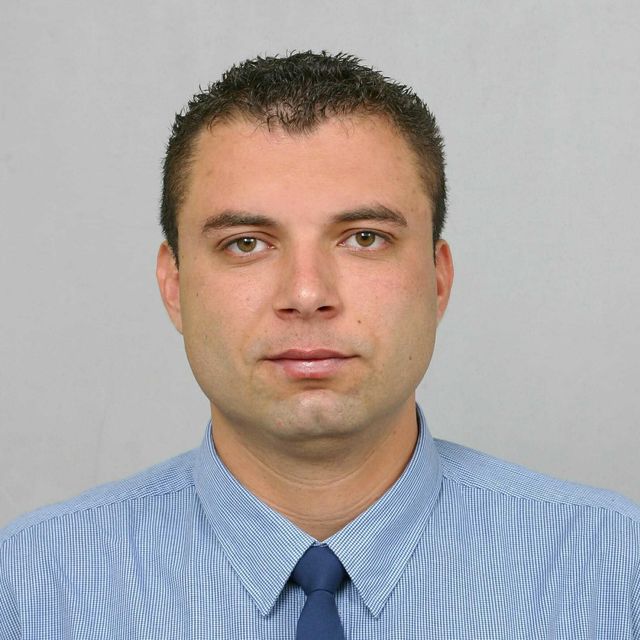
Slav Angelov is a Senior Lecturer in the Department of Informatics at New Bulgarian University (NBU), serving since September 2017. He teaches core courses including Applied Mathematics for Economists, Quantitative Methods in Management, Probability and Statistics, and Knowledge Extraction from Data, while contributing to NBU's joint program with the University of Sheffield. His academic credentials include: Master's degree with honors in Optimization from Sofia University "St. Kliment Ohridski" (2014) PhD in Computer Science and Informatics from NBU (2019), dissertation: "Computer Simulation and Assessment of Corporate Risks" Dr. Angelov's research focuses on statistical modeling and algorithmic development, with expertise in regression analysis (particularly multicollinearity solutions and cross-validation techniques), machine learning applications, and knowledge extraction systems. His work bridges theoretical statistics with practical implementations in energy forecasting and bioinformatics. His publication record reveals a consistent research trajectory centered on advancing regression methodologies across diverse domains. Key contributions include modified regression techniques for risk assessment and educational frameworks for data mining pedagogy, demonstrating dual expertise in methodological innovation and curriculum development. He has been an integral member of NBU's Center for Risk Management, leading analytical work on critical national infrastructure projects including the Belene Nuclear Power Plant, Balkan gas hub development, and long-term electricity consumption forecasting for Bulgaria through 2030.
Chief Assistant Professor Ivaylo Radev serves at the University of Architecture, Civil Engineering and Geodesy (UACEG) within the Faculty of Geodesy, Department of Higher Geodesy. His academic career spans geodetic monitoring, crustal deformation analysis, and landslide process studies with active involvement in international research projects. His research focuses on geodynamic processes , particularly through GPS monitoring of crustal deformations and active fault analysis. Key areas include landslide monitoring in urban environments like Sofia's Botanical Garden, Krupnik-Kresna region geodynamics, and integration of gravimetric measurements with geodetic data. His methodological approach combines field measurements with finite element modeling for deformation analysis. Publications reveal a consistent research trajectory in geodetic monitoring techniques from 2004-2012, with emphasis on practical applications for natural hazard assessment. His work demonstrates strong collaboration with the Bulgarian Academy of Sciences and international partners through NATO-funded projects. As project manager for multiple geodynamic research initiatives including 'Complex Research of Modern Geodynamics in the Krupnik-Kresna Area' (2006) and 'Study of Modern Active Faults Through Geodetic Methods' (2012), he has contributed to regional seismic hazard understanding. His participation in the NATO Science for Peace project 'HEMUSNET' (2006-2011) highlights international research engagement. He maintains active teaching responsibilities with documented lecture courses and Teams-based educational platforms for geodetic instruction. His laboratory work centers on deformation monitoring systems within the Department of Higher Geodesy infrastructure.
Georgi Marinov serves as Assistant Professor at the University of Architecture, Civil Engineering and Geodesy (UACEG) in Sofia, Bulgaria, within the Faculty of Geodesy's Department of Higher Geodesy. His current responsibilities include teaching exercises on Global Navigation Satellite Systems (GNSS) and Basic Geodetic Measurements and Networks. Education: Doctor of Science in General, Higher and Applied Geodesy (2009, Sofia) Master of Engineering in Geodesy (2003, UACEG-Sofia) Marinov's research focuses on engineering geodesy applications, particularly coordinate transformations and GNSS network analysis. His work bridges theoretical geodesy with practical construction projects, including Sofia metro expansions and anti-erosion infrastructure. The 2008 publications reveal deep expertise in seven-parameter Helmert transformations, addressing computational challenges in datum conversions and deformation analysis. His methodologies support precision requirements in large-scale civil engineering where millimeter-level accuracy is critical. Marinov actively participates in the BALkan GEodetic Observing System (BALGEOS), contributing to regional geodetic infrastructure. His project portfolio includes: Comprehensive geodynamics study in Krupnik-Kresna region Sofia metro expansion (multiple sections) Tunnel construction under Cherni Vrah Boulevard Varna slope anti-erosion reinforcement He holds legal certification for cadastre activities and maintains proficiency in English and Russian for international collaboration.
Roumen Nikolov is an Associate Professor in the Department of Computer Science at the University of Library Studies and Information Technologies in Sofia, Bulgaria. He is an active researcher with 19 publications generating over 10,773 reads and 81 citations, specializing in the integration of information technology across education, environmental management, and urban development. As a core member of Elena Shoikova's Lab, his work bridges theoretical frameworks with practical implementations of emerging technologies. His research spans Smart Education systems, Blockchain applications, Smart City ecosystems, and Forest Management solutions. Key interests include developing competence-based learning models for digital natives, creating energy-efficient smart home environments, and establishing interoperable standards for urban IoT infrastructure. His publications consistently emphasize sustainability, user-centered design, and the socio-technical implications of digital transformation in both educational and ecological contexts. Analysis of his 15 most recent publications reveals a pronounced interdisciplinary trajectory where computer science fundamentals converge with environmental science and educational theory. Dominant themes include the application of Big Data analytics in urban ecosystems, blockchain-enabled industrial innovation, and the conceptualization of smart learning environments. His work demonstrates particular strength in translating technical capabilities into tangible solutions for Bulgaria's national ICT strategy implementation and sustainable regional development. Nikolov maintains extensive collaborative networks across Bulgarian academic institutions including the Technical University of Sofia and Bulgarian Academy of Sciences. His primary research vehicle is Elena Shoikova's Lab, which focuses on advanced ICT applications in education and environmental management. Current projects emphasize cloud-based educational architectures, smart forest ecological management systems, and the development of service-oriented smart home solutions that prioritize energy efficiency and user experience.
Martin Georgiev serves as a Senior Lecturer at the University of Architecture, Civil Engineering and Geodesy (UACEG) in Sofia, Bulgaria, within the Faculty of Architecture's Department of Residential Buildings. He maintains regular office hours on Tuesdays and Fridays from 1:00 PM to 2:00 PM in Cabinet 1025. His educational background includes: Doctor of Architecture from UACEG's Faculty of Architecture, Department of Residential Buildings (2020-2023) Professional field 5.7 "Architecture, Construction and Geodesy" with scientific specialty in "Architecture of Buildings, Structures, Facilities and Details" Master's degree in Architecture from UACEG, Faculty of Arts (1998-2004) Secondary education at First English Language High School in Sofia (1992-1997) Dr. Georgiev's research focuses on the intersection of computational methods and architectural design, particularly emphasizing parametric, algorithmic, and generative design approaches applied to residential buildings. His work explores how digital tools can be integrated into early design phases to optimize construction processes through data-driven methodologies. He has developed specialized expertise in architectural modeling using digital tools, which forms the basis of his doctoral research on construction and optimization of residential buildings through data and algorithms. His recent publications demonstrate a clear trajectory toward computational design solutions in architecture, with emphasis on practical applications of data and algorithms in residential building design. The research shows particular attention to optimizing construction processes through digital methodologies. Dr. Georgiev actively participates in architectural practice through associations with geoarchitects.eu and capitalfort.com, bridging academic research with professional design work. His teaching responsibilities encompass multiple residential buildings courses across the 3rd, 4th, and 5th year curriculum, including specialized projects and lectures on digital architectural modeling techniques.
Radul Shishkov serves as Chief Assistant at the University of Architecture, Civil Engineering and Geodesy (UACEG), specifically within the Faculty of Architecture's Department of Interior and Design for Architecture. He also holds the position of Managing Partner and Lead Architect at CAST Studio while lecturing in the master's program "Contemporary and Computational Design" at UACEG. His educational background includes a Doctorate in "Strategies for the application of algorithmic modeling in architectural design" (2020), a Master's degree in Architecture (2008-2013) from UACEG, and earlier education at the Professional High School of Construction, Architecture and Geodesy in Plovdiv. Shishkov's research focuses on computational approaches to architectural design, with particular emphasis on parametric and algorithmic modeling techniques. His work bridges theoretical exploration with practical application in both interior and architectural contexts. He has developed specialized courses in parametric design, computational design, and digital fabrication, contributing significantly to the integration of advanced computational methods in architectural education. His publication history reveals a consistent focus on applying computational techniques to architectural challenges, spanning from interior design to urban environment analysis. The publications demonstrate progression from practical design applications toward more sophisticated algorithmic approaches for building information modeling and urban analysis. Shishkov actively participates in international design workshops and research projects, including "Parametric Planning" with SOFIAPLAN and various EU-funded initiatives. His professional practice includes significant architectural projects such as residential buildings, restaurant designs across multiple countries, and technical expertise for historical building restoration. He leads international workshops on parametric design and digital fabrication across locations including Athens, Vienna, Sofia, and Amman, demonstrating his commitment to advancing computational design methodologies globally. His CAST Studio serves as both a professional practice and research platform for exploring the frontiers of computational architecture.
Martin Evlogiev is an Assistant Professor at the Department of Architectural Technology, Faculty of Architecture, University of Architecture, Civil Engineering and Geodesy (UACEG) in Sofia, Bulgaria. He has been teaching since April 2022, with previous experience as a part-time lecturer from February to April 2022. His teaching responsibilities include courses on computer technologies in architecture, building construction, and architectural structures for various year levels. Dr. Evlogiev received his architectural education at UACEG, Faculty of Architecture, where he completed his Master's degree in Architecture specialization with a focus on "Public Buildings" between 2009 and 2015. His earlier education includes attending secondary schools "Lev Nikolaevich Tolstoy" (1997-2004) and "Alexander Sergeyevich Pushkin" (2004-2009) in Sofia. He further enhanced his expertise with a Specialized Course in Cultural Heritage Conservation at Ecole de Chaillot from 2017 to 2019. Martin Evlogiev's research focuses on the intersection of architecture and advanced digital technologies. His work explores how artificial intelligence, building information modeling (BIM), and 3D visualization tools can transform architectural design processes and education. He investigates both the technical applications and ethical implications of these technologies in architectural practice. His research spans from practical software implementation challenges to broader questions about how digital tools reshape creative workflows and professional standards in architecture. His recent publications demonstrate a strong focus on artificial intelligence applications in architecture, with particular attention to visualization techniques, ethical considerations, and design automation. He also conducts research on educational aspects of technology adoption in architectural curricula and explores specialized applications of BIM and virtual reality in architectural practice. Dr. Evlogiev has received numerous awards and recognitions for his work: November 2024: Special Prize by Chaos for great contribution at AEC Hackathon in Sofia October 2022: Nomination in the "Computer Graphics" category at International Computer Art Forum "Computer Space" November 2020: Audience Award at Sixth national exhibition-competition for graduate thesis December 2019: First Prize in Logo Competition for the "Bulgarian Flying Disc Federation" September 2014: First prize as part of "Niconsult" team in Competition for the reconstruction of the monument "1300 years of Bulgaria" December 2013: Audience Award at Sofia Architectural Hall October 2013: First Prize in "Architecture" - Highest Architectural Potential Award at ArchHackathon April 2013: Special Award at Positive/Negative Competition May 2013: Third prize at "Keep caml & make DVOR" competition With extensive professional experience in architectural practice since 2013, Dr. Evlogiev brings real-world insights to his academic work. He has worked at firms including "Archont" (2019-2025), "Ivo Petrov Architects" (2015-2019), and "Niconsult" (2014-2015). His practical experience spans architectural design, computer-generated architecture, and internships at various architectural studios. He is also actively involved in research projects, including the "Sozopol 2021 Architectural Studio" analyzing the historic center of Sozopol. Dr. Evlogiev is a member of several professional organizations including CAB (with PPP), SAB ("SPA 15" Company, where he serves as Deputy Chairman), and BANHA. He is currently pursuing doctoral studies independently since 2025 and continues to develop his expertise in advanced architectural technologies.
Tsanko Vladimirov Karadzhov serves as an Associate Professor at the Technical University - Gabrovo, specifically within the Technical College - Lovech under the Department of Mechanical engineering, computer systems and electrical engineering. Holding a Doctor (scientific and educational) degree in Technical Sciences, he maintains an active research and teaching profile at the institution. Dr. Karadzhov's research spans precision measurement systems, mechanical engineering, laser technology applications, and robotics. His work demonstrates particular expertise in gear metrology, angular coordinate measurement systems, and dynamic error compensation techniques. His scholarly contributions bridge theoretical foundations with practical engineering solutions across multiple disciplines within mechanical and electrical engineering. Analysis of his recent publications reveals a consistent research trajectory focused on innovative measurement methodologies. His work progresses from fundamental mechanical engineering principles to increasingly sophisticated integrated systems incorporating computer vision, adaptive algorithms, and multi-sensor approaches. Key thematic areas include precision metrology for mechanical components, laser-based measurement systems, and advanced applications in gear design and manufacturing. Dr. Karadzhov has supervised at least one PhD student, Miroslav Mitkov Mihov, whose research focused on developing methods for strengthening through powder deposition on details. He has participated in five significant research projects at TU Gabrovo between 2018-2022, with primary focus on measurement systems for planar surfaces, angular coordinates of moving objects, and three-coordinate measuring systems with delta robot implementations.
Dr. Antoaneta Ivanova Hinova serves as a Senior Lecturer at Technical University - Gabrovo, specifically within the Technical College - Lovech, where she is part of the Mechanical Engineering, Computer Systems and Electrical Engineering Department. With a Doctorate in Technical Sciences, she has established herself as a dedicated academic with significant contributions to engineering education and research. Her research interests span multiple technical domains with a strong focus on mechatronics, electrical engineering, and innovative educational technologies. She has particularly emphasized the application of artificial intelligence in technical education, computer graphics, and the development of practical educational tools for non-electronic specialties. Her work demonstrates a consistent commitment to improving engineering education through technological integration. Analysis of her recent publications reveals a strong trend toward integrating emerging technologies like AI into traditional engineering education, with particular attention to practical applications that enhance student learning experiences. Her research spans both theoretical foundations and practical implementations, with significant work in simulation environments like MATLAB/Simulink, electronic circuit design, and energy systems optimization. Dr. Hinova has actively supervised numerous students, overseeing 44 diploma works across various technical disciplines. Her involvement in 10 research projects from 2012-2024 demonstrates sustained research activity, particularly in developing educational laboratory equipment, mechatronic systems, and ICT-based educational solutions. She has also authored two significant educational books and numerous scientific publications that bridge theoretical knowledge with practical applications. Her work in developing laboratory demonstration modules, particularly for mechatronic elements and electromechanical devices, has significantly contributed to enhancing the educational infrastructure at Technical College - Lovech. Her research extends to practical applications in automotive systems, energy efficiency, and security systems, demonstrating a comprehensive approach to engineering education and research.
Miroslav Leventov Kokalarov is an Assistant Professor at the Department of Mechanical Engineering and Instrumentation Engineering, Faculty of Mechanical Engineering and Instrumentation Engineering, Technical University - Gabrovo. He serves as the Responsible for Admission of Candidates at the faculty and maintains an active research profile in metrology and mechanical engineering applications. Dr. Kokalarov's research focuses on photogrammetric and stereophotogrammetric measurement methods, with particular emphasis on their application in mechanical engineering, industrial production, and heavy machinery. His work spans multiple areas including: Precision measurement systems for mechanical components Error analysis and uncertainty budgeting in measurement processes Contactless measurement techniques for gears and complex geometries Application of photogrammetry in deformation analysis of engineering structures Development of cost-effective measurement methodologies using standard equipment His recent publications (2022-2024) show a strong trend toward practical industrial applications of photogrammetric methods, with increasing focus on real-time monitoring, integration with standard computational devices, and optimization for specific industrial contexts. The research demonstrates a clear progression from theoretical foundations to practical implementation across various mechanical engineering domains. Dr. Kokalarov has supervised numerous diploma theses, as evidenced by his written reviews of at least 10 student works covering topics from risk management to mechanical design and quality control systems. His supervisory work spans multiple engineering disciplines, indicating a broad advisory role within the university.