Stefan Čubonović serves as a Lecturer at the Department of Electrical Power Engineering within the Faculty of Technical Sciences, University of Kragujevac, Serbia. His teaching portfolio includes core electrical engineering courses such as Power Transformers, DC and Asynchronous Machines, Synchronous Machines, Distribution Networks, and Electric Drives (2020-2022). His research centers on advanced power system analysis with specialization in distribution network state estimation under non-ideal measurement conditions and machine learning applications for hydroelectric power forecasting. Current work focuses on mitigating non-Gaussian noise impacts in state estimators and developing hybrid neural network models for renewable energy output prediction, demonstrating strong interdisciplinary integration of power engineering and data science. Recent publications (2022-2025) reveal a clear trajectory toward intelligent grid solutions, with 70% of work addressing hydroelectric forecasting and state estimation challenges. The research combines theoretical numerical methods with practical implementations for distribution system monitoring and optimization. Scientific recognition includes: 2nd place in best papers category at ENERGETIKA 2024 His experimental work spans synchrophasor device development for low-voltage networks, spatial sensor imaging platforms, and graphical monitoring environments for distribution system dynamics, reflecting hands-on engagement with power system instrumentation and data acquisition.
Dr. Maјa Radović is an Assistant Professor in the Department of Information Technologies at the Faculty of Technical Sciences Čačak, University of Kragujevac, Serbia. She has been working at this institution since September 2008, specializing in Information Technologies and Systems. She was born on May 4, 1980 in Čačak, Serbia. She completed her elementary education at Buk Karadžić Elementary School and attended the Social and Linguistics Department at Grammar School in Čačak, graduating in 1999. She enrolled at the Faculty of Technology in Čačak in 2003, majoring in Technology and Informatics, and graduated on February 18, 2008, with an impressive grade point average of 9.44 and a perfect score of 10 on her diploma thesis. She earned her doctoral degree on October 17, 2024, with a thesis titled 'Ontology-guided student testing in e-learning' from the Faculty of Electronics in Niš, in the field of Computing and Informatics. Dr. Radović's research spans several interconnected areas in information technology and education. Her primary focus is on electronic learning systems, where she investigates the application of virtual environments like Sloodle for course delivery and assessment. She has made significant contributions to ontology-driven learning assessment, particularly in medical education. Her work also extends to database systems, multimedia applications, and the use of 3D technologies in educational contexts. She has been instrumental in developing e-learning curricula and assessment methodologies that enhance educational outcomes. Her recent publications demonstrate a clear trajectory toward integrating advanced technologies like ontologies, 3D printing, and virtual environments into educational frameworks. She has increasingly focused on assessment methodologies in e-learning, particularly using Script Concordance Tests and ontology-driven approaches. Her work bridges computer science, educational technology, and medical education, creating innovative solutions for complex teaching challenges. She has received notable recognition for her academic excellence, including the prestigious 'Dr. Milivoje Urošević' Foundation Award for being the best graduate student in the 2007/2008 academic year. Dr. Radović has been actively involved in numerous significant research projects. She participated in international TEMPUS projects focused on e-Learning curriculum development. She contributed to the WUS MSDP project 'MSc in eLearning: e-moderating Module' and the international TEMPUS project 'Enhancing the quality of distance learning at Western Balkan higher education institutions' (DL@WEB). She was also involved in the Ministry of Science and Technological Development project 'Application of Biomedical Engineering in Preclinical and Clinical Practice.' More recently, she participated in United Nations Development Program (UNDP) initiatives titled 'Serbia on Your Fingertips – Digital Transformation for Development,' focusing on IT requalification programs. Her work extends to laboratory settings where she applies her research in practical educational contexts, particularly in computer science laboratories and virtual learning environments.
Dr. Vesna Marinković is an Associate Professor at the Department of Computer Science, Faculty of Mathematics, University of Belgrade. She is actively involved in teaching courses such as Computer Graphics, Algorithms and Data Structures, Database Programming, and Construction and Analysis of Algorithms (both undergraduate and Master's level). Her research focuses on automated reasoning in geometry and coherent logic. Education: Graduated from Faculty of Mathematics, University of Belgrade (2006, GPA 9.45/10) PhD in Computer Science (2015): Automated solving of construction problems in geometry under Professor Predrag Janičić Her research combines formal theorem proving with automated reasoning, particularly applied to geometric construction problems. She has developed systems like ArgoTriCS for automated triangle construction and contributed to coherent logic frameworks for readable proofs. Her work also extends to algorithm design and educational tools for teaching computational geometry. Recent publications highlight her focus on geometric problem-solving automation, including methods for Wernick's list of problems and constructibility classes in triangle location. Her work bridges theoretical mathematics with practical algorithm implementation. Academic Affiliations: Member of ARGO (Automated Reasoning GrOup) Department of Computer Science, Faculty of Mathematics, University of Belgrade She teaches courses at both undergraduate and graduate levels, including Computer Graphics , Algorithms and Data Structures , and Construction and Analysis of Algorithms . Her teaching emphasizes practical implementation and theoretical foundations.
Mladen Nikolić is an Associate Professor at the Faculty of Mathematics, University of Belgrade, specializing in machine learning and automated reasoning. He actively contributes to the Machine Learning and Applications Group (MLA@MATF) and the Automated Reasoning GrOup (ARGO) . His research spans earthquake damage assessment , deep learning object tracking , LLM integration with tabular data , and astronomical data analysis . Recent work focuses on the RELAR Project for rapid earthquake loss assessment, CNN architectures for structural damage classification, and novel approaches to incorporating large language model priors into machine learning systems. His publications demonstrate strong interdisciplinary applications connecting computer science with seismology, transportation engineering, and astrophysics. Developed frameworks for earthquake loss assessment and recovery Advanced deep learning filters for non-linear motion tracking Integrated LLMs with tabular data processing systems Contributed to LSST astronomical data challenges Nikolić maintains active research collaborations through MLA@MATF and ARGO groups, with publications spanning machine learning theory, automated reasoning systems, and practical applications across multiple scientific domains. His work shows increasing focus on real-world deployment of AI systems for disaster response and scientific data analysis.
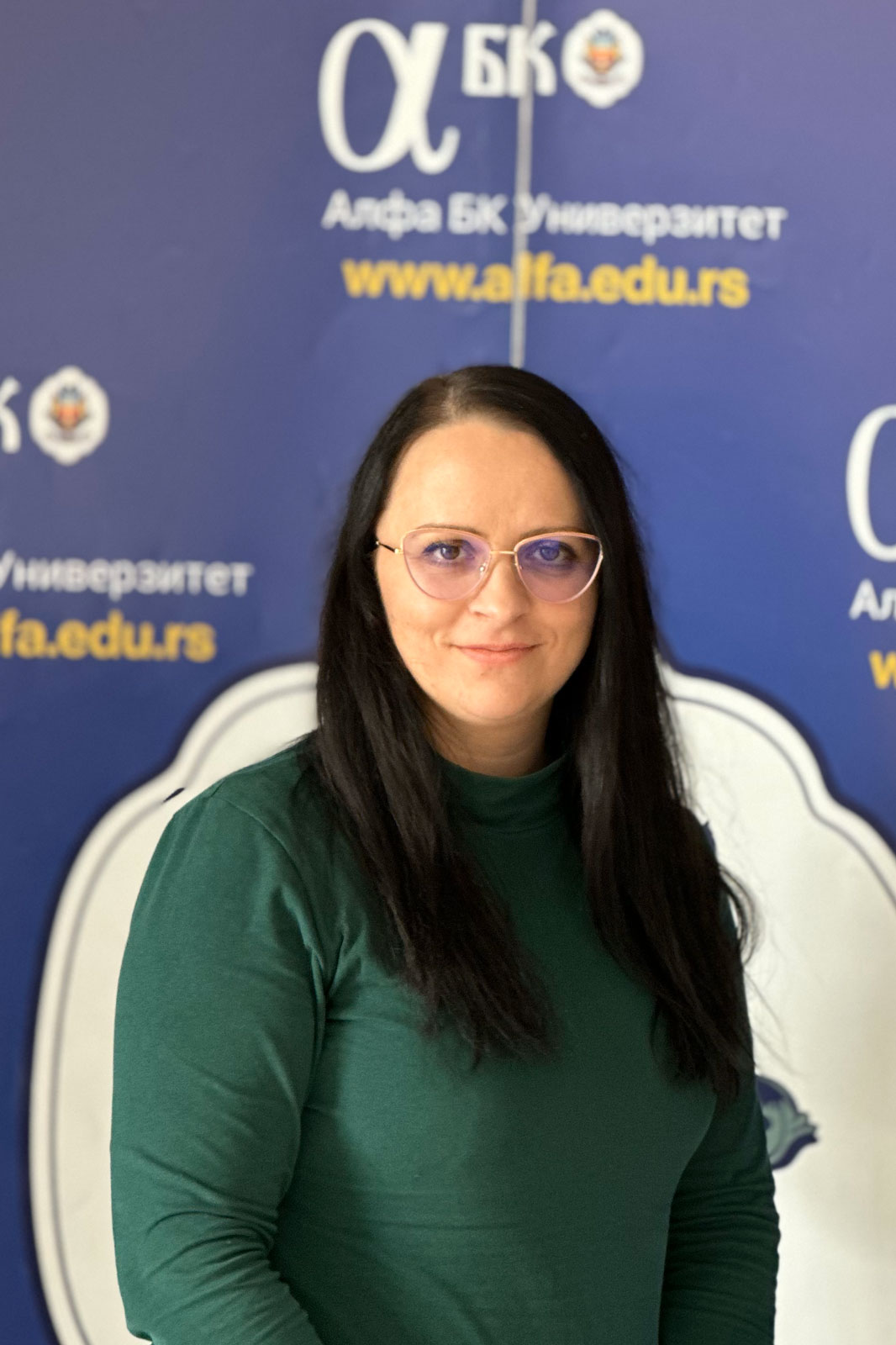
Milica Varšandan serves as a Teaching Assistant at the Faculty of Mathematics and Computer Sciences, Alfa BK University in Belgrade, Serbia. She holds a Bachelor of Computer Science degree earned in September 2023. Education: Bachelor of Computer Science, Faculty of Mathematics and Computer Sciences, Alfa BK University (2023). Thesis: "Designing a web graphic user interface for mountain tourism and e-commerce". Research Interests: Her work centers on Web Development , User Interface Design , E-commerce , and Tourism Technology , with demonstrated involvement in the international AlfaTech scientific conference. Professional Activity: Actively engaged in teaching within the Computer Science program without indication of part-time status, awards, or student advisement.
Dejan D. Rancic is a Professor at the Faculty of Electronics , University of Niš, Department of Electrical Engineering and Computer Science. His academic career spans over two decades, with promotions to Assistant Professor in 2005 and Full Professor in 2015. He earned his PhD (2004), Master's (1997), and BSc (1993) degrees from the same department. Current projects: 3 National, 1 International Reviewer for WSEAS journal series Rančić’s research focuses on Geographic Information Systems (GIS), 3D terrain visualization, and algorithm optimization for large-scale spatial data processing. His work bridges computer science with geospatial engineering, emphasizing parallelism and web-based frameworks. His publications highlight trends in GIS integration (mobile/web), terrain rendering algorithms, and advanced signal processing for meteorological applications. Key subfields include raster map creation, adaptive rendering, and spatial coherency techniques. Contact: Email: dejan.rancic@elfak.ni.ac.rs Address: Aleksandra Medvedeva 4, 18104 Niš Tel: +381 (18) 529-105
Bratislav B. Predić is a Full Professor at the Faculty of Electronics in Niš, University of Niš, Department of Computing and Informatics. He began his academic career as an Assistant Trainee in 2004 and was elected to his current rank in 2024. He graduated in 2003 from the same faculty (Department of Electrical Engineering and Computer Science), and holds a master's and doctorate in related fields. His research focuses on mobile geographic information systems (GIS), transportation systems, data analysis, and algorithm optimization for real-world applications. Key research interests include context-aware mobile GIS frameworks, automatic vehicle location systems (AVL), and large terrain rendering algorithms. He has authored/co-authored multiple papers in journals and conferences such as WSEAS Transactions on Computers, AGILE Conference, and IASTED International Conferences. His work spans transportation optimization, meteorological visualization, and embedded GIS systems. Currently, he participates in 2 national and 1 international scientific projects. His laboratory and collaboration work involves developing practical solutions for urban mobility, field work automation, and cloud-based geospatial systems. Contact: bratislav.predic@elfak.ni.ac.rs
Erik Demaine is a Professor at the Massachusetts Institute of Technology (MIT), holding positions in the Department of Electrical Engineering and Computer Science (EECS) within the School of Engineering. He is also affiliated with the Computer Science and Artificial Intelligence Laboratory (CSAIL) and the Theory of Computation (TOC) group. His research focuses on algorithms, computational geometry, data structures, complexity theory, discrete mathematics, and interdisciplinary areas like biology (protein folding) and computational archaeology. He is renowned for his interdisciplinary work, blending mathematics, computer science, and art. Notable contributions include the Carpenter's Rule Theorem, which proves planar linkages can be straightened without intersection, and foundational work on folding and unfolding problems. His collaborative approaches, including 'supercollaboration,' emphasize open problems and interdisciplinary methods. He has been featured in documentaries such as NOVA's The Origami Revolution and authored influential books like Geometric Folding Algorithms and Games, Puzzles, and Computation . Awards: MacArthur Fellowship (2003) Tetris Master Key Projects: Curved-crease sculptures in MoMA's permanent collection Virtual Glass software for glass design Origami-based computational models Demaine's work bridges academia and art, with notable exhibitions at the Museum of Modern Art (MoMA) and collaborative projects with his father, Martin Demaine. His research often explores playful yet rigorous computational challenges, reflecting his belief in the interplay between theory and creativity.
Dr. Ana Perišić is an Associate Professor at Singidunum University's Center in Novi Sad, teaching courses like Social Computing, Web Design, and Multimedia Systems since 2020. Born in Novi Sad, Serbia (1983), she holds a PhD from the Faculty of Technical Sciences (2016) focusing on Computer Graphics in Simulations and Parametric Performance Analysis. Education: Doctoral Studies: Faculty of Technical Sciences, Novi Sad (2016) Master's Studies: Faculty of Technical Sciences, Novi Sad (2009) Her research emphasizes Digitization in Education , Human-Computer Interaction , UX/UI Design in Gaming , and Virtual Environments . She explores applications of Digital Twins, cognitive psychology in media, and daylight analysis in architecture. Her publications span urban morphology analysis (daylight modeling, privacy during lockdowns) and smart home systems. She has collaborated on projects like Digital Twins frameworks and parametric building simulations. While no scientific awards are listed, her work intersects technology, design, and societal impact. She advises no documented students but contributes to interdisciplinary teams in informatics and urban systems.
Ivan Milovanović is a faculty member at Singidunum University, affiliated with the Faculty of Technical Sciences under the Department of Informatics and Computing. He holds a doctoral degree in Advanced Protection Systems from Singidunum University (2009-2015), following a master's in Contemporary Information Technologies (2008-2009) and a bachelor's in Graphic Design (2004-2008). His research focuses on wireless communications, signal processing, neural networks, and telecommunications, with an emphasis on applications such as direction-of-arrival estimation, stochastic source localization, and channel modeling. He has published extensively in journals like the International Journal of RF and Microwave Computer-Aided Engineering and presented at conferences including TELSIKS and ICEST. Education: PhD: Advanced Protection Systems, Singidunum University (2009–2015) Master's: Contemporary Information Technologies, Singidunum University (2008–2009) Bachelor's: Graphic Design, Singidunum University (2004–2008) High School: Stevan Sremac Gymnasium (2000–2004) Research Interests: His work integrates neural networks with electromagnetic systems to address challenges in wireless communications, including signal localization, noise analysis, and adaptive antenna systems. He explores hybrid models for indoor/outdoor path loss calculation and secure wireless sensor networks for critical infrastructure protection. Recent studies focus on stochastic processes in far-field environments and the design of efficient neural network architectures for real-time signal processing. Publications: Key contributions include papers on DoA estimation using hierarchical neural models, analysis of WSN-FSO systems, and performance benchmarks for DBMS engines. His research bridges theoretical advancements with practical applications in telecommunications and data systems. Labs/Teams: Active in Singidunum University's research groups focusing on telecommunications and neural network applications. Collaborates with institutions like the Faculty of Electronic Engineering in Niš and international partners such as TU Dresden and TU Ilmenau.
Nikola Savanović is a researcher and academic at Singidunum University, specializing in cybersecurity, machine learning, and web technologies. He holds a PhD in Advanced Security Systems (2024) from Singidunum University, following a Master's in Contemporary Information Technologies (2016) and a Bachelor's in Informatics and Computing (2013), both from the same institution. He also completed high school in Computer-Aided Design at Politehnika School for New Technologies (2003-2007). His research focuses on intrusion detection systems, machine learning optimization for cybersecurity applications, and adaptive web technologies. He has contributed to educational technology through virtual learning environments and game-based learning. His mathematical work includes fixed point theory in b-metric spaces. He has authored/co-authored multiple books on web design, multimedia systems, and digital marketing. Publications highlight interdisciplinary work: hybrid CNN-XGBoost models for medical diagnostics, metaheuristic algorithms for software defect detection, and cybersecurity innovations in healthcare IoT systems. His articles span computer science, mathematics, and data science, emphasizing practical applications in education and healthcare. Despite no listed awards, his extensive publication record and teaching roles reflect significant academic contributions. He actively collaborates on university projects and advises students in informatics and computing disciplines, though no formal student list is provided.
Ivan Radosavljević is a researcher affiliated with Singidunum University's Faculty of Informatics and Computing. His work focuses on interdisciplinary applications of artificial intelligence, machine learning, and software engineering. He has contributed to projects involving environmental monitoring frameworks, computer vision applications, and medical informatics solutions. Academic Affiliation: Faculty of Informatics and Computing, Singidunum University Research Themes: AI-driven systems, data generation techniques, software tools for research management His research portfolio includes innovations like the Microraptor GUI software for rendering process monitoring, generative models for synthetic datasets, and frameworks for panoramic image processing in GIS applications. Collaborations with colleagues have produced notable outputs such as breast cancer risk assessment systems and distance estimation algorithms trained on synthetic stereo images. Publications highlight his contributions to both theoretical advancements (e.g., fuzzy space theory applications) and practical implementations (e.g., dictation software development). His work often bridges academic research with real-world problem-solving in sectors like environmental science and healthcare.
Дејан Д. Ранчић је редовни професор на Електронском факултету у Нишу (Универзитет у Нишу), где је изабран 2015. године након дугогодишњег рада као доцент од 2005. године. Дипломирао, магистрирао и докторирао је на истом факултету у области Електротехника и рачунарство. Његово образовање укључује: Дипломирани инжењер електротехнике и рачунарства (1993) Магистар електротехнике и рачунарства (1997) Доктор електротехнике и рачунарства (2004) Ранчићев истраживачки фокус је на ГИС технологијама , 3D визуелизацији терена и обраги радарских сигнала . Кључни доприноси укључују развој алгоритама за мобилне ГИС апликације, паралелно рендеровање великих терена и радарску обраду података за сузбијање града. Његов рад комбинује теоријску рачунарску геометрију са практичним инжењерским решењима. Анализа његових радова показује еволуцију од радарских система (1997-1999) ка иновативним ГИС решењима (2000-2006), са посебним нагласком на визуелизацију терена и мобилне платформе. Најзначајнији радови објављени су у часописима као што су Computer and Geosciences и WSEAS Transactions on Computers . Тренутно учествује у 3 национална и 1 интернационални истраживачки пројекат, а као рецензент ради за WSEAS серију часописа. Иако детаљи о менторству нису наведени, његова публикацијска активност и пројекти указују на значајну улогу у развоју геопросторних технологија у Србији.
Ivan Milovanović is a researcher at the Department of Postgraduate Studies , University of Singidunum, Belgrade, Serbia. He holds a doctoral degree in Advanced Protection Systems from Singidunum University (2015) and has previously completed master's and bachelor's studies in Contemporary Information Technologies and Graphics and Design at the same institution. His career spans roles in software development, wireless communication research, and neural network applications for electromagnetic signal processing. B.Sc. in Graphics and Design (2008), Singidunum University M.Sc. in Contemporary Information Technologies (2009), Singidunum University Ph.D. in Advanced Protection Systems (2015), Singidunum University Milovanović's research focuses on applying neural networks to solve complex problems in wireless communications, particularly in direction-of-arrival (DOA) estimation for stochastic electromagnetic sources. His work addresses challenges in localization accuracy, signal correlation, and power variation. He has contributed to advancements in 2D/1D DOA estimation using hybrid neural models, experimental validation of antenna array measurements, and noise interference analysis in wireless systems. Publications span topics like wireless sensor networks, channel modeling, and MESH network security. Recent publications highlight a strong interdisciplinary focus combining neural networks with electromagnetic signal processing , antenna array optimization , and wireless communication systems . His work explores stochastic source tracking, coherent signal resolution, and noise mitigation techniques, often collaborating with researchers like Z. Stanković and N. Dončov. While no scientific awards are explicitly mentioned in the provided text, his extensive publication record indicates active contributions to applied electromagnetics and telecommunications engineering.
Dejan Viduka is a Full Professor at the Faculty of Information Technologies, Alfa BK University, with over 25 years of experience in information and communication technologies (ICT). His teaching portfolio includes subjects such as Programming, Web Development, Software Testing, Information Systems Management, Computer Networks, Computer Graphics, Cyber Security, and Digital Media Design. Born in 1980, Osijek, Croatia Bachelor of Electrical Engineering and Computing (Alfa BK University) Master's in Informatics (Sinergidunum University) Doctoral studies in Technical Sciences His research focuses on the application of ICT in business and education, particularly in Artificial Intelligence , Cyber Security , and Decision Theory . He has authored over 70 scientific papers and multiple books in ICT disciplines. Dejan actively contributes to academia through conference paper reviews and industry collaborations on modern ICT solutions. His scientific output is accessible via ORCID (0000-0001-9147-8103), Google Scholar, and Serbian academic databases.