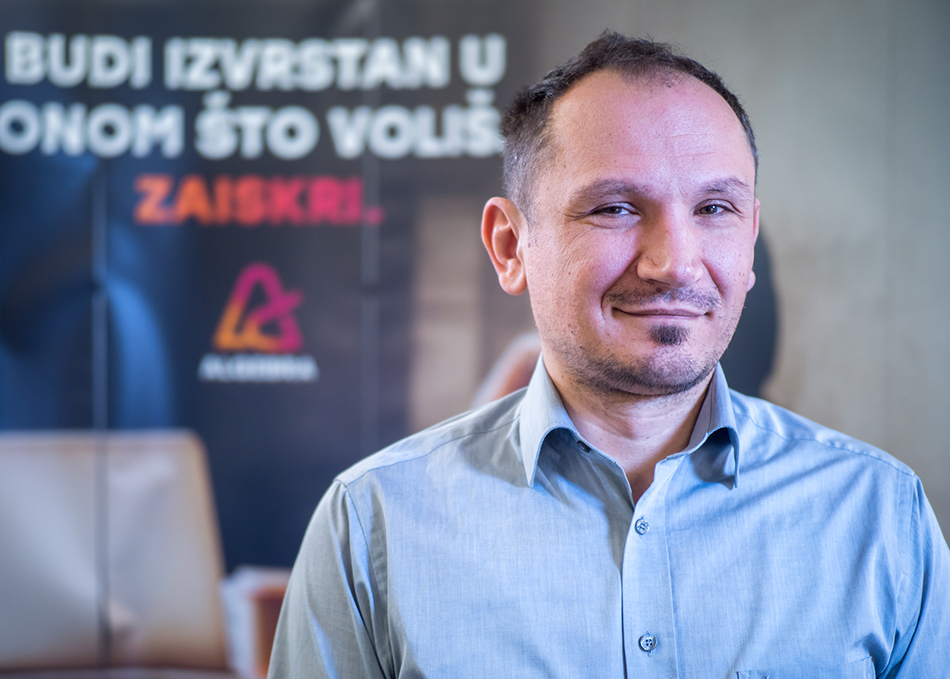
Igor Dobrača is an Adjunct Assistant Professor at the Juraj Dobrila University of Pula , affiliated with the Faculty of Medicine and working within the Department for Research/Arts, Technology and Entrepreneurship . He serves as a lecturer in charge for undergraduate and integrated graduate courses in Web Design and Tools 2.0 and Audio and Video Processing , focusing on integrating digital technologies into educational frameworks. Research Focus: Educational Technology, Digital Competence Development, Environmental Monitoring in Education, Gamification, Assistive Technologies, and Software Localization. Teaching Roles: Lecturer in charge for courses related to web design, ICT, and multimedia processing. Key Contributions: Work on classroom environmental monitoring, gamification in curricular education, and multilingual educational software adaptation.
Mirjana Radetić-Paić is a full Professor at the Faculty of Educational Sciences, Juraj Dobrila University of Pula, Croatia. Her academic career spans roles such as Vice-Rector for Students (2019-2025), Dean (2015-2018), and Head of the Department of Educational Sciences (2014-2015). She holds a PhD in Pedagogy and has over two decades of experience in higher education, specializing in inclusive education, social pedagogy, and behavioral disorders in children and youth. Education: BSc (1994), MSc (2002), PhD (2009) from University of Zagreb Key roles: Vice-Rector, Dean, Department Head, Editor-in-Chief of 'Metodički obzori' Her research focuses on inclusive education practices, behavioral intervention strategies, and youth risk behaviors. She has authored 13 books and over 70 scientific papers, emphasizing social pedagogy, family resilience, and teacher competencies. Awards include the 2012 Best Paper Prize and recognition from educational institutions and Policlinic Pula. Her work addresses community-based prevention programs and integrates modern technologies in education. She also contributes to teacher training initiatives and cross-cultural educational collaborations.
Danijel Kučak is a Senior Lecturer at the University of Algebra since 2007. He holds a Master's in Mathematics from the Faculty of Science (2002) and a PhD in Information Sciences from the Faculty of Philosophy, University of Zagreb (2025). With 10 international programming certifications, his expertise spans web application development using .NET and Java platforms. He has authored/co-authored 5 books and over 20 scientific papers focusing on software engineering, machine learning, and educational technology. Beyond academia, he owns a programming business, contributing to systems like MedicalBit (for lung disease clinics) and CRIS (Croatian Road Inspection System). His research emphasizes gamification in education, blockchain applications, and AI-driven solutions. Research interests include machine learning applications, gamification strategies for programming education, and secure blockchain systems. His work bridges theoretical computer science with practical implementations in healthcare, transportation, and education. Notable contributions include empirical studies on gamification's long-term impact on student outcomes and innovative approaches to E-learning platforms. Awards: Multiple Best Lecturer Awards at the University of Algebra Business Experience: Developed custom software systems for healthcare and traffic management Publications: Over 20 peer-reviewed articles and 5 books on software engineering and educational technology Labs/Teams: Active in developing IoT architectures for environmental monitoring and AI models for educational outcomes prediction. His programming business integrates academic research with real-world system implementations.
Željka Car is a Professor at the Faculty of Electrical Engineering and Computing (FER) , University of Zagreb, Croatia. She serves as Head of the Department of Telecommunications and focuses on research in telecommunications, software engineering, and human-computer interaction. Research Interests : Accessibility in digital systems, augmented reality, assistive technology, serious games for education, machine learning applications, network reliability, and project management. Teaching : Leads courses in project management and software development methodologies. Projects : Involved in developing ICT-AAC applications for children with developmental disabilities, VR/AR tools for military and educational use, and software process improvement frameworks. Publications highlight trends in accessible software design, gesture-based interfaces, and integration of emerging technologies with augmentative and alternative communication (AAC) systems.
Assistant Professor Dario Šebalj, Ph.D., works at the Department of Quantitative Methods and Informatics, Faculty of Economics, University of Osijek. Since 2014, he has contributed to teaching courses in Business Simulation Games, Business Intelligence, Data Management, and ICT Project Management. He previously served as a postdoctoral fellow (2020) and secretary of the Alumni EFOS association (2017-2019), and as executive editor of Ekonomski vjesnik (2020-2023). Doctorate (2019): Simulation model of Croatia's natural gas supply chain for cost optimization Research Focus: Machine learning, simulation modeling, energy systems, business analytics, data-driven decision-making Key Projects: Croatian Science Foundation's natural gas supply chain research, two Erasmus+ projects Conference Involvement: Organizing committee for Business Logistics in Modern Management, Interdisciplinary Management Research, KOI; program/scientific committees for IBIMA and EBES His publications span predictive modeling (employee turnover, credit ratings), energy efficiency analytics, and pandemic-era workforce studies. He combines computational methods with economic decision-making frameworks. Scientific contributions include over 20 papers in international journals and conference proceedings, with recent works in Logforum and Ekonomski vjesnik . He applies machine learning and simulation techniques to complex economic systems. He has contributed to Croatian higher education digitalization through ICT integration studies and participates in international academic collaborations. His editorial and organizational roles demonstrate commitment to advancing economic research.
Marija Vukšić Pučar, PhD, is a Lecturer at the Department of Business Foreign Languages, Faculty of Economics and Business, University of Zagreb. Her academic work bridges linguistics, educational technology, and sociocultural analysis. Education: PhD in Ethnology and Anthropology (University of Zadar, 2024), MA in English and Ethnology (University of Zagreb, 2016), BA in English and Ethnology (University of Zagreb, 2013) Her research focuses on: Business English and English for Specific Purposes Game-based and E-learning methodologies Scientific communication and qualitative research applications Anthropological analysis of healthcare and sustainability frameworks Article trends highlight her expertise in: Educational technology implementation during the pandemic Digital solutions for elderly healthcare Language pedagogy in business contexts Cultural models of sustainable development
Katarina Kostelić, Ph.D., serves as an Assistant Professor at the Faculty of Informatics in Pula, part of Juraj Dobrila University of Pula. She earned her doctorate in 2017 and maintains an active role in both undergraduate and graduate education, teaching courses including Social Network Analysis, Quantitative Methods of Business Decision Making, Operations Research, Statistics, and Business Analytics. Her office is located at room 13 (Negrijeva ulica 6; university campus). Dr. Kostelić's research spans multiple interconnected domains, with a strong emphasis on game theory applications in decision-making processes, social network analysis, and cybersecurity. Her work frequently examines how awareness (or lack thereof) influences strategic interactions, with particular attention to emotional intelligence in organizational contexts. She has made significant contributions to understanding business networks, tourism economics, and statistical methodologies. Analysis of her recent publications reveals a clear trajectory toward increasingly complex applications of game theory in cybersecurity contexts, alongside continued exploration of social networks in tourism and business environments. Her research demonstrates interdisciplinary reach, connecting computer science, economics, psychology, and management studies. The integration of neutrosophic sets in satisfaction measurement and the application of TOPSIS frameworks to cybersecurity risk assessment highlight her methodological innovation. Dr. Kostelić serves in multiple editorial capacities, including Managing Editor of Applied Sciences and Business Economics, Member of the Editorial Board of Journal of Interdisciplinary Sciences, and Member of the Editorial Team for Symmetry. She has also contributed to the popularization of science through accessible explanations of strategic situations, game theory applications in cybersecurity, and business network dynamics. Her research leadership is evident through projects including 'Analysis of social networks in Croatian tourism' (2019-2022), 'Role of emotions in strategic decision-making' (2019-2023), and contributions to international collaborations like MEGASFORA and SMART INNO. Dr. Kostelić has also developed educational resources, most notably her 2024 publication 'Introduction to R and RStudio,' supporting statistical education.
Assistant Professor Nikola Tanković, Ph.D. (born 1986 in Pula, Croatia) is affiliated with the Faculty of Informatics in Pula at Juraj Dobrila University of Pula . He received his B.Sc. (2009) and Ph.D. (2017) in Computer Science from University of Zagreb Faculty of Electrical Engineering and Computing. His roles include Project Leader of EDIH Adria , Vice Dean for Science and Industry Relations (2020-2024), and Member of University Informatics Committee (2019-present). Teaching: Offers courses in Programming, Software Engineering, Distributed Systems, and Web Applications Research: Focuses on Software Modeling, Quality Optimization, Distributed Systems, and Machine Learning applications across domains His 15 most recent publications span Cloud Computing , Peer-to-Peer Learning , Medical Imaging Optimization , and Business Process Modeling . Awards include the Rector's Award for SCORE 2009 Championship . He advises students on projects related to database systems, distributed architectures, and AI applications. Current initiatives include EDIAH Adria (European Digital Innovation Hub) and EVOSOFT (Software Evolution Analysis).
Luka Blašković, MSc in Informatics, is an Assistant Professor at the Faculty of Informatics in Pula, Croatia. He contributes to both undergraduate and graduate programs, teaching courses in Operating Systems, Programming in Scripting Languages, Business Process Management, Web Applications, and Distributed Systems. Department: Department of Informatics Research Focus: Computer Science, Game Development, Artificial Intelligence, User Experience Projects: Key participant in the EDIH Adria initiative (European Digital Innovation Hub) His research spans Human-Computer Interaction , Gaming Experience Evaluation , and Mobile Banking Applications . Recent work includes developing a conversational agent for personalized teaching materials (2024) and analyzing EDIH Adria TBI projects' impact (2025). Scientific publications include studies on Unity Engine game development (2023), vector databases (2022), and mobile banking quality (2022). While no explicit awards are listed, his active participation in international conferences like MIPRO underscores his academic engagement. Contact: luka.blaskovic@unipu.hr | Personal Website