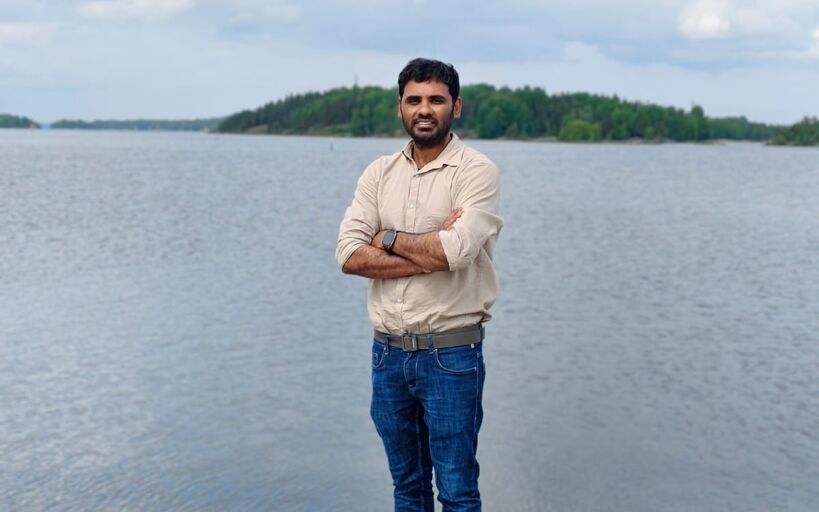
Naresh Garg is a Postdoctoral Researcher at the Department of Computer Science, Aalto University. His work focuses on computational research, with expertise spanning artificial intelligence, machine learning, and data science. Contact: naresh.garg@aalto.fi
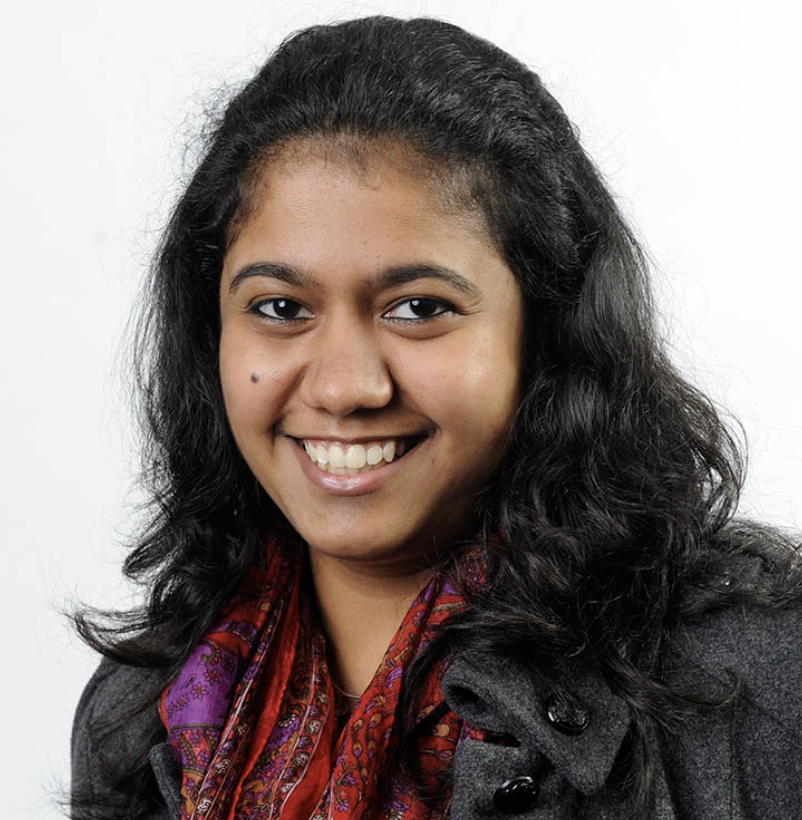
Prachi Sharma is a Doctoral Researcher at the Department of Information and Communications Engineering at Aalto University . Her research focuses on Speech Synthesis , with affiliations to related research groups.
Ragini Kihlman serves as a Researcher in the Department of Computer Science at Aalto University, contributing to Finland's leading technical institution with expertise spanning multiple computing disciplines. Her research portfolio encompasses: Artificial Intelligence and machine learning systems Large-scale data analytics and processing Algorithmic design and optimization Human-centered interaction frameworks Software architecture and development methodologies Professional correspondence may be directed to ragini.kihlman@aalto.fi for research collaboration or academic inquiries.
Dr. Otto Kässi serves as a Research Fellow within the Department of Computer Science at Aalto University, Finland's leading technical institution. His academic role focuses on advanced research in computational disciplines. His research spans core domains of modern computing: Computer Science (broad theoretical and applied foundations) Artificial Intelligence (algorithmic decision-making systems) Data Science (large-scale data analysis methodologies) Software Engineering (development lifecycle optimization) Theoretical Computer Science (computational complexity) Machine Learning (adaptive model architectures) No information is available regarding scientific awards, graduate student supervision, laboratory leadership, or grant-funded projects in the provided materials. His professional activities appear centered on independent research within the university's computer science framework.
Dr. Indrė Žliobaitė is a researcher in the Department of Computer Science at Aalto University. Her work spans interdisciplinary domains, combining computational methods with ecological and biomedical applications. Adaptation Concept drift Evolving data streams Change detection Predictive analytics Discrimination aware data mining Her research includes modeling respiratory motion for medical applications, analyzing fossil records for paleoecological insights, and developing energy-efficient computing architectures. Publications highlight applications of Bayesian models, mobility trace analysis, and approximate computing techniques.
Arash Badie-Modiri is a Visiting Professor at Aalto University's School of Science, Department of Computer Science. His research focuses on temporal networks, multilayer networks, and computational modeling of complex systems. Institution: Aalto University School: School of Science Department: Department of Computer Science Rank: Visiting Professor Email: ext-arash.badie-modiri@aalto.fi His work spans network science, statistical physics, and software development, with particular emphasis on temporal network analysis , multilayer network modeling , and dynamic connectivity estimation . Recent publications highlight contributions to epidemic modeling, crowdsourcing methodological improvements, and open-source software tools like the pymnet library. Collaborations with researchers such as Kimmo Kaski, Jari Saramäki, and Mikko Kivelä reflect his integration into multidisciplinary academic networks. Research outputs demonstrate expertise in temporal network theory , weighted event graphs , and percolation dynamics applied to complex systems.
Rohit Babbar serves as an Assistant Professor in the Department of Computer Science at Aalto University, Finland, leading a research group dedicated to advancing large-scale machine learning methodologies. His team specializes in tackling computational challenges inherent in extreme classification problems with massive output spaces while ensuring model robustness. His primary research domains encompass large-scale learning systems, extreme multi-label classification architectures, deep learning integration, sequential data processing, and robustness engineering. This work directly addresses industry pain points like computational inefficiency in massive label spaces and model vulnerability to distribution shifts, with applications spanning natural language processing, information retrieval, and recommendation systems. Publication trends reveal a strategic focus on algorithmic innovation for extreme classification, featuring breakthroughs in dynamic sparsity techniques, large language model integration for zero-shot scenarios, and calibration of extreme classifiers. Recent work demonstrates consistent emphasis on computational efficiency through optimized negative sampling, lightweight frameworks like InceptionXML, and specialized metrics for long-tail performance evaluation. Scientific recognition includes: Outstanding Reviewer Award at ACL 2021 Conference (July 2021) for exceptional contributions to computer science peer review As research group leader, Babbar directs collaborative efforts on next-generation classification systems while mentoring emerging scholars in machine learning. His team maintains active partnerships with industry leaders in search and recommendation technologies. The research group operates at the intersection of theoretical machine learning and practical deployment, developing frameworks that balance computational feasibility with predictive accuracy in extreme-scale environments. Current initiatives focus on integrating foundation models with specialized classification architectures while addressing real-world challenges like data sparsity and concept drift.
Ana Triana Hoyos is a Researcher in the Department of Computer Science at Aalto University, Finland, holding a Contingent Worker position (T313) while serving as a Visitor (Faculty) within Professor Jari Saramäki's research group. Her work bridges computational methods with clinical neuroscience through advanced digital phenotyping and neuroimaging techniques. Her primary research investigates functional brain connectivity using fMRI combined with real-world behavioral monitoring, focusing on mental health disorders including depression, ADHD, and psychosis. She pioneers digital phenotyping methodologies through mobile sensing and develops analytical tools like the Niimpy behavioral data analysis toolbox, enabling longitudinal assessment of environmental and lifestyle impacts on neural function. Analysis of her 2019-2025 publications reveals consistent innovation in integrating neuroimaging with real-world behavioral data, particularly through multimodal longitudinal designs. Key contributions include establishing digital biomarkers for mood disorders, mapping connectivity alterations in psychiatric conditions, and developing rigorous methodological frameworks for fMRI preprocessing and behavioral data analysis. Scientific Awards: No awards were documented in the source materials. Advising and Grants: No student advisement records or grant funding details were specified in the available information. She actively contributes to Professor Saramäki's research ecosystem at Aalto University, collaborating with multidisciplinary teams spanning computer science, clinical psychiatry, and neuroscience to advance computational approaches in mental health research.
Matti Tapio Vaaja is an Assistant Professor at Aalto University's Department of Built Environment, specializing in digital photogrammetry and laser scanning technologies. He also holds an Associate Professorship at Shinshu University's Institute of Mountain Science (Japan) focused on laser scanning applications in forestry. His research spans close-range laser scanning, 3D point cloud processing, environmental change detection, and forest mapping. With over 100 publications and significant contributions to geoinformatics, he coordinates the 4D GEO-IT doctoral education network and supervises 10 doctoral theses in photogrammetry and remote sensing. Notable Achievements: National Open Science Prize (2019) Over 2,700 citations with H-index 24 Contributions to 3D urban modeling, biomass estimation, and smart city development Recent publications demonstrate cross-disciplinary integration of UAV photogrammetry, terrestrial laser scanning, and game engine visualization techniques for urban vegetation monitoring and watershed analysis. His work bridges technical advancements with practical applications in environmental science and urban planning.
Juhi Kulshrestha serves as an Assistant Professor in the Department of Computer Science at Aalto University, Finland, specializing in Computational Social Science and Social Computing with a focus on digital ethics, societal impacts of technology, and policy implications. Her research addresses critical challenges at the intersection of human behavior and digital systems. Her scholarly work investigates misinformation propagation, algorithmic bias in search/social media, and AI's societal consequences through interdisciplinary approaches. Key research themes include affect-driven information seeking, Holocaust representation in AI-generated content, digital divides in AI adoption, and cross-national vaccine misinformation dynamics. She employs large-scale data analysis combining computational methods with social science theories. Recent publications (2022-2025) reveal a strong emphasis on real-world societal issues: analyzing ChatGPT user demographics in Germany, examining visual Holocaust representations across search engines, and studying conspiracy theory ecosystems (e.g., flat earth/9-11 theories). Her collaborative work spans public health, political science, and psychology, frequently appearing in top venues like PLOS One and New Media and Society. Kulshrestha leads the Digital Ethics, Society and Policy (Digital-ESP) research group, which examines ethical frameworks and policy interventions for digital technologies. No information regarding student supervision or research grants is provided in the source material.
Fahime Seyedheydari is a Postdoctoral Researcher at Aalto University's Department of Electrical Engineering and Automation. Her research focuses on advanced optical and electromagnetic phenomena in nanostructures, particularly in the near-infrared regime. Institution: Aalto University Department: Electrical Engineering and Automation Rank: Researcher Her work bridges nanotechnology , optics , and materials science , with a focus on plasmonic effects , core-shell nanoparticles , and light propagation in engineered materials. She investigates how electromagnetic responses of metal-semiconductor-oxide systems can enhance sensor capabilities in the near-infrared spectrum. Recent publications highlight her expertise in anisotropic nanoparticles , dielectric modeling , and photonic applications of semiconductor microinclusions. Her collaborations span computational materials science and experimental photonics. Email: fahime.seyedheydari@aalto.fi Phone: +358503059998
Jenni Partanen is an Assistant Professor at Aalto University, specializing in Built Environment research. Her work focuses on urban planning and computational social science, with particular emphasis on transportation systems, smart city technologies, and sustainable urban development. She is affiliated with the Planning and Transportation research group. Her research explores innovative approaches to urban challenges through computational modeling and data-driven analysis. Key areas include pedestrian safety optimization, wind comfort in public spaces, 15-minute city concepts, and urban vitality enhancement using big data. Recent publications highlight her contributions to computational urban planning, environmental design, and spatial analysis. Her methodological approach combines agent-based modeling, cellular automata simulations, and integration of socio-economic metrics with traditional urban data.
Kim Eklund is a Doctoral Researcher at the Chemistry and Materials department of Aalto University. Their work focuses on computational materials science, particularly in modeling inorganic materials and ferroelectric systems using hybrid density functional methods. Research Interests: Pyroelectric and ferroelectric materials Density functional theory (DFT) simulations Crystal structure and bonding analysis Electronic and magnetic properties of metal oxides Nanomaterials and thin film characterization Recent publications highlight expertise in materials modeling , with emphasis on ferroelectrics (BaTiO3, KNbO3, PbTiO3), doped carbon nanotubes , and transition metal oxides . They collaborate with researchers like Antti J. Karttunen and Florian Kraus, contributing to fields such as Crystal Growth and Design , Chemistry of Materials , and Inorganic Chemistry .
Zeyu Yang serves as a Researcher in the Department of Information and Communications Engineering at Aalto University, actively contributing to the Mobile Cloud Computing research group. His role focuses on advancing mobile application infrastructure through cloud integration within the university's technical research ecosystem. His primary research domain is Mobile Cloud Computing, specializing in optimizing mobile user experiences via cloud resource allocation. This work intersects with broader disciplines including Cloud Computing, Computer Science, and Wireless Communications, addressing critical challenges in latency reduction, energy efficiency, and scalable mobile service delivery across heterogeneous networks. Within the Mobile Cloud Computing research group, Yang engages in collaborative projects developing next-generation mobile-cloud frameworks. His technical contributions support the group's mission to bridge theoretical research with practical implementations for emerging mobile technologies and edge computing paradigms.
Bhanu Pratap Yadav is a Postdoctoral Researcher in the Department of Information and Communications Engineering at Aalto University. His work focuses on coding theory and its applications to discrete mathematics. Research interests include: Asymptotic properties of additive cyclic codes Structural analysis of self-dual and LCD codes Negacirculant code constructions Applications of ring theory to coding Error-correcting code optimization Recent publications demonstrate expertise in: Discrete Mathematics Computer Science Information Theory Algebraic Coding