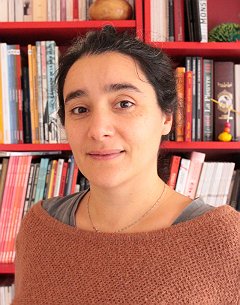
Assia Mahboubi is a tenured Researcher at Inria in France and an endowed professor at the Algebra and Number Theory section of the Vrije Universiteit Amsterdam . She works on formal verification, type theory, and computer-aided mathematics, using tools like the Rocq prover and Mathematical Components libraries. Research Focus : Foundations and formalization of mathematics in type theory, automated verification of mathematical proofs, interplay between computer algebra and formal proofs. Team : Supervises PhD candidates Vojtěch Štěpančík , Tomás Vallejos Parada , and Alain Chavarri Villarello , with former PhD students like Matthieu Piquerez and Enzo Crance . Grants & Awards : Holds an ERC Consolidator Grant for the FRESCO project. Active in academic service as a committee member for conferences like POPL, CPP, and ICFP, and organizer of workshops like CoqPL. Art & Science Outreach : Collaborates with Athenor national theater on C.H.A.T.S workshops and contributes to public engagement through talks and publications.
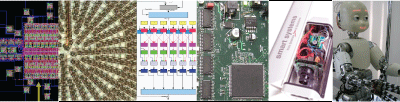
Francesco Rea is a Senior Technician at Istituto Italiano di Tecnologia (IIT) and holds adjunct/teaching positions at University of Lethbridge and University of Genova. He leads the Cognitive Architecture for Interactive Technology (CONTACT) lab, focusing on humanoid perception, cognitive skills, and industrial applications. Education: B.Sc. Information Engineering, Università di Bergamo (2004) Specialization in Computer Engineering, Università di Bergamo (2007) M.Sc. Robotics and Automation, University of Salford (2008) Ph.D. Robotics, University of Genoa (2012) Research: His work bridges cognitive neuroscience and robotics, developing systems for auditory awareness, adaptive tutoring, and human-robot collaboration in manufacturing/healthcare. Key projects include VOJEXT, APRIL, and PROMEN-AID, funded by EU H2020 and Human Brain Project. Publications: Recent works (2025) explore LLM-based tutoring architectures, visuo-motor learning, and social robotics, demonstrating consistent focus on AI-driven human interaction and cognitive modeling. Awards: Canada-Italy Innovation Award (2017, 2021) Best Paper Award at ROMAN2020 Mitacs Globalink Research Award (2018) AI for Robotics Award (2020) Grants & Teams: Secured €multi-million funding for 5+ EU projects. Leads a 10+ member team at CONTACT lab developing cognitive architectures for industrial robots and healthcare applications.
Dr Milorad Cerovac serves as a Lecturer in Pedagogy and Education Futures within the School of Education at La Trobe University, Australia. With a background as a registered teacher across Mathematics, Physics, Software Development and Systems Engineering, he bridges industry experience with academic work to develop authentic problem-based learning approaches for pre-service and in-service teachers. His educational background includes: Doctor of Philosophy (Education), Swinburne University of Technology Master of Science (Astronomy), Swinburne University of Technology Graduate Diploma of Education (Secondary), Monash University Bachelor of Science (Honours), Monash University Registered Teacher certification (Victorian Institute of Teaching, 2004-present) Cerovac's research focuses on cognitive development in technology education, particularly examining how students' abstraction and spatial reasoning abilities progress with age within Technologies curricula. His work extends to gender disparity in STEM fields, inquiry-based learning methodologies, and the integration of artificial intelligence in classroom settings. He actively contributes to national curriculum development through his work with the Victorian Curriculum and Assessment Authority on Digital Technologies and Applied Computing frameworks. Analysis of his 15 most recent publications reveals strong emphasis on gender-inclusive technology education, spatial reasoning development, and practical implementation of computational thinking across K-12 settings. His work consistently connects cognitive theory with classroom application, particularly through robotics programs and problem-based learning frameworks. Cerovac directs significant professional development efforts, having presented numerous workshops for educators on Digital Technologies, Design and Technologies, and Physics both nationally and internationally. His research program includes the current Managing the double-edged sword project funded through the Award for Inclusion Research Program (2023-2024), which investigates generative AI frameworks for female inclusion in K-16 schools. As co-founder and lead mentor of the RoboCats (a school-girl-only robotics team participating in FIRST Robotics Competition from 2014-2020), he maintains active involvement with the FIRST LEGO League program in Victoria. His 17-year prior career as a Software Developer and Database Specialist informs his emphasis on real-world problem-based learning activities shared with teacher education students.