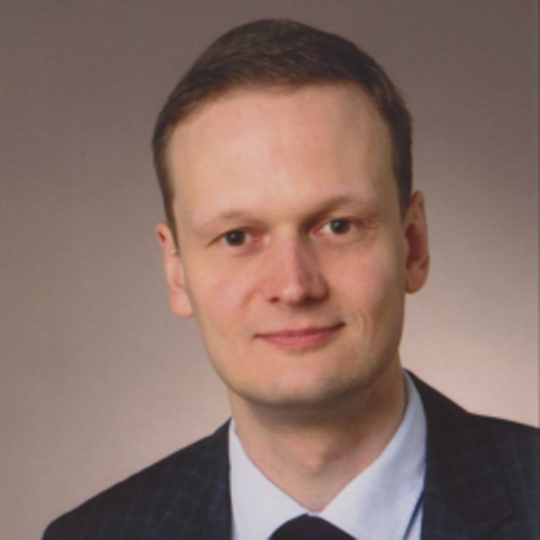
Khaled Zbeeb is a Professor at the School of Engineering and Technology of Western Illinois University (WIU Quad Cities campus), where he has been affiliated since at least 2011. He holds formal academic qualifications in Mechanical and Aerospace Engineering, with a career focus on computational methods and applied mechanical systems. Education Ph.D. in Mechanical Engineering (2011), Florida Atlantic University M.S. in Mechanical Engineering (2009), Florida Atlantic University B.S. in Aerospace Engineering (1992), University of Kansas Research and Academic Contributions Khaled Zbeeb specializes in Computational Fluid Dynamics (CFD) and its applications in thermodynamics, heat transfer, and applied combustion. His work extends to advanced dynamics and control systems, finite element analysis, solid mechanics, stability and stress analysis, and mechanical design principles including computer-aided design (CAD) methodologies. He teaches core engineering courses such as Fluid Mechanics, Thermodynamics, Heat Transfer, and Mechanical Engineering Laboratory, often integrating hands-on learning with software tools like SolidWorks and MATLAB.
Professor Santosh Kumar Tadakamadla serves as the Head of Dentistry and Oral Health at La Trobe Rural Health School, La Trobe University, Australia. With over 15 years of international experience as a dental academic and researcher, he specializes in public health dentistry and has made significant contributions to oral health policy and practice. His leadership extends to adjunct professorial appointments at University of Bari Aldo Moro (Italy), Dr D Y Patil Dental College & Hospital (India), and SRM Dental College (India). Professor Tadakamadla completed his PhD at Griffith University, Master of Public Health Dentistry at Rajasthan University of Health Sciences, and Bachelor of Dental Surgery at Rajiv Gandhi University of Health Sciences. He also holds a Postgraduate Diploma in Health Promotion from Public Health Foundation of India and a Graduate Certificate in University Learning and Teaching from Griffith University. His research focuses on oral health promotion, workforce distribution, health inequalities, oral epidemiology, and community-based interventions to address oral health disparities. Professor Tadakamadla has published over 170 peer-reviewed articles in high-impact journals including The Lancet and Journal of Dental Research. His work has influenced health policy, featured in OECD and Cochrane documents, and translated into large-scale health promotion initiatives. His recent publications demonstrate expertise across digital dentistry, oral health promotion interventions, substance-related oral trauma, and addressing health disparities among vulnerable populations. Professor Tadakamadla's scientific recognition includes: NHMRC Early Career Fellowship International Association for Dental Research (IADR) Centennial Emerging Leader Award for Asia-Pacific (2020) IADR Distinguished Scientist Young Investigator Award (2025) Honorary membership from the Australian Dental Association Victoria Branch Fellowships from the Pierre Fauchard Academy and International College of Dentists Senior Fellow of the Higher Education Academy As an experienced HDR supervisor, thesis examiner, and grant assessor, Professor Tadakamadla has mentored numerous early- to mid-career academics. He actively engages with Indigenous and rural communities, serves on international editorial boards, and collaborates globally to advance oral health equity. His research leadership extends to National Health and Medical Research Council-funded projects in Australia, with findings influencing health policy and practice.
José Antonio López Vázquez is a faculty member at the University of A Coruña , specifically within the Industrial Engineering Department at the School of Engineering of Ferrol . His academic career focuses on teaching and research in areas such as Graphic Expression in Engineering and BIM (Building Information Modeling) applied to industrial and sustainable projects. He has contributed to research through collaborations on topics including energy efficiency in buildings, BIM methodology for healthcare centers, and renewable energy installations. His work spans both theoretical and practical applications, with involvement in projects like the development of BIM models for health centers and energy-efficient design of industrial facilities. José Antonio López Vázquez provides mandatory and optional courses such as Graphic Expression and BIM Methodology , with significant teaching hours dedicated to Industrial Engineering and Energy Efficiency and Sustainability programs. He also supervises Bachelor's and Master's theses related to industrial design, renewable energy, and construction projects.
Ivica Lacković is a Senior Lecturer at the University of Slavonski Brod, Faculty of Mechanical Engineering, within the Department of Production Engineering. He holds a B.Sc. in Mechanical Engineering from the Faculty of Mechanical Engineering and Naval Architecture in Zagreb (1994) and has been actively contributing to engineering education and research since 2009. Education: B.Sc. in Mechanical Engineering, Faculty of Mechanical Engineering and Naval Architecture, University of Zagreb (1994) His research interests span mechanical design, manufacturing technologies, sustainable energy systems, computer-aided modeling, agricultural engineering, and renewable energy. He teaches core courses such as Mechanics I & II, Technical Drawing and Computer Graphics, Structural Elements, and Construction Theory in the Professional Undergraduate Study in Production Engineering. The analysis of his recent publications reveals a strong focus on applied engineering solutions for sustainable development. His work addresses real-world challenges in energy efficiency, waste-to-energy conversion, agricultural technology, and adaptive manufacturing. Key themes include photovoltaic system resilience, thermal insulation economics, biofuel production from plastic waste, and digitalization in agriculture, demonstrating a multidisciplinary approach to engineering innovation. Scientific Awards: No scientific awards mentioned in the provided text. Ivica Lacković actively mentors students, supervising final and diploma theses in mechanical and production engineering, though specific student names are not listed. He has contributed to institutional research projects such as "ZELGO" (2021–2025) and "ZETRA" (2025–). His professional engagement includes organizing study trips, facilitating international academic collaboration, and co-authoring a textbook on computer-aided modeling of spatial models. He continues to publish in national and international engineering conferences, maintaining an active role in both teaching and applied research. Labs and Research Teams: Involved in institutional projects "ZELGO" and "ZETRA" at the University of Slavonski Brod. Collaborates with researchers such as Mladen Bošnjaković, Slaven Šimunić, and Nataša Veljić on sustainable energy and agricultural engineering projects. Part of the teaching and research staff in the Department of Production Engineering, contributing to curriculum development and applied research.
Peter Jellitsch is a Lecturer at the Academy of Fine Arts Vienna, affiliated with the Department of Fine Arts. He is actively involved in teaching courses focused on the technical aspects of sculpture and spatial representation techniques in the Summer Semester 2025. His research and teaching interests lie at the intersection of traditional sculptural practices and digital representation tools. Key areas include: Technical foundations of wood-based sculpture Computer-Aided Design (CAD) in artistic spatial modeling Methods of visual and structural representation in art The available data does not include any recent publications; therefore, no article trend analysis can be performed. However, his instructional focus suggests a strong applied and technical orientation within fine arts education. He has not been mentioned as receiving any scientific awards. Peter Jellitsch is actively contributing to academic instruction, particularly in foundational and technical courses. There is no information available regarding graduate student supervision or external research grants. He is associated with teaching activities within the core curriculum of the Department of Fine Arts, particularly in technical training modules for sculptural practice.
BOGDANFFY Lorand is a Professor and Head of the Department of Automation, Computers, Electrical and Power Engineering at the Faculty of Mechanical and Electrical Engineering, UPET.RO. He holds a PhD and specializes in IoT systems, control engineering, renewable energy, and e-learning technologies. His research integrates simulation, modeling, and sensor networks into practical applications like smart urban management, solar tracking systems, and underground mining safety. His work spans interdisciplinary areas such as: IoT-enabled environmental monitoring for sustainable cities Computational methods in mining safety and risk analysis Development of e-learning platforms and educational software Advanced motor control systems and sensorless vector control His recent publications highlight trends in: Smart infrastructure and energy optimization Data-driven decision-making in insurance and risk management 360° imaging systems and mobile teleoperation No scientific awards are listed in the provided texts. His advising and grants focus on engineering education and industrial automation projects. He leads teams in developing control systems and renewable energy solutions.
Dr. Yumei Huo is a Professor in the Department of Computer Science at the College of Staten Island, City University of New York (CUNY). Her work spans theoretical and applied domains, including combinatorial optimization, sequencing and scheduling, high performance computing, and medical imaging. She has developed and taught multiple HPC-focused courses and actively supervises undergraduate and graduate research. Education : BS, University of Science and Technology (China) MS, University of Science and Technology (China) PhD, New Jersey Institute of Technology Dr. Huo's research focuses on Sequencing and Scheduling , Combinatorial Optimization , Computational Complexity , Operations Research , High Performance Computing (HPC) , and more recently, Medical Imaging and Big Data . Her recent publications apply deep learning and CNN models to lung nodule detection, polyp classification, and CT image analysis, demonstrating a shift toward biomedical data science. Her recent publications (2018–2021) show a strong trend in applying machine learning to medical imaging, particularly in CT scans for lung and colon analysis. Earlier works focus on theoretical scheduling problems with constraints like machine availability, processing sets, and completion time optimization, indicating a foundation in algorithmic design and complexity theory. Scientific Awards and Recognition : Extensive peer reviewer for over 40 journals and conference proceedings Reviewed more than 50 PSC-CUNY research grant proposals and Chancellor’s Research Fellowship applications Contributed to NSF/IEEE TCPP curriculum initiatives in parallel computing education Dr. Huo has supervised numerous students on research projects and co-authored publications with them. She has also led curriculum development, including launching four HPC courses. She has no known active grants mentioned, but her sustained publication and educational contributions reflect ongoing research support. She is affiliated with research teams in algorithm design and medical imaging AI, particularly collaborating with researchers like H. Zhao, J. Y-T. Leung, and J. Tan.
Kathryn Brennand is a Senior Lecturer in Fashion Design with Textiles at the University of Huddersfield's School of Arts and Humanities, where she has served as Course Leader since 2008. Her practice-based PhD research (commenced 2015) integrates creative skills with subject specialist knowledge, while her MA in Professional Development (2014) underpins her pedagogical approach. Research Focus: Fashion design, textile innovation, and cultural ecologies Technology Integration: Developed industry-aligned CAD curriculum Sustainability Emphasis: Aligns work with UN Sustainable Development Goals Her research fingerprint demonstrates expertise in Fashion Design (100%), Brass (34%), Artifact (31%), Craftspeople (24%), Handbag (21%), Love Lost (21%), and Silicone (18%). Notable scientific achievements include: Royal Society of Arts award for fashion design (2003) Award-winning participation in international fashion competitions Leadership in design pedagogy innovation Kathryn actively collaborates with industry partners and has participated in major exhibitions like Making Material Memories (2018) and Brass (2025), while contributing to public engagement through media appearances and community-focused design initiatives.
Claire Evans is a Senior Lecturer at the Department of Design and Architecture within the School of Arts and Humanities at the University of Huddersfield. She has over 12 years of experience leading fashion design courses and has previously worked at the University of Leeds. Her academic journey spans both industry and education, including founding a global fashion design label. B.A. (Hons) Fashion/Textiles PhD in Fashion Production Waste Repurposing Her research focuses on fashion production waste efficiencies , digital production platforms , and alignment with the UN Sustainable Development Goals . She has pioneered virtual garment wearer trials and explores how technology enhances creative processes in garment design. Key themes include sustainable practices, 3D simulation applications, and digital marketing innovations for independent fashion brands. Claire’s academic career includes roles as an external validator, examiner, and course developer. She actively investigates pattern cutting software , grainline optimization , and digital personal shopping strategies. Her work has been featured in international media outlets like Innovation in Textiles.
Martin Schütz is a Lecturer at the Department of Mechanical and Process Engineering at ETH Zürich, where he is affiliated with the Engineering Design and Computing Laboratory. He is responsible for CAD development and integration within the lab, contributing to engineering design and computational methods in mechanical systems. His research interests lie in the domain of engineering design and computing, with a strong focus on computer-aided design (CAD), digital product development, and industrial application of engineering software. His work bridges academic research and industrial practice through hands-on development and system integration. The trend in his professional focus, though not detailed in publications, centers on applied engineering computing and design methodologies, particularly in mechanical systems and industrial collaboration. Scientific awards: None listed. There is no public information on student advising or research grants. Martin Schütz has a strong industry background, having co-founded Tribecraft AG and served as CTO for a decade, which informs his current academic and technical role. He is part of the Engineering Design and Computing Laboratory at ETH Zürich, a research group focused on digital engineering, design automation, and computational tools for mechanical systems.
Pedro Ignacio Álvarez Peñín is a Professor at the University of Oviedo, Department of Construction and Manufacturing Engineering, specializing in Graphic Expression in Engineering. His research focuses on Computer-Aided Design (CAD), educational technology, and applications of graphic engineering. He has directed four doctoral theses and actively contributes to academic conferences and publications. Notable projects include the development of platforms like DIBUTEC and Selfcad, which enhance interactive learning in CAD and engineering graphics. His work integrates CAD with medical imaging for surgical simulations and explores BIM technology in industrial education. He has collaborated extensively on projects addressing curriculum adaptation to European standards and modernizing technical drawing education through multimedia and web-based tools. Institutions: University of Oviedo (1988–present) Education: Ph.D. in Graphic Design Systems from the University of Oviedo (1988). Research Interests: CAD in education, interactive learning systems, BIM technology, medical imaging applications, graphic engineering pedagogy, and software integration for engineering projects. He emphasizes practical applications of CAD tools in both academic and industrial contexts. Articles Trends: His work spans CAD education, software development for engineering documentation, and the integration of technology into teaching. Recent projects highlight cross-platform tools (e.g., DIBUTEC), mobile applications for energy simulation, and BIM-based industrial training. Earlier contributions explored algorithmic approaches to CAD systems and 3D modeling for surgical planning. Directed Theses: Bernardo Busto Parra (2016): Industrial project management with ICT. Pablo Pando Cerra (2006): 3D CAD learning environments. Ramón Rubio-García (2003): Modular CAD applications. Maximo Roman Perez Morales (2002): Descriptive geometry teaching tools. Grants/Projects: Multiple collaborations on EU-funded educational technology initiatives and graphic engineering research. Labs/Teams: Part of the University of Oviedo’s Graphic Engineering research group, focusing on CAD integration and educational innovation.
Jordi Cortadella Fortuny serves as a Full Professor in the Department of Computer Science at the Faculty of Informatics of Barcelona (FIB), Polytechnic University of Catalonia (UPC), where he has maintained continuous academic service since 1985. He currently chairs the UPC Ethics Committee (2021-2025) and leads research within the ALBCOM group specializing in algorithms, bioinformatics, complexity, and formal methods. Education: M.S. in Computer Science, Universitat Politècnica de Catalunya, 1985 Ph.D. in Computer Science, Universitat Politècnica de Catalunya, 1987 Research Interests: Professor Cortadella's pioneering work centers on Electronic Design Automation (EDA) with deep specialization in asynchronous circuit design and concurrent systems . His research integrates formal methods and mathematical optimization to solve complex VLSI design challenges, particularly in logic synthesis and computer arithmetic. This interdisciplinary approach bridges theoretical computer science with practical semiconductor engineering, yielding significant industry impact through patented methodologies and industrial collaborations. Scientific Awards: Fellow of the IEEE (2015) Member of Academia Europaea (2013) Distinction for University Research Promotion by Catalan Government (2003) Five-time Best Paper Award recipient at premier conferences (2004-2020) Descartes Prize Finalist (2002) UPC Best Ph.D. Thesis Award (1992) National Computer Science Student Award (1986) Advising and Service: Cortadella has mentored numerous graduate students while serving on editorial boards for IEEE Transactions on CAD and SN Computer Science. His extensive service includes technical committee leadership at major international conferences and co-founding Elastix Corp. as Chief Scientist (2007-2010), where he directed Barcelona-based R&D for semiconductor verification tools. Research Infrastructure: As core member of the ALBCOM research group, he directs projects in algorithmic foundations of EDA, maintaining strong industry partnerships with Intel and semiconductor design firms through UPC's CITCEA laboratory facilities.
Kaveh Shamsi is an Assistant Professor in the Department of Electrical & Computer Engineering at the Erik Jonsson School of Engineering and Computer Science, University of Texas at Dallas. His work bridges hardware design and cybersecurity, with a focus on ensuring trustworthiness in integrated circuits. His research interests include: IP protection through circuit obfuscation Side-channel-resilient hardware design Computer-aided design (CAD) for secure hardware CMOS and beyond-CMOS circuit design The trends in his research indicate a strong emphasis on hardware security and trustworthy computing, particularly at the physical and circuit levels. He contributes to the development of defensive techniques against hardware-level threats and intellectual property piracy. Kaveh Shamsi has not listed any scientific awards in the provided profile. He has not listed any advisees or grants in the provided information. His academic journey reflects a strong foundation in electrical and computer engineering through degrees from reputable institutions in the United States and Iran. No lab or research team information is explicitly mentioned in the current profile.
Prof. Dr.-Ing. Andreas Dietzel is a faculty member at the Faculty of Mechanical Engineering, Ilmenau University of Technology. His work focuses on CAD, mechanical design, and optical metrology for manufacturing processes. Educational background includes a dissertation on modeling forming limits of beech veneer at TU Ilmenau (2017). Research interests center on natural fiber composites, finite element modeling (FEM), and optical strain measurement techniques. He has developed simulation methods for 3D veneer deformation and climate-adapted material testing. Recent publications emphasize orthotropic material models for veneer, automated deformation analysis, and multi-layer composite characterization. Collaborations span projects like InnoFur and ViPrüf. He leads research initiatives integrating experimental material characterization with FEM simulations for composite durability and process optimization.
Professor Hogg is affiliated with the College of Engineering at Mannheim University of Applied Sciences , specializing in Mechanical Engineering . He teaches core subjects including Materials Science (WK), Engineering Mechanics (TM), Design Principles (KG), and Computer-Aided Engineering (CAE). Contact: m.hogg@hs-mannheim.de | Office: Building L, Room 157 | Phone: +49 621 292 65 15