Rik Crutzen is a Full Professor at the Faculty of Health, Medicine and Life Sciences, Maastricht University, specializing in health promotion and digital interventions. His research focuses on leveraging technology to improve health behaviors across diverse populations, including adolescents, older adults, and immigrant communities. He leads projects in the CAPHRI research group for Promoting Health & Personalised Care. Research trends include: Digital health innovations (e.g., helplines, apps, algorithms) Chronic disease management (post-COVID-19, dementia risk) Health equity in immigrant populations (cervical cancer, maternal care) Behavioral interventions (physical activity, sleep, STI prevention) Systematic reviews and mixed-methods studies He has supervised 22 academic works and contributed to datasets on activity patterns and sleep-activity correlations. His work spans public health policy, health education, and technology integration.
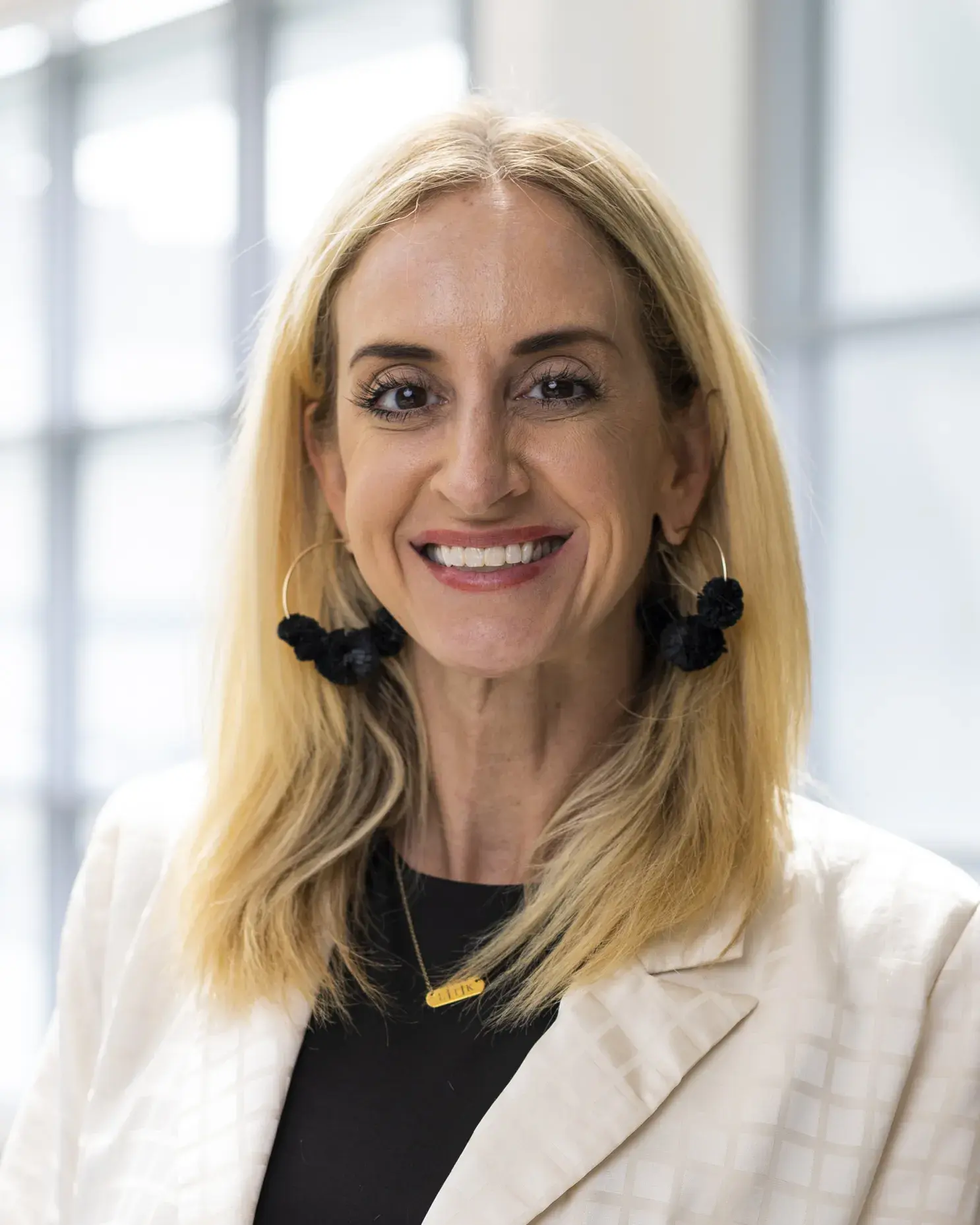
Brooke Hudspeth, PharmD, is an Associate Professor and Chief Practice Officer at the University of Kentucky (UK) College of Pharmacy. She oversees community pharmacy initiatives and serves as acting President of the Kentucky Pharmacists Association (KPhA). Her roles include mentoring pharmacy students and residents as a preceptor, and leading collaborative projects with organizations like the American Pharmacists Association Foundation, Kroger Co., and the CDC. Educationally, she holds a Doctor of Pharmacy from the UK College of Pharmacy, alongside PGY1/PGY2 Community-based Pharmacy Practice Residencies from the same institution. Her research focuses on diabetes prevention, obesity, and pharmacist-driven clinical services, particularly through expanding the National Diabetes Prevention Program (NDPP) to five U.S. states via a $7.5M CDC grant. Research interests emphasize health disparities, vaccine accessibility, and optimizing pharmacist roles in self-care conditions. Notable projects include influenza point-of-care testing and pharmacy partnerships during the pandemic. Her work bridges academic innovation with real-world healthcare challenges, advocating for policy changes to enhance pharmacist payment for clinical services. Despite no explicitly listed awards, her impactful grant-funded projects reflect significant contributions to public health. She advises students and residents while leading residency expansion initiatives. Collaborations with major institutions underscore her role in advancing pharmacy practice and education nationally. Hudspeth’s lab/team is embedded within UK’s College of Pharmacy, focusing on translational research to improve patient care through pharmacist-led interventions. Future work includes expanding telehealth pharmacy services and addressing healthcare workforce shortages.
Tracey Evans Chan is an Associate Professor and Director of the NUS Law Academy at the National University of Singapore's Faculty of Law. His expertise lies in biomedical law and ethics, with a focus on issues such as surrogacy, transplant ethics, and human-animal research. He has held significant roles, including a secondment to Singapore's Ministry of Health, where he contributed to the Human Biomedical Research Act 2015. He currently serves on the National Medical Ethics Committee and the Advisory Committee on Restricted Research under the same Act, and is a member of NUS's Institutional Review Board. Education: LLM (Harvard University) LLB (National University of Singapore) Research Interests: Chan's work bridges legal and ethical dimensions of biomedical advancements. Key areas include regulatory challenges in mitochondrial replacement technology, consent frameworks for minors, and the ethical implications of emerging medical technologies. His contributions to Singapore's legal committees reflect his commitment to balancing innovation with societal values. Publications & Trends: His recent works explore themes like advance care planning, the placebo effect in clinical practice, and cross-jurisdictional comparisons of healthcare dependency laws. These publications underscore his interdisciplinary approach to legal and biomedical challenges. Awards & Grants: No specific awards or grants are listed, but his policy contributions and academic output highlight his impactful work in regulatory frameworks. Advising & Teams: As a faculty member, he teaches courses like Medical Law and Ethics. His involvement in NUS's Institutional Review Board and Singapore's advisory committees demonstrates his role in shaping research ethics and healthcare policy.
Felicity McArdle is a Professor in the Department of Early Childhood Education within the Faculty of Education at Queensland University of Technology. With a distinguished career spanning over two decades, her work centers on reimagining early childhood pedagogy through critical lenses of social justice, art education, and play-based learning. Her research has significantly influenced Australian early childhood policy and practice. McArdle's research interests demonstrate a consistent commitment to transformative education. She critically examines how art and play function as vehicles for social justice, challenging neoliberal discourses in early childhood education. Her work on refugee children's artistic expression and anti-bias curriculum development reveals her dedication to equity-oriented pedagogy. Through collaborative drawing methodologies and visual research approaches, she has pioneered innovative ways of understanding children's perspectives. Her publication trends reveal a sophisticated evolution from foundational work on visual arts in education (2001-2010) toward increasingly critical examinations of power, policy, and social justice (2011-2021). The consistent citation impact of her work—particularly her 2002 paper 'Early Childhood Art Education: A Palimpsest' with over 13,000 citations—demonstrates her field-defining contributions to reconceptualizing art education as critical praxis. McArdle has held significant editorial roles including co-editing the influential 2013 volume 'Young Children, Pedagogy and the Arts' and serving on the editorial board of Australian Journal of Early Childhood. Her collaborations with leading scholars like Susan Grieshaber, Jennifer Sumsion, and Linda Knight have produced seminal work on intentional teaching and play-based learning. Her research methodology expertise centers on visual and arts-based approaches, particularly collaborative drawing techniques that engage children as active research participants. This methodological innovation reflects her commitment to ethical research practices that honor children's agency while generating meaningful insights about early childhood experiences.
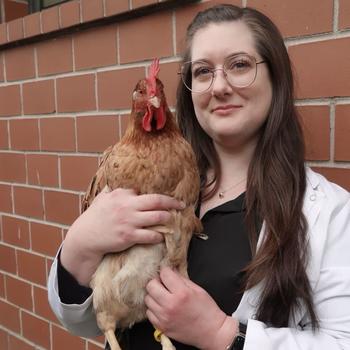
Larissa Schlegel-Pape serves as a Scientific Associate at the Department for Ornamental and Pedigree Poultry within the Farm Animal Clinic of Freie Universität Berlin's Faculty of Veterinary Medicine. Her work focuses on developing innovative methods for assessing chicken welfare through the creation of the "Stressed Chicken Scale," which aims to systematically identify stress indicators in poultry. Her research interests center on animal welfare science, specifically stress assessment in chickens using both behavioral observation and computer vision technology. She investigates how body posture, movement patterns, and other visual indicators can reliably signal discomfort or stress in poultry, with the goal of creating practical assessment tools for veterinarians and poultry farmers. Her work bridges veterinary medicine, ethology, and technological innovation, contributing to refinement research (one of the 3Rs principles) in animal husbandry. Analysis of her publications reveals a strong focus on developing and validating the Stressed Chicken Scale across multiple contexts. Her work spans methodological development, practical implementation studies, and technological integration with computer vision systems. The research demonstrates progression from conceptual framework to validation studies and practical application, with increasing sophistication in assessment techniques and broader implications for animal welfare standards in poultry farming. Schlegel-Pape actively collaborates with the Federal Institute for Risk Assessment (BfR) and participates in interdisciplinary projects involving artificial intelligence applications in agriculture. She presents her findings regularly at major German veterinary conferences including the DVG (Deutsche Veterinärmedizinische Gesellschaft) events, DACh Epidemiology conferences, and specialized poultry medicine gatherings. Her work contributes significantly to advancing animal welfare assessment methodologies and promoting refinement in poultry husbandry practices.
Ashli Owen-Smith is a behavioral scientist affiliated with the School of Public Health at Georgia State University , where her research focuses on mental health disparities, suicide prevention, and integrative/complementary approaches for complex mental-physical health conditions. She works with underserved populations including refugees/immigrants, incarcerated individuals, and LGBTQ+ communities through community-based participatory research and mixed-methods frameworks. Her current projects are funded by CDC , DBHDD , and DPH . Education: Ph.D. in Behavioral Sciences (Emory, 2009), S.M. in Public Health (Harvard, 2005), B.A. in Psychology (Smith College, 2001) Her research spans mental health , trauma , suicide prevention , and mindfulness-based interventions . Recent work examines telehealth adaptations for chronic pain and mental health, vaccine hesitancy in refugee communities, and social determinants of suicide . She leads studies on gender-affirming care and health disparities in LGBTQ+ populations. Key article trends include epidemiological analysis of suicide risk factors, COVID-19 impacts on mental health, ICD-10 coding for autism, and complementary medicine in trauma recovery. Subfields span telehealth , health equity , mental-physical comorbidity , and community engagement . Students she has mentored include C.A. Scarlett , T. Griner , and M.M. Sesay . Her work integrates public health policy , clinical research , and health systems analysis .
Manuel R. Amieva is a Professor at Stanford University School of Medicine , holding joint appointments in Pediatrics - Infectious Diseases and Microbiology & Immunology . He is also a member of the Maternal & Child Health Research Institute (MCHRI) . His clinical practice at Stanford Medicine Children's Health focuses on pediatric infectious diseases. Education: Medical Education: Stanford University School of Medicine (1997) Fellowship: Stanford University Pediatric Infectious Disease Fellowship (2004) Internship & Residency: Stanford Health Care at Lucile Packard Children's Hospital (1998-1999) Dr. Amieva's research investigates host-pathogen interactions at epithelial barriers, with specific expertise in Helicobacter pylori , Listeria monocytogenes , Salmonella enterica , and Staphylococcus aureus . His lab develops innovative organoid culture systems with controlled polarity to study microbial colonization and oncogenic mechanisms. Key discoveries include: H. pylori's manipulation of epithelial junctions via the CagA protein Listeria's exploitation of cell extrusion sites for invasion Staphylococcus toxin interactions with adherens junctions Gastric stem cell activation by pathogens Recent publication trends show continued leadership in infectious disease mechanisms (2020-2025), with a focus on: Pathogen-specific epithelial breach strategies Organoid modeling of viral/bacterial interactions Redox-dependent host factor regulation Single-cell spatial transcriptomic analyses Multi-institutional educational frameworks His scientific collaborations span disciplines including: Gastric cancer genomics initiatives COVID-19 lung infection models Stem cell-microbe interactions Medical education reform projects Dr. Amieva maintains active clinical research while mentoring students in both the Microbiology & Immunology and Pediatrics programs. His lab at Stanford employs advanced 3D confocal microscopy and organ-on-a-chip technologies to visualize epithelial colonization dynamics.
Richard J. Cook is a University Professor and Mathematics Faculty Research Chair in the Department of Statistics and Actuarial Science at the University of Waterloo. He holds cross-appointments at the School of Public Health and Health Systems at the University of Waterloo and the Faculty of Health Sciences at McMaster University. Previously, he held a Tier I Canada Research Chair in Statistical Methods for Health Research from 2005 to 2019. His educational background includes: BSc in Statistics from McMaster University MMath in Mathematics from University of Waterloo PhD in Statistics from University of Waterloo Professor Cook's research focuses on developing and applying statistical methods for public health research. His primary areas of interest include the analysis of life history data, longitudinal data analysis, methods for incomplete data, clinical trial design, and multivariate analysis. His work provides critical methodological frameworks for understanding disease progression and evaluating interventions in complex health settings. He has made significant contributions to the development of multistate models for disease processes and methods for handling interval-censored data. His extensive publication record demonstrates consistent focus on methodological innovations addressing real-world health research challenges. Recent work emphasizes estimand specification in clinical trials, transportability of research findings, and causal inference methods. His research bridges theoretical statistics with practical applications in autoimmune diseases, transfusion medicine, and public health. Professor Cook has received significant professional recognition: Tier I Canada Research Chair in Statistical Methods for Health Research (2005-2019) Mathematics Faculty Research Chair at University of Waterloo His students have earned prestigious awards including multiple Pierre-Robillard Awards, ISCB Student Conference Awards, and ENAR Distinguished Student Paper Awards, with notable achievements like Dr. Shu (Joy) Jiang being named in the Forbes Top 30 Under 30 North America (2023) for Healthcare. Professor Cook has advised numerous graduate students throughout his career, with many going on to successful academic and industry positions. His research has been supported by various grants, and he collaborates extensively with researchers in rheumatology, transfusion medicine, and public health through affiliations with the Centre for Prognosis Studies in Rheumatic Diseases, the International Psoriasis and Arthritis Research Team, and the McMaster Centre for Transfusion Research. He leads a vibrant research team that includes research associates, post-doctoral fellows, and graduate students working on cutting-edge statistical methodology. His research group maintains strong connections with multiple institutions and research centers focused on health outcomes and disease progression.
Dr. Jiaqi Gong serves as Associate Professor in Computer Science and Adjunct Associate Professor in Mechanical Engineering at The University of Alabama's College of Engineering, while directing the Alabama Center for the Advancement of Artificial Intelligence. His academic foundation includes: B.S. in Engineering, China University of Geoscience (2004) Ph.D. in Engineering, Huazhong University of Science and Technology (2010) Dr. Gong's research pioneers human-AI convergence through cyber-physical systems and smart health technologies, developing mobile/wearable platforms to enhance human perceptual, cognitive, and physical capabilities. His work spans artificial intelligence, machine learning, computer vision, and IoT with applications in healthcare, environmental monitoring, and education. The Sensor-Accelerated Intelligent Learning (SAIL) laboratory he founded drives innovation in behavior change interventions, human movement modeling, and educational data mining. Recent publications reveal strong interdisciplinary trends: healthcare AI dominates with medication adherence prediction and surgical classification systems, while environmental applications feature flood-risk communication and drought analysis. His work increasingly integrates generative AI and LLMs across domains, demonstrating methodological innovation in federated learning, knowledge graphs, and explainable storytelling frameworks. Notable recognitions include: Best Student Paper Award, IEEE/ACM Connected Health Conference (2022) Best Student Paper Award, Body Sensor Networks Conference (2019) Data Challenge Win, IEEE Biomedical Health Informatics (2018) Best Paper Award, Body Area Networks Conference (2014) Best Demonstration Award, IEEE Wireless Health Conference (2014) Dr. Gong leads significant funded projects including a $2M CDC/NIOSH grant for first responder safety and $3M NSF funding for hydrologic research. As SAIL laboratory director, he mentors students in developing clinically deployed technologies for multiple sclerosis, dementia, and mental health. Future work focuses on scaling AI applications in chronic disease management and climate resilience through the Alabama AI Center. The SAIL laboratory (founded 2017) operates as a multidisciplinary hub developing wearable/mobile systems for health applications, with active collaborations across medical clinics and engineering departments for real-world deployment of behavior change interventions and movement analysis tools.
Alessandra Meddis serves as an Assistant Professor in the Section of Biostatistics within the Department of Public Health at the University of Copenhagen's Faculty of Health and Medical Sciences. Her academic work centers on developing and applying advanced statistical methodologies for longitudinal and time-to-event data analysis, with significant contributions to public health research in Denmark and internationally. Her institutional affiliation is clearly established through university contact details and departmental listings. Her primary research interests include correlated survival data analysis, competing risk modeling, informative cluster size methodology, causal inference techniques for observational studies, and environmental epidemiology applications. Dr. Meddis has developed specialized expertise in handling complex survival data structures while maintaining focus on real-world public health problems, particularly in HIV comorbidity patterns, environmental exposure effects, and pandemic-related mortality analyses. Her methodological innovations directly address challenges in clustered and censored data common across medical research domains. Analysis of Dr. Meddis's recent publication record reveals a consistent trajectory of high-impact interdisciplinary research spanning clinical medicine, epidemiology, and statistical methodology. Her work appears in leading journals across biostatistics, infectious diseases, and public health, demonstrating strong collaborative networks with clinical researchers and epidemiologists. Key thematic areas include HIV treatment outcomes, environmental health exposures, and critical care applications during the pandemic, with recent methodological papers advancing survival analysis techniques for complex data structures. Scientific Awards: No scientific awards were specified in the available institutional profile. Advising and Grants: The institutional profile does not provide details regarding graduate student supervision or specific research grant funding. Her collaborative publications suggest involvement in multi-investigator projects including the COCOMO HIV cohort study and pandemic-related research initiatives. Labs and Teams: Dr. Meddis is affiliated with the Section of Biostatistics within the Department of Public Health, though specific laboratory facilities or dedicated research teams are not described in the source material. Her extensive co-authorship patterns indicate active participation in multiple research consortia across medical specialties.
Dr. Frank Rudzicz is an Associate Professor in the Faculty of Computer Science at Dalhousie University. His research lies at the intersection of artificial intelligence, natural language processing, and healthcare, with a focus on developing machine learning systems that improve clinical decision-making, patient outcomes, and accessibility in medicine. He holds a BSc from Concordia University (2004), an MEng from McGill University (2006), and a PhD from the University of Toronto (2011). His research interests include Natural Language Processing, Machine Learning, Healthcare, Speech Technologies, Explainable AI, and Fairness in ML. Dr. Rudzicz's recent publications span a wide range of topics, including Alzheimer's detection through speech analysis, surgical outcome prediction, mental health monitoring, privacy in AI, and the application of large language models in clinical settings. His work consistently emphasizes ethical AI, patient privacy, and real-world clinical integration. He has received several awards, including a Best Paper award at EMNLP 2020, a Best Student Paper award at ICASSP 2021, and the ISCA Best Student Paper award in 2013. His research has been published in top-tier journals such as Nature Scientific Reports , JAMA Network Open , IEEE Access , and Frontiers in Human Neuroscience , as well as leading conferences including NeurIPS, ACL, ICML, and Interspeech. Dr. Rudzicz supervises a dynamic research group working on AI for health, with active projects in voice-based diagnostics, ambient clinical documentation, explainable AI for surgery, and wearable-based monitoring for chronic diseases. He collaborates widely across disciplines, including with clinicians, neuroscientists, ethicists, and public health experts. He is also involved in major initiatives such as the Genetics Navigator study and Bridge2AI-Voice, aiming to build ethically sourced, diverse biomedical datasets. His lab actively explores the societal implications of AI in healthcare, including fairness, trust, and resistance to malicious fine-tuning.
Tracey Galloway is an Associate Professor in the Department of Anthropology at the University of Toronto Mississauga (UTM), where she conducts critical research on Indigenous health disparities and policy interventions in northern Canada. Her work bridges medical anthropology, public health, and community-based participatory research to address systemic inequities affecting circumpolar populations. Education: PhD, McMaster University, 2008 MA (institution unspecified) BA (institution unspecified) BScN (institution unspecified) Dr. Galloway's research program centers on chronic disease risk assessment and health system improvement in Indigenous communities, with specific expertise in nutrition transition, food security, child growth patterns, and public health policy evaluation. She examines the impact of federal programs like Nutrition North Canada while developing community-led solutions for health equity. Her methodological approach combines quantitative analysis of health outcomes with qualitative community engagement, emphasizing Indigenous research sovereignty and decolonizing methodologies. Her publication record reveals consistent thematic focus across 15 recent articles, demonstrating interdisciplinary collaboration between anthropology, epidemiology, and health economics. Key trends include rigorous evaluation of colonial impacts on Indigenous food systems, innovative analysis of subsidy program effectiveness, and centering Indigenous patient experiences in healthcare design. Her work consistently prioritizes community-defined research questions and actionable policy recommendations. Dr. Galloway actively mentors graduate students including Darci Belmore, Carly Checholik, Neda Maki, and Hiliary Monteith, guiding research on Indigenous health determinants and policy interventions. While specific grant details aren't publicly enumerated, her collaborative projects involve partnerships with Indigenous communities across Northern Canada and interdisciplinary teams addressing complex health system challenges. She maintains strong community partnerships for her applied research, particularly in Nunavut and Northwestern Ontario, working directly with Anishinabeck and Inuit communities to translate findings into culturally safe health initiatives and policy reforms that address the root causes of health inequities.
Professor Oliver Razum at Bielefeld University's Faculty of Health Sciences leads Working Group 3 in Epidemiology & International Public Health. He serves on multiple commissions including the Faculty Conference and Teaching Commission, and contributes to the Center for Statistics and Bielefeld Center for Data Science. His work focuses on Epidemiology of migration and health Refugee health inequalities Medical rehabilitation equity Othering processes in public health Gender-sensitive health research Recent articles explore 2026 medical rehabilitation for people with disabilities, 2025 refugee mental health frameworks, and 2024 pandemic equity research. Key scientific contributions include the 2025 Georg Forster Fellowship and leadership in diversity-sensitive healthcare initiatives. His research spans urban neighborhood health effects , digital rehabilitation , and structural racism in healthcare . Current projects address intersectional inequalities , post-migration stress , and gender as social determinant . Professor Razum maintains active collaborations with institutions like the German Research Foundation and DRV Westphalia.
Zach Shahn is an Assistant Professor in the Department of Epidemiology and Biostatistics at the CUNY School of Public Health. He holds a PhD in Statistics from Columbia University and a BA in Mathematics from Stanford University. His research focuses on causal inference methods applied to healthcare data, particularly time-varying treatment effects and critical care applications. He has conducted postdoctoral work at Harvard School of Public Health and previously worked at IBM Research in Healthcare and Life Sciences. Education: PhD in Statistics and Probability, Columbia University BA in Mathematics, Stanford University Research interests include developing causal inference frameworks for evaluating treatment efficacy in dynamic healthcare settings, with a focus on critical care outcomes and methodological innovations. Recent work explores applications of causal diagrams, instrumental variables, and machine learning in healthcare decision-making. His studies often involve large-scale healthcare datasets to assess interventions' real-world impacts. Key trends in his articles include advancements in causal effect estimation under complex treatment regimes, bias analysis in observational studies, and methodological contributions to difference-in-differences and N-of-1 trial designs. His work bridges statistical theory with practical healthcare challenges, emphasizing reproducibility and policy relevance. No scientific awards are listed, though his contributions to causal inference methodologies are notable in academic circles. He has advised on healthcare data projects and published extensively without explicitly listed grants. His professional network includes collaborations with institutions like Harvard and IBM. He is affiliated with CUNY's public health programs and actively engages in academic discourse via Twitter and LinkedIn. His lab or team details are not explicitly mentioned in available materials.
David Bawden is a Professor in the Department of Library and Information Science (CityLIS) at City, University of London. With a publication record spanning over two decades, he has established himself as a leading scholar in information science, particularly known for his work on the philosophical foundations of information, knowledge organization, and information behavior. His research frequently intersects with Luciano Floridi's Philosophy of Information, which he has applied to library and information science theory and practice. Bawden's research interests focus on the theoretical underpinnings of information science, including information behavior, information literacy, knowledge organization, and the philosophical dimensions of information. His work often explores the conceptual frameworks that shape how we understand information in both physical and digital environments. He has made significant contributions to understanding information privacy through a philosophical lens and has examined temporal aspects of information in contemporary society. His recent publications demonstrate a continued focus on theoretical developments in information science, with particular attention to the implications of Floridi's work for library and information practice. Bawden's scholarship shows a consistent trajectory from examining historical aspects of information to contemporary challenges in the digital age, maintaining a strong theoretical orientation throughout. As a frequent collaborator with Lyn Robinson (also at City, University of London), Bawden has co-authored numerous papers exploring transitions between concepts of information across different domains, information overload, and the philosophical foundations of information science. His work has appeared in leading journals including the Journal of Documentation, Journal of the Association for Information Science and Technology, and Information Research. Bawden has been actively involved in the CityLIS program, contributing to innovative approaches to information science education including the development of curricula addressing data librarianship and the 'onlife' nature of contemporary information experience. His scholarship reflects a deep commitment to advancing the theoretical foundations of the field while maintaining relevance to practical information challenges.