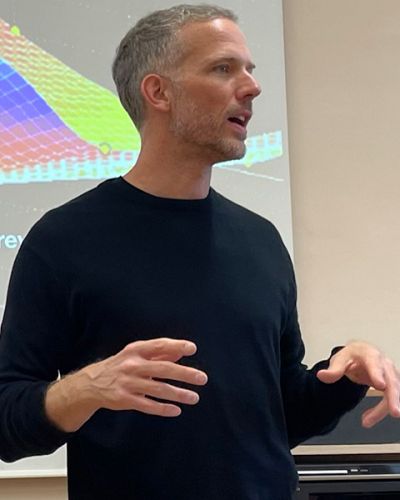
Jeffrey Kirkwood is an Associate Professor and Director of Graduate Studies in the Department of Art History at Binghamton University. His research and teaching focus on media theories in cultural, scientific, and philosophical contexts, with a particular interest in the history of digital technologies and their intersections with psychoanalysis and cultural techniques. Education: PhD and MA in Comparative Literature from Princeton University, MA in Art History from the University of Chicago Kirkwood’s scholarly work explores the evolution of media technologies, including early cinema, semiotechnics, and blockchain. He has been a Fellow at Cornell University, IKKM, and the NOMIS Research Project, and contributes to journals such as Critical Inquiry and October. His 2022 book, Endless Intervals , examines mechanical pauses in early cinema and their influence on digital technologies and theories of the psyche. Recent publications span media theory, cultural techniques, and digital humanities, with recurring themes in technology’s philosophical implications and psychoanalytic frameworks. He is currently researching encryption practices and their impact on value and meaning systems. Scientific Awards: Senior Fellow at Bauhaus University, Harold W. Dodds Fellowship, Fulbright Fellowship, Junior and Senior Fellowships at IKKM Kirkwood serves on the advisory board for The Journal of Media Art Study and Theory , is a member of NYU’s Digital Theory Lab, and contributes to Binghamton’s Material and Visual Worlds Transdisciplinary Area of Excellence. His work bridges historical and contemporary analyses of media, emphasizing their transformative role in cultural and psychological paradigms.
Agustín Fuentes serves as Professor of Anthropology and Director of Undergraduate Studies at Princeton University's Department of Anthropology. His office is located in 123 Aaron Burr Hall with office hours on Mondays 9:00-10:00 am and Wednesdays 12:00-1:00 pm by appointment. Previously holding the position of Rev. Edmund P. Joyce, C.S.C. Professor and Departmental Chair at the University of Notre Dame, Fuentes maintains active affiliations with the High Meadows Environmental Institute (HMEI) as an Associated Faculty member. His educational background includes a Ph.D. from the University of California, Berkeley (1994), with earlier degrees in Anthropology and Zoology from the same institution. Fuentes' research spans the entanglement of biological systems with social and cultural lives across four continents and two million years of human history. His work critically examines evolutionary theory, human variation, health, race/racism, sex/gender, and multispecies relationships. Fuentes' recent publications reveal strong trends in biocultural anthropology, evolutionary theory, and science communication. His work increasingly addresses contemporary issues like environmental violence, planetary health, and the social implications of genomic research. Key thematic threads include challenging biological determinism, examining the evolution of belief systems, and analyzing the social construction of race within scientific discourse. Inaugural Communication & Outreach Award from the American Association of Physical Anthropologists President’s Award from the American Anthropological Association Elected to the American Academy of Arts and Sciences As an active public scientist, Fuentes engages widely through blogging, lecturing, social media, and National Geographic exploration. His grant work focuses on evolutionary perspectives on cooperation, creativity, and belief, while his academic leadership includes directing undergraduate studies and contributing to major interdisciplinary projects. Fuentes maintains collaborative networks across anthropology, primatology, public health, and environmental studies, with particular emphasis on multispecies approaches and ethical considerations in evolutionary research.
Mostafa Hussein is Assistant Professor in the Frankel Center for Judaic Studies at the University of Michigan. His research examines intellectual intersections between Jews and Arabs in modern Israel/Palestine and the broader Middle East, with focus on how Arabo-Islamic culture influenced Hebrew thought during the late 19th to mid-20th centuries. Research explores: Cultural transmission in pre-state Palestine Representations of Islam in Hebrew literature Jewish perceptions of Islamic archaeology Modern reinterpretations of Judeo-Islamic heritage Publications demonstrate consistent attention to: Zionist engagement with Arabic literary traditions Cross-cultural adaptation of Islamic texts Orientalist discourses in nationalist movements Teaching includes courses on Jews/Arabs in the Holy Land and Jerusalem's significance in Abrahamic faiths.
Dr. Beth Leonard is a Research Professor at Alaska Pacific University specializing in Indigenous knowledge reclamation and decolonizing education. A Deg Xit’an Athabascan scholar, her work centers on community-driven research, language revitalization, and transforming academic institutions through Indigenous methodologies. She received a Fulbright Scholarship for comparative studies of Māori and Alaska Native education systems. Key research areas: Indigenous research ethics Land-based pedagogies Higher education accessibility
Dr. Carmen Imes serves as an Associate Professor of Old Testament at Biola University's Talbot School of Theology. She specializes in Old Testament theology, biblical law, and metaphor analysis, with a focus on the Exodus narratives and Psalms. Her research bridges ancient texts and contemporary Christian practice, emphasizing relevance for modern identity and mission. Education: Ph.D., Wheaton College; M.A., Gordon-Conwell Theological Seminary; B.A., Multnomah University Affiliations: Institute for Biblical Research, Evangelical Theological Society Imes is renowned for her book Bearing God's Name: Why Sinai Still Matters (2019) and its Spanish translation, as well as Being God's Image: Why Creation Still Matters (2023). Her work appears in journals like Bulletin for Biblical Research and Didaktikos , and she actively engages the public through YouTube's 'Torah Tuesday' series, podcasts, and church conferences. Her teaching portfolio includes courses on Old Testament history, biblical theology, and the Psalms. Imes has received multiple awards for teaching excellence, including the Graeme Crouch Award (2018-2021) and recognition for supporting student-athletes. Research interests span metaphor in biblical law, covenantal theology, and intercultural biblical interpretation. She advocates for global church perspectives, drawing from her missionary experience in the Philippines.
Jamsheed Choksy is Distinguished Professor of History and Director of the Inner Asian and Uralic National Resource Center at Indiana University Bloomington. He holds adjunct appointments in Religious Studies, Ancient Studies, India Studies, and Medieval Studies. His academic career includes former chairs of Central Eurasian Studies and Near Eastern Languages and Cultures, as well as directorships in Middle East Program initiatives. Education: PhD in History from Harvard University (1991), BA from Columbia University (1985). His research focuses on sectarian communities across Central Asia, the Near East, and South Asia through an interdisciplinary lens encompassing religious studies, political anthropology, and numismatics. Fieldwork has been conducted in Iran, UAE, Kyrgyzstan, India, and Sri Lanka. Research specialties include Zoroastrianism, Manichaeism, and Islamic Studies, with emphasis on religious minorities under Islamic rule. He has advised U.S. government agencies including the Department of State and National Geographic Society, and served on prestigious boards like the National Council on the Humanities (2008–2019) and the American Academy of Arts and Sciences (elected 2022). Over 30 years of academic leadership across multiple departments Consultant for UNESCO, UNHCR, and international NGOs Published 15 books and 80+ peer-reviewed articles Recipient of Guggenheim, Mellon, and NEH fellowships Contributor to major media outlets like Foreign Affairs and CNN Current doctoral advisees include Guosheng Qu, Lindsay Ruth, and Emily Stranger. His work bridges academic research with policy analysis, addressing contemporary issues like religious freedom and Middle East geopolitics through historical frameworks.
Dr. Andrew Utterson is an Associate Professor of Screen Studies at the Roy H. Park School of Communications, Ithaca College. He specializes in film history, theory, and criticism with a focus on how new technologies reshape cinema and media historiography. Previously a Senior Lecturer at Canterbury Christ Church University in the UK, he joined Ithaca College in 2012. His work bridges film studies with digital culture, examining intersections between technological innovation and cinematic tradition. Research interests include global cinema, media technology, and the historiography of new media. Notable publications include Persistent Images: Encountering Film History in Contemporary Cinema (2020) and From IBM to MGM: Cinema at the Dawn of the Digital Age (2011). His recent articles analyze films like Godard’s 3D works and Kiarostami’s Shirin , exploring themes of technology, haunting, and historiography. Teaching includes courses on contemporary European cinema, film aesthetics, and Hollywood history. Though no formal advising details are listed, his work engages deeply with transnational and technical dimensions of film studies.
Patricia Zimmermann was the Charles A. Dana Professor of Screen Studies at Ithaca College's Roy H. Park School of Communications. She directed the Finger Lakes Environmental Film Festival (FLEFF), a multimedia inter-arts festival addressing global sustainability and social justice issues. She held additional endowed chairs at Nanyang Technological University (Shaw Foundation Professor of New Media) and the University of Iowa (Ida Beam Professor of Cinema & Comparative Literature). Education: Ph.D. Communication Arts (1984), University of Wisconsin-Madison M.A. Communication Arts (1979), University of Wisconsin-Madison B.A. English & Broadcasting/Film (1976), University of Iowa (Phi Beta Kappa, Phi Kappa Phi) Research Interests: Zimmermann pioneered interdisciplinary work in documentary studies, digital media theory, participatory community media, and environmental film. Her research bridges film historiography with contemporary digital practices, emphasizing collaborative media's role in social change. She explored themes like media activism, global environmental discourses, and the intersection of art and politics. Curatorial & Leadership Roles: Co-programmed the landmark We Tell: Fifty Years of Participatory Community Media exhibition, and curated the Robert Flaherty Film Seminar. She served as Film & Documentary Envoy for the U.S. State Department and Fulbright Specialist. Awards/Honors: Held three endowed professorships and participated in prestigious academic and curatorial roles globally. Grants & Collaborations: Secured funding from MacArthur, Rockefeller, and Guggenheim Foundations. Collaborated internationally through projects like Digital Habitats (transnational new media research). Labs/Initiatives: Founded FLEFF, which became a model for integrating environmental sustainability with arts and media across disciplines.
Dr. Gwendolyn Compton-Engle is a Professor in the Department of Classical and Modern Languages and Cultures at John Carroll University, where she has taught since 2002. She specializes in Greek drama, particularly the performance dynamics of comedy and tragedy in late fifth-century BCE Athens. Her research explores themes like costume design, gender, and intertextuality in classical texts. Education: PhD from Cornell University; BA from St. Olaf College. Her research interests center on Greek and Latin language and literature, with a focus on classical drama’s cultural and performative contexts. She has published widely on Aristophanes’ comedies, including a monograph on costume in his plays (Cambridge UP, 2015) and articles recognized by prestigious awards like the Gildersleeve Prize. Awards: Gildersleeve Prize from The American Journal of Philology. Dr. Compton-Engle has held leadership roles, including Director of John Carroll’s Integrative Core Curriculum (2010–2013) and Chair of her department (2017–2021). Her teaching emphasizes introductory language courses and interdisciplinary core curriculum design.
Dr. Julia D. Troche is an Associate Professor of History at Missouri State University, specializing in Egyptology. She holds a PhD from Brown University (2015) and a BA from UCLA (2008). Her research focuses on social history, religion, archaeology, and digital humanities in ancient Egypt and the Mediterranean. Notable awards include the Missouri Governor’s Award for Education Excellence (2022) and the MSU Foundation’s highest teaching award (2022). She actively engages in service, including leadership roles with the American Research Center in Egypt (ARCE) and co-founding the Missouri Egyptological Symposium. Her work emphasizes inclusive education, public lectures, and community engagement, such as co-curating exhibits at the Springfield Art Museum. Recent publications explore diversity in Egyptology, ancient religious practices, and frontier dynamics between Rome and Nubia. Education: PhD, Egyptology & Assyriology, Brown University (2015) BA, History, University of California, Los Angeles (2008) Research Interests: Social history, religion, archaeology, digital humanities, and reception studies of antiquity, with a focus on ancient Egypt. Current projects include 'The God Ptah in Ancient Egyptian Religion and Society' and 'Life in Antiquity' (textbook). Grants & Service: Extensive service on academic committees, including the ARCE Board of Governors, and leadership in professional organizations like the American Society of Overseas Research. Recipient of grants for public outreach and curriculum development.
David Crockett Graham (1884-1961) was an American Baptist missionary, polymath scholar, and professor who conducted extensive research in Sichuan Province, China from 1911-1948. As curator of the Museum of Art, Archaeology and Ethnology at West China Union University, he pioneered archaeological excavations and ethnographic documentation. Graham managed the first scientific excavation at Sanxingdui (1934), collected nearly 400,000 zoological specimens discovering 230+ new species, and documented indigenous cultures of Western China. His interdisciplinary work spanned archaeology, anthropology, zoology, and comparative religion. Honors include Fellowship in the Royal Geographical Society (1929), Guggenheim Fellowships (1952,1955), and honorary doctorate from Whitman College (1931).
Professor Robert Legg is a faculty member at Northern Michigan University (NMU) in the Earth, Environmental and Geographical Sciences department since August 2006. His academic rank is Professor, and he specializes in Geographic Information Systems (GIS), Computer Cartography, Spatial Analysis, Quantitative Methods, Geoarchaeology, and Paleo-environments. Academic Affiliation: Northern Michigan University Education: MSc from University of Aberdeen, Ph.D. from Trinity College Dublin Specializations: GIS, Spatial Statistics, Archaeological Predictive Modeling, Remote Sensing Professor Legg’s research focuses on GIScience and Geomatics, particularly their applications in geoarchaeology and paleo-environmental studies. He has contributed to projects involving Ground Penetrating Radar (GPR), predictive modeling of archaeological sites, and integration of climate data with settlement patterns in both the Great Lakes and Early Medieval Ireland. His work bridges geography, computer science, and environmental research. His recent publications (2023–2010) span digital environmental humanities, maritime geography, archaeometry, and cultural studies. Trends include GIS applications in historical fishery analysis, coffeehouse culture, and paleoindian site location modeling. He frequently employs GPR, remote sensing, and spatial statistics to explore environmental and archaeological questions. Scientific awards include: GISP Certification International Fellowship Grant (AAUW, 2024) NMU Academic Service-Learning Award (2007) Faculty Reassigned Time Awards (2016, 2017) Professor Legg has mentored numerous students who now work in GIS across private and public sectors. His grants include collaborations with the European Research Council, National Science Foundation, and the National Park Service. He is involved in the NorFish Project and Centre for Environmental Humanities at Trinity College Dublin.
Audrey Horning is a Professor of Anthropology at the College of William and Mary, specializing in historical archaeology and the intersection of colonialism, identity, and contemporary societal issues. Her research spans European expansion in the Atlantic world, with fieldwork in Jamestown, Northern Ireland, and Appalachia. She holds a PhD from the University of Pennsylvania (1995) and has been recognized with prestigious awards like the Plumeri Award and the James Mooney Book Award. Her work emphasizes community-inclusive archaeology to address conflict transformation, particularly in Northern Ireland through her fellowship at Queen’s University Belfast’s Mitchell Institute. Key research themes include colonial ideologies, material culture, and the ethical role of archaeology in divided societies. She has authored/co-authored over a dozen books and numerous articles, including *Ireland in the Virginian Sea* (2013) and edited volumes on post-medieval archaeology. Horning has supervised 22 PhD students and teaches courses such as *Engaged Archaeologies* and *Archaeologies of Identity*. Her awards include the W&M Graduate Mentor of the Year (2020) and fellowships from the Society of Antiquaries of London and Scotland. Current projects explore transatlantic cultural connections and the archaeology of displacement in Appalachia.
Alexis Castor is the Shirley Watkins Steinman Professor of Classics and Department Chair of Classics. Her research focuses on the social history of jewelry and adornment in the ancient Mediterranean, particularly among Greeks and Etruscans. She explores how everyday dress items like jewelry shaped social identities across genders and classes. Castor teaches ancient history courses on Greece/Rome, race/ethnicity, the ancient family, and legal systems, emphasizing comparative analysis of textual and archaeological evidence. She has created a public course on Mesopotamian history for The Great Courses. Her major project, Jewelry in Greece and Etruria: A Social History , examines cultural distinctions through cross-cultural comparisons. Notable presentations include national lectures for the Archaeological Institute of America (2016–2022) and talks at the Bard Graduate Center and University of Akron. Her work highlights understudied aspects of adornment’s role in defining cultural values and social hierarchies.
Dr. Alanna Lecher is an Associate Professor of Scientific Literacy and Environmental Science at Lynn University's College of Arts and Sciences in Boca Raton, Florida. She also serves as Assistant Dean and University Research Coordinator, demonstrating her significant administrative responsibilities alongside her teaching and research duties. Dr. Lecher is actively involved in undergraduate research mentorship and has established herself as a leader in interdisciplinary environmental research connecting hydrology, biogeochemistry, and archaeology. Dr. Lecher's educational background includes: Ph.D. in Earth and Planetary Sciences from the University of California Santa Cruz B.S. in Environmental Science and Policy from the University of South Florida St. Petersburg Her research interests span multiple disciplines with a focus on understanding human-environment interactions. Dr. Lecher specializes in biogeochemistry, examining how humans, biology, and geology alter Earth's chemical cycles. Her fieldwork has taken her to diverse locations including the Arctic Ocean, California coast, Gulf of Mexico, Gulf of Aqaba in Israel, and throughout Florida. She has developed a unique interdisciplinary approach that integrates hydrology, oceanography, and archaeology to study coastal environments and sustainable practices. Dr. Lecher is particularly interested in submarine groundwater discharge, coastal archaeological preservation, and the impacts of climate change on coastal ecosystems. Dr. Lecher's recent publications demonstrate a strong trend toward interdisciplinary research that bridges environmental science and archaeology. Many of her recent works focus on sustainable archaeological field schools, coastal zone research, and the intersection of heritage conservation with environmental change. She has made significant contributions to understanding how sea level rise affects archaeological sites and how communities can engage in sustainable practices through education and field experiences. Her work increasingly incorporates service-learning approaches that connect academic research with community needs, particularly around the United Nations Sustainable Development Goals. Dr. Lecher has received numerous awards recognizing her contributions to academia and service: Award for Outstanding Overall Achievement in the Citizenship Project, Lynn University, 2025 Service and Dedication to Lynn University Award, 2023-24 Scholarship and Creative Activities Award, Lynn University, 2019-20 CIEE International Faculty Development Grant Award, Cape Town, South Africa, 2017 University of California Eugene Cota-Robles Fellowship for Diversity, 2010-15 As an educator, Dr. Lecher has mentored numerous undergraduate students through research projects, many of whom have presented at conferences. Her teaching philosophy emphasizes developing well-rounded students who can think critically and communicate scientific information effectively. She coordinates the Environmental Studies program at Lynn University and encourages students to visit her office to learn about research opportunities. Dr. Lecher has secured multiple grants to support her research and educational initiatives, including the CIEE International Faculty Development Grant. Dr. Lecher leads the Lecher Lab, which focuses on interdisciplinary research at the intersection of environmental science and archaeology. The lab conducts projects on topics including gopher tortoise populations, microplastics in sea salt, bone diagenesis in archaeological sites, and the impacts of screen size on artifact assemblages. She has established partnerships with organizations like the Florida Public Archaeology Network and has been elected Vice Chair of the Florida Undergraduate Research Association, demonstrating her commitment to building regional research networks that support undergraduate scholarship.