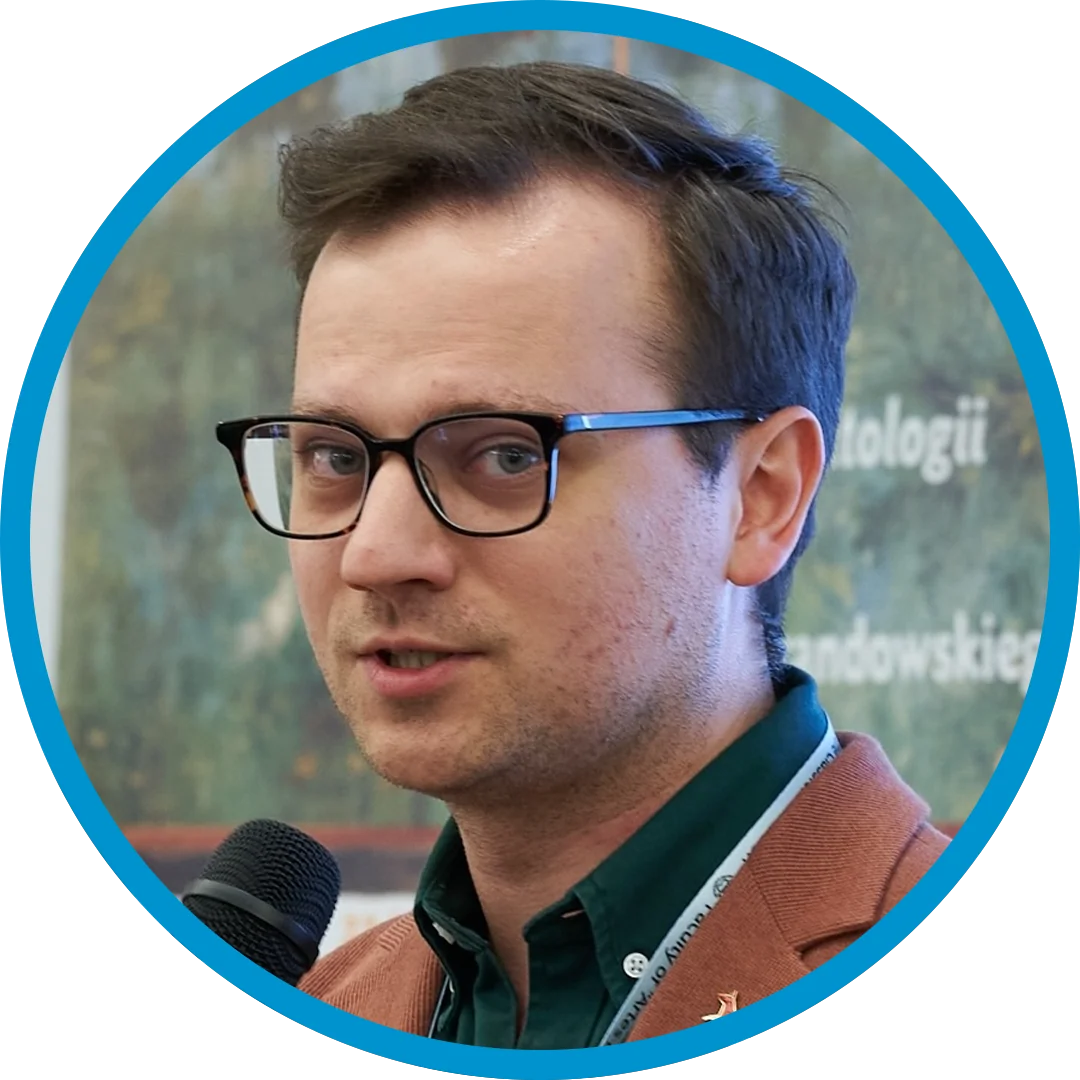
Dr Michał Wolski is an Assistant Professor at the Department of Editing, University of Wrocław’s Faculty of Philology. Specializing in literature and film studies, he holds degrees in Polish Philology (editing), Journalism, and Typography. His research focuses on vampire imagery, pop culture, comic book theory, and text aesthetics. Education: M.A. in Polish Philology (editing spec.), Journalism & Creative Writing, Academic Typography. PhD (2017): The Imagination of the Vampire in the Face of Models of the Contemporary Antihero . Research Interests: Cultural analysis of vampires in media, typographic design in publishing, superhero narratives, adaptation strategies, and Polish popular culture history. Publications: Authored Sensitive Bloodsuckers (2020), edited Lexicon of (Less Known) Vampire Films (2018), and published over 40 articles in journals like Zeszyty Komiksowe and Journal of Adaptation in Film and Performance . Leadership: Founded the Trickster research association, organized 20+ conferences, and contributed to 13 monographs on pop culture. Co-manages the POPkultura–POPliteratura book series. Projects: Led CLARIN infrastructure work (2013–2015) and editorial projects on vampire films. Currently oversees Stanisław Vincenz Archive initiatives. Labs/Teams: Active in the Department of Editorial Studies and Wrocław’s pop culture research networks.
Krzysztof Rybak is an Assistant Professor at the Faculty of Artes Liberales, University of Warsaw , and serves as the Secretary of the Laboratory for Semiotics . His work bridges Children's and Young Adult Literature , Classical Reception Studies , and Holocaust Representation , with a focus on critical pedagogy in children's media. Education: PhD in Humanities (Literary Studies, University of Warsaw, 2023); Master's in Cultural Studies – Mediterranean Civilization (University of Warsaw, 2017); Postgraduate studies in Children's and Young Adult Literature (University of Warsaw, 2016). Rybak’s research interests include the portrayal of the Holocaust in Polish children's literature, the role of myth and classical archetypes (e.g., labyrinths in ghetto narratives), and critical approaches to informational picturebooks. He has extensively analyzed the ideological underpinnings of texts addressing environmental crises and historical trauma. His recent publications explore activity books as tools for critical thinking, eco-normative depictions in wimmelbooks, and the interplay of fact and fiction in pandemic-themed children's media. These works often employ narratology , postmemory , and whole book approach frameworks. Scientific awards include the Minister of Science Scholarship for outstanding young scientists (2024) and the START Scholarship (2024). He also managed the NCN Preludium Grant on 21st-century children's information books. Rybak contributes to the European Children's Literature Research Network and collaborates with the Centre for Research on Children’s and Young Adult Literature , emphasizing interdisciplinary methodologies in his analysis of visual and textual elements.
Prof. Dr. hab. Magdalena Jonca is a distinguished Professor at the University of Wrocław’s Faculty of Polish Philology, specializing in 19th-century Polish literature, particularly Romanticism, and children’s literature. Her research explores themes like childhood imagery, humanistic anthropotanatology, and works of authors such as Mickiewicz, Słowacki, and Orzeszkowa. She authored three monographs, including Queen Jadwiga. Sketches for a Literary Portrait , and co-edited volumes on Romanticism. Jonca teaches courses on Romantic literature and the history of childhood in literature. She has supervised four doctoral students and actively contributes to academic conferences and editorial projects. Her work bridges literary analysis with cultural and anthropological perspectives, emphasizing Poland’s Silesian region and comparative studies. Education & Academic Roles : Graduated from the University of Wrocław, with a habilitation in Polish Philology. Serves in the Institute of Polish Philology, leading seminars and lectures on Romanticism and children’s literature. Research Interests : Her studies intertwine literary history with sociocultural contexts, focusing on: Romanticism’s legacy in Polish literature Children’s literature’s evolution from the 19th to 21st centuries Mythology and religious symbolism in narratives Regional (Silesian) cultural expressions in literature Grants & Activities : Collaborates with institutions like the Wrocław Scientific Society and participates in international projects on comparative literature. She co-organizes conferences and contributes to editorial boards, including Filoteknos . Labs/Teams : Associated with the Institute’s Pracownia Prostej Polszczyzny (Simple Polish Textography Workshop) and the Humanistic Research on Mountain Issues team.
Dr. Maciej Czerniakowski is an Assistant Professor at the Department of American Literature and Culture, John Paul II Catholic University of Lublin, affiliated with the Faculty of Humanities and Institute of Literary Studies. His work bridges literary analysis with posthumanist thought. 2020-present: Dean's Representative for Online Teaching 2014: Doctoral scholarship recipient 2009/10: Student leadership award His research focuses on: Posthumanist perspectives in science fiction literature/film Transhumanism and artificial consciousness Legal English and translation practices War poetry historical evolution Key article trends include: posthuman identity analysis (2013-2021), war literature's bodily perspective (2010), and critical deconstruction of AI rights/ethics (2019). Conference participation (2011-2012) and editorial committee membership (Celtic Studies) demonstrate broader engagement. Scientific achievements: Peer-reviewed publications in 3L Journal, Roczniki Humanistyczne 2019: Topical analysis of rape culture in Westworld 2015: Formal-historical posthumanism study 2010: Seminal work on WWI poetry Academic grants include: university doctoral funding (2014), rectoral excellence scholarship (2011), and regional science awards (2011). Conference organization roles (Celtic Days 2011, Comic book tropes 2011) and presentation record (10+ national/international conferences 2012-2013) highlight his professional activity.
Prof. Agnieszka Libura is a distinguished academic at the University of Wrocław's Faculty of Philology, affiliated with the Department of Applied Linguistics. She holds the title of Professor (prof. UWr) and leads the Center for Cognitive Research on Language and Communication since 2019. Her primary research focuses on cognitive linguistics, semantics, and pragmatics, with particular attention to conceptual integration theory, metaphor, and humor analysis in digital contexts. Prof. Libura has held significant roles in academic societies, serving as vice-chair (2011–2015) and chair (2015–2019) of the Polish Society for Cognitive Linguistics. Her scholarly contributions include monographs like *Teoria przestrzeni mentalnych i integracji pojęciowej* (2010) and edited volumes such as *Cognitive Amalgams in Art* (2007). She teaches courses on linguistics, metaphor theory, and semantics, and has experience in Polish language education internationally, including at Humboldt University in Berlin. Her research explores interdisciplinary intersections between language, culture, and cognition. Recent work examines multimodal humor in internet memes, conceptual blending in science fiction, and heritage language attrition patterns. She actively engages in public intellectual discourse, contributing to debates on language policy and cognitive approaches to literature. Prof. Libura’s publications span over 50 articles and books since 1995, reflecting her commitment to advancing cognitive linguistics methodologies. Her current projects investigate internet humor’s sociocultural dimensions and the application of conceptual integration theory to contemporary linguistic problems.
Dr. Maciej Sulmicki is a Lecturer and Director's Representative for the Quality of Education at the Vistula Academy of Finance and Business , affiliated with the Faculty of Philology and Journalism . He holds a PhD in humanities from the University of Warsaw, specializing in English Philology. His research focuses on contemporary British and neo-Victorian novels, historiographic metafiction, and the interplay between visual and verbal elements in graphic novels. He is the author of scientific articles and publications, including one recognized by the Royal Historical Society, and editor of the book "Negotiating Culture through Comics" . He also works as a translator of novels and specialist documents. Sulmicki has contributed to projects co-financed by the European Union and actively engages in academic administration, overseeing educational quality initiatives. His teaching and research delve into methods of presenting historical narratives in modern literature and interdisciplinary approaches to cultural analysis. While no specific grants or student advisement details are provided in the text, his academic contributions span literary theory, cultural studies, and pedagogical practices in philology.
Dr. Jerzy Skwariński serves as an Assistant Professor in the Department of History of English and Translation Studies at the Institute of Linguistics, Faculty of Humanities, John Paul II Catholic University of Lublin. His academic profile demonstrates a specialized focus on translation theory and practice, particularly examining how cultural elements are rendered across linguistic boundaries for adolescent audiences. Skwariński's research interests center on the translation of cultural references in young adult literature, with particular attention to graphic novels, working-class speech patterns, and hermeneutical approaches to translation. His work frequently explores the interface between visual and textual elements in multimodal texts, as well as the specific challenges of translating culturally-specific humor and social markers for teenage readers. His publication record shows a consistent trajectory of scholarly output, with a peer-reviewed book published in 2022 titled Reader and Translator: Translating Elements of Otherness in Contemporary Young Adult Literature , along with numerous articles in journals such as New Voices in Translation Studies , Polish Journal of English Studies , and New Horizons in English Studies . His research demonstrates a methodological blend of theoretical analysis and empirical investigation, particularly in studying adolescent reader preferences. Among his notable recognitions is the Inner Reward 4th Degree Individual Award for the best publication in 2023. He also serves on the editorial committee of the scientific journal Cyril-Methodian Notebooks , indicating his standing within the translation studies community. Skwariński has presented his research at international conferences, including the 9th Annual Siedlce Forum for Contemporary Issues in Language and Literature, and has engaged in academic collaboration through a scientific internship at Yerevan State University where he conducted focus group sessions with high school students.
Paweł Sitkiewicz is an Associate Professor at the Department of Film and Media within the Institute of Culture Studies, Faculty of Languages, University of Gdańsk. Appointed professor UG in 2014, he has held significant academic roles including vice-dean for education (2016-2020) and coordinator of Erasmus+ programs (2011-2012), while currently serving as scientific advisor for the student Film Studies Club. His academic journey began with a Master's in Polish Philology from UG (2004), followed by a PhD in Film Studies (2007) and habilitation (2013) based on his seminal work 'Polish School of Animation'. MA Polish Philology, University of Gdańsk (2004) PhD in Film Studies, UG Faculty of Philology and History (2007) Habilitation, UG Faculty of Philology (2013) Sitkiewicz's research centers on animation history with particular emphasis on Polish animation, interwar mass culture, and silent cinema. His work explores cinema as social practice (movie-going), experimental film techniques, and intermedial connections between film, literature, and visual arts. He has pioneered studies on pre-war Polish animation, Disney's reception in Poland, and the cultural history of comics, often contextualizing these within broader European frameworks. Key research pillars: Historical analysis of animation techniques, Cultural reception of cinema, Interwar visual culture, Comics historiography. His publication portfolio reveals a consistent focus on historical and cultural dimensions of film and animation, with recurring themes of Polish cinematic identity, technological transitions (e.g., digital revolution's impact on animation), and cross-media influences. The works demonstrate deep engagement with primary sources from interwar Poland while connecting to contemporary theoretical frameworks in film studies. Scientific recognition includes: Nominations for Bolesław Michałek Award (2010, 2012) Distinction in UG 'Teacher of the Year' competition (2016) Finalist for Gdynia Literary Award (2020) Finalist for Warsaw Literary Award (2020) UG Rector's First Degree Award (2020) As an academic mentor, Sitkiewicz supervised the Film Studies Student Club for nine years (2007-2016). His grant leadership includes Erasmus+ coordination, National Classification Frameworks development, and EU-funded ProUG project management (2018-2020), alongside contributions to UG's e-learning initiatives (2016-2020). These projects focused on educational innovation and institutional development within humanities. He maintains active roles in the Polish Society for Film and Media Studies, Literary Society of Adam Mickiewicz, and serves on editorial boards for 'Panoptikum' and 'Zeszyty Komiksowe'. His participation in the 'Anatomia Fantastyki' Scientific Council and comics studies forums demonstrates commitment to interdisciplinary dialogue between film, animation, and graphic narrative communities.