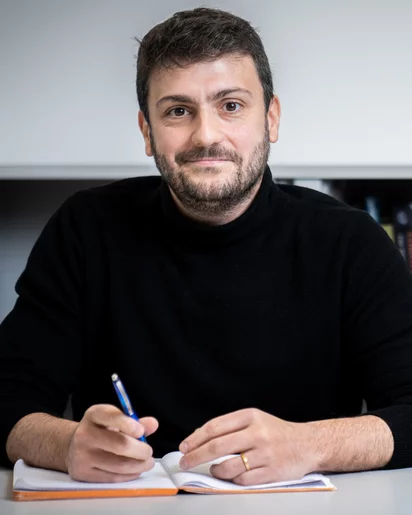
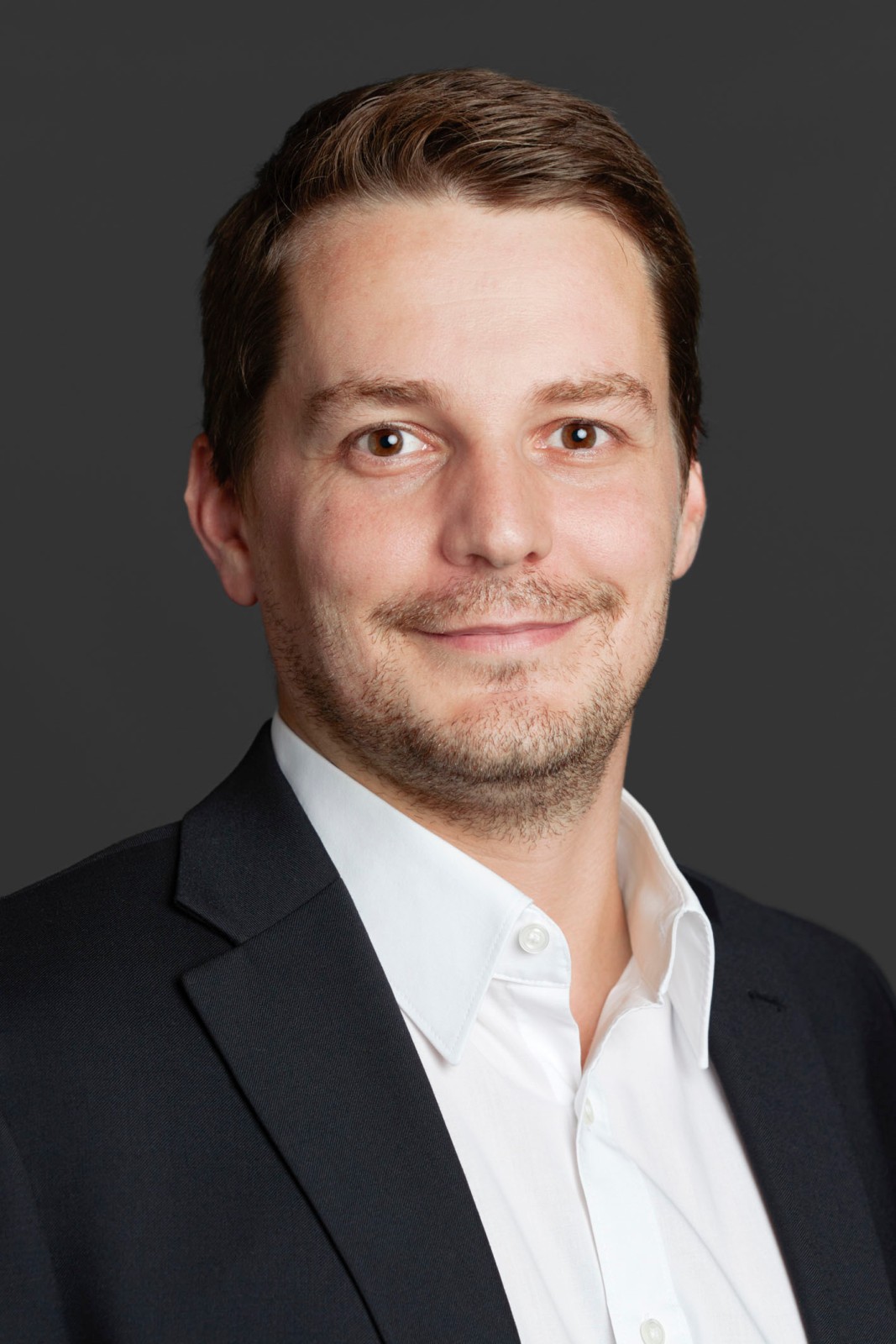
André Bardow is a Full Professor at the Department of Mechanical and Process Engineering, ETH Zürich. His research focuses on energy systems optimization, life cycle assessment, computer-aided molecular design, and CO2 capture/utilization. Professor (ETH Zürich, 2020–present) Head of Institute of Technical Thermodynamics (RWTH Aachen University, 2010–2020) Visiting Professor (University of California, Santa Barbara, 2015/16) Part-time Director (Forschungszentrum Jülich, 2017–2022) Associate Professor (TU Delft, 2007–2010) Research Interests: His work spans energy and process systems engineering, with emphasis on sustainable technologies. Key areas include: Computer-aided molecular and process design Machine learning for chemical engineering Carbon capture and utilization (CCU) Life cycle assessment (LCA) of industrial processes Thermo-economic modeling of energy systems Multiphase equilibrium analysis Publication Trends: Recent articles focus on integrating machine learning with process design, optimizing CO2 capture in steel production, and advancing electrochemical cooling technologies. Subfields include sustainable plastics, ORC working fluids, and solvent mixture design. Scientific Awards: Fellow of the Royal Chemical Society Recent Innovative Contribution Award (EFCE, 2019) PSE Model-Based Innovation Prize (2018) Covestro Science Award (first recipient) Arnold-Eucken-Award (VDI-GVC) Highly Cited Researcher (Clarivate, 2024) Advising and Grants: Professor Bardow mentors students in process optimization and leads projects like Systemic expansion of territorial CIRCULAR Ecosystems for end-of-life FOAM (Grant 101036854, EC).
Dr. Imad El Haddad serves as Group Head of the Molecular Cluster and Particle Processes group at the Laboratory of Atmospheric Chemistry (LAC), part of the Center for Energy and Environmental Sciences at Paul Scherrer Institute (PSI), Switzerland, since 2018. Previously, he held positions as Tenured Scientist and Deputy Head (2018-2019), Senior Scientist in the Smog Chamber group (2015-2018), and Postdoctoral Fellow (2011-2015) at PSI. His research aims to quantify how anthropogenic emissions alter atmospheric pollutant composition and impact Earth's climate and public health through molecular-level analysis using advanced mass spectrometry techniques. His academic background includes: Ph.D. in Atmospheric Chemistry, University of Provence, Marseille (2007-2011) Master's in Environmental Sciences (with distinction, rank 1/9), University of Provence (2006-2007) Master's in General Chemistry (with distinction, rank 1/10), Saint-Joseph University of Beirut (2005-2006) Bachelor of Science in Chemistry (with distinction, rank 1/14), Saint-Joseph University of Beirut (2002-2005) El Haddad's work centers on molecular fingerprinting of atmospheric aerosols , utilizing mass spectrometry (GC/MS, HPLC/APCI-MS2, HPLC/ESI-MS2) to identify primary and secondary molecular markers. He conducts smog chamber experiments to characterize emissions from wood burning, traffic, and cooking processes, determining secondary organic aerosol potential and oxidation state evolution. His group also studies in-cloud aqueous-phase aging and collaborates with global modelers to link aerosol composition to climate forcing and health outcomes like oxidative stress. Recent publications (2025-2024) reveal three dominant trends: (1) rigorous molecular-scale analysis of secondary aerosol formation under varying humidity/temperature, (2) source apportionment breakthroughs in diverse regions (India, Europe, Arctic) using 14C and AMS data, and (3) quantification of health-relevant aerosol properties such as oxidative potential through DTT assays. High-resolution mass spectrometry is a consistent methodological thread across these studies. His scientific awards include: MENRT research fellowship from French ministry of research (2007-2010) Excellence Scholarship (top 1% student, University of Saint Joseph, 2005) Distinction Prize (best student, University of Saint Joseph, 2005) As Group Head, El Haddad oversees the Molecular Cluster and Particle Processes group's research direction and mentorship of junior scientists. While specific grant details are absent from the text, his leadership in multi-institutional publications (e.g., CERN CLOUD, iCUPE) implies active grant management and international collaboration. The group's work bridges laboratory simulations, field deployments, and health/climate modeling to address air pollution complexities. The Molecular Cluster and Particle Processes group develops cutting-edge online/offline mass spectrometers for 1 Hz-resolution atmospheric analysis. They deploy instruments in laboratory smog chamber experiments and global field studies, focusing on molecular marker identification, emission source characterization, and aging process quantification. Collaborations with biochemists and climate modelers extend their impact beyond pure aerosol physics into health risk assessment and policy-relevant climate science.
Anna Michailidis is a researcher at the Department of Combustion and Acoustics for Power and Propulsion Systems at ETH Zürich. She is affiliated with the Institute of Energy and Process Engineering. Research interests include: Combustion Science Acoustics Power Systems Propulsion Engineering Contact: Phone: +41 44 632 08 71 Email: mianna@ethz.ch
Prof. Patrick Jenny is a Full Professor at the Department of Mechanical and Process Engineering and Head of the Institute of Fluid Dynamics at ETH Zurich. His research focuses on computational fluid dynamics (CFD), numerical methods for turbulent and multiphase flows, and reservoir simulation. He has held positions at ChevronTexaco and Cornell University, and received the National Latsis Prize 2005. PhD in CFD from ETH Zurich (1997) Postdoctoral work at Cornell University (1997–1999) Senior Researcher at ChevronTexaco (1999–2003) Research interests include: turbulent reactive flows, PDF modeling, multi-scale reservoir simulation, and data assimilation in engineering systems. He teaches courses on fluid dynamics, turbulence, and computational methods. Over 100 peer-reviewed publications span topics like fracture modeling, LES/RANS coupling, and particle-laden flows. His work bridges academia and industry, addressing challenges in energy systems, environmental engineering, and numerical algorithms. Winner: National Latsis Prize 2005 Led over 20 PhD projects and collaborates with institutions globally. His lab develops open-source tools for CFD and energy systems analysis.
Christopher Onder is a Lecturer at the Department of Mechanical and Process Engineering at ETH Zürich, where he serves as Deputy Head of the Institute for Dynamic Systems and Control. His research focuses on control engineering, energy systems, and sustainable transportation solutions. Role : Lecturer, Deputy Head of Institute Department : Mechanical and Process Engineering Institute : Dynamic Systems and Control University : ETH Zürich His research interests include: Control systems for hybrid and electric vehicles Energy management optimization Thermal comfort in public transport Co-design of mechanical and racing strategies Nonlinear control in aerospace applications Model-based calibration for diesel engines Contact: onder@idsc.mavt.ethz.ch
Christian Ludwig is an Adjunct Professor at EPFL and head of the joint EPFL-PSI Professorship, leading the Chemical Processes and Materials (CPM) research group at the Paul Scherrer Institute. His work bridges sustainable resource management, waste treatment technologies, and nanomaterials development with applications in energy and environmental systems. Education: PhD in Inorganic, Analytical, and Physical Chemistry from University of Berne (1993) Master's degree from University of Berne (1990) Research interests focus on developing sustainable technologies for resource management. His group investigates thermal and aqueous waste treatment systems, bioenergy technologies, nanoparticle-based materials for clean technology applications, analytical methods for real-time environmental monitoring, and recycling strategies for minerals and rare earth elements. Recent work examines nucleation processes, trace element fate in bioenergy systems, and algal biomass applications. Publication trends show strong focus on sustainable materials processing, environmental nanotechnology, and waste valorization. Recent articles demonstrate innovative approaches to nanoparticle characterization, supercritical fluid applications, and resource recovery from complex waste streams. Scientific awards: No major awards documented in provided materials. Advising and lab leadership: Supervised 23 PhD students and leads the Ludwig Group (EPFL) and CPM group (PSI), focusing on sustainable energy carriers and processes. Research integrates synchrotron methods, nanoparticle synthesis, and environmental technology development.
Stephan Caruso is a researcher at the ETH Zürich , affiliated with the Department of Mechanical and Process Engineering and the Combustion and Acoustics for Power and Propulsion Systems professorship. His work focuses on interdisciplinary research at the intersection of combustion dynamics, acoustics, and propulsion technologies. Email: carusos@ethz.ch Location: ML J 12.1, ETH Zürich His research interests span combustion processes, noise control in propulsion systems, and energy-efficient drive technologies. Stephan is associated with research groups including the Coletti Group, Jenny Group, and Supponen Group, contributing to collaborative projects in thermal and acoustic systems.
Andreas Güntner is an Assistant Professor at ETH Zürich's Department of Mechanical and Process Engineering and a research associate at the University Hospital Zürich's Endocrinology, Diabetes and Clinical Nutrition department. His interdisciplinary research integrates physics, chemistry, and medicine to develop micro/nanosystems for chemical sensing, with applications in healthcare and environmental monitoring. Research focuses on creating innovative sensor technologies from concept to validated devices, particularly chemoresistive gas sensors and handheld detectors. Recent breakthroughs include selective benzene and methanol detection systems, breath analyzers for metabolic monitoring, and nanoparticle-based sensors fabricated via flame synthesis. Publications demonstrate expertise in nanomaterials engineering for molecular sensing, with applications spanning medical diagnostics (breath analysis for diabetes) to environmental protection (air quality monitoring). His group develops complete sensing systems from fundamental material science to portable device implementation. Honors include the De Vigier Award (2022), ERC Starting Grant (2022), and ETH Medal for outstanding PhD (2017). Patents cover handheld detection devices for toxic compounds in consumer products.
Dr. David Bell is a Scientist at the Paul Scherrer Institute (PSI) within the Center for Energy and Environmental Sciences and Laboratory of Atmospheric Chemistry . Since 2017, he has conducted research on aerosol formation and aging processes, particularly focusing on secondary organic aerosol (SOA) from biomass burning and complex combustion sources. He transitioned to a Tenure Track position at PSI in 2021. Education : B.Sc. in Chemistry and Mathematics from University of Wisconsin-Stevens Point (2008); Ph.D. in Chemistry from University of Utah (2013); Postdoctoral Researcher at Pacific Northwest National Laboratory (2013-2017). His research systematically investigates aerosol source profiles using atmospheric simulation chambers and real-time chemical composition analysis. Key areas include secondary organic aerosol formation , oxidative potential of combustion aerosols , and humidity effects on aerosol behavior . He employs advanced instrumentation like extractive electrospray ionization mass spectrometry (EESI-TOF) for molecular-level insights. The 15 most recent publications (2023-2025) highlight his work on biomass burning emissions , α-pinene oxidation , NO3 radical impacts , and instrument development for aerosol analysis. His studies emphasize the interplay between inorganic-organic interactions (e.g., ammonia effects) and climate-relevant processes (e.g., cloud formation).
University of Applied Sciences and Arts Northwestern SwitzerlandSwitzerland
Prof. Dr. Heinz Burtscher serves as Professor at the FHNW University of Applied Sciences Northwestern Switzerland since 1996, where he founded and led the Institute of Aerosol and Sensor Technology until 2018. Affiliated with the School of Engineering and Environment , he specializes in Aerosol Measurement Technology and Measurement and Sensor Technology with focus on combustion-generated nanoparticles, environmental aerosol monitoring, and sensor development for particulate matter analysis. PhD in Electrical Engineering (1980) from ETH Zurich Postdoctoral qualification in experimental physics (1991) on combustion aerosols His research interests span: Characterization of small particles from combustion processes (e.g., diesel soot, wood burning) Development of field measurement techniques for particle emissions Advancements in sensor technology for ambient air monitoring Toxicological evaluation of nanoaerosols Innovations in exhaust gas cleaning systems Recent publications address sub-23 nm particle measurement , e-cigarette vapor characterization , and real-time SOA formation potential in combustion emissions. He received the Smoluchowski award (1994) from the Gesellschaft für Aerosolforschung (GAeF) and maintains active membership in GAeF and the Swiss Aerosol Group. As both educator and researcher, Burtscher teaches Power electronics , Electrical drives , and Sensor systems while leading projects on: Volcanic ash detection systems Nanoparticle exposure assessment Vehicle cabin air filtration Periodic emission inspection protocols He works closely with the Institute for Sensors and Electronics at FHNW and collaborates with ETH Zurich's combustion research groups.
Zurich University of Applied Sciences (ZHAW)Switzerland
Mirko Bothien is a Senior Lecturer and Head of Research/Focus Area Renewable Energy at the Institute of Energy Systems and Fluid Engineering (IEFE) within the Zurich University of Applied Sciences (ZHAW) School of Engineering. He also holds an Associate Professor position at the Department of Energy and Process Engineering at the Norwegian University of Science and Technology (NTNU) in Trondheim. Previously, he was a Rudolf Diesel Industry Fellow at the Institute for Advanced Study at TU München from 2018 to 2022. His work focuses on renewable energy systems with particular emphasis on hydrogen technologies and gas turbine applications. Dr. Bothien earned his Dr.-Ing. in Thermoacoustics and Combustion from the Institute of Fluid Mechanics and Acoustics at TU Berlin (2005-2008) and his Dipl.-Ing. in Turbo-machinery and Jet Propulsion from RWTH Aachen (2001-2005). In 2023, he completed a Certificate of Advanced Studies in Teaching and Learning in Higher Education from PH Zürich, enhancing his pedagogical expertise. Dr. Bothien's research spans thermoacoustics, combustion dynamics, gas turbine technology, hydrogen energy systems, and alternative fuels. He leads numerous projects investigating hydrogen combustion in gas turbines, ammonia-hydrogen co-firing, and advanced combustion systems for carbon-free power generation. His work addresses critical challenges in decarbonizing power systems through innovative combustion technologies that maintain high efficiency while reducing emissions. His research integrates experimental, numerical, and theoretical approaches to understand complex combustion phenomena, particularly focusing on thermoacoustic instabilities in reheat combustors and novel flame stabilization mechanisms. He teaches Thermodynamics, Heat Transfer, and Wind Power and Hydropower courses. Analysis of Dr. Bothien's recent publications reveals a strong focus on hydrogen and ammonia combustion technologies for gas turbines, with particular attention to thermoacoustic stability, flame dynamics, and emissions characteristics. His work demonstrates increasing emphasis on carbon-free energy carriers and their integration into existing power generation infrastructure. The research spans fundamental combustion science to applied engineering solutions, with a clear trajectory toward enabling hydrogen-based power systems. Dr. Bothien actively leads multiple research projects including HyPowerGT (demonstrating hydrogen-powered gas turbines), FLEX4H2 (hydrogen flexibility), AETHER (hydrogen burner development), and ADONIS (ammonia-hydrogen combustion in micro gas turbines). These projects involve collaboration with industry partners and research institutions across Europe, securing significant research funding for advancing renewable energy technologies. As Head of Research at IEFE, Dr. Bothien oversees a research team focused on renewable energy systems, with particular expertise in thermoacoustic analysis, combustion dynamics, and hydrogen technologies. The team operates advanced experimental facilities for combustion research and maintains strong industry partnerships to translate research findings into practical applications for the energy sector.
Prof. Ilya Karlin is a Lecturer at the Department of Mechanical and Process Engineering at ETH Zürich. His research focuses on advanced computational fluid dynamics, particularly leveraging lattice Boltzmann methods for simulating complex fluid phenomena. Key areas include non-ideal fluid behavior, multiphase flows, combustion processes, and hydrodynamic closures. He has contributed extensively to improving numerical methods for compressible flows, turbulent systems, and reactive mixtures in porous media. His work bridges kinetic theory with continuum mechanics, addressing challenges in hydrodynamic manifolds and non-local effects. Dr. Karlin's publications emphasize rigorous mathematical analysis alongside computational innovation, such as spectral closure techniques and entropy-based models. His research often explores the interplay between microscopic kinetic descriptions and macroscopic hydrodynamic equations. He has developed novel algorithms like the 'particles on demand' method for handling strong discontinuities in flows. Recent work includes studies on rarefaction effects, capillarity-viscosity balance, and exact hydrodynamic manifolds for BGK equations. His studies span diverse applications from microfluidics and phase transitions to detonation modeling and environmental fluid mechanics. While no specific awards are listed in the provided text, his prolific publication record indicates significant contributions to the field of computational fluid dynamics.
Robin Lewis Modini is a Tenured Staff Scientist at the Paul Scherrer Institute (PSI) in Switzerland, working within the Laboratory of Atmospheric Chemistry since 2012. He leads research on atmospheric aerosols with expertise in aerosol optics, health impact mechanisms, and climate interactions. His position evolved from Tenure-Track Scientist (2016-2020) to Tenured Staff Scientist (2020-present), following postdoctoral work at EPFL (2012-2016) under Prof. Satoshi Takahama and Scripps Institution of Oceanography (2010-2012) under Prof. Lynn Russell. Education includes: PhD in Physics from Queensland University of Technology, Australia (2007-2010) with thesis on marine aerosol water uptake under Prof. Zoran Ristovski Bachelor of Applied Science with Honours in Physics from Queensland University of Technology, Australia (2002-2005) His research centers on aerosol health effects through oxidative potential measurements (SNSF project), in situ characterization of black carbon optical properties (ACTRIS/EUROCHAMP), and bridging observational gaps between ground-based and remote sensing data (BISAR project). Key methodologies involve the Single Particle Soot Photometer (SP2), machine learning applications, and field campaigns at Jungfraujoch and Zeppelin Observatory. Current work emphasizes combustion aerosol toxicity and Arctic aerosol-cloud interactions. Recent publications (2022-2025) show consistent focus on instrument validation, oxidative potential quantification, and black carbon behavior across environments. Trends include advancing real-time health-relevant metrics (e.g., dithiothreitol assays), refining optical property measurements (CAPS monitors, polar nephelometers), and analyzing transcontinental pollution transport (Africa-Amazon, Bolivia-Andes). International collaborations through ACTRIS and EUROCHAMP underpin high-impact work in Aerosol Science and Technology, Atmospheric Chemistry and Physics, and Nature Communications. No scientific awards were mentioned in the provided text. Modini directs SNSF-funded health impact studies and participates in European projects (ACTRIS, EUROCHAMP, BISAR) examining aerosol optical properties and oxidation processes. His AC/BC project conducted black carbon measurements in Arctic clouds at Svalbard's Zeppelin Observatory. While he served as postdoc adviser at EPFL and Scripps, no current advisees are listed. Notable grants include Swiss National Science Foundation support for aerosol health research and European infrastructure funding for chamber studies. He operates within the Aerosol Physics Group at PSI's Laboratory of Atmospheric Chemistry, utilizing SP2 photometers and custom polarimetric instruments. The group conducts field campaigns across Switzerland (Jungfraujoch), Bolivia (La Paz), Southern Ocean (Antarctic Circumnavigation Expedition), and Arctic regions, with international teams including ETH Zurich and UC San Diego collaborators. Current efforts focus on machine learning integration for aerosol-cloud interaction modeling and health metric development.
PD Dr. Daniel Werner Meyer-Massetti is a Privatdozent (Part-Time Lecturer) at the Department of Mechanical and Process Engineering , ETH Zürich. His research focuses on stochastic methods for fluid dynamics and multiphase transport problems in complex systems. Primary Affiliation: ETH Zürich, Department of Mechanical and Process Engineering Email: meyerda@ethz.ch His work bridges theoretical and applied research in turbulence, porous media, and combustion. Key contributions include: Stochastic particle-based frameworks for fractured subsurface flows Turbulence modulation in droplet-laden flows Uncertainty quantification in heterogeneous reservoirs Computational tools like the Netflow Python library His recent publications demonstrate methodological advancements in: Modeling inertial particle clustering in turbulence Simulating evaporation dynamics in reactive flows Developing non-local transport formulations Quantifying dispersion mechanisms in porous media Validating kinematic turbulence models Creating adaptive simulation strategies He collaborates with research groups including the Coletti Group , Jenny Group , and Supponen Group , while maintaining connections to the Haller Group and Noiray People as a former member.
Zurich University of Applied Sciences (ZHAW)Switzerland
Prof. Dr. Rolf Krebs serves as Head of the Institute of Natural Resource Sciences at Zurich University of Applied Sciences (ZHAW) School of Life Sciences and Facility Management. His institutional affiliation includes leadership over soil and water research teams, with a current advisory role at Lucky Shrimp AG (2022-2026). Previously, he directed soil protection for Canton St. Gallen (1998-2002) and led inorganic chemistry in water/soil protection at Canton Bern (2002-2005), establishing his expertise in environmental management across Swiss cantonal and academic sectors. His educational foundation includes a PhD in Environmental Sciences (1992-1996) and Dipl.nat. ETH in Environmental Sciences (1987-1992), both from ETH Zurich. Professional development is evidenced by ZHAW certifications: CAS Management for Leaders (2016) and CAS Leadership advanced (2015), reflecting administrative specialization beyond core environmental science training. Research centers on hydrothermal carbonization (HTC) for sewage sludge valorization, with emphasis on phosphorus recovery , pathogen removal , and energy-efficient waste treatment . Complementary work explores heavy metal behavior in soils, alpine environmental processes , and soil formation dynamics over geological timescales. His HTC innovations bridge waste management with agricultural resource recovery, targeting circular economy solutions. Article trends reveal a strategic pivot toward sustainable sanitation since 2013: 10 of 15 recent publications focus on HTC applications for sewage sludge, waste whey, and fecal treatment. Key journals include Energies and Applied Sciences , highlighting interdisciplinary work combining chemical engineering, soil science, and public health. Earlier studies (2012-2010) established his legacy in heavy metal contamination and alpine soil evolution. No scientific awards, fellowships, or medals are documented in the provided text. As institute head, Krebs leads research teams but no advisees are explicitly named. His project involvement (e.g., hydrothermal carbonization for fecal waste treatment) implies grant management, though specific funding sources aren't cited. The Lucky Shrimp AG advisory role indicates industry collaboration beyond academia. The Institute of Natural Resource Sciences houses laboratories for soil chemistry, water analysis, and waste processing. His hydrothermal carbonization research utilizes industrial-scale test reactors, while historical work involved cantonal environmental monitoring teams in Bern and St. Gallen for soil protection and water quality assessment.