Dr. Anna Puglisi is a Research Fellow at the University of Southampton, specializing in observational and theoretical astrophysics. Her work focuses on galaxy formation, active galactic nuclei (AGN), and the interplay between star formation and cosmic structures. She actively employs multi-wavelength data from facilities like JWST, ALMA, and interferometric arrays to study high-redshift galaxies and obscured AGN phenomena. Her research bridges empirical observations with semi-empirical models to understand galactic evolution across cosmic time. Key research interests include analyzing galaxy morphology, ionized gas dynamics, and dust-obscured components in star-forming systems. She has contributed to studies of galaxy kinematics, structural evolution, and the role of orientation in AGN obscuration mechanisms. Her work often integrates advanced data analysis techniques such as pseudo-Sérsic profile modeling and uv-plane interferometric analysis. Recent publications highlight her exploration of clump structures in star-forming galaxies, turbulent kinematics in obscured systems, and the interplay between stellar mass functions and intracluster light. She collaborates internationally on projects like the SUPER survey and KAOSS initiative, advancing our understanding of galactic evolution through innovative observational strategies.
Oscar Defrain is an Associate Professor at Aix-Marseille University, affiliated with the Laboratoire d’Informatique et Systèmes (LIS UMR CNRS 7020) and the ACRO team. He holds a Ph.D. from Université Clermont Auvergne (2020) and completed a postdoc at the University of Warsaw. His research focuses on algorithms and combinatorics in graphs, hypergraphs, and lattice structures, with expertise in minimal dominating sets, maximal independent sets, and Boolean function dualization. Education : Ph.D. in Computer Science, Université Clermont Auvergne (2020) Research Interests : Defrain specializes in structural graph theory, hypergraph dualization, and algorithmic enumeration. His work spans combinatorial optimization, parameterized complexity, and lattice theory, with recent contributions to geometric graph certification, metric graph problems, and XOR-CNF signature enumeration. He coordinates the ANR JCJC PARADUAL project and participates in ERC Cutacombs and ANR DISTANCIA. Recent Publications (2024-2025) examine quasi-optimal bounds for induced paths, polynomial-delay isomorphism generation, hypergraph dualization with FPT-delay, and geometric graph certification. These works intersect graph algorithms, combinatorics, and theoretical computer science. Teaching : Defrain teaches graph theory, algorithmic enumeration, and programming (Java/Python) at Aix-Marseille University (M1, L1, L2) and Université Clermont Auvergne (M1, L3). He uses platforms like Moodle and AMeTICE for course materials.
Associate Professor Željka Tomasović holds a PhD and is affiliated with the Department of Information Sciences and Technologies at the University of Zadar. Her research focuses on digital image processing, signal analysis, nanoelectronics, optoelectronics, and time-frequency analysis. She teaches courses including Programming I, Digital Image Processing, and Database Design. Her scientific interests span from nanotechnology applications in electronics to advanced signal processing techniques, with recent work emphasizing IoT security, digital humanities, and entropy-based denoising algorithms. She has published extensively on topics like spectrogram analysis, medical electrode failure detection, and non-stationary signal processing. Professional activities include mentoring students in computer science disciplines and participating in international conferences such as SpliTech. Dr. Tomasović maintains an active research agenda with projects addressing open science frameworks, digital competence development, and advanced signal feature recognition methods.
Yağız Aksoy is an Assistant Professor leading the Computational Photography Lab at Simon Fraser University's School of Computing Science. His research focuses on inverse rendering, physical modeling of image formation, and applications in computational photography, movie post-production, and image editing. He completed his PhD at ETH Zurich under Marc Pollefeys, with postdoctoral work at MIT CSAIL and Disney Research Zurich. His work is funded by NSERC, CFI, BC Government, Adobe Research, and Meta Reality Labs. Notable achievements include the Best Paper Award Honorable Mention at SIGGRAPH Asia 2024 for 'Colorful Diffuse Intrinsic Image Decomposition in the Wild' and contributions to projects like physically controllable relighting and high-resolution depth estimation. His lab combines academic research with active production environments, emphasizing collaboration with filmmakers and industry partners. Key research themes include mid-level vision, intrinsic image decomposition, HDR reconstruction, and illumination-aware compositing. Ongoing projects explore RGB+NIR editing, semantic segmentation, and computational flash photography. Students supervised include Obumneme Stanley Dukor (MSc 2024) and Chris Careaga (lead author on multiple papers).
Petr Hliněný is a Professor at the Faculty of Informatics, Masaryk University in Brno, Czech Republic, where he also serves as the Vice-dean for research, development, and doctoral studies. He is affiliated with the Department of Computer Science and leads the Discrete Methods and Algorithms (DIMEA) research group. His research interests span Graph Theory , Discrete Mathematics , Theoretical Computer Science , with a focus on structural and topological graph theory, parameterized complexity, logic in computer science, twin-width, crossing numbers, and discrete geometry. His recent work includes structural results on planar graphs, visibility graphs, and logical aspects of graph classes. His recent publications exhibit a strong trend in analyzing structural width parameters such as twin-width and clique-width, their logical transductions, and algorithmic implications. He has published extensively on planar graphs, crossing numbers, and geometric graphs, often in top venues like European Journal of Combinatorics , Journal of Combinatorial Theory , and LIPIcs conference proceedings. Professor, Faculty of Informatics, Masaryk University Vice-dean for Research, Development and Doctoral Studies Head of DIMEA Research Group Guarantor of Doctoral Study Programme in Computer Science He actively supervises PhD and master’s students, including current doctoral candidates Filip Pokrývka, Shubhang Mittal, Jakub Balabán, and Jan Jedelský. He has led multiple research grants funded by the Czech Science Foundation (GAČR), including project 20-04567S on tractable instances of hard graph algorithmic problems. He also organizes seminars such as IV119 and IV131, and offers thesis topics in discrete mathematical methods.
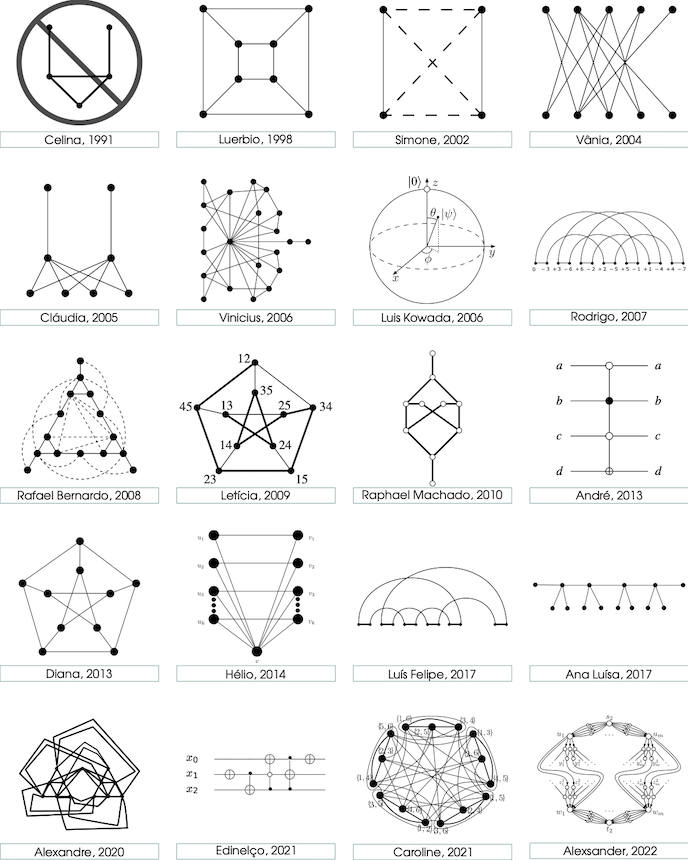
Celina Miraglia Herrera de Figueiredo is a full Professor at the Systems Engineering and Computer Science Program (PESC) of COPPE, the Alberto Luiz Coimbra Institute for Graduate Studies and Research in Engineering at the Federal University of Rio de Janeiro (UFRJ). She holds a PhD in systems and computer engineering from UFRJ and a postdoctoral degree from the University of Waterloo, Canada. She is a CNPq Level 1A Research Fellow and a FAPERJ Cientista do Nosso Estado awardee, and leads the algorithms and combinatorics research group at COPPE/UFRJ. University: Federal University of Rio de Janeiro School: Alberto Luiz Coimbra Institute for Graduate Studies and Research in Engineering Department: Systems Engineering and Computer Science Program Academic Rank: Professor Email: celina@cos.ufrj.br Her research centers on theoretical computer science, with a focus on graph theory, algorithms, computational complexity, and combinatorial optimization. She has made significant contributions to the understanding of graph classes such as perfect graphs and snarks, algorithm design, and computational complexity. Her work is grounded in the Mathematics Subject Classification codes 05-XX (Combinatorics), 68-XX (Computer Science), and 90-XX (Operations Research). The most recent publications indicate a strong trend in analyzing the computational complexity of graph problems (e.g., MaxCut, Steiner Tree, total coloring) on structured graph classes such as interval, permutation, and path graphs. Her work frequently involves proving NP-completeness results, developing parameterized algorithms, and studying graph invariants like pebbling numbers and chromatic numbers. She consistently publishes in high-quality journals such as Discrete Mathematics , Discrete Applied Mathematics , and RAIRO Operations Research . Giulio Massarani Award for Academic Merit (2006) COPPE Fifty Years Award (2013) CNPq Research Fellowship (Level 1A) FAPERJ Cientista do Nosso Estado Member of the Brazilian Academy of Sciences (2023) Celina has advised numerous students, including Raphael Machado, Vinícius de Sá, Alexsander Melo, and Ana Silva, and has secured significant research funding from CNPq and FAPERJ. She is deeply involved in the academic community, serving on the editorial boards of RAIRO Theoretical Informatics and Applications, Bulletin of the Brazilian Mathematical Society, and Matemática Contemporânea. She has also been a key organizer and committee member for major international conferences such as LAGOS, WG, LATIN, and FCT, reflecting her leadership in the fields of algorithms and combinatorics. She coordinates the Center of Excellence in Randomized, Quantum, and Approximative Algorithms and has been a driving force in promoting women in science, serving on the jury of the L'Oréal–UNESCO–ABC Program for Women in Science. Her Erdős number is 2, highlighting her extensive collaborative network in mathematics and computer science.
George B. Mertzios is an Associate Professor in the Department of Computer Science at Durham University, affiliated with the Algorithms and Complexity Research Group (ACiD) within the School of Engineering and Computing Sciences. He has held academic positions at Durham since 2011, progressing from Lecturer to Senior Lecturer and then to Associate Professor since 2017. He has also held visiting positions at institutions including the University of Bordeaux/CNRS and the University of Haifa. His research interests lie at the intersection of theoretical computer science and network science, with a strong focus on temporal graphs , algorithmic graph theory , parameterized complexity , and combinatorial optimization . He investigates efficient algorithms for dynamic and evolving networks, geometric graph models, and computational problems in network evolution and connectivity. His work often bridges foundational theory with applications in network design and distributed systems. The recent publications and ongoing activities of George B. Mertzios demonstrate a consistent and impactful research trajectory centered on the algorithmic foundations of temporal and dynamic networks. His work spans complexity analysis, algorithm design, and structural graph theory, with a notable emphasis on temporal vertex cover, sliding window models, and connectivity in time-varying graphs. He frequently publishes in top-tier conferences such as ICALP, MFCS, AAAI, and STACS, as well as leading journals including the Journal of Computer and System Sciences and Algorithmica . Gold Medal, Balkan Mathematical Olympiad, 1998 Distinguish Diploma, Bulgarian National Mathematical Competition 'Chernorizets Hrabar', 1998 Certificate of Merit, Mediterranean Mathematics Competition, 1999 Best paper award of Track C, ICALP 2010 Best student paper award, SAND 2024 George B. Mertzios has been actively involved in research supervision and leadership. He has supervised multiple PhD students to completion and currently advises ongoing doctoral research. He has served as Principal Investigator for EPSRC grants on Algorithmic Aspects of Temporal Graphs and Algorithmic Aspects of Intersection Graph Models , and as a Co-Investigator on projects related to graph coloring. He is a frequent organizer of scientific workshops, including the Algorithmic Aspects of Temporal Graphs series at ICALP and Dagstuhl seminars, and serves on the program committees of numerous international conferences such as MFCS, IWOCA, and SAND. He is a key member of the Network Engineering Science and Theory in Durham (NESTiD) research group, where he coordinates seminar series and fosters collaborative research in network algorithms and theory.
Brian Lavallee is a Lecturer in the Department of Computer Science at the University of Vermont , joining in 2024. His research bridges structural graph theory , parameterized complexity , and approximation algorithms to solve real-world computational problems. At UVM, he teaches foundational courses in programming, automata theory, and computational complexity. Education : Ph.D. in Computing (University of Utah, 2023), B.S. in Computer Science (Duke University, 2017) Brian's research focuses on developing efficient algorithms for NP-hard problems through structural graph analysis and complexity-based approaches. His work on structural rounding and vertex cover approximation has advanced scalable solutions for graphs near tractable classes. Recent publications highlight his expertise in hypergraph clustering, gerrymandering complexity, and generalized coloring hardness. In teaching, he emphasizes core computer science principles through courses like CS 1210 - Computer Programming I and CS 2250 - Computability and Complexity . His office is located in Innovation Hall, Room E322, at UVM's Burlington campus.
Ni Luh Dewi Sintiari is a Lecturer and Researcher at the Informatics Engineering Department, Computer Science Study Program of Universitas Pendidikan Ganesha, Indonesia, since January 2022. She holds a PhD in Theoretical Computer Science from ENS de Lyon (2018–2021), supervised by Nicolas Trotignon at LIP, and a master’s degree from ENS de Lyon. Her research focuses on structural graph theory, particularly even-hole-free graphs and their algorithmic properties. She received the Accessit of the Charles Delorme Graphs Thesis Prize (2022) for her thesis on width parameters in even-hole-free graphs. Education: BSc in Mathematics Education (Universitas Pendidikan Ganesha), MSc in Theoretical Computer Science (ENS de Lyon), PhD in Computer Science (ENS de Lyon/LIP). Postdoctoral research at Wilfrid Laurier University (2023). Her teaching includes courses on Design and Analysis of Algorithms, Linear Algebra, Discrete Mathematics, and English for IT/Computer Science. Research interests span Discrete Mathematics, Graph Theory, Combinatorics, and algorithmic aspects of graph classes. Her work emphasizes forbidden induced subgraphs, structural properties, and algorithmic applications. She has presented at conferences such as CanaDAM, Ontario Combinatorics Workshop, and Journées Graphes et Algorithmes.
Paloma Thomé de Lima is a Lecturer in Theoretical Computer Science at IT University of Copenhagen. Her research focuses on graph theory, algorithms, and computational complexity, particularly in chordal graphs, induced subgraphs, and graph modification problems. Her work includes studies on bounded degree constraints, matching numbers, and polynomial time algorithms. Recent publications address problems in claw-free graphs, min-cut optimization, and structural graph theory. She has received the Best Paper Award at IPEC 2022 for collaborative research. Current projects include Unifying Theories for Graph Modification Problems funded by Danmarks Frie Forskningsfond (2023–2027).
Victor Lagerkvist is an Associate Professor at the Department of Computer Science (IDA) , Linköping University, Sweden. He is affiliated with the Theoretical Computer Science Laboratory (TCSLAB) and the Artificial Intelligence and Integrated Computing Systems (AIICS) division. His research focuses on the algebraic method for analyzing computational complexity , particularly in constraint satisfaction problems (CSPs), SAT, and graph homomorphism problems. PhD in Computer Science (2016, Linköping University) Habilitation (2020, Linköping University) His recent work investigates fine-grained complexity , twin-width , and universal algebra to improve algorithms for NP-hard problems. Publications span topics like propositional abduction, Allen's interval algebra, and semiring-based dynamic programming. His scientific awards include the Swedish Research Council Starting Grant (2020) and the 2017 Young Researcher Prize from the Ruth and Nils-Erik Stenbäck Foundation. He supervises PhD students such as Leif Eriksson and serves as a secondary supervisor for others at Linköping University and Université de Lorraine.
Dr. Marieke van der Wegen is an Assistant Professor at the Mathematical Institute within the Faculty of Science at Utrecht University. Her academic work bridges theoretical computer science and mathematics, with a strong focus on computational aspects of graph theory. Her primary research interests include: Graph Gonality and its computational complexity Rainbow vertex coloring and other graph coloring problems Scheduling algorithms and complexity Parameterized complexity of graph problems Connections between graph theory and algebraic geometry Dr. van der Wegen's publication record demonstrates a consistent research trajectory examining the computational complexity of graph invariants, particularly various measures of graph gonality. Her work has established fundamental complexity results for determining graph gonality, showing that many of these problems are computationally hard (NP-hard). She has also developed algorithms for specific graph classes and identified connections between graph-theoretic concepts and algebraic geometry. Her research often focuses on the boundary between tractable and intractable problems in graph theory. As an educator, Dr. van der Wegen teaches courses including Proofs in Mathematics, Calculus and Linear Algebra, and Mathematics and Physics. Her teaching portfolio reflects her deep expertise in both theoretical mathematics and its applications. She has been actively involved in the Mathematics curriculum at Utrecht University since at least the 2021-2022 academic year.
Stephanie Henderson serves as Assistant Professor in the Department of Atmospheric and Oceanic Sciences at the University of Wisconsin-Madison, where she leads research bridging weather forecasting and climate prediction through subseasonal-to-seasonal (S2S) variability studies. Her work addresses the critical predictability gap between synoptic weather systems and seasonal climate patterns, with direct implications for food security, public safety, and economic planning. Education: PhD in Atmospheric Science from Colorado State University Research Focus: Dr. Henderson specializes in tropical-extratropical interactions and global teleconnections , with particular expertise in the Madden-Julian Oscillation (MJO) and atmospheric blocking phenomena. Her methodology integrates observational analysis , numerical modeling , and statistical techniques to unravel how subseasonal processes (2-8 weeks) influence midlatitude weather extremes. Current projects examine MJO impacts on South American precipitation, Northeast Pacific blocking dynamics, and Arctic moisture intrusions. Publication Trends: Recent work (2022-2025) reveals intensifying focus on MJO teleconnection mechanisms across diverse regions, with growing emphasis on polar atmospheric rivers and climate change impacts on subseasonal predictability. Her research increasingly leverages satellite observations (e.g., PREFIRE mission) and addresses practical forecasting applications for extreme weather events. Research Environment: She directs the Subseasonal to Seasonal Variability group, utilizing resources including NOAA PSL SST monitoring, IRI ENSO forecasts, and CIMSS weather portals. The group maintains active collaborations with federal agencies to translate fundamental research into operational forecasting improvements for North American weather extremes.
Prof. Frits C.R. Spieksma is a full professor in the Department of Mathematics and Computer Science at Eindhoven University of Technology (TU/e) , where he leads research within the Combinatorial Optimization Group. He has held academic positions at Maastricht University, KU Leuven, and the University of British Columbia, and has been at TU/e since 2018. Education: M.Sc. in Econometrics, University of Groningen (1987) Ph.D. in Operations Research, Maastricht University (1992) Research Focus: His work lies at the intersection of combinatorial optimization and real-world applications . Key themes include: Scheduling and clustering problems, especially in sports tournaments Organ allocation optimization for Eurotransplant Assignment and transportation problems Approximation algorithms and graph-theoretic optimization Scientific Service & Leadership: Founder and ex-Chair, EURO Working Group OR in Sports Member, Steering Committees of MAPSP and MathSports International President, EURO (Association of European Operational Research Societies) Former Vice-President, IFORS Former President, Belgian Society of Operations Research (ORBEL) Editorial Boards: Associate Editor, 4OR (2015–present) Associate Editor, Journal of Quantitative Analysis in Sports (2014–present) Associate Editor, Operations Research Letters (2008–2024) Former Associate Editor, INFORMS Transactions on Education , OMEGA , Computers & Operations Research , IIE Transactions , Naval Research Logistics PhD Supervision & Mentoring: He has supervised more than 25 PhD theses at KU Leuven and TU/e, many of whom now hold academic positions worldwide. Conference & Workshop Organisation: Recent leadership roles include General Chair of IPCO 2022 (Eindhoven), organiser of Benders Day 2024 , and co-organiser of the Dagstuhl Seminar on Fairness in Scheduling and Resource Allocation (March 2025).
Dr. Joachim Spoerhase is a Lecturer at the Department of Computer Science , University of Liverpool , specializing in algorithm design and combinatorial optimization. His research focuses on approximation algorithms for clustering, network design, and geometric optimization problems. PhD in Computer Science (2010) and Habilitation (2017) from the University of Würzburg Former Research Associate at the Max Planck Institute for Informatics Research positions at Aalto University and University of Wroclaw His recent work explores high-dimensional data structures, polyline bundle simplification, and robust clustering frameworks. He also investigates hardness of approximation and theoretical limits in algorithm design. The University of Liverpool serves as his primary affiliation, with contributions to both computational geometry and machine learning. Notable research trends include interdisciplinary applications in network design, geometric optimization, and interpretable AI frameworks. Dr. Spoerhase teaches modules like Computer Networks (COMP211) and contributes to algorithmic theory development.