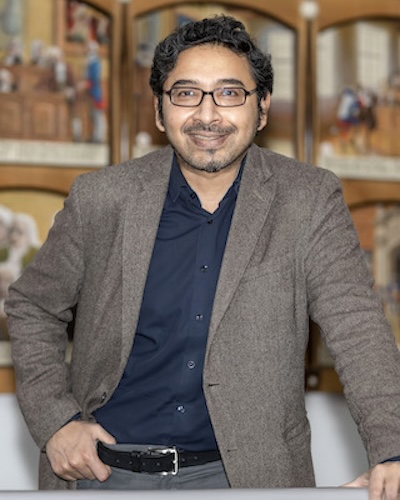
Daniel Hedinger is an Acting Professor at the Humboldt University of Berlin , affiliated with the Institute of Asian and African Studies . His research bridges East Asian history, global history, and fascist ideologies, with a focus on Japan's historical intersections with Western modernity. Education: Bachelor in Japanese Studies, INALCO (Paris), 2000 Master's in History and Japanese Studies, University of Zurich, 2004 Doctorate in Philosophy, University of Zurich, 2009 Career: Acting Professor, Humboldt University (2014–present) Research Associate, LMU Munich (2013–present) Research Associate, Free University of Berlin (2012–13) Fellow, University of Freiburg (2011–12) Research Interests: Hedinger specializes in 19th-20th century Japanese and East Asian history, transnational fascism, and the role of exhibitions in shaping national identity. His work explores biopolitics, legal globalization, and cultural mobilization during wartime. Publications: His 2011 monograph In Competition with the West examines Japan's exhibition history (1854–1941). His articles span topics from Meiji-era legal trials to Shōwa-period militarism, reflecting his interdisciplinary approach combining history, law, and sociology. Labs/Involvements: He contributes to the Mori-Ōgai Memorial at the Institute of Asian and African Studies, engaging with historical narratives of Japanese modernization and science.
Elisa Mucciarelli is a Scientific Associate and Research Assistant at the Chair of Slavic Literature and Cultural Studies at the University of Regensburg since March 2024, working under Prof. Dr. Mirja Lecke. She also serves as a Lecturer of German as a Foreign Language at the Department of Economics within the same university as part of the DAAD project "Ukraine digital." Her academic foundation includes an MA in East-West Studies from the University of Regensburg (2021-2024) with focus on Slavic cultural studies and linguistics, and a BA in Scandinavian Studies from the University of Vienna (2017-2021) with extension in Slavic Studies. Her research centers on Russian-language literature from the North Caucasus, particularly Ingush and Chechen literary production, Russian-Georgian literary interrelations, and post/decolonial approaches to space construction in literature. Her doctoral dissertation "Writing Abkhazia. Literature and Space in the (Post-)Soviet Realm" analyzes literary works about Abkhazia through Doreen Massey's spatial theory, examining how space is produced through human and non-human interactions in contexts of conflict and multiethnic coexistence. She employs decolonial frameworks to investigate knowledge production from local perspectives rather than urban centers. Mucciarelli's scholarly output demonstrates strong engagement with spatial literary theory and postcolonial critique across the Caucasus region. Her recent presentations at academic conferences in 2024 reveal consistent focus on Abkhazia as a case study for examining space, decoloniality, and literary production in post-Soviet contexts. Her work bridges literary analysis with human geography, political science, and postcolonial studies. As an emerging scholar, Mucciarelli has presented her research at multiple academic venues including the SMIR colloquium (Salzburg, Munich, Innsbruck, Regensburg), the Graduate School for Eastern and Southeastern European Studies, and the University of Regensburg's early career researcher day. She has taught academic writing workshops focused on Slavic literary and cultural studies and will teach "Multinational Soviet Literature" in the upcoming winter semester.
Max Planck Institute for Social AnthropologyGermany
Keith Breckenridge is a Professor and Deputy Director at WiSER , University of the Witwatersrand, Johannesburg. He specializes in the cultural/economic history of South Africa, biometric identification systems, and financialisation technologies across Africa. Biometric State (Cambridge, 2014) Co-editor of Registration and Recognition (OUP, 2012) Key research themes: Historical entanglement of state surveillance with biometric capitalism, digitization of African economies, and critical analysis of civil registration systems. His work examines Ghana, Kenya, Nigeria, and South Africa where commercial banks are building centralized biometric databases for credit scoring. Recent publications analyze biometric anti-bank technologies, silicosis surveillance in mining history, and the politics of parallel digital archives. Projects: Biometric Capitalism (ongoing) and Curriculum Development (completed) in Science & Technology Studies.
Max Planck Institute for Social AnthropologyGermany
Enrico Ille is an Assistant Professor at the Institute of African Studies, University of Leipzig, specializing in the political ecology of Sudan. Previously, he served as Assistant Professor at Martin Luther University of Halle and Ahfad University for Women in Sudan. His academic journey includes a doctoral degree in Social and Cultural Anthropology from the University of Halle and ongoing Habilitation research focused on Sudan's political economy. University of Halle (PhD in Social and Cultural Anthropology) University of Leipzig (current position) Ahfad University for Women, Sudan (former position) Martin Luther University Halle (former position) Ille's research centers on the economic and environmental effects of gold mining near Sudan's borders with Eritrea, Ethiopia, and South Sudan, examining how military-dominated economic relations impact different areas. His work connects long historical perspectives with contemporary political developments, focusing on human interactions with Sudan's economic crises. He studies socio-ecological changes in Nile settlements, date palm production along the Nile, and the political economy of the Nuba Mountains. His research forms part of the Rift Valley Institute's X-Border subproject 'Reconstructing trajectories through the Nile Valleys,' which examines resource flows across Central Sudanic Africa. His scholarly output reveals consistent focus on Sudan's resource extraction, particularly gold mining, and its relationship to political conflict, environmental change, and social organization. His recent publications (2020-2024) demonstrate expanding research into urbanization trends in Khartoum and comparative studies across East African cities. Urgent Anthropology Fellow at The British Museum / Royal Anthropological Institute (2016-2018) 'Date palm production and socio-economic changes along the Nile in northern Sudan' research award (2016-2017) Ille leads research teams studying gold mining in Sudan's border regions as part of the Rift Valley Institute's X-Border Local Research Network. His work has been supported by various institutions including the Institute of Development Studies at the University of Sussex, where he worked as a post-doctoral researcher on inclusive urbanization projects in Dar es Salaam, Mwanza, and Khartoum. His Habilitation research integrates earlier projects on violent conflicts in the Nuba Mountains and date production in Northern State to develop a comprehensive political ecology framework for understanding Sudan.
Max Planck Institute for Social AnthropologyGermany
Fazil Moradi is a Visiting Associate Professor at the Faculty of Humanities – Johannesburg Institute for Advanced Study, University of Johannesburg, where he serves as convener of a monthly Actuvirtual Symposium. He holds additional academic affiliations as an Associate Researcher at the Institute for Social Anthropology, Austrian Academy of Sciences, and as an Affiliated Scholar at the Center for the Study of the Holocaust, Genocide, and Crimes against Humanity at the Ralph Bunche Institute for International Studies, Graduate Center—CUNY. His academic background includes prior research at the Max Planck Institute for Social Anthropology in Halle and teaching at the Institute for Social and Cultural Anthropology, University of Halle in Germany. Dr. Moradi's research spans multiple interconnected fields with a focus on decolonial knowledge production and the legacies of violence. His work examines the Destruction of the Kingdom of Benin in 1897 and restitution of plundered artworks across Benin, Babylon and Egypt. He investigates memories of imperial-colonialism and femicidal/genocidal violence of the modern/colonial state, exploring how these historical processes continue to shape contemporary institutions. His concept of 'Al-Khwārizmīc [Algorithmic] Modernity' offers a critical framework for understanding the technological dimensions of colonial power. Other key research areas include Genophilia, Decolonial Knowledge and Politics, and Forced Displacement/Migration, all approached through a transdisciplinary lens that bridges anthropology, law, and political philosophy. Analysis of Moradi's publication record reveals consistent engagement with themes of translation, evidence, and the politics of representation in contexts of extreme violence. His work demonstrates a methodological commitment to examining how colonial and genocidal violence are mediated through bureaucratic, legal, and technological systems. A significant portion of his research focuses on Kurdish experiences, particularly the impacts of chemical warfare in Halabja and the genocidal violence against Êzîdîs by the Islamic State. His scholarship consistently bridges theoretical innovation with urgent political concerns, particularly regarding the restitution of cultural property and justice for victims of state violence. Dr. Moradi is actively involved in multiple research networks including the Sci-Tech Asia Research Network and Refugee Outreach & Research Network. His work with medical science scholars at Sahlgrenska Academy – University of Gothenburg examines the long-term impacts of chemical warfare agents. His academic contributions extend beyond traditional scholarly publications to include public intellectual engagement through platforms like openDemocracy, where he has written on contemporary political issues in Iraq and Kurdistan.
Stephanie Béreiziat-Lang is Acting Professor of Romance Philology at the University of Heidelberg since April 2024, holding the Chair of Prof. Dr. Robert Folger. She previously served as a Research Associate at the Collaborative Research Center 933 Material Text Cultures (2015-2024) and as a Research Assistant at Heidelberg’s Romance Department (2013-2015). Doctorate in Romance Philology (2009-2014) from Ludwig Maximilian University of Munich and Utrecht University Magister Artium in Romance Studies and Classical Archaeology (Munich, Tarragona, Bordeaux) Licence de Lettres Modernes in Spanish and French (Bordeaux III) Her research focuses on comparative literature , text-body relationships , and transculturality in pre-modern and modern Iberian literatures. She leads the DFG network An den Rändern der Moderne (2023-2025) and contributed to the SFB 933 Material Text Cultures project. Publications include a monograph on Translationen der décadence (Winter, 2015) and co-edited volumes on Transcultural Modernity (tranvía, 2017) and Somatic Writing (Brill, 2020). Scientific Awards: Doctoral scholarship from the Research Institute for History and Culture (OGC), University of Utrecht (2011-2013) She collaborates with scholars like Prof. Dr. Robert Folger and PD Dr. Michael R. Ott, focusing on material text cultures and interdisciplinary approaches to literary studies.
Dr. Gautam Chakrabarti is a researcher at the Institute for European Studies (IFES) of Europa-Universität Viadrina. His work bridges literary, cultural, social, and intellectual history. Research focuses on world literature and global literary knowledge Examines 'maverick cosmopolitanism/s' during the cultural Cold War Specializes in (post-)colonialism in Southern Asia Analyzes cultural politics of the former Yugoslavia Explores Indo-Jewish literary and cultural connections Contact: chakrabarti@europa-uni.de
Aliyu Sakariyau Alabi is a Senior Lecturer in the Department of History at Bayero University, Kano, Nigeria , specializing in the history of the Muslim World since 2008. He holds a Master's degree from the University of Ilorin and a PhD from Universitiet Leiden, Netherlands, focusing on Islamic education in Ilorin (1897-2012). As a Cadbury Fellow (2016) at the University of Birmingham, he studied modernization of Islamic educational systems. His research spans Islamic Education , Nigerian Intellectual History , and Literary Publishing . Academic Rank: Senior Lecturer Institution: Bayero University, Kano Current Bayreuth Academy Fellow Research Focus : Alabi examines how Nigerian ulama adapted Islamic education to colonial and post-colonial realities, analyzing tensions between Western and Islamic educational systems. His recent work explores educational entrepreneurship in Ilorin, highlighting shifts from resistance to appropriation of Western education among Muslims in the New Millennium. Publications & Creative Work : He has published in Islamic Africa and Journal of Muslim Minority Affairs , and authored the historical play ÀFỌ̀NJÁ (2018) under pseudonym Sakky Jojo. His curated anthology Songs of Almajiri (2021) demonstrates literary activism. Scientific Contributions : 2016 Cadbury Fellowship 2021 Degruyter publication on African colonial history 2019 Islamic Africa journal article on educational systems Current Project : At Bayreuth Academy, he investigates new trends in Muslim learning in Ilorin, particularly how educational systems have evolved since 2000 to balance tradition and modernity.
Professor Adepeju Layiwola is a distinguished academic and practicing artist at the Department of Creative Arts, University of Lagos. She serves as President of the Art Council of the African Studies Association (ACASA) in the USA and maintains active international collaborations through residencies like the Bayreuth Academy fellowship. Her research centers on Benin Kingdom historiography, cultural restitution, and textile traditions. Key interests include: Advocacy for repatriation of looted Benin artifacts Contemporary art interventions in colonial memory Evolution of Nigerian textile design (particularly adire resist-dyeing) Gender dynamics in African art production Her recent curatorial projects RESIST! The Art of Resistance (2020-2022) and I Miss You (2022-) at Cologne's Rautenstrauch-Joest Museum examine restitution debates through contemporary art. Publication trends reveal consistent focus on Benin's material culture, transcultural dialogues in African art, and feminist reclamation of women artists' narratives. Major recognitions include: Lagos Studies Association Distinguished Scholar's Award (2021) Tyson Scholar at Crystal Bridges Museum (2019) Terra Foundation Grant (2018) SSA Cultural Exchange Grant (2021) She directs MasterArtClasses and the Women and Youth Art Foundation in Lagos while conducting archival research on Ulli Beier and Jean Kennedy's contributions to Nigerian art history. Current projects address Germany's repatriation of 1,000+ Benin artifacts and digital ethics in museum restitution practices.
Iris Schröder is a Professor at the University of Erfurt , holding the Professorship for Global History within the Faculty of Arts and Humanities’ Historical Department. She directs the Research College for Transcultural Studies / Perthes Collection, serves as Vice Dean for Research in her faculty, and leads the junior research group 'History of Knowledge in the Modern Age.' Her work bridges historical science, cultural geography, and global historiography. Director, Research College for Transcultural Studies / Perthes Collection Vice Dean for Research, Faculty of Arts and Humanities Spokesperson, junior research group 'History of Knowledge in the Modern Age' Research Interests focus on globalization of knowledge, gender history, visual history, and transnational political movements. Her publications explore topics like colonial cartography, UNESCO heritage conflicts, and Cold War ideological dynamics. Her recent articles highlight trends in 20th-century political ideologies , colonial geographies , and visual representation of global knowledge . She integrates historical anthropology and transcultural studies to analyze spatial and gendered dimensions of history.
Prof. Dr. Andreas Renner holds the Chair of Russia-Asia Studies at the Ludwig Maximilian University of Munich . His research explores the interconnected histories of Eurasia, with a focus on Russian-Japanese relations, medical geography, and visual history.
Dr. Ken Chitwood is a Freie Universität Berlin researcher affiliated with the Berlin Graduate School Muslim Cultures and Societies , focusing on Islam in the Americas , Latinx Muslim communities , and translocal religious dynamics . He combines ethnographic methods with digital age analyses. Ph.D. in American religion and global Islam from University of Florida Lecturer in Islamic Studies at Otto Friedrich University Bamberg Journalist-fellow at University of Southern California's Center for Religion and Civic Culture His research spans Muslim cosmopolitanism , Christian-Muslim relations , religion in digital spaces , and Jewish communities in Latin America . Recent publications emphasize Puerto Rican Muslim identity , Islamic philanthropy , and religious intersections in late modernity . Key article trends reveal his expertise in religion in the Americas through interdisciplinary lenses, examining postcolonial Muslim identities , transnational faith networks , and spiritual responses to globalization . His work appears in journals like International Journal of Latin American Religions and Journal of Muslim Philanthropy .
PD Dr. Thomas Hovestadt is a faculty member at the University of Würzburg where he has led the Theoretical Evolutionary Ecology Group (TEE) since 2015. His research focuses on evolutionary ecology with emphasis on dispersal evolution, life history strategies, and host-parasite systems. Based at the university's Biocenter, he maintains active collaborations across European institutions including the University of Ghent where he served as Guest Professor from 2013-2015. His academic credentials include: Diploma in Biology from University of Tübingen (1987) PhD in Biology from University of Würzburg (1997) Habilitation at University of Würzburg (2006) Hovestadt's research program investigates how organisms evolve movement rules and resource allocation strategies in fragmented landscapes. His work integrates theoretical modeling with empirical data to examine evolutionary dynamics in spatially structured populations, particularly focusing on dispersal polymorphisms, foraging optimization, and the impacts of anthropogenic disturbances like light pollution and habitat fragmentation. Statistical approaches underpin his analysis of niche evolution and population viability. Analysis of his 15 most recent publications (2022-2025) reveals consistent focus on dispersal ecology across diverse taxa including insects and moths. Key themes include landscape heterogeneity effects on biodiversity, anthropogenic impacts (light pollution, climate change), and theoretical modeling of metapopulation dynamics. His work frequently employs simulation approaches and field-based validation, with growing emphasis on conservation applications for fragmented ecosystems. No scientific awards are documented in the available information. As head of the TEE group, Hovestadt oversees research mentoring and project coordination. His current funding includes SFB 1047: Insect timing, DFG HO2051/3, and the MacMan collaborative project, indicating sustained support from the German Research Foundation for theoretical ecology research. The Theoretical Evolutionary Ecology Group operates from the University of Würzburg's Biocenter, maintaining connections to Field Station Fabrikschleichach and UFZ Leipzig. The group specializes in developing analytical frameworks for evolutionary processes in spatially complex environments, with particular expertise in movement ecology and population dynamics modeling.
Anneke Schewe is a researcher and assistant lecturer at the English Department of Kiel University's Philosophical Faculty. Since 2020, she has combined early career research with teaching responsibilities while serving in multiple roles including diversity officer for the Philosophical Faculty (since 2023) and emergency first aider (since 2025). Her academic work focuses on intersectional analysis of genre hybridity in North American cultural production. M.A. in Media Science (Film and TV) and English/North American Studies (2020) B.A. in European Ethnology & English/North American Studies (2017) Her research explores: Frontier mythologies in Western genre evolution Queer representation in historical and speculative fictions Indigenous narrative sovereignty Genre theory and subversive storytelling Dark academia's postcolonial implications Visual rhetoric in banned books discourse Recent publications focus on intersectional analysis of post-revisionist Westerns, queer media representation, and postcolonial critique in speculative fiction. She co-organized the department's Book Sale and manages the Fachergänzung module for the Center for North American Studies. As diversity and equality guide, she advocates for inclusive classroom practices while teaching courses on literary methodologies, frontier myths, and queer representation. Her work connects cinematic aesthetics with critical theory across historical and contemporary narratives.
Dr. James Wilson is a Researcher affiliated with the Academic Group for the History of Religions at the University of Konstanz since June 2022, and a member of the Zukunftskolleg research college. His work focuses on reversing traditional Crusade historiography by examining colonialist and orientalist influences in 19th-century European translations of medieval Arabic chronicles. Specializes in Islamic perspectives on the Crusades Analyzes colonial entanglements in manuscript translation Investigates textual selection processes of Arabic sources Focuses on Ibn al-ʿAdim’s Zubda al-halab as case study His research bridges Crusader studies, postcolonial historiography, and Arabic manuscript analysis. Recent accolades include the 2024 Messmer Foundation Research Award for his project "Translating the Crusades: Historical Legacies of the Orientalist Translation Movement." Examines epistemological impacts of colonial-era curation Compares 19th-century translations with original manuscripts Studies diplomatic practices in medieval Syria Scientific Awards Messmer Foundation Research Award (2024) Institutional Affiliations Academic Group for the History of Religions (University of Konstanz) Zukunftskolleg research college (University of Konstanz)