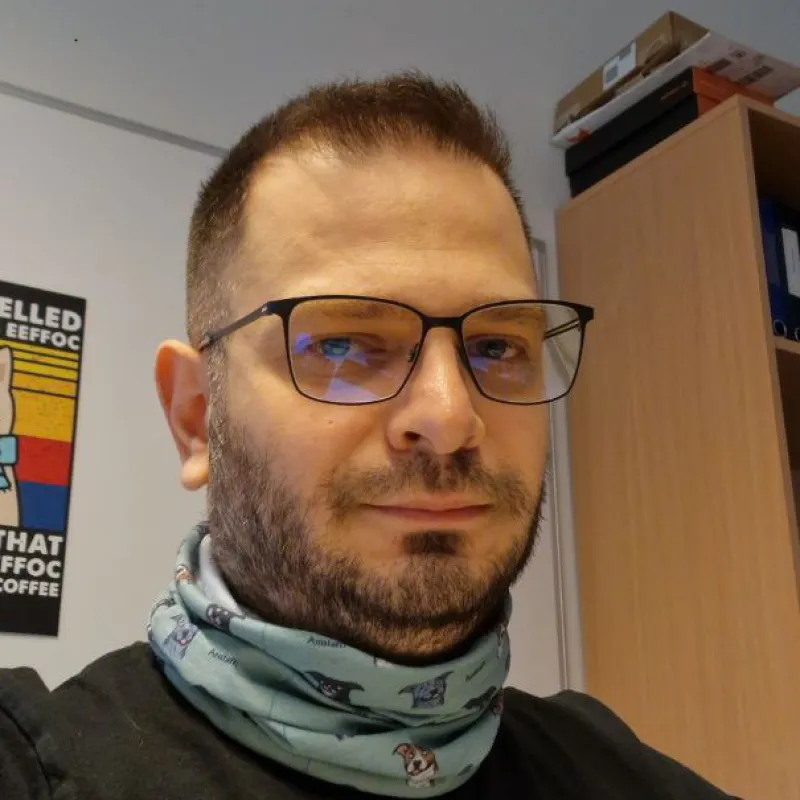
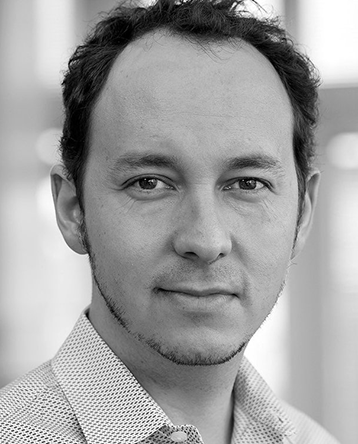
Dr. Jurgen Becque is an Associate Professor in Structural Engineering at the University of Cambridge's Department of Engineering. He specializes in cold-formed steel structures, stainless steel structural behavior, and stability analysis, with a focus on local-overall buckling interaction and innovative design methodologies. His work bridges experimental investigations with computational modeling and machine learning applications. Research Interests: Cold-formed steel structural systems Stainless steel column stability Local and overall buckling interaction Mechanics-based design optimization Machine learning for structural behavior prediction Recent publications demonstrate expertise in cross-sectional stability, connection mechanics, and composite systems like UHPC-confined stainless steel columns. His work addresses both monotonic and cyclic loading scenarios, contributing to Eurocode 3 design standards.
Marek Locmelis is an Associate Professor at the Department of Earth and Planetary Sciences and the Bureau of Economic Geology within the Jackson School of Geosciences at the University of Texas at Austin. His research focuses on magmatic, hydrothermal, and sedimentary ore deposits, with an emphasis on critical mineral supply strategies, including recycling of mine waste and STEM education in economic geology. He holds a PhD from Macquarie University and prior roles at Missouri University of Science and Technology and NASA Goddard Space Flight Center. Education PhD in Earth and Planetary Sciences, Macquarie University (Australia) Diploma (MSc equivalent) and Pre-Diploma (BSc equivalent) in Geosciences, University of Hannover (Germany) Research Interests His work spans geochemistry, petrology, and planetary evolution, with a focus on critical minerals (e.g., lithium, rare earth elements) and novel exploration techniques. He investigates pathways to enhance domestic critical mineral recovery through reprocessing mine waste and optimizing production streams. His planetary research includes atmospheric toxicity studies and habitability potential of extraterrestrial environments. Awards Fellow of the Society of Economic Geology (SEG) SEG Graduate Student Fellowship Program Chair NSF CAREER Award (2020) NASA Postdoctoral Fellowship (2014) Advising & Grants Locmelis has advised postdocs and students through workshops on critical mineral resilience. His NSF CAREER project explores metal transport via magmatic-hydrothermal fluids. He co-organized conferences on critical minerals and led the Roadmaps Into the Geosciences (RIGS) program to support student career development. Labs & Teams He collaborates with the Bureau of Economic Geology and interdisciplinary teams in critical mineral research, combining fieldwork, geochemical analysis, and policy advocacy.
Sunny Xiang is an Associate Professor of English at Yale University, where she teaches and conducts research at the intersection of literature, race, war, and empire. Her work critically examines U.S. military empire in Asia and the Pacific, particularly through aesthetic, cultural, and documentary forms from the mid-twentieth century. She is affiliated with the Department of English in the Faculty of Arts and Sciences at Yale. Ph.D., University of California, Berkeley B.A., Northwestern University Her research focuses on the cultural genealogies of American empire, with an emphasis on how war and militarism shape perception, knowledge, and everyday life. Key areas include Cold War aesthetics, Asian American studies, Pacific studies, critical militarization studies, and feminist science studies. She is particularly interested in how literary and cultural forms reveal the intimate, quotidian, and often invisible operations of empire. Her publications span journals such as ASAP/Journal , Radical History Review , PMLA , and Public Books . Her first book, Tonal Intelligence: The Aesthetics of Asian Inscrutability During the Long Cold War (Columbia University Press, 2020), explores the visual and narrative trope of Oriental inscrutability in relation to U.S. intelligence operations. Her current project, Chemical Apophenia: Air Conspiracies and Skin Connections in the Toxic Tropics , investigates how WWII military science in the Pacific generated new paradigms for detecting toxicity. The articles reflect a consistent engagement with themes of militarized domesticity, aesthetic excess, diasporic memory, and the entanglement of fashion, food, and war in imperial contexts. Mundane Militarisms: War, Archives, and Everyday Life (2024) Militarized Comfort: How to Feel Naked While Wearing Clothes (2023) Bikinis and Other Atomic Incidents: The Synthetic Life of the Nuclear Pacific (2022) Wars of Contemporary Life (2020) Global China as Genre (2019) Sunny Xiang has not been mentioned in relation to any scientific awards or fellowships in the provided text. She teaches courses such as War and Everyday Life, Readings in Comparative World English Literatures, and The Teaching of English. While her advisees or research teams are not listed, her scholarship demonstrates deep engagement with interdisciplinary methodologies and collaborative work, such as with the Mundane Militarisms Collective. She has not indicated any lab affiliations, but her research involves critical archival work and analysis of visual, literary, and cultural materials.
Ralph H. Colby serves as Professor of Materials Science and Engineering and Chemical Engineering at Pennsylvania State University's College of Earth and Mineral Sciences, holding the Corning Faculty Fellowship. His research focuses on molecular-level dynamics in complex fluids, particularly polymers, ionomers, and liquid crystalline systems. With over 130 publications and authorship of the textbook Polymer Physics (2003), he directs an active research program examining structure-property relationships in soft matter. B.S. in Materials Science and Engineering, Cornell University (1979) M.S. in Chemical Engineering, Northwestern University (1983) Ph.D. in Chemical Engineering, Northwestern University (1985) Professor Colby's research spans polymer physics, rheology, and materials for energy applications. His group employs mechanical rheology, dielectric spectroscopy, and scattering techniques to investigate ion transport in single-ion conductors for batteries, dynamics of glass-forming liquids, and self-assembly in polyelectrolyte systems. Current work emphasizes structure-property relationships in ionomers, liquid crystalline polymers, and branched architectures. Analysis of recent publications reveals consistent focus on ionomer membranes for energy applications, processing-structure relationships in advanced polymers, and fundamental dynamics of complex fluids. Key trends include increasing integration of computational modeling with experimental characterization, expansion into sustainable materials processing, and growing emphasis on applications in battery technology and biomedical materials. Penn State Faculty Scholar Medal for Outstanding Achievement (2022) Bingham Medal, Society of Rheology (2012) American Chemical Society Fellowship Corning Faculty Fellowship in Materials Science and Engineering Professor Colby leads multiple federally funded projects including NSF's 'Fundamental Studies of Flow-Induced Polymer Crystallization' and DOE's 'Conduction mechanisms and structure of ionomeric single-ion conductors'. His group maintains strong industry partnerships with Corning Incorporated and participates in interdisciplinary initiatives like the Penn State Intercollege Graduate Degree Program in Materials Science and Engineering. Current research includes collaborations on breast cancer adherence interventions in Rwanda and conjugated polymer development for flexible electronics. The Colby Research Group operates specialized facilities for rheological characterization, dielectric spectroscopy, and X-ray scattering at Penn State's Materials Research Institute. The team maintains active collaborations with national laboratories and international research groups, focusing on translating fundamental polymer physics discoveries into practical applications for energy storage and advanced manufacturing.
Jari Puttonen is a Professor of Structural Engineering at Aalto University's Department of Civil Engineering, School of Engineering. His research focuses on structural analysis, fire safety, materials science, and nuclear infrastructure safety. He has held roles as Principal Investigator in projects related to nuclear waste repository concrete modeling and aging management of NPP infrastructure. He has advised over 20 academic visitors and served in doctoral thesis committees. Education: Doctoral degree (1987), Licentiate (1984), and Master's degree (1979) in Engineering and Technology from Helsinki University of Technology (now part of Aalto University). Research Interests: Steel and composite materials behavior under extreme conditions Fire resistance of structural systems Long-term performance of concrete in nuclear facilities Non-destructive testing of construction materials Seismic resilience of critical infrastructure Awards: Recipient of the Knight, First Class of the Order of the White Rose of Finland (2020), PUUPalkinto 2010, and Schweighofer Prize 2011 for innovative energy facade research. Grants & Projects: Led 13 research projects including PERCO2_2023 (nuclear waste repository modeling) and CONAGE2022 (NPP concrete aging). Active in EU-funded initiatives and industry collaborations. Labs & Teams: Core member of Aalto's Structural Engineering Research Group, collaborating with Chalmers University and Technical University of Munich on advanced materials testing.
Xiaomei Chen is a Professor of Chinese Literature at the University of California, Davis, affiliated with the Comparative Literature, Performance Studies, Cultural Studies, and CATS (Cinematic and Technological Studies) programs. Her research focuses on modern Chinese literature, theater, cultural studies, and performance studies, with a particular emphasis on revolutionary propaganda, postsocialist cultural reconfigurations, and diasporic narratives. Education: She holds a Ph.D. in Comparative Literature from Indiana University, an M.A. in English Literature from Brigham Young University, and a B.A. in English (equivalent) from Beijing Institute of Foreign Languages. Research Interests : Modern Chinese literature and drama Revolutionary theater and propaganda Women’s literature and feminist critique Cross-cultural performance and comparative literature Postsocialist cultural studies Publications include seminal works such as Staging Chinese Revolution: Theater, Film and the Afterlives of Propaganda (2016), Occidentalism: A Theory of Counter-discourse in Post-Mao China (1995), and edited volumes on modern Chinese drama and cultural studies. Her articles critically examine themes like revolutionary narratives, diasporic identities, and the intersection of theater with political discourse. She has taught courses on modern Chinese literature, film, and drama in English translation, emphasizing cultural analysis and transnational perspectives. Her work bridges historical and contemporary studies, offering insights into China’s evolving cultural landscape.
Magnus Linnarsson is a Professor of History at Stockholm University's Department of History, specializing in political history with a focus on early modern and modern Sweden. His research examines institutional change, public-private service organization, and the evolution of the welfare city. He leads undergraduate programs and supervises students at all levels. PhD in History (2010), Lund University Associate Professor (2017), Stockholm University His research spans four centuries of political conflicts over public services, state formation, and urban development. Key works include analyses of Sweden's postal, customs, and welfare systems, comparing hierarchical and contractual state organization models. Recent publications (2024) in Nordic Welfare Cities explore urban citizenship and inclusive welfare systems since 1850, challenging national narratives by emphasizing local governance. Earlier studies (2022–2018) dissected regime shifts, mercantile-state relations, and publicness concepts in tramway and telecom debates. Current projects include: Skiftande regimer (2021–2025): State formation and administrative reform (Vetenskapsrådet-funded) Olika vägar till välfärdsstaden (2021–2025): Nordic urban welfare debates (Riksbankens jubileumsfond-funded) He advocates for interdisciplinary analysis of political economy, institutional loyalty, and spatial dynamics, connecting historical debates to modern policy challenges.
Paolo Riva is a Full Professor of Structural Engineering at the Department of Design and Technologies of the Faculty of Engineering, University of Bergamo. He has served as Dean of the Faculty of Engineering (2009-2012) and Director of the Department of Engineering at the same university since 2012. His expertise lies in seismic engineering and structural analysis of reinforced concrete structures. Professor Riva graduated in Civil Engineering from Politecnico di Milano in 1984 and earned his Ph.D. in Civil Engineering from the University of Waterloo, Canada in 1987. He began his academic career as a researcher at the University of Brescia (1991-2001), became Associate Professor there in 2001, and joined the University of Bergamo as Full Professor in 2005. His primary research interests focus on the seismic behavior of reinforced concrete structures, particularly structural walls and prefabricated structures. He also specializes in seismic retrofitting of historic buildings, nonlinear analysis of reinforced concrete structures, and fire behavior of reinforced concrete structures. His work bridges theoretical analysis with practical applications for enhancing structural safety in earthquake-prone regions. Professor Riva's recent publications demonstrate a strong focus on seismic damage assessment, structural retrofitting solutions, and sustainability in structural engineering. His research often addresses practical challenges in post-earthquake scenarios, including damage identification through advanced monitoring techniques and development of innovative retrofit strategies for existing structures. A notable trend is his increasing emphasis on integrating sustainability principles into seismic retrofitting practices. Seismic Reliability of Structures (WP3 - Reluis), 2022, 24 months Structural vulnerability models for natural hazards and industrial cascading effects, 2024, 33 months Sustainable Approaches For Earthquake Resistant_REhabilitation solutions for the BUILT environment, 2024, 15 months Professor Riva has directed all these research projects as Scientific Director. His expertise has been recognized through appointments to post-seismic emergency commissions following major earthquakes in Italy, where he provided critical guidance on intervention methods for seismic repairs and improvements for public and monumental buildings.
Shahriar Afkhami is a Researcher in the Department of Mechanical Engineering at LUT School of Energy Systems, LUT University. His research focuses on advanced materials science, additive manufacturing processes, and mechanical properties of high-strength steels and dissimilar joints. He specializes in fatigue analysis, welding technologies, and the optimization of structural components for industrial applications. His work integrates experimental methods with computational modeling to address challenges in material behavior under extreme conditions. Key research areas include: Welding of ultra-high strength steels and dissimilar materials Mechanical performance of additively manufactured components Fatigue life assessment of welded joints and cut edges Thermomechanical behavior of heat-affected zones Material characterization of laser powder bed fusion (LPBF) steels Publications highlight trends in additive manufacturing for industrial applications, particularly in optimizing 3D-printed metal structures and analyzing their mechanical integrity. His work on notch-load interactions and fatigue strength has advanced methodologies for predicting component failure under complex loading conditions. Notable contributions include the VERKOTA project exploring 3D printing networks for enhanced industrial adoption. No scientific awards are listed in the provided information. Afkhami's research has been supported by collaborative projects such as the VERKOTA initiative, though specific grants are not detailed here. He maintains an active presence on professional networks including LinkedIn and Google Scholar.
Benjamin Mangrum is Associate Professor of Literature at MIT's School of Humanities, Arts, and Social Sciences, specializing in 20th/21st-century literature, digital humanities, and environmental humanities. His scholarship examines literature's engagement with technology, environmental crisis, and political liberalism. Dr. Mangrum's research analyzes computational obsolescence, environmental rights discourse, and the intersections of literary form with political thought. His publications demonstrate interdisciplinary approaches combining literary criticism with philosophy, digital studies, and environmental theory. Recent publications show growing engagement with energy humanities, data visualization ecologies, and artificial intelligence's cultural implications. His work consistently examines how literary forms mediate technological change and environmental consciousness. Awards: Levitan Prize (2023) Fellowships: Michigan Society of Fellows Professor Mangrum teaches courses on comedy, science fiction, environmental literature, and AI at both undergraduate and graduate levels.
Dr. Marina Bock is a Chartered Civil Engineer and Lecturer in Civil Engineering at Aston University's College of Engineering and Physical Sciences. She specializes in structural engineering with expertise in metallic structures, additive manufacturing, and numerical modeling. Currently accepting PhD students, her work bridges academic research and industry applications in sustainable construction. Her educational background includes: PG Cert in Building and Design and Construction Technology, University of Wolverhampton (2017-2018) PhD in Local Buckling and Web Crippling Response of Stainless Steels, Universitat Politècnica de Catalunya (2010-2015) MSc in Patch Loading of Hybrid Plate Girders, Universitat Politècnica de Catalunya (2004-2010) Dr. Bock's research integrates laboratory experiments and numerical modeling to advance metallic structural systems, with pioneering work in additive manufacturing for construction. Her investigations span stainless steel design code development, corrosion prevention in reinforced concrete using hydrogels, and cold-formed steel behavior. Recent projects focus on sustainable infrastructure solutions through novel composite materials. Analysis of her 2022-2025 publications reveals dominant themes in additive manufactured aluminum structures, cold-formed steel design methodologies, and sustainable paving materials for urban heat island mitigation. Her work consistently addresses practical engineering challenges through experimental validation and code-compliant design solutions. Scientific recognition includes: IStructE Academic Research Award Commendation (2021) for research on aluminum SHS/RHS under biaxial bending Dr. Bock has secured significant research funding including a Royal Society Research Grant (£20k, 2023) for additive manufactured Al7075 aluminum and Innovate UK funding (£437k) for UV-reflective resin-based paving. Previous internal projects (£20k) focused on structural aluminum applications. She supervises PhD research in additive manufacturing and corrosion prevention while maintaining industry collaborations. Her experimental work utilizes advanced university laboratories for structural testing, with collaborations spanning European research consortia and industrial partners. Current projects involve multi-institutional teams developing reusable structural systems and solar-energy-harvesting building envelopes.
Daniel Cardoso Llach is an Associate Professor at Carnegie Mellon University's School of Architecture , where he chairs the Master of Science in Computational Design program and co-directs the CoDe Lab . His scholarship merges history, science and technology studies (STS), and computational design , focusing on the cultural and socio-technical dimensions of design automation. Education: PhD and MS in Architecture: Design and Computation from MIT , BArch from Universidad de los Andes Research Grants: Supported by the Graham Foundation for historical CAD exhibitions and by the Alexander Von Humboldt Foundation for postwar computational design research in Germany His work interrogates the politics of software, the materiality of computational systems , and the ethical implications of AI/robotics in architectural practice. Recent projects include reconstructing early CAD systems and analyzing data-driven urban technologies. Scientific awards include: Alexander Von Humboldt Fellowship (2024–2025) ACM CSCW Methods Mention for emulation-based software research (2021)
Hannah Blum serves as the Alain H. Peyrot Associate Professor in Structural Engineering within the Department of Civil and Environmental Engineering at the University of Wisconsin-Madison. Her research program focuses on infrastructure resilience, next-generation structural design methodologies, and advanced visualization techniques including extended reality applications, supported by funding from federal agencies, industry associations, and private companies. Her academic credentials include a PhD in Civil Engineering from the University of Sydney (2017), complemented by MS (2012) and BS (2010) degrees in Civil Engineering from Johns Hopkins University. Dr. Blum's research program spans critical domains in structural engineering with particular emphasis on steel systems. Key focus areas include: Steel, cold-formed steel, and stainless-steel structural systems Steel deck and joist system behavior Structural stability and reliability analysis Virtual and augmented reality applications in structural steel fabrication Data-driven approaches to structural engineering problems Analysis of her 15 most recent publications (2023-2025) reveals a concentrated research trajectory centered on data-driven design methodologies, advanced material systems (particularly stainless steel and high-strength alloys), and immersive technology integration. Notable trends include machine learning applications for buckling prediction, experimental validation of novel structural systems, and mixed-reality solutions for fabrication processes. Her distinguished recognition includes: University of Wisconsin-Madison Chancellor’s Teaching Innovation Award (2024) College of Engineering Harvey Spangler Award for Innovative Teaching (2023) American Institute of Steel Construction Terry Peshia Early Career Faculty Award (2023) Structural Stability Research Council McGuire Award for Junior Researchers (2022) Structural Stability Research Council Yoon Duk Kim Young Researcher Award (2021) Dr. Blum actively mentors graduate students through CIV ENGR 790 (Master's Research) and 890 (Pre-Dissertator's Research) courses while securing diverse research funding streams. Her professional service includes active participation in steel design standards committees for structural, cold-formed, and stainless-steel systems through organizations like the Structural Stability Research Council. Her experimental and computational research requires specialized facilities for structural testing and digital visualization, though specific laboratory names are not documented in the provided materials. Current projects demonstrate strong industry collaboration, particularly with steel manufacturing and construction technology firms.
Anne Rawls is a Professor of Sociology and Chair of the Department of Sociology at Bentley University. She also holds roles as Professor for Interaction, Work, and Information at the University of Siegen (Germany), Senior Fellow at Yale University's Urban Ethnography Project, and Director of the Garfinkel Archive, LLC. Her academic career began with a B.A. in Sociology (Summa Cum Laude), M.A. in Philosophy, and Ph.D. in Sociology from Boston University, followed by a Post-Doctoral Fellowship in Psychiatry at the University of Wisconsin-Madison. Her research focuses on ethnomethodology, race relations, workplace studies, and the sociology of information. Notable works include Epistemology and Practice: Durkheim's Elementary Forms of the Religious Life (Cambridge University Press) and editorship of Garfinkel’s Archive . She explores how interactional practices shape social order, race dynamics, and modern democratic systems, emphasizing the role of 'constitutive practices' in creating moral and social facts. Teaching interests span race, gender, globalization, and the ethics of situated practices. Her consulting work addresses workplace studies and computer-mediated work design. Rawls' contributions bridge classical sociological theory (Durkheim, Garfinkel) with contemporary issues like racial justice and technology's societal impact. Her research highlights tacit racism in everyday interactions, the moral foundations of public life, and the interplay between sociology and technology. She has presented globally and contributed to debates on sociological methodology and the legacy of key theorists like Goffman and Garfinkel.
Dr. Mani Khezri is a Lecturer in the School of Civil Engineering at The University of Sydney since 2014, specializing in structural mechanics and innovative numerical methods. His research focuses on cold-formed steel structures, buckling behavior of plates and laminated assemblies, and functionalizing buckling for structural morphing. He holds a Ph.D. in Structural Engineering from UNSW, an M.Sc. from SUT, and a B.Sc. from IUT. Key research areas include extending cold-formed steel applications to mid-rise structures through built-up sections, analyzing buckling and post-buckling behaviors, and leveraging buckling for smart technologies like kinetic façades. He collaborates with industry to develop affordable, prefabricated structures and sustainable materials through additive manufacturing. His work bridges theoretical analysis (e.g., meshfree methods) with practical applications, such as optimizing ventilation systems via buckling-induced airflow control. He leads grants like 'Solid-State Additive Manufacturing For Recycled Aluminium Alloys' and 'Complete limit state analysis of steel structural framework.' Students include Pouya AFSHAR IMANI (additive manufacturing), Cynthia LIU (built-up columns), Emad TAYARANINAJJARAN (floor systems), and Ruilin ZHANG (serviceability analysis). His lab, the Centre for Advanced Structural Engineering, explores advanced structural systems and computational mechanics.