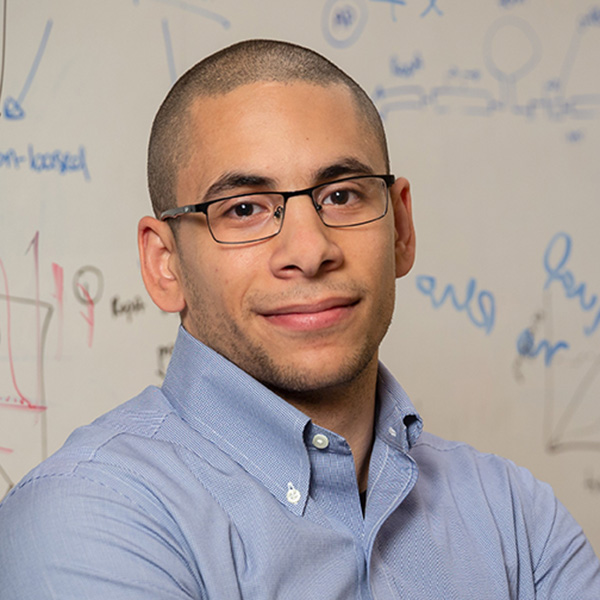
Ahmed Badran is an Assistant Professor at the Scripps Research Institute , specializing in Synthetic Biology and Molecular Evolution . Previously, he was affiliated with the Liu Lab at the Department of Chemistry and Chemical Biology at Harvard University during his doctoral studies (enrolled 2010). Research Focus: Designing artificial enzymes for sustainable biomanufacturing, combating antibiotic resistance, and developing precision therapeutics through synthetic biology strategies. Publications: Recent work includes studies on precision antibiotics and tRNA-directed evolution of quadruplet codon suppression systems. Labs: Leads the Badran Lab at Scripps Research Institute, dedicated to innovative solutions in biotechnology and medicine.
Edward P. O'Brien, Jr. is a Professor of Chemistry at Penn State University. He is affiliated with multiple institutes, including the Institute for Computational and Data Sciences (ICDS), Penn State Cancer Institute, and Huck Institutes of the Life Sciences. His research focuses on protein folding, translation quality, codon usage, and molecular entanglement phenomena. Institution: Penn State University Department: Chemistry Key Research Areas: Protein Folding, Codon Optimization, Translation Dynamics, Structural Entanglement Recent Publications (2024-2025) reveal computational and experimental investigations into protein misfolding mechanisms, SARS-CoV-2 ACE2 interactions, and lasso entanglements in folded proteins. His work combines biophysical modeling with machine learning approaches to understand translation elongation speeds and molecular physiology. Grants & Projects include NSF-funded initiatives like the National Synthesis Center for Emergence in Molecular and Cellular Sciences (2024-2029) and interdisciplinary collaborations with researchers in climate modeling, cyberinfrastructure, and RNA biology. Current projects emphasize co-translational folding and massively parallel assays.
Mark Heise, PhD, is a Professor at the UNC School of Medicine, with dual appointments in the Department of Genetics and Microbiology and Immunology . He is a member of the UNC Lineberger Comprehensive Cancer Center , where his research focuses on virus-host interactions and vaccine development. His laboratory investigates mechanisms of viral immunomodulation and genetic factors influencing disease susceptibility. Specialties: Virology, Immunology, Vaccine Development Email: mark_heisem@med.unc.edu Location: 9039 Burnett Womack Building, UNC-Chapel Hill His research has significant implications for: Understanding how viruses manipulate innate immune systems Developing safer vaccine vectors through codon optimization Identifying genetic markers for differential vaccine responses Exploring mitochondrial gene downregulation during SARS-CoV-2 infection Advancing RNA-based therapies for infectious diseases Improving immunotherapies for vulnerable populations
Dr. Chenguang Fan is an Associate Professor in the Department of Chemistry & Biochemistry at the University of Arkansas, College of Arts & Sciences. He earned his BS in Biological Pharmacy from Nanjing University, PhD in Biochemistry from Iowa State University under Professor Thomas Bobik, and conducted postdoctoral research with Professor Dieter Söll at Yale University. Research Interests: Protein chemistry, bacterial pathogenesis, cancer biology, and synthetic biology using genetic code expansion techniques. Key Techniques: Development of noncanonical amino acid incorporation systems, site-specific acetylation studies in Escherichia coli, and engineering bacterial microcompartments. Teaching: Offers undergraduate and graduate courses in chemistry and biochemistry. Dr. Fan's work spans interdisciplinary approaches to study post-translational modifications, particularly lysine acetylation, in metabolic enzymes and bacterial pathogens. His group focuses on: Mapping protein-protein interaction networks Developing tools for noncanonical amino acid labeling Designing inhibitors for Salmonella metabolic organelles Engineering bacterial microcompartments as nano-bioreactors for biofuels Investigating cancer-related phosphorylation and acetylation His publications highlight contributions to genetic code expansion, enzyme encapsulation in metal-organic frameworks, and functional analysis of bacterial microcompartments. Notable awards include the Ralph E. Powe Junior Faculty Enhancement Award and Arkansas Biosciences Institute New Investigator of the Year 2018. Dr. Fan has received NIH grants from NIAID and NIGMS to support his research.
Dr. Tomislav Jelesijevic is an Assistant Professor in the Department of Comparative Biomedical Sciences at Louisiana State University's School of Veterinary Medicine, having joined the faculty on August 15, 2021. His academic credentials include a PhD from the University of Georgia, an MS from the University of Belgrade, and a DVM equivalent from the same institution. He is certified as a Diplomate of the American College of Veterinary Pathologists. Dr. Jelesijevic's research centers on immunology and infectious diseases, with specific interests in: Myeloid Derived Suppressor Cells in tumors and immune disorders Bacterial pathogenesis (Burkholderia mallei/pseudomallei) Drug repurposing for COVID-19 therapies Veterinary oncology and parasitology He has secured $342,400 in recent grants for SARS-CoV-2 research and biosafety lab enhancements.
Juan Cortés is a CNRS Research Director at LAAS-CNRS (Toulouse), leading the Robotics and Interactions Team. He holds a PhD in automated systems/robotics from the National Polytechnic Institute of Toulouse (2003). His research spans robotics, artificial intelligence, and computational biology, with focus areas including: Protein conformational dynamics and disordered proteins Robotic motion planning and multi-agent systems Development of computational tools for structural biology (e.g., AFflecto, MoMA-LoopSampler) His publications emphasize algorithm development for molecular flexibility analysis and robotic coordination. Recent work explores Wasserstein distance metrics for protein ensemble comparisons and optimization methods for energy landscapes. Cortés contributes to understanding pathogenic protein structures (e.g., huntingtin) and surface-molecule interactions. He advises on doctoral committees and collaborates internationally but currently lists no direct students or major awards.
Dr. Pau Bernadó is a Professor of Structural Biology at Centre de Biologie Structurale (CBS), a joint research unit of CNRS, INSERM, and University of Montpellier in France. His research program focuses on intrinsically disordered proteins (IDPs) and protein conformational ensembles, utilizing integrative structural biology approaches with particular emphasis on Small-Angle X-ray Scattering (SAXS) techniques combined with computational modeling. Dr. Bernadó's research interests include: Structural characterization of intrinsically disordered proteins Development of computational tools for analyzing protein conformational ensembles Protein-protein interactions in flexible systems Structure-function relationships in protein homorepeats Integrative structural biology methodologies His recent work has centered on developing advanced computational approaches like WARIO and WASCO for characterizing conformational ensembles of highly flexible proteins. The research spans fundamental protein science to understanding disease-related proteins and viral components. With over 110 scientific publications including numerous high-impact papers in journals such as Nature Communications, PNAS, and Nucleic Acids Research, Dr. Bernadó has established himself as a leading researcher in the field of protein structural dynamics. Notable scientific contributions include: Development of computational tools for IDP analysis (pyDockSAXS, WARIO, WASCO) Advancement of SAXS methodologies for studying flexible proteins Major contributions to the Protein Ensemble Database (PED) Structural insights into protein homorepeats and their disease relevance Methodological innovations for studying low-complexity protein regions Dr. Bernadó maintains active collaborations with researchers across Europe and supervises students and postdoctoral researchers in structural biology and biophysics. His lab provides interdisciplinary research opportunities at the interface of experimental and computational structural biology, with particular focus on understanding the dynamic nature of protein structure and function.
Dr. Adélaïde Raguin leads the Computational and Theoretical Biophysics research group within the Institute for Computational Cell Biology at Heinrich Heine University Düsseldorf's Department of Computer Science. She established her independent third-party funded research team in 2021 after postdoctoral work at University of Aberdeen and Heinrich Heine University. Her group develops advanced stochastic simulation methods to investigate mesoscopic biological systems with emphasis on plant polysaccharides, protein synthesis regulation, and cytoskeletal transport. Her primary research interests focus on the dynamics of complex biological polymers , particularly plant cell wall biosynthesis/degradation, starch biogenesis, glycogen granule formation, and protein synthesis regulation. Using computational biophysics approaches, her team bridges theoretical modeling with experimental validation to understand how molecular structure interplays with enzymatic processes in systems like lignocellulose saccharification and starch granule formation. Key methodologies include stochastic simulations of collective transport processes and development of predictive tools for biological systems. The group's publication trends reveal strong focus on plant biomass conversion (40% of recent work), macromolecular dynamics (30%), and translation regulation (20%), with increasing emphasis on software tool development for experimentalists. Recent outputs include the PREDIG web application for saccharification prediction and ExpressInHost for codon optimization. Dr. Raguin actively supervises multiple PhD and Master's students while leading the Stochastic Models of Biological Systems module in the Computer Science Master's program. Her research is supported by major grants from CEPLAS, BioSC, DFG, and BMBF, including the OptiCellu project for sustainable cellulose fiber production and EtransColi for bacterial stress response studies. Her laboratory maintains strong collaborations with experimental groups through the CEPLAS Cluster of Excellence and develops open-source software tools including: ExpressInHost: Codon tuning for recombinant protein expression PREDIG: Web application for plant biomass saccharification modeling Glycogen granule biogenesis simulation tools Whole-translatome protein production models