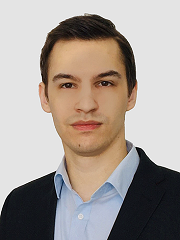

Stephan Leible is a Researcher at the Department of Computer Science , University of Hamburg (MIN Faculty). Holding both M.Eng. in Business Engineering and an MBA, he focuses on employee-driven digital innovation, intrapreneurship, and leveraging generative AI for organizational transformation. Research Interests : Employee-driven Innovation, Intrapreneurship, Generative AI Governance, Design & Data Thinking, IT Innovation Management Contact : stephan.leible@uni-hamburg.de | Room 117C, Vogt-Kölln-Straße 30, Hamburg His work bridges citizen development with public sector innovation, emphasizing value co-creation, real-time analytics, and ethical AI implementation. Current studies explore: Generative AI adoption patterns and limitations Interpretable machine learning for urban mobility Participatory frameworks for smart city futures Methodologies for continuous improvement in conversational agents
Dr. Yulin Hu serves as a Visiting Professor at RWTH Aachen University, holding the Chair of Information Theory and Data Analytics. His research program bridges theoretical foundations with practical implementations in next-generation wireless systems, with particular emphasis on UAV-aided networks and information-theoretic approaches to communication challenges. His core research interests span multiple interconnected domains: Wireless Communications (especially finite blocklength regimes) Information Theory applications in network design UAV trajectory optimization and network integration Wireless power transfer with nonlinear energy harvesting Edge computing and distributed learning systems Data analytics for network performance optimization Analysis of Dr. Hu's 2025 publication record reveals a concentrated research thrust on UAV trajectory design, where he develops joint optimization frameworks addressing energy efficiency, security, and reliability constraints. His work consistently integrates information-theoretic principles—particularly finite blocklength analysis—to solve practical challenges in ultra-reliable low-latency communications (URLLC) and wireless power transfer. A distinctive feature of his approach is the fusion of deep reinforcement learning with traditional optimization methods for dynamic network scenarios, including no-fly zone constraints and covert operations. While no specific scientific awards are documented in the available materials, his prolific output across top-tier venues demonstrates significant scholarly impact. Details regarding graduate student mentoring and research funding mechanisms remain unspecified in the current documentation. The Chair of Information Theory and Data Analytics, which Dr. Hu leads, functions as a specialized research unit focused on theoretical rigor and algorithmic innovation for wireless systems, though specific laboratory infrastructure or team composition details are not provided.
Ingo Weber is a Professor affiliated with Technische Universität München (TU Munich) and Fraunhofer Gesellschaft. His research focuses on blockchain technology, business process management (BPM), and artificial intelligence (AI), with a particular emphasis on integrating these fields. He has held former positions at TU Berlin, CSIRO Data61, and other institutions. Current affiliations: TU Munich and Fraunhofer Gesellschaft Former affiliations: TU Berlin, CSIRO Sydney, University of New South Wales, SAP Research, and University of Massachusetts Amherst Research interests include blockchain applications in business processes, process mining, AI-driven systems, and sustainability-oriented process analysis. His work explores topics such as blockchain scalability, data confidentiality, and cost-efficient process execution on next-generation blockchains like Algorand. He has pioneered frameworks like SOPA for sustainability analysis and FhGenie for confidentiality-preserving AI. Key contributions include over 200 publications in journals like IEEE Access, Future Generation Computer Systems, and ACM Transactions on Management Information Systems. Recent work emphasizes AI-augmented BPM systems and the application of large language models (LLMs) in scientific contexts. Notable projects include blockchain-based process execution engines (e.g., Caterpillar), platform architectures for multi-tenant blockchain systems, and frameworks for evaluating payment channel networks. He has collaborated extensively with industry partners and academic institutions globally.
Gerhard Wellein is a Professor for High Performance Computing at the Department of Computer Science of Friedrich-Alexander-Universität Erlangen-Nürnberg (FAU). He is the head of NHR@FAU (Erlangen National Center for High Performance Computing) and a member of the board of directors of the German NHR-Alliance. Since 2024, he has also served as a Visiting Professor for HPC at the Delft Institute of Applied Mathematics, Delft University of Technology. He holds a PhD in theoretical physics from the University of Bayreuth and has over two decades of experience in HPC education and research. Research Interests: His research focuses on performance modeling and engineering, architecture-specific code optimization, novel parallelization techniques, and the development of hardware-efficient building blocks for sparse linear algebra and stencil solvers. His work bridges computer science, applied mathematics, and computational physics, aiming to maximize efficiency on current and future HPC architectures, including exascale systems. Publication Trends: His recent publications emphasize analytical performance modeling (e.g., Roofline, oscillator models), energy efficiency, GPU optimization, and scalable linear algebra. They reflect a strong focus on both theoretical modeling and practical implementation, with applications in CFD, quantum physics, and molecular dynamics. Scientific Awards: 2011 Informatics Europe Curriculum Best Practices Award (shared with Jan Treibig and Georg Hager) for outstanding teaching contributions in HPC. Grants and Advising: He has led numerous third-party funded projects from the EU, BMBF, and DFG, including EoCoE-III, ESSEX, EXASTEEL, and ProPE. These projects focus on exascale software, performance engineering, fault tolerance, and multiscale simulation. He has mentored multiple researchers and students, contributing to the development of tools such as LIKWID, ClusterCockpit, and GEOPM. Labs and Teams: He leads the HPC research group at FAU and is deeply involved in national and international HPC initiatives. His team collaborates extensively on open-source HPC software and performance tools, fostering a strong community-driven approach to performance engineering.
Harald Köstler is an Associate Professor and Head of Research at the Erlangen National High Performance Computing Center (NHR@FAU) within the Department of Computer Science at Friedrich-Alexander-Universität Erlangen-Nürnberg (FAU). He leads the research group on HPC Software Design at the Chair of Computer Science 10 (System Simulation), focusing on software engineering for high-performance computing and data analytics. His research interests include: Software Engineering for HPC Code Generation for Numerical Solvers Performance Engineering on Hybrid Architectures Discontinuous Galerkin and Lattice Boltzmann Methods Multigrid Solvers and Parallel Algorithms Performance Portability across CPUs, GPUs, and FPGAs The recent publications highlight a strong trend in developing efficient, scalable, and portable simulation frameworks for complex physical systems. His work emphasizes code generation, performance optimization, and the integration of classical model-driven and data-driven approaches. Key application areas include computational fluid dynamics, geotechnical engineering, and climate modeling, often leveraging the waLBerla and ExaStencils frameworks. Harald Köstler has no listed scientific awards in the provided text. He advises students in the areas of high-performance computing, numerical methods, and software engineering for scientific applications. His research is supported by collaborations within the FAU HPC ecosystem and likely involves grants related to national high-performance computing initiatives. He is a key contributor to the waLBerla framework, a block-structured, high-performance software for multiphysics simulations, and is involved with the ExaStencils project, which focuses on advanced multigrid solver generation. These frameworks form the core of his research team's efforts in scalable scientific computing.
Santiago Berrezueta is a Lecturer at the School of Computation, Information and Technology within Technical University of Munich (TUM). He actively contributes to research in Virtual Reality , Artificial Intelligence , and Robotic Assistance , with a focus on applications in Education and Healthcare . 2025 : 10 publications in VR, robotics, and AI ethics. 2024 : 4 co-authored studies on ChatGPT in ADHD therapy and collaborative learning. His research intersects Interactive Learning and Computer Vision , particularly in ADHD treatment , Language disorder detection , and VR-based education . He supervises Bachelor’s/Master’s theses on topics like gaze-based interaction, collaborative VR workflows, and AI-driven therapeutic tools. 2025: Excellent Paper Award at International Symposium on Educational Technology (ISET 2025) 2024: Best Presentation Award at International Conference in Intelligent Environments (IE 2024) He leads courses on Software Engineering and Programming Fundamentals at TUM’s Heilbronn campus. His work also explores IoT applications and ethical AI in vulnerable populations.
John P. Dougherty is a Teaching Professor of Computer Science at Haverford College, PA. His primary affiliation is with the Department of Computer Science within the College of Arts and Sciences. Dougherty has collaborated with institutions like Drexel University and has been actively involved in computing education research since at least 2002. Focus areas include CS1 curriculum design, pedagogy for non-majors, and the integration of music/theatre into computing education. Contributed to debates on mathematics requirements for CS majors and the role of peer code review. Published extensively in Journal of Computing Sciences in Colleges and SIGCSE proceedings. Research Interests Explores innovative teaching methodologies, including project-based learning and interdisciplinary approaches. Specializes in understanding how foundational disciplines like mathematics impact student success in computing. Active in national conversations about the future of computing education through workshops and collaborative reports. Notable Contributions Lead author on influential papers addressing: Music-based concept reinforcement (2022) Mathematics perceptions in CS undergraduates (2023) Decadal trends in computing education research (2022 co-authored)
Prof. Dr. Katharina Frosch holds the professorship for General Business Administration with a focus on Human Resource Management at the Brandenburg University of Technology since March 2015. She also serves as the overall project leader for the SCALE-C initiative and has held a research professorship in the field of "Digital- and AI-supported learning at the workplace" since September 2024. Additionally, she has been a member of the Senate of the Brandenburg University of Technology since October 2023. Her research focuses on digitally supported human resource management tools for small and medium-sized enterprises (SMEs), human resource economic analyses in knowledge-intensive sectors, and AI-supported workplace learning. Key research areas include testing digitally supported onboarding processes in SMEs, hybrid approaches to work-integrated learning, and developing low-threshold digital HR tools for the Brandenburg-Berlin metropolitan region. Her work emphasizes professionalizing interactions between HR managers and employees at critical points to improve recruitment, motivation, and retention of skilled workers. Prof. Frosch's recent publications demonstrate a strong trend toward AI-enhanced learning solutions, particularly in microlearning, conversation training, and cybersecurity education. Her research increasingly examines how AI technologies can transform workplace learning while maintaining human elements of communication and trust. The SCALE-C project represents a significant interdisciplinary effort combining cybersecurity, artificial intelligence, and learning design to create semi-automated microlearning content. Best Paper Award at eLmL 2023 for 'Scan to Learn: A Lightweight Approach for Informal Mobile Micro-Learning at the Workplace' Best Paper Award at ICDS 2023 for 'Taking the Matter in Their Own Hands – Can Business Unit Developers Fullfill their Digital Demands with Low-Code Development Platforms?' Prof. Frosch actively collaborates with SMEs and public institutions in the Brandenburg-Berlin metropolitan region, leading a community of researchers, students, and HR practitioners developing Open HRM tools. She offers numerous opportunities for students to participate in research through project work, theses, and the SCALE-C initiative. Her teaching portfolio includes courses on Human Resources and Organization, Strategic Personnel Management, and Applied Research in Personnel Psychology, with a special focus on the Open HRM Hackathon. She leads the Open HRM Community, which conducts regular hackathons to develop functional HR app prototypes. Current projects include scientific support for the Federal Office for Foreign Affairs in implementing psychologically supported digital onboarding approaches, developing digital learning laboratories for workplace competence acquisition in SMEs, and implementing digital HR processes for companies like Autohaus Mothor GmbH.
Dr. Shashikant Ilager is an Assistant Professor at the Informatics Institute (IVI) , University of Amsterdam. His research focuses on distributed systems , energy efficiency , and machine learning , with a specific emphasis on sustainable large-scale AI platforms. Current affiliation: University of Amsterdam (Oct 2024–present) Previous roles: Postdoctoral Researcher at TU Wien; Visiting Research Scientist at IBM PhD: CLOUDS Lab, University of Melbourne Research Focus Dr. Ilager develops data-driven approaches to optimize cloud/edge platforms for environmental and economic sustainability , particularly in AI workloads. His work bridges system characterization with learn-centric optimization techniques. Recent Publications 2025: ACM e-Energy (LLM carbon amortization), TAAS (self-adaptive edge monitoring), CCGRID (code generation efficiency). 2024: ICSOC (edge time series classification), EdgeSys (federated learning with GANs). Awards Best Paper Award @ ACM/IEEE UCC 2023 Community Engagement Organizer of the GreenSys workshop (2025) at EuroSys. Member of HPDC 2025 Technical Program Committee.
Francesca Fallucchi is an Associate Professor at Guglielmo Marconi University in Rome since 2008 and an information scientist at Georg-Eckert-Institut (GEI) since July 2017, working in the Human-Centered Technologies for Educational Media department. Her research focuses on the intersection of computer science and humanities, with particular emphasis on knowledge organization , information retrieval , semantic technologies , and big data management applied to educational media and cultural heritage. Her work bridges theoretical computer science with practical applications in digital humanities. Analysis of her recent publications (2021-2024) reveals a research trajectory spanning multiple domains: from foundational work in semantic web and NLP to emerging applications in metaverse technologies, blockchain for energy monitoring, and explainable AI for healthcare. Her work consistently demonstrates interdisciplinary approaches combining computer science with domain-specific challenges. Dr. Fallucchi has been actively involved in academic service, including organizing the 17th International Conference on Metadata and Semantics Research (MTSR 2023) and serving as editor for Computers trade magazine since 2021. Her professional activities include significant project leadership as Deputy Project Manager for Edumeres Toolbox and contributions to numerous research projects including GLOTREC, GEI-Digital, PalTex, DemoS, PVE-E, and WorldViews.
Oliver Bringmann is a full Professor and head of the Chair of Embedded Systems at the University of Tübingen, Germany, and a member of the board of directors at the FZI Research Center for Information Technology. His research integrates embedded-system design, energy-efficient AI accelerators, dependable automotive perception, and medical AI for capsule endoscopy. Education & Career Ph.D. in Computer Science, University of Tübingen, 2001 Diploma in Computer Science, University of Karlsruhe (KIT) Head, Chair of Embedded Systems, University of Tübingen (since 2012) Deputy spokesperson & spokesperson, Dept. of Computer Science, University of Tübingen (2014-2022) Board of Directors, FZI Research Center for Information Technology Research Interests Bringmann’s group pioneers hardware/software co-design for ultra-low-power Edge-AI , developing RISC-V based accelerators, compiler-aware neural-architecture search, and real-time perception systems for autonomous driving and medical devices. Key topics include: Energy-efficient AI architectures (“Edge AI”) and custom accelerator generation Robust collective perception under adverse weather (LiDAR, camera, V2X fusion) Timing/power-predictable embedded software and system-on-chip design automation Hardware-assisted security and safety for automotive & IoT systems AI-driven capsule endoscopy localization and anomaly detection Recent Publication Trends His 2024-2025 articles reveal a strong shift toward robust multimodal perception for automated driving (snow, fog, collective LiDAR fusion) and Edge-AI medical devices (capsule endoscopy with multi-task CNNs). Core contributions span dataset generation (SCOPE, SnowyLane), safety metrics (LSM), and fast performance modeling for DNN accelerators. Professional Service & Projects Executive/Steering Committees: IEEE/ACM DATE, CODES+ISSS, CASES, ITSS conferences EU CATRENE EDA roadmap chapter lead (Embedded Software & ESL-to-RTL) Principal investigator in Scale4Edge, OCEAN12, enerDAG and other national projects on energy-efficient sensorics and secure energy trading. His group maintains extensive collaborations with automotive and semiconductor industry, focusing on dependable, energy-aware embedded intelligence.
Hoa Khanh Dam is Professor and Deputy Head of School (Research) & Head of Postgraduate Studies in the School of Computing and Information Technology at the University of Wollongong, Australia. He serves as Co-Director of the Decision System Lab where he leads research at the intersection of Software Engineering and Artificial Intelligence. His research focuses on developing AI-driven solutions for software quality, cybersecurity, and productivity enhancement. Key interest areas include: AI/IoT autonomous and cyber resilient systems Software Analytics and Mining Software Repositories Large Language Models for software engineering tasks Defect prediction and vulnerability analysis Agile project management optimization Analysis of Dam's 12 publications from 2018-2025 reveals consistent application of machine learning to software engineering challenges. His work shows progressive evolution from traditional ML techniques toward LLM-based frameworks, with major contributions in defect prediction (DeepJIT), vulnerability analysis, microservice recommendation, and agile effort estimation. The research demonstrates strong industry relevance through practical implementations in code review, component prediction, and security systems. Dam co-leads the Decision System Lab at UOW, which develops intelligent decision support systems using AI and data analytics. The lab's work bridges theoretical AI advancements with real-world software engineering applications, particularly in cybersecurity and autonomous systems development.
Jacky Wai Keung is an Associate Professor in the Department of Computer Science at City University of Hong Kong with extensive industry connections across the Asia Pacific region. He leads the Artificial Intelligence and Software Engineering Research Group (AiSE) and serves as Chairman of IEEE Computer Society Hong Kong Chapter and Vice-President of Hong Kong STEM Education Alliance. Prof. Keung received his B.Sc.(Hons) in Computer Science from the University of Sydney and Ph.D. in Software Engineering from the University of New South Wales, Australia, before working as a Research Scientist at NICTA (now DATA61, CSIRO) in Sydney. His research spans software engineering, data science, AI, FinTech, machine learning, blockchain systems, and large language models for code generation and analysis. His recent work focuses on applying large language models to software engineering challenges, with publications examining code translation, anomaly detection, and autonomous driving system testing. The research shows a strong trend toward practical applications of AI in software development processes, particularly in FinTech and autonomous systems domains. Among his numerous accolades, Prof. Keung has been named in Stanford's top 2% most highly cited scientists for both 2022 and 2023, received the President's Teaching Excellence Award in 2020, and earned multiple IEEE best paper awards. His editorial service includes roles as Area Editor for Journal of Systems and Software since 2017 and Associate Editor for Information and Software Technology since 2020. Prof. Keung has successfully secured over HK$20 million in research funding through GRF, ITF, and TDG grants, including major projects like 'Smart Intelligent Process Automation for the Mortgage Lending Industry' (HK$2.62 million) and 'Software Data Analytics and Blockchain Technological Advancements' (HK$6 million). His industry collaborations have significantly enhanced student opportunities, with CS student starting salaries increasing by over 15% year-on-year for the past three years. He currently leads multiple research initiatives including RealisticCodeBench for evaluating LLMs in code generation and FedLAD for federated log anomaly detection, with several active projects focused on AI-enhanced InsurTech systems and deep probabilistic reasoning using deep learning.
Gregory Gay is an Associate Professor in the Interaction Design and Software Engineering division within the Department of Computer Science and Engineering at Chalmers University of Technology and the University of Gothenburg, Sweden. His academic profile spans numerous software engineering conferences where he has served as committee member, program chair, and active researcher since at least 2018. Dr. Gay's research focuses on the intersection of software engineering and artificial intelligence, with particular emphasis on: Software Testing and Analysis Search-Based Software Engineering AI for Software Engineering (AI4SE) AI Engineering Automation of development tasks Software Carbon Footprint and sustainability His recent publications demonstrate a strong trend toward applying AI and optimization techniques to software testing challenges, with increasing focus on sustainability aspects of software development. Many studies take an industrial perspective, examining real-world applications in automotive software systems. His work blends theoretical foundations with practical applications, making significant contributions to both academic research and industrial practice in software engineering. Dr. Gay has been actively involved in numerous top software engineering conferences including ASE, ICSE, ESEC/FSE, ISSTA, and ICST, serving on program committees and organizing tracks. His research methodology typically combines optimization, artificial intelligence, and machine learning to help developers deliver complex systems in a safe, secure, and efficient manner.
Haipeng Cai serves as an Associate Professor in the Department of Computer Science and Engineering at the University at Buffalo, SUNY. His academic work spans software engineering, program analysis, and software security with particular emphasis on adaptive analysis techniques for mobile and distributed systems. His research interests center on adaptive/data-driven static and dynamic analysis for security applications targeting mobile apps, distributed systems, and multilingual software. Current work focuses on enhancing vulnerability detection, cross-language bug analysis, and automated security tooling through machine learning approaches. His lab produces tools like VinJ for vulnerability data generation and PolyFax for multilingual software characterization. Recent publications reveal strong trends in multilingual system security and AI-enhanced analysis , with 15+ papers since 2022 addressing cross-language vulnerabilities, Android security, and learning-based vulnerability detection. His work bridges theoretical program analysis with practical security applications in real-world software ecosystems. As an active academic contributor, he serves on program committees for major conferences including ASE, ICSE, and FSE, and will deliver a keynote at PROMISE 2025. His leadership includes journal-first paper chair roles and session chair positions at top software engineering venues. Dr. Cai maintains an active research presence through his personal website , GitHub repository ( github.com/chapering ), and academic social media profiles, with consistent contributions to the software engineering research community since 2018.