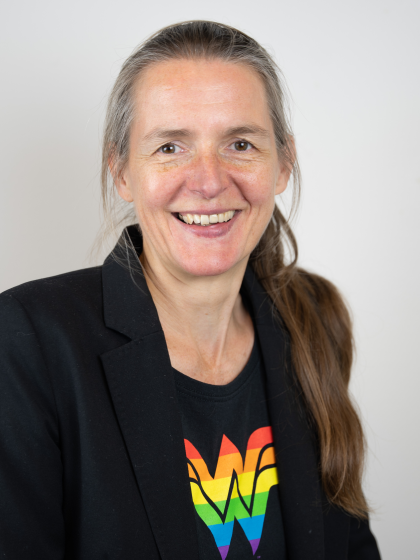
Prof. Bettina van Hoven holds the Aletta Jacobs Chair in 'Place, Social Change and Collaborative Research for Wellbeing and Justice' at University College Groningen (University of Groningen). She earned her PhD in 1999 from the University of Plymouth with research on post-socialist rural societies in Germany. Her work focuses on participatory methodologies addressing marginalized groups' spatial experiences, including disability, aging, migration, and environmental challenges. She advocates 'slow science' emphasizing ethical collaboration and community co-creation. Education: PhD (University of Plymouth, 1999), studies in Biology and Physical Geography (University of Osnabrück and Plymouth). Research: Integrates visual methods, community partnerships, and arts-based dissemination to produce inclusive knowledge. Key themes include urban wellbeing, disability inclusion, and participatory resilience-building. Teaching: Project-based learning focused on bridging theory and real-world challenges. Advising: Supervised 9 PhD students since 2013, including works on climate action, Syrian refugee masculinities, and aging-in-place. Labs/Teams: Leads the Aletta Jacobs Chair research group, collaborating with organizations like 'This Abled City' to improve urban accessibility. Serves on editorial boards for Emotion, Space and Society and Journal for Undergraduate Ethnography .
Holly J. Nibert is an Associate Professor of Hispanic Linguistics and Director of the Spanish Language Program in the Department of Spanish and Portuguese at The Ohio State University. Her research focuses on second language acquisition (SLA) of Spanish phonology and phonetics within the revised Speech Learning Model (SLM-r). She also emphasizes principles of teaching Spanish as a second language, instructor training, and language program administration. Education: Ph.D. in Spanish Linguistics, University of Illinois at Urbana-Champaign (2000) M.A. in Spanish Linguistics, University of Illinois at Urbana-Champaign (1991) B.A. in Spanish, University of Illinois at Urbana-Champaign (1989) Research interests span Spanish phonetics/phonology SLA, pedagogical techniques, and leadership in language program administration. Her recent work examines applying leadership studies to program direction. She co-authored two Spanish textbooks: ¡Arriba! and Día a día . Key awards include the 2013 WMU Distinguished Teaching Award and multiple teaching accolades as a graduate TA. Her work bridges theoretical SLA research with practical classroom applications, including curriculum design and international teaching assistant training. Her contributions to the field include advancing techniques for SLA of segmental and prosodic features, as well as leadership strategies for language programs. She previously directed Western Michigan University's First-Year Spanish Program for 15 years before joining OSU in 2014.
Peter Bearman serves as Director of the Incite Institute and holds the Jonathan R. Cole Professorship of Sociology at Columbia University, where he maintains an active research and teaching profile within the Department of Sociology. His office is located at Knox Hall on Columbia's Morningside Heights campus. Bearman specializes in social network analysis and historical sociology, with significant contributions to health/population studies and qualitative methodology. His research increasingly integrates computational approaches for text and narrative analysis, examining phenomena ranging from historical religious discourse to modern social conflict dynamics. This interdisciplinary work bridges classical sociological theory with contemporary methodological innovation. Recent publications reveal a trajectory toward computational social science applications, particularly in semantic network analysis of historical texts and neural correlates of social behavior. His work consistently connects micro-level interactions with macro-scale social structures across diverse contexts including religious history, workplace conflict, and collective violence. His distinguished scientific honors include: Kohli Prize for Sociology (2025) for contributions to movements, networks, health, and science Golden Goose Award (2016) for the National Longitudinal Study of Adolescent Health Election to the National Academy of Medicine (2019) Membership in the American Academy of Arts and Sciences Membership in the National Academy of Sciences Bearman co-designed the landmark National Longitudinal Study of Adolescent Health, demonstrating sustained leadership in major federally-funded research initiatives. As Director of the Incite Institute, he oversees interdisciplinary research teams and co-edits Columbia University Press's Middle Range and Oral History book series, actively shaping scholarly discourse through mentorship and publication curation. The Incite Institute functions as Bearman's primary research hub, facilitating collaborations that advance innovative methodologies in social science while connecting historical analysis with contemporary network theory applications.
Professor Michael Davies is Professor of Building Physics and the Environment at the UCL Institute for Environmental Design and Engineering (IEDE) within The Bartlett School of Environment, Energy & Resources at University College London. He is also a member of the UK Climate Change Committee. With over two decades of academic experience, Professor Davies leads research at the critical intersection of building physics, environmental design, and public health, focusing on how the built environment impacts human well-being. His educational background includes: Doctor of Philosophy from the University of Westminster (1994) Postgraduate Certificate in Education from the University of York (1990) Bachelor of Science from the University of Manchester (1986) Professor Davies has pioneered transdisciplinary research methods, particularly in modeling health impacts and applying system dynamics approaches to address urban health challenges. His work demonstrates how healthy sustainable development can be achieved through innovative stakeholder participation and methodological advancements. His research spans building physics, climate change adaptation, indoor environmental quality, and the health implications of urban design, with particular attention to vulnerable populations and environmental justice considerations. His extensive publication record (over 300 outputs) reveals a consistent evolution toward more integrated approaches that connect building science with public health and climate policy. Recent work shows growing emphasis on health equity in climate adaptation, advanced modeling of complex urban systems, and the application of system dynamics to understand interconnected challenges in housing and urban environments. His research bridges technical building performance analysis with broader policy implications, reflecting his commitment to solutions that address both environmental sustainability and social equity. Professor Davies has secured significant research funding, including the prestigious EPSRC Platform Grant funding the Complex Built Environment Systems group at UCL (awarded only to "world leading" centers) and the Wellcome Trust-funded 'CUSSH' project. In total, he has served as PI or Co-I on approximately 50 research projects, demonstrating exceptional ability to lead large-scale, transdisciplinary research initiatives addressing critical urban challenges. As an educator, Professor Davies leads the 'Energy Context' module in the Environmental Design and Engineering MSc course and supervises EngD and PhD students. His teaching emphasizes the integration of energy systems within broader environmental, social, and policy contexts, preparing students to address complex sustainability challenges in the built environment sector.
Jessica Ringrose is a Professor of Sociology of Gender and Education at the UCL Institute of Education (IOE), part of University College London's Faculty of Education and Society. She co-directs the UCL Centre for Sociology of Education and Equity and leads the global Phematerialism.org network, focusing on feminist posthumanism and new materialism in education. Her research centers on gender equity, digital media's impact on youth, and technologically facilitated sexual violence. Notable projects include the Mayor of London’s 'Women We See' initiative, which addressed advertising diversity, and studies on cyberflashing influencing the UK Online Safety Bill. She has also explored youth experiences of online harassment during the pandemic. Ringrose holds a PhD from York University (Canada) and has advised UK governmental bodies, educational institutions, and NGOs on gender and digital safety. Her awards include the 2020 AERA Gender Equity Award. She advocates for inclusive education policies, digital literacy, and feminist methodologies to combat gender-based violence. Education: PhD in Sociology from York University, Canada Key Projects: Online Safety Bill advocacy (cyberflashing criminalization) 'Women We See' advertising diversity campaign AHRC-funded 'Postdigital Intimacies' research network Public Engagement: Regular media contributions to BBC, The New York Times, and The Guardian. Her work bridges academia and activism, emphasizing intersectional approaches to gender, sexuality, and digital justice.
Dr. Yiran Chen is the John Cocke Distinguished Professor at Duke University's Department of Electrical and Computer Engineering, leading the NSF AI Institute for Edge Computing (Athena) and the Duke Center for Computational Evolutionary Intelligence (DCEI). A global leader in neuromorphic computing, emerging memory systems, and edge AI, he holds prestigious roles including IEEE Fellow and Editor-in-Chief of IEEE Transactions on Circuits and Systems for AI. His research spans machine learning accelerators, security-hardened hardware, and co-design of EDA tools with LLMs. With over 700 publications and 96 patents, he has been awarded 15 paper awards and 17 nominations, including rare Technical Achievement Awards from IEEE societies. He advises over 60 PhD students and 4 postdocs, many of whom hold academic positions worldwide. His work bridges academia and industry, contributing to startups and venture capital through his board roles. Education: B.S. (Tsinghua, 1998) → M.S. (Tsinghua, 2001) → Ph.D. (Purdue, 2005). Career path: Assistant/Associate Professor at University of Pittsburgh (2010–2014) → Duke since 2014. Awards include the ACM SIGDA Outstanding New Faculty Award (2014), NSF CAREER Award (2013), and the Stansell Family Distinguished Research Award (2022). Research focuses on innovations in: (1) Non-volatile memory architectures for AI acceleration, (2) Hardware-software co-design for edge computing, (3) Security in neuromorphic systems, and (4) Large-scale ML for EDA. His group pioneered ReRAM-based accelerators like ReBNN and MARC, and introduced novel edge AI frameworks like Ecco and Prosperity. These works address scalability, energy efficiency, and real-time performance challenges. Key initiatives include the NSF IUCRC for Alternative Sustainable & Intelligent Computing (ASIC), advancing sustainable computing through novel materials and architectures. His leadership in standard-setting bodies like the IEEE Circuits and Systems Society ensures cutting-edge research translates into industry practices. Grants: Lead PIs for multiple NSF AI Institutes and industry partnerships. Labs: Directs the Athena Institute and DCEI, fostering collaboration between academia and industry. Current projects include quantum computing placement algorithms (QPlacer), federated learning frameworks (FedGPT), and neuro-symbolic architectures.
Daniel Powell is a Senior Lecturer in Health Psychology and Programme Director of the MSc Health Psychology at the University of Aberdeen, School of Medicine, Medical Sciences and Nutrition. He is a core member of the Aberdeen Health Psychology Group and the interdisciplinary Centre for Labour Market Research. He holds a PhD from the University of Southampton and became a Fellow of the Higher Education Academy in 2019. His educational background includes: BSc (Hons) Psychology – University of the West of England, 2007 MSc Health Psychology – University of Southampton, 2009 PhD Psychology – University of Southampton, 2014 Daniel's research focuses on health psychology, particularly using intensive longitudinal methods such as ecological momentary assessment (EMA) to study stress, fatigue, self-regulation, and decision-making in real-world contexts. His work spans chronic illness (e.g., multiple sclerosis, diabetes), healthcare professionals (e.g., doctors, nurses), and occupational settings (e.g., fly-in fly-out workers). He leads the Stress and Health Research Theme and convenes regular workshops to support health psychology researchers. His methodological expertise includes real-time data collection, psychophysiology (e.g., heart rate variability, cortisol), and interdisciplinary collaboration with health economics, primary care, and bioengineering. His recent publications (2024–2025) reveal a strong trend in investigating decision fatigue in healthcare, stress and recovery patterns in medical professionals using biometric monitoring, and the psychosocial impact of shift and rotation work. He frequently employs EMA and systematic reviews to explore behavioral patterns in context. His work also extends to sustainable clinical research and digital health tools for pandemic response. His scientific recognition includes: Stan Maes Early Career Award, European Health Psychology Society (2019) Rosemary Anne Price Student Award, MS Society (2013) Daniel actively supervises five PhD students on topics including decision fatigue in healthcare, quality of life after limb loss, stress in medical and dental students, and low-carbon clinical trials. He teaches across postgraduate programs, coordinates the PU5053 course on Stress, Personality & Health, and co-founded an annual Summer School in Intensive Longitudinal Methods. He has no indication of part-time status and is actively engaged in research, teaching, and leadership. He is affiliated with several professional organizations, including the British Psychological Society (Chartered Psychologist), Division of Health Psychology, European Health Psychology Society, and UK Society for Behavioural Medicine. His research lab is embedded within the Aberdeen Health Psychology Group, which fosters interdisciplinary collaboration and methodological innovation in health behavior research.
Professor Susan Jebb is a leading academic in diet and population health at the University of Oxford, holding dual roles as Professor of Diet and Population Health in the Nuffield Department of Primary Care Health Sciences and Senior Research Fellow at Jesus College. She chairs the Food Standards Agency and has held influential advisory roles including the UK Government’s Foresight Report on Obesity and Public Health England’s Obesity Review Group. Her research focuses on dietary interventions for obesity prevention, behavioral change strategies in primary care, and translating scientific evidence into public health policy. Education: BSc (University of Surrey, 1986) and PhD (University of Cambridge, 1990). Early career included roles at the MRC Dunn Nutrition Unit and MRC Human Nutrition Research before moving to Oxford in 2013. Research Interests: Behavioral interventions for weight management, policy impacts on dietary behavior, and obesity-related chronic diseases. Her group conducts randomized controlled trials to improve healthcare practices and public health strategies. Notable contributions include developing school food standards and shaping hospital food policies. Awards: Awarded OBE (2008) for services to public health. Teaching and Advising: Co-leads the nutrition module in the MSc in Global Health Sciences. Supervises DPhil students in primary care and population health. Leads large-scale trials such as the NHS Diabetes Remission Programme. Public Engagement: Active in media (e.g., BBC documentaries) and collaborates with public panels to co-design research studies.
Stefan Riezler is a full professor of Statistical Natural Language Processing at Heidelberg University's Department of Computational Linguistics (since 2010), affiliated with the Faculty of Mathematics and Computer Science. Prior to this, he worked in Silicon Valley at Xerox PARC and Google Research. He holds a PhD in Computational Linguistics from the University of Tübingen (1998) and conducted postdoctoral research at Brown University (1999). His research spans machine learning, NLP, and medical informatics, focusing on interactive statistical learning. He co-leads the Interdisciplinary Center for Scientific Computing (IWR) and serves on the editorial boards of Computational Linguistics and Transactions of the Association for Computational Linguistics . Key research areas include neural machine translation, healthcare AI (e.g., sepsis prediction), data augmentation, and reproducibility in ML. He develops tools like JoeyNMT and explores ethical challenges in clinical machine learning. Notable recent work includes advancements in time series analysis, multimodal interfaces (e.g., NLMaps for OpenStreetMap), and ethical frameworks addressing validity in healthcare ML. His publications emphasize practical applications of NLP in healthcare, speech translation, and cross-lingual systems. Grants and collaborations include interdisciplinary projects on medical data science and training next-gen NLP researchers. He actively contributes to open-source toolkits and reproducible research practices.
William A Pasmore is a Professor of Practice in the Social-Organizational Psychology Department at Teachers College, Columbia University. With a unique background spanning academia and consulting, he focuses on complex organizational change, digital transformation, and leadership development. His work bridges theoretical rigor with practical application through roles at the Center for Creative Leadership, Oliver Wyman Delta consulting, and his own firm, Pasmore Advisors. Education: Ph.D. in Administrative Sciences (Purdue University, 1976), B.S. in Aeronautical Engineering/Industrial Management (Purdue University, 1973) His research spans organizational change, digital transformation, and future organizational models, with recent publications emphasizing networked organizations and continuous change frameworks. Collaborative action research and board effectiveness are recurring themes in his work with global corporations. Scientific Awards: European HRM association's HR Influential Thinker recognition Academy of Management co-recipient of collaborative research award Pasmore co-founded STARLabs - a consortium with Google, Microsoft, Shell, and other Fortune 500 companies studying digital transformation. He previously served as tenured professor at Case Western Reserve University (1976-1997) and visiting professor at INSEAD and Stanford.
Jessica Fish is an Associate Professor in Family Science and Behavioral and Community Health at the University of Maryland School of Public Health. She co-directs the UMD Prevention Research Center and serves as Faculty Affiliate at the Maryland Population Research Center. Her research examines LGBTQ+ health equity with focus on substance use, mental health, and family systems. Dr. Fish's work identifies modifiable factors contributing to health disparities to inform prevention strategies and policies. She holds a Ph.D. in Family and Child Sciences from Florida State University and will accept PhD advisees starting 2025-2026.
Dr. P.J. White is a Senior Lecturer and Research Director at the Department of Humanities and designCORE at South East Technological University (SETU). He also holds adjunct roles at McMaster University (Adjunct Full Professor) and the McMaster Institute for Research on Aging, Canada. His expertise lies in Product and Service Design, with a focus on Aging, Co-Design, and Interdisciplinary Research. Education: PhD in Product Design (Maynooth University, 2012), National Diploma in Industrial Design (2002), and a Bachelor’s in Industrial Design (2002). Research interests include aging-related design, participatory design methodologies, and addressing the digital divide in aging populations. Key projects involve health services co-design (HSE), dementia standards development (NSAI), and global collaborations in Uganda and Mozambique. Notable awards include the Gerontological Society of America David A. Peterson Award (2020) and design accolades from the Institute of Designers Ireland (2002, 2015). He supervises PhD students and has led funded projects like the SFI-supported labor market digital tools initiative. As SETU’s representative in Carlow’s Age Friendly Alliance, he bridges academia and policy. His work spans 53 publications, including high-impact journal articles and conference contributions.
Patrick Emmenegger is a Professor of Comparative Political Economy and Public Policy at the University of St. Gallen's School of Economics and Political Science (SEPS-HSG). He chairs the PhD Program in International Affairs and Political Economy and serves on the Executive Committee of the Council for European Studies. His research focuses on direct democracy, electoral systems, vocational education policy, and the political economy of skill formation. He has held roles in federal vocational education commissions and served as editor of the Socio-Economic Review. His academic interests include the interplay between economic policy and political institutions, particularly in Switzerland and Europe. Recent work examines voter behavior in direct democratic contexts, electoral district design, and the adaptation of skill formation systems to the knowledge economy. He co-authored a forthcoming book on electoral system reforms and contributed to policy reports on industrial policy and education reforms. Key research outputs include analyses of higher education as industrial policy, municipality-level voting patterns in Switzerland, and partisan strategies in electoral districting. His work bridges comparative political economy with methodological rigor, addressing topics like taxation politics, labor market governance, and the impact of war on state capacity. Advising and grants include leadership of the PhD program and contributions to federal education policy initiatives. His research team explores themes such as gender segregation in occupations and the role of skill requirements in labor markets. He maintains strong links with European policy networks through his involvement in the Council for European Studies.
Karrie A. Shogren is the Ross and Marianna Beach Distinguished Professor at the University of Kansas. Her work focuses on self-determination for individuals with intellectual and developmental disabilities, emphasizing educational outcomes, policy, and inclusive practices. She holds a Ph.D. in Disability and Education from KU, an M.A. in Psychology from the University of Dayton, and a B.S. in Psychology from The Ohio State University (summa cum laude). Her research spans self-determination interventions, special education policy, and the intersection of disability and citizenship. Key areas include improving IEP goal attainment, evaluating technology-delivered interventions, and co-designing inclusive environments with disability communities. She advocates for supported decision-making alternatives to guardianship and has published extensively on measurement tools for self-determination. Dr. Shogren’s awards include the distinguished professorship, recognizing her contributions to advancing equity in education for marginalized groups. She collaborates internationally, adapting interventions across cultural contexts while prioritizing anti-racism and anti-ableism in transition services. Her work intersects with museum accessibility, telehealth mindfulness programs for adolescents with disabilities, and policy reforms to reduce educational segregation. She emphasizes practitioner partnerships, developing teacher coaching models to implement self-determination practices in inclusive classrooms.
Professor Mehmet Demirbag serves as Deputy Dean of Essex Business School and Professor of International Business at the University of Essex. Previously, he held significant leadership roles including Vice Dean (Internationalisation) and Head of Department of Strategy and Organisation at Strathclyde Business School, and Chair in International Business at the University of Sheffield Management School. His extensive academic career spans over a decade in UK higher education institutions with specialized expertise in international business strategy. Dr. Demirbag completed his Master's degree in Business Analysis at the University of Leicester and earned his PhD at the University of Bradford Management School. His educational background established the foundation for his research focus on international business phenomena, particularly regarding emerging economies and multinational enterprises. His research interests center around internationalisation of R&D activities, offshore R&D, FDI location choice, product and regional diversification strategies of MNEs, multinationals from emerging countries, international mergers and acquisitions, and reverse knowledge transfer by emerging country MNEs. These interconnected research streams examine how firms navigate global markets, particularly focusing on the strategic behavior of emerging market multinationals and their interactions with developed economies. Analysis of his recent publications reveals consistent thematic patterns across international business, strategic management, and human resource management domains. His work demonstrates particular emphasis on emerging market multinationals, cross-border knowledge transfer mechanisms, international strategic decision-making in uncertain environments, and the institutional contexts shaping multinational enterprise behavior. The interdisciplinary nature of his research bridges theoretical frameworks from international business, strategic management, and organizational studies. Professor Demirbag maintains active editorial roles as consulting editor of the Journal of International Management and advisory editor of Eurasian Business Review. He has co-guest edited special issues for numerous prestigious journals including British Journal of Management, Human Resource Management, Journal of World Business, and International Business Review, among others. His editorial contributions span research areas related to emerging market MNEs, MNEs in emerging markets, transitional periphery contexts, and human resource management in uncertain environments. As an educator, Professor Demirbag teaches International Business and International Strategic Management at undergraduate, postgraduate, and executive levels. His supervision portfolio includes doctoral candidates such as Selman Alisan Gemuhluoglu and previously guided Koushik Das Sarma to completion of their PhD in Business Administration. His research has received funding from various sources including the European Commission, and his work on FDI and SMEs has contributed to REF impact cases at both the University of Bradford and the University of Sheffield.