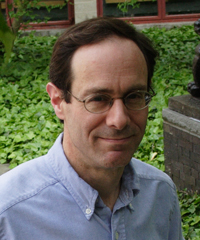
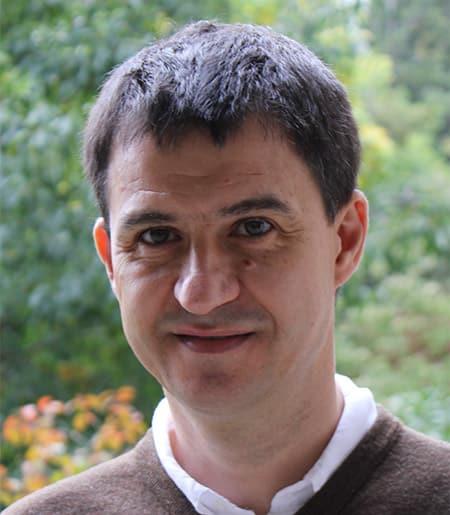
Renjie Feng is a Research Fellow in Mathematics and AI at the School of Mathematics and Statistics and the Sydney Mathematical Research Institute , University of Sydney. His work bridges probability theory, statistics, and applications in machine learning, deep learning, and artificial intelligence. His research interests focus on probability theory and its applications to machine learning , random matrix theory , and statistical physics . He investigates extreme value problems, spectral properties of random matrices, and topological features of random fields over Riemannian manifolds. Recent publications highlight trends in random matrix theory (GUE, GOE, GSE), extreme gap problems , determinantal point processes , and Wiener chaos . Collaborative works with F. Götze, D. Yao, and R. Adler emphasize U-statistics , multivariate linear statistics , and random topology inspired by Poisson point process studies.
Harvey Reall is a Professor of Theoretical Physics at the University of Cambridge , affiliated with the Department of Applied Mathematics and Theoretical Physics (DAMTP) and a Fellow of Trinity College . His research focuses on General Relativity and Effective Field Theory , particularly in the context of black hole mechanics , higher-dimensional gravity , and cosmic censorship . He has held prestigious positions including a Royal Society University Research Fellowship from 2005 to 2013. Education: PhD from DAMTP, University of Cambridge. Previous Appointments: Lecturer at the University of Nottingham (2005-2007); Postdoctoral positions at the Kavli Institute (2003-2005), Queen Mary University of London (2000-2003), and University of California, Santa Barbara (2003-2005). Reall's work explores the uniqueness and stability of black holes , causality in gravitational theories , and effective field theory approaches to gravity . His recent publications address nonperturbative second law formulations , event horizon dynamics , and axisymmetry theorems in extended theories of gravity. He has supervised numerous researchers including Aidan McSharry (2025-) , Maxime Gadioux (2022-) , and Iain Davies (2020-24) , contributing to the training of the next generation of physicists. Scientific Awards: Royal Society University Research Fellow (2005-2013)
Tzu-Mao Li is an Assistant Professor in the Department of Computer Science and Engineering (CSE) at the University of California, San Diego (UCSD), affiliated with the Center for Visual Computing. His research focuses on differentiable graphics algorithms, combining classical visual computing with modern machine learning techniques. He holds a Ph.D. from MIT CSAIL under Frédo Durand and a postdoc at MIT and UC Berkeley with Jonathan Ragan-Kelley. His work spans rendering, programming languages for graphics, Monte Carlo methods, and inverse problems. Education: B.S. and M.S. from National Taiwan University (2011-2013), advised by Yung-Yu Chuang. Ph.D. from MIT CSAIL (Computer Graphics Group), advised by Frédo Durand. Postdoctoral research at MIT and UC Berkeley with Jonathan Ragan-Kelley. Research Interests: Differentiable rendering, Monte Carlo integration, programming language design for visual computing, physical simulation, adversarial machine learning, and applications in computer vision and robotics. Key areas include rendering algorithms (path tracing, bidirectional methods), optimization techniques (MCMC, gradient-based), and neural representations (SDFs, neural fields). Publications focus on advancing rendering algorithms, differentiable systems, and applications in inverse problems. Notable contributions include edge sampling for differentiable rendering, warped-area sampling, and diffusion models for BSDF sampling. Awards: ACM SIGGRAPH 2020 Outstanding Doctoral Dissertation Award, multiple Best Paper Awards at SIGGRAPH, and oral presentations at ICCV. Teaching: Courses include CSE 167 (Computer Graphics), CSE 168 (Rendering), and CSE 272 (Advanced Image Synthesis), emphasizing physically-based methods and programming.
Brent Pym is an Associate Professor in the Department of Mathematics and Statistics at McGill University. His research focuses on the intersection of differential, algebraic, and noncommutative geometry, with a particular emphasis on Poisson varieties and deformation quantization. He has held academic positions at the University of Edinburgh, University of Oxford, and was a Postdoctoral Fellow at McGill and the University of Toronto. Education: BScE in Engineering Physics, Queen's University (2007) MSc in Mathematics, University of Toronto (2008) PhD in Mathematics, University of Toronto (2013) Research Interests: Pym studies Poisson structures, their quantizations, and connections to mathematical physics. His work involves classical/derived algebraic geometry, D-modules, moduli spaces, the Stokes phenomenon, and multiple zeta values. Recent projects include holonomic Poisson manifolds, log symplectic structures, and software for symbolic calculations in deformation quantization. Awards: Lichnerowicz Prize (2018) Advising & Grants: Pym has openings for graduate students (admission 2026) and undergraduate projects (2026–27). He develops the Star Products software package for symbolic calculations in Poisson brackets and quantization. His work is supported by research collaborations and institutional grants. Labs & Teams: Pym collaborates with researchers in geometry and mathematical physics, contributing to projects in noncommutative algebra and geometric quantization. His software tools enhance symbolic computation in these fields.
Ali Feizmohammadi is an Assistant Professor, Teaching Stream (LTA) in the Department of Mathematics at the University of Toronto Mississauga, affiliated with the Mathematical and Computational Sciences division. His research focuses on inverse problems, partial differential equations, and geometric analysis. He holds a position emphasizing teaching excellence within the university's framework. His work addresses advanced mathematical challenges such as coefficient identification in subdiffusion equations, fractional Laplacian problems on Riemannian manifolds, and nonlinear elliptic equations on manifolds. Recent articles highlight contributions to the Calderón problem in various contexts, wave equation control, and spacetime finite element methods. No scientific awards or grants are explicitly listed in the provided information. He has not yet listed advisees in the available data. His research trends emphasize rigorous mathematical analysis of inverse problems in both classical and fractional PDE frameworks, with applications to geometric and control-theoretic questions. Dr. Feizmohammadi's work spans theoretical advancements in inverse problems, numerical methods for control systems, and the interplay between differential geometry and PDEs. His contributions address both fundamental theory and applied methodologies in mathematical physics and engineering.
James Sparks is a Professor of Mathematical Physics at the Mathematical Institute of the University of Oxford and a Fellow of Oriel College. He works at the intersection of mathematical physics, theoretical physics, and geometry, with a focus on supersymmetric field theories, supergravity, and the AdS/CFT correspondence. His research explores geometric structures in string theory, including special holonomy manifolds, Sasaki-Einstein manifolds, and generalized geometry. Education: MA and PhD from the University of Cambridge Current Role: Head of the Department of Mathematical Physics Contact: Mathematical Institute, University of Oxford, Andrew Wiles Building, Radcliffe Observatory Quarter, Woodstock Road, Oxford, OX2 6GG Sparks' research interests center on the interplay between quantum field theory, supergravity, and differential geometry. He investigates localization techniques in supersymmetric theories, holographic dualities, and geometric constructions relevant to string theory. His work often bridges mathematical rigor with physical insights from the AdS/CFT correspondence. His recent publications highlight advancements in supergravity localization, black hole thermodynamics, and equivariant cohomology in AdS/CFT. Articles span topics like toric gravitational instantons, matrix models from black hole geometries, and geometric duals of extremization principles in holography. These contributions reflect his focus on connecting geometric methods to physical phenomena in high-energy theory. In teaching, Sparks has lectured on quantum theory, electromagnetism, classical mechanics, and dynamics. He maintains an active research profile with collaborations on topics such as spinning spindles, squashed spheres, and brane tilings. His work continues to shape understanding of geometric structures in theoretical physics and their dual gravitational descriptions.
Alfonso Giuseppe Tortorella is a Tenure Track Assistant Professor in the Department of Mathematics at the University of Salerno since October 31, 2022. Previously, he held research positions at CMUC (Center of Mathematics of the University of Coimbra), CMUP (Center of Mathematics of the University of Porto), and KU Leuven. He received his PhD in Mathematics from the University of Florence in 2017 under the supervision of Luca Vitagliano and Paolo de Bartolomeis. His educational background includes an MSc in Mathematics from the University of Salerno (2013) with honors, where he completed his thesis titled "Geometric methods of Hamiltonian mechanics" under Luca Vitagliano's guidance. Tortorella's research focuses on Poisson geometry in the broadest sense, with particular emphasis on deformation theory of coisotropic submanifolds in Jacobi manifolds, multiplicative structures on Lie groupoids, and VB-groupoids. His work explores the intersection of differential geometry, mathematical physics, and algebraic structures, developing sophisticated theoretical frameworks to understand geometric structures and their deformations. He has made significant contributions to understanding symplectic foliations, contact dual pairs, and the algebraic structures underlying Jacobi geometry. His most recent publications (2023-2025) demonstrate a consistent focus on deformation problems in Poisson and related geometries, with particular attention to coisotropic submanifolds in contact geometry, symplectic foliations, and the application of L∞ algebras to geometric deformation problems. His work shows increasing sophistication in handling higher structures and their applications to geometric problems. Abilitazione Scientifica Nazionale for Professore Associato in Geometria e Algebra (01/A2 - II Fascia) (May 24, 2021 - May 24, 2030) Qualification aux fonctions de Maître de conférences, section 25 - Mathématiques (December 31, 2018 - December 31, 2022) PhD internship at IM PAN awarded by WCMCS (December 2014) PhD scholarship from INdAM (October 2013) Scholarship from SMI (June 2013) Tortorella has advised multiple PhD, MSc, and BSc students, including Vanessa Oliveira (PhD, University of Porto), Antonio Maglio (PhD, University of Salerno), and Rodrigo de Oliveira Baptista (MSc, University of Porto). He has served on examination committees and as a reviewer for numerous prestigious mathematics journals. His collaborative work extends across international boundaries, with research stays at institutions in Italy, Portugal, Belgium, Poland, France, Germany, and Brazil. He is an active organizer of conferences and workshops, particularly in the field of Poisson geometry, serving on the organizing committees for events like Poisson 2024 and the INdAM Intensive Period on Poisson Geometry & Mathematical Physics.
John F. Canny is the Paul and Stacy Jacobs Distinguished Professor of Engineering at the University of California, Berkeley, in the Department of Electrical Engineering and Computer Science (EECS). He joined the faculty in 1987 and is affiliated with the Berkeley Artificial Intelligence Research Lab (BAIR), Berkeley Center for New Media (BCNM), and other research institutes. His research focuses on artificial intelligence, robotics, human-computer interaction, and computational geometry. Canny is renowned for developing the Canny edge detector and contributions to motion planning, privacy-preserving algorithms, and real-time simulation. Education: B.Sc. in Computer Science and Theoretical Physics (Adelaide University, 1979), B.E. (Hons) in Electrical Engineering (Adelaide University, 1980), M.S. and Ph.D. in Electrical Engineering (MIT, 1983 and 1987). Research Interests: His work spans AI, robotics (including universal planar manipulation), HCI (e.g., MultiView video conferencing), and security (privacy in collaborative filtering). He has pioneered algorithms for edge detection, non-linear FEM simulation, and computational algebra. Awards: ACM Fellow (2020), Okawa Research Grant (2003), AAAI Classic Paper Award (2002), NSF PYI (1989), Packard Fellowship (1988), and ACM Doctoral Dissertation Award (1987). Advising & Grants: Advised over 30 Ph.D. students, many of whom hold prominent roles in academia and industry. His grants include NSF and Packard funding for foundational research in robotics and computational methods. He currently teaches CS188: Introduction to Artificial Intelligence. Labs/Teams: Leads research at the Berkeley Institute of Design (BiD), focusing on RISC robotics, activity-based computing, and privacy-enhanced telepresence systems.
Mihalis Dafermos is a Professor of Mathematics at Princeton University, with affiliations in the Department of Physics and the Princeton Gravity Initiative. He holds dual roles as a researcher and educator in mathematical physics and partial differential equations. Education: B.A. in Mathematics (Harvard, 1997), Ph.D. in Mathematics (Princeton, 2001 under Demetrios Christodoulou). Professional History: Previous positions include Lowndean Professor of Astronomy and Geometry at the University of Cambridge (2015–present), and roles at MIT (2001–2004) and other institutions. Research: Focuses on general relativity, black hole stability, gravitational collapse, and singularities. His work combines geometric analysis with PDEs, addressing foundational questions like cosmic censorship and the formation/stability of black holes. Awards: Adams Prize (2004) Bodossaki Prize (2008) Whitehead Prize (2009) IAMP Early Career Award (2009) Fellow of the AMS (2016) Advising & Grants: Advisor to 16 Ph.D. students. Secured grants from NSF, ERC, and others, including NSF DMS-2005464 (2020–2024) and EPSRC Programme Grant (with A. Neves et al., 2013–2019). Labs/Teams: Member of the Princeton Gravity Initiative and editorial boards of journals like Annales Henri Poincaré and Classical and Quantum Gravity .
David Jerison is a Professor of Mathematics at the Massachusetts Institute of Technology (MIT), where he conducts research in Fourier analysis and partial differential equations. His work focuses primarily on free boundary problems and, more recently, on internal Diffusion Limited Aggregation (internal DLA), a stochastic growth model. He maintains an active research program with numerous publications in leading mathematical journals. Professor Jerison's research spans several interconnected areas of mathematical analysis. His primary interests include Fourier analysis and partial differential equations, with particular emphasis on free boundary problems. In recent years, he has expanded his research to include internal Diffusion Limited Aggregation, a stochastic growth model that has connections to probability theory and mathematical physics. His work often bridges geometric analysis, spectral theory, and probabilistic methods, demonstrating the deep connections between different branches of mathematics. Analysis of Professor Jerison's recent publications reveals a consistent focus on geometric aspects of partial differential equations, particularly free boundary problems. His research shows progression from classical PDE theory toward more stochastic and probabilistic approaches, as evidenced by his work on internal DLA. The publications demonstrate interdisciplinary connections between mathematical analysis, probability theory, and mathematical physics, with applications ranging from geometric measure theory to quantum mechanics. Professor Jerison is actively involved in teaching and mentoring at MIT. He has taught courses including Differential Equations (18.03), Fourier Analysis and Applications (18.103), and Differential Analysis (18.155). He also directs the Summer Program for Undergraduate Research (SPUR), which is exclusively for MIT undergraduates, and organizes the mathematics section of the Research Science Institute (RSI) for high school students. His teaching materials are available through MIT's Open Courseware platform, indicating his commitment to educational outreach and accessibility.
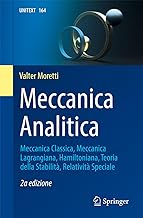
Valter Moretti is a Full Professor in the Department of Mathematics at the University of Trento. His academic career spans roles from Research Fellow to Full Professor, focusing on Mathematical Physics and Quantum Field Theory (QFT) in curved spacetime. He earned an MSc in Physics from Genova University and a PhD in Theoretical Physics from Trento University. Research Interests : Algebraic QFT, General Relativity, Quantum Mechanics, Operator Algebras, and Spectral Theory. His work bridges mathematical rigor with physical applications, particularly in quantum localization, entanglement, and curved spacetime phenomena. Publications : Authored 15+ recent papers on topics like quantum particle localization, entanglement certification, and QFT on curved backgrounds. Collaborated on a 2022 patent for generating entangled photon states. Awards : Holds a patent for a quantum-certified random number generator (2022). Supervision : Advised 8 PhD students, including N. Pinamonti, L. Franceschini, and C. van de Ven. Coordinated national and international research projects (e.g., H2020-MSCA-COFUND-2015). Labs & Collaborations : Affiliated with INFN, TIFPA-INFN, and Q@TN (Quantum@Trento). Organized conferences like Quantum Physics and Geometry (2014) and Quantum Machine Learning (2023). Teaching : Lectures on Analytical Mechanics, Quantum Relativistic Theories, and Special Relativity. Authored textbooks on Spectral Theory and Quantum Mechanics.
Professor Gary Gibbons is a distinguished academic at the University of Cambridge, holding the position of Professor of Theoretical Physics within the Department of Applied Mathematics and Theoretical Physics (DAMTP), part of the Faculty of Mathematics. His research focuses on general relativity, quantum gravity, cosmology, and black hole physics. He is a core member of the Relativity and Gravitation Group, known for contributions to gravitational wave theory, black hole thermodynamics, and geometric methods in physics. His work intersects with areas such as the memory effect of gravitational waves, Carroll symmetry, and the mathematical structure of spacetime. Prof. Gibbons collaborates internationally, publishing extensively in top journals like Physical Review D and Classical and Quantum Gravity . His research also extends to applied mathematics, including studies on abrasion processes and shape evolution in geosciences. He maintains an active role in theoretical physics, advising graduate students and contributing to the academic community through lectures and seminars.
Georgios Dimitroglou Rizell is a Senior Lecturer in the Department of Mathematics at Uppsala University, Sweden, where he also serves as Head of the Department since 2020. His academic work is centered at the Ångström Laboratory, where he conducts research in symplectic and contact topology. He maintains dual affiliations with both the Department of Mathematics and the Center for Geometry and Physics at Uppsala University. Dr. Dimitroglou Rizell earned his PhD from Uppsala University in 2012 under the supervision of Tobias Ekholm. Following his doctoral studies, he held postdoctoral positions at the Université Libre de Bruxelles (2012-2013), Université Paris-Sud (2013-2014), and the University of Cambridge (2014-2015), all supported by prestigious fellowships from the Knut & Alice Wallenberg Foundation. He returned to Uppsala University as a researcher (2015-2017) and Assistant Lecturer (2017-2021) before being promoted to Senior Lecturer in 2021. His research primarily focuses on symplectic and contact topology, with special emphasis on understanding and classifying Lagrangian and Legendrian submanifolds. His work employs advanced mathematical techniques including pseudoholomorphic curves, pseudoholomorphic foliations, Symplectic Field Theory, and Floer homology. His investigations span a broad range of topics within geometric topology, from the classification of Lagrangians near the Whitney immersion to the study of Legendrian submanifolds and their invariants. His research has significant implications for understanding the geometric structures underlying classical mechanics and quantum physics. His recent publications (2020-2025) demonstrate a consistent focus on Lagrangian and Legendrian submanifolds, with particular attention to their classification, invariants, and interactions with symplectic structures. A notable trend is the development of new techniques for studying C^0-limits of Legendrians, exact Lagrangians in various settings, and the geometric generation of Fukaya categories. His collaborative work with researchers like Michael Sullivan, Roman Golovko, and others has produced significant advances in Floer theory and symplectic field theory. Scientific Awards Wallenberg Scholar (2023-2028, KAW 2023.0294) Wallenberg Academy Fellow (extension 2022-2027, KAW 2021.0191) Wallenberg Scholar (2022-2023, KAW 2021.0300) Wallenberg Academy Fellow (2017-2021, KAW 2016.0198) As Head of the Department of Mathematics, Dr. Dimitroglou Rizell oversees academic programs and research initiatives. His leadership is supported by significant funding from the Knut & Alice Wallenberg Foundation, which has awarded him multiple prestigious fellowships throughout his career. These grants have enabled his research in symplectic geometry and supported collaborative projects with international mathematicians. Dr. Dimitroglou Rizell is actively involved in the Center for Geometry and Physics at Uppsala University, where he collaborates with researchers across mathematical disciplines. His work intersects with theoretical physics, particularly in areas related to geometric quantization and the mathematical foundations of quantum mechanics. He participates in seminar series and reading groups focused on symplectic topology and its applications.
Peter Schroeder is the Shaler Arthur Hanisch Professor of Computer Science and Applied and Computational Mathematics at the California Institute of Technology (Caltech). He holds a B.S. from the Technical University of Berlin (1987), M.S. from MIT (1990), M.A. and Ph.D. from Princeton University (1992–1994). His academic roles at Caltech include Assistant Professor (1995–1998), Associate Professor (1998–2001), Professor (2001–2013), and Hanisch Professor since 2013. He served as Division Deputy Chair (2012–2015) and Acting Director of the Center for Advanced Computing Research (2013–2014). Schroeder’s research focuses on numerical algorithms for computer graphics, geometric modeling, and physical simulation. His work emphasizes Discrete Differential Geometry, rebuilding classical differential geometry for computational applications. Key areas include cloth deformation, fluid dynamics, and vortex simulations. Notable contributions include 'Schrödinger’s smoke' and fluid visualization techniques using Clebsch maps. His publications span ACM Transactions on Graphics and address topics like constrained Willmore surfaces, filament-based plasma models, and shape reconstruction from metrics. He has received the ACM Fellowship and Best Paper in Geometry Processing Award. His research often bridges computational mathematics with artistic and engineering challenges, such as simulating ink chandeliers and solar flares. Schroeder’s academic leadership includes co-founding the ACM SIGGRAPH Academy and mentoring students like James R. McLaughlin and Yanke Song, both recipients of the Henry Ford II Scholar Award.
Camil Muscalu is a Professor of Mathematics at Cornell University, affiliated with the College of Arts and Sciences. His research focuses on harmonic analysis and partial differential equations, particularly exploring the interplay between Fourier series, singular integrals, and their applications in physics and number theory. He has authored influential works such as Classical and Multilinear Harmonic Analysis with Wilhelm Schlag. Education: Ph.D. in Mathematics from Brown University (2000). Research Interests: Harmonic Analysis Partial Differential Equations Fourier Analysis Operator Theory Functional Analysis Recent Articles: Highlighting contributions to multilinear operators, sparse domination techniques, and the helicoidal method, with applications to estimates for Schrödinger equations and Fourier restriction problems. Collaborations include work with Terence Tao, Christoph Thiele, and Cristina Benea. Advising: Supervised 10+ Ph.D. students, including notable alumni Eyvindur Palsson, Cristina Benea, and Itamar Oliveira. Editorial roles at Communications on Pure and Applied Analysis , Journal of Functional Analysis , and Mathematische Zeitschrift . Labs/Teams: Active in Cornell’s Analysis Seminar and Oliver Club, fostering collaborative research in harmonic analysis and related fields.