Amanda Phillips is an Associate Professor at Georgetown University, affiliated with the Departments of English, Film and Media Studies, Women’s and Gender Studies, and American Studies. Their research focuses on feminist and queer theory in digital media, with a particular emphasis on critical game studies and digital humanities. Selected publications include Gamer Trouble: Feminist Confrontations in Digital Culture and co-editing the Queer/Trans/Digital book series. Their scholarship appears in journals such as ROMchip , Feminist Media Histories , and Games and Culture . Research Interests: Digital media and gender politics Queer theory in gaming contexts Decolonial and anti-racist digital humanities Critical analysis of game mechanics Digital labor and precarity Affective histories of gaming Scientific Awards: Mellon/ACLS Dissertation Completion Fellow Academic Leadership: Former chair of the American Studies Association Digital Humanities Caucus Co-founder of the #transformDH Collective Editorial work on special issues of Game Studies and Antares: Letras e Humanidades Previous Institutions: IMMERSe Postdoctoral Fellow at University of California, Davis Ph.D. recipient from University of California, Santa Barbara with emphasis in Feminist Studies
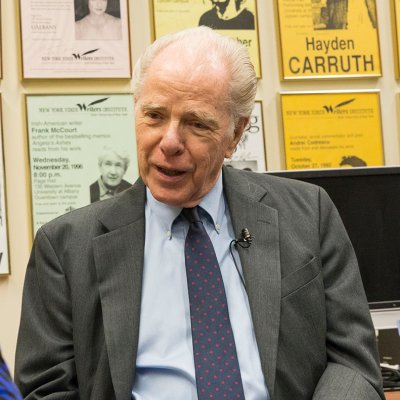
William Kennedy is a Professor in the English Department at the University at Albany, State University of New York. For over 40 years, he has crafted a body of literature centered on Albany, New York, creating what is known as the "Albany Cycle" of novels. His work has established Albany as a significant place in American literature, comparable to Joyce's Dublin and Bellow's Chicago. His educational background includes a BA from Siena College, following attendance at Public School 20 and Christian Brother's Academy. Professor Kennedy's creative work focuses on American fiction, particularly historical and urban narratives rooted in Albany's cultural and political landscape. His writing explores machine politics, family sagas, and the interplay between individual lives and historical events, rendering Albany's "outcasts and machine politicians, lowlifes and swells" with profound humanity. His narratives transform the city into a mythic capital of national memory. His publications consistently draw from Albany's history, with recurring themes of political corruption, redemption, and the resilience of marginalized communities. The "Albany Cycle" demonstrates his mastery in blending local history with universal human struggles across multiple literary forms. William Kennedy's distinguished honors include: John D. and Catherine T. MacArthur Foundation Fellowship Election to the American Academy of Arts and Letters National Endowment for the Arts Fellowship Regents Medal of Excellence from SUNY Governor's Arts Award Commander of the Order of Arts and Letters in France Election to the American Academy of Arts and Sciences As an educator, Kennedy taught creative writing and journalism at the University at Albany from 1974-1982 and Cornell University in 1982-83. His MacArthur Fellowship directly funded the creation of the New York State Writers Institute at Albany, with matching funds from the university and legislative support from Governor Cuomo. He has served on the New York State Council for the Humanities board and the Academy of Motion Picture Arts and Sciences. William Kennedy co-founded the New York State Writers Institute in 1984, which has grown into a major literary hub conducting statewide cultural and educational activities. The Institute remains central to his legacy, fostering literary arts through readings, workshops, and educational programs across New York.
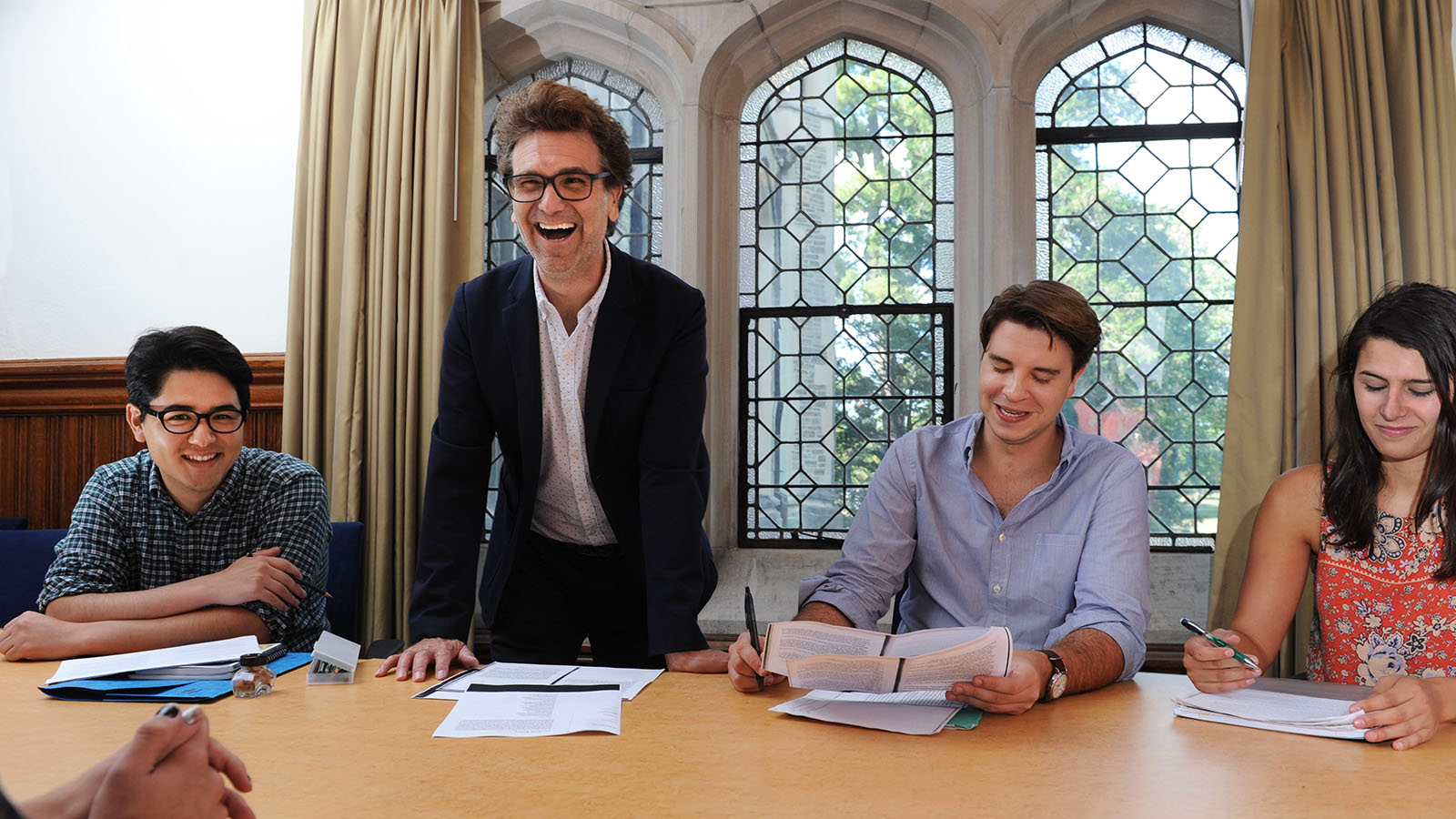
David Means is a Visiting Associate Professor of English at Vassar College, where he has taught since 2001. He holds a BA from The College of Wooster and an MFA in poetry from Columbia University. His academic work centers on creative writing, modern and contemporary fiction and poetry, and American culture. Education: BA, The College of Wooster MFA, Columbia University in the City of New York Means is a celebrated author of short fiction and novels, known for his lyrical prose, experimental narrative structures, and deep exploration of trauma, memory, and redemption. His work frequently appears in The New Yorker , Harper’s , The Paris Review , and other prestigious literary journals. His writing often returns to themes of violence, loss, and the quiet grace that emerges in their aftermath, drawing comparisons to Flannery O’Connor and Denis Johnson. His stories are marked by a nonlinear sense of time and a profound empathy for marginalized or broken characters. His recent publications include the story collection Instructions for a Funeral (2019) and Two Nurses, Smoking , with his novel Hystopia longlisted for the Man Booker Prize. His forthcoming non-fiction book, Pivot: Ruminations in the Shadow of Death , reflects on mortality and personal reflection. Selected Awards and Honors: Guggenheim Fellowship (2013) Three O. Henry Prizes Three Pushcart Prizes Los Angeles Book Prize for Fiction Finalist, National Book Critics Circle Award Finalist, Frank O’Connor International Short Story Prize Longlisted, Man Booker Prize Means has advised and influenced many emerging writers through his teaching and public readings. While specific students are not named in the sources, his role as a mentor is evident in his sustained presence in creative writing programs. He has no known research grants or lab affiliations, as his work is primarily literary and individual. He continues to publish and engage in public discourse on the nature of storytelling, including critiques of AI-generated fiction.
Professor Gabriel Brostow is a faculty member in the Department of Computer Science at University College London (UCL), where he leads research in Computer Vision and Human-Computer Interaction. He also serves as Chief Research Scientist and Senior Director of the R&D Team at Niantic, the company behind Pokémon GO. His work bridges academic research and industry applications, focusing on developing AI systems that enhance human capabilities through what he terms 'Human in the Loop AI'—now commonly referred to as Human-Centered AI. Brostow completed his BS in Electrical Engineering at UT Austin, followed by a PhD with Irfan Essa at Georgia Tech. He then pursued postdoctoral research with Roberto Cipolla's Computer Vision & Robotics Group at Cambridge University as a Marshall Sherfield Fellow, and with Marc Pollefeys in ETH Zurich's CVG Group. His research explores how AI, particularly Computer Vision, can serve as 'super-tools' for professionals across various domains including filmmaking, architecture, robotics, and scientific research. Specific interests include assistive technology for everyday life, authoring systems that maximize user effort, 3D reconstruction, depth estimation, and vision-language models. His work often involves creating systems that are validated through real-world human interaction to ensure practical utility. Analysis of his recent publications reveals a strong focus on practical applications of Computer Vision that directly interact with humans. His research spans 3D scene understanding, depth estimation, sketch-based interfaces, and multimodal AI systems. There's a clear emphasis on creating benchmarks and tools that facilitate human-AI collaboration, with applications in assistive technology, urban planning, filmmaking, and biodiversity monitoring. His work frequently appears at top conferences including CVPR, NeurIPS, ECCV, and CHI. Marshall Sherfield Fellowship Brostow actively mentors PhD students, with current advisees including Ross Murphy, Skanda Koppula, Gizem Unlu, Omiros Pantazis, and Jamie Watson. His alumni include numerous PhD graduates and MSc students who have gone on to successful careers in academia and industry. He emphasizes selecting students based on passion and potential rather than just academic credentials, valuing traits like helpfulness, drive, and hunger to learn. His research is supported through collaborations with major institutions and companies including DeepMind, MIT, and the University of Edinburgh. He leads a research group at UCL that collaborates closely with Niantic's R&D team, creating a unique bridge between academic research and industry application. His team's work frequently involves developing novel Computer Vision techniques that are validated through real-world human interaction, ensuring practical utility alongside technical innovation. The group explores blue-sky research problems with applications ranging from assistive technology to professional tools for filmmakers, architects, and scientists studying diverse environments.
Wenhu Chen is an Assistant Professor at the University of Waterloo's Computer Science Department and a CIFAR AI Chair at the Vector Institute. He also holds a part-time role as a Senior Research Scientist at Google DeepMind (20% allocation). His research focuses on natural language processing, deep learning, and multimodal reasoning, with contributions to models like MAmmoTH, OpenCoderInterpreter, and VISTA. He received awards including the Canada CIFAR AI Chair (2022) and the UCSB CS Outstanding Dissertation Award (2021). Education: PhD in Computer Science from the University of California, Santa Barbara (under William Wang and Xifeng Yan). Research interests include complex reasoning, controllable GenAI, and multimodal benchmarks like MEGABench and MMMU. Grants include CIFAR AI Chair Funding (2022-2027), NSERC Discovery Fund (2023-2028), and multiple NRC Canada grants. He directs the TIGER Lab, advancing generative models in text, images, videos, and music. Recent talks include presentations on multimodal reasoning at Apple and NeurIPS workshops.
Manuel Kaufmann is a Lecturer in the Department of Computer Science at ETH Zürich. His work focuses on advanced 3D human motion capture, sensor-based systems, and computer vision applications. He is affiliated with the Institute of Informatics (inf.ethz.ch) and contributes to research in real-time motion tracking, dataset development, and machine learning integration for human-robot interaction. Research interests include holistic human-scene reconstruction from monocular videos, gaze estimation using EEG signals, and expressive avatar creation. His projects emphasize practical applications in robotics, sports analytics, and biomedical engineering, often leveraging electromagnetic and inertial sensors for high-precision data acquisition. His publications reflect a trend toward multi-modal data fusion, real-world dataset creation (e.g., WorldPose, ARCTIC), and addressing challenges in loose garment modeling (Reloo). These efforts aim to improve markerless motion capture, crowd analysis, and human-robot collaboration. No scientific awards or grants are explicitly listed. He has no documented advisees, though his research may involve collaborations with students or teams. His office is located at OAT X 23, Andreasstrasse 5, Zürich, Switzerland, and contact details include a phone number and professional email.
Hiroshi Ishikawa is a Professor in the Department of Computer Science and Engineering at Waseda University's Faculty of Science and Engineering. He also serves as a Visiting Professor at the National Institute of Informatics since 2016. Previously, he held positions at Nagoya City University from 2004-2010 as Assistant Professor, Associate Professor, and Professor. His academic journey includes being a JST PRESTO Researcher from 2009-2013 and an Associate Research Scientist at New York University's Courant Institute of Mathematical Sciences from 2000-2001. Ph.D. in Computer Science, New York University (2000) Master of Science, Kyoto University Bachelor's degree in Mathematics, Kyoto University Faculty of Science (1991) Hiroshi Ishikawa's research spans perceptual information processing, computer vision, artificial intelligence, deep learning, and discrete optimization. His work focuses on developing algorithms for image restoration, segmentation, and understanding, with significant contributions to energy minimization techniques in computer vision. He has pioneered approaches in sketch simplification, medical image segmentation, and higher-order graph cuts. His research bridges theoretical advances in mathematical optimization with practical applications in medical imaging, computer graphics, and consumer electronics. Ishikawa's recent publications demonstrate a strong focus on leveraging deep learning for image enhancement and understanding. His work spans super-resolution techniques, colorization methods, human avatar generation, and medical image analysis. A notable trend is the increasing integration of attention mechanisms and generative models to solve complex vision problems, with growing emphasis on real-world applications in medical imaging and computer graphics. His research group consistently produces high-impact work that appears in top-tier computer vision conferences. 75th Annual IEICE Best Paper Award (2019) Innovative Technologies 2016 Special Prize for Culture (Ministry of Economy, Trade and Industry) MIRU Nagao Award (Best Paper Award) (2009) Young Author Award (IEEE Computer Society Japan Chapter, 2006) MIRU2006 Excellent Paper Award (2006) Harold Grad Memorial Prize (Courant Institute of Mathematical Sciences, NYU, 2000) As a professor at Waseda University, Ishikawa has mentored numerous students who have become active researchers in computer vision, including Yuya Masuda, Edgar Simo-Serra, and Satoshi Iizuka. His research has been supported by various grants, including JST PRESTO funding from 2009-2013. He has served on editorial boards for prestigious journals including IEEE Transactions on Pattern Analysis and Machine Intelligence and has held leadership roles in major computer vision conferences such as ICCV, CVPR, and ACCV. Ishikawa leads a vibrant research group at Waseda University focused on computer vision and image processing. His laboratory collaborates extensively with researchers at Nagoya City University, National Institute of Informatics, and international institutions. The group maintains strong connections with industry partners, particularly in medical imaging and consumer electronics sectors, translating theoretical advances into practical applications.
James Manning is a Lecturer in Digital Design at RMIT University's School of Design. His research focuses on game design, digital media, and cultural memory, exploring topics such as game preservation, livestreaming practices, and the intersection of play and technology. He is particularly interested in 'anarchaeological' approaches to defunct games and the documentation of everyday play practices. His teaching interests include game studies, interactive media, animation aesthetics, and design methodology. He actively supervises research in strategies for reflective shortform game design and has contributed to projects like the Astrosurf interactive dome experience. Key research themes include media archaeology, esports culture, and the sociocultural dimensions of digital games. His work bridges theoretical frameworks with empirical studies, examining how digital platforms shape media consumption and cultural production.
Marc Erich Latoschik is a Professor in the Department of Human-Computer Interaction at the University of Würzburg, Germany. He previously held roles at Bayreuth University, Bielefeld University, and FHTW Berlin. His research focuses on virtual and augmented reality, embodiment, human-computer interaction, and applications in health, education, and social systems. Education: Completed his PhD in 2001 at Bielefeld University with a thesis on multimodal interaction in virtual reality. Research Interests: Embodied interaction, virtual embodiment, presence and plausibility in VR/AR, avatar design, social virtual reality, health applications (e.g., VR therapy for body image issues), and XR security/privacy. Active in developing frameworks like Reality Stack I/O and MAIL for VR/AR research. Key Projects: ViTraS study on body image exercises in VR, avatars for mass use via smartphone reconstruction, and motion-based biometrics in XR. Collaborates with medical teams on cybersickness detection and emergency training simulations. Labs/Teams: Leads research groups on immersive technologies and social VR applications. Involved in interdisciplinary projects combining HCI, AI, and healthcare.
Devi Parikh is an Associate Professor at the School of Interactive Computing, Georgia Institute of Technology, and a Research Director at Meta’s FAIR lab. Her research focuses on generative models, AI for creativity, computer vision, and natural language processing. Education: B.S. in Electrical and Computer Engineering from Rowan University (2005), M.S. and Ph.D. in Electrical and Computer Engineering from Carnegie Mellon University (2007, 2009). Research interests include embodied AI, human-AI collaboration, and creative applications of AI. She has held visiting positions at Cornell, MIT, CMU, and others. Awards include NSF CAREER Award, IJCAI Computers and Thought Award, and multiple fellowships. Led development of Habitat , a platform for embodied AI research, and contributed to the Open Catalyst Project for renewable energy storage.
Nancy Pollard is a Professor at Carnegie Mellon University, affiliated with both the Robotics Institute and the Computer Science Department. Her research focuses on understanding physical interaction with the environment through robotics and computer graphics, particularly in areas like dexterous manipulation, human motion analysis, and soft robotics. She explores how human examples can inform robot control policies and create natural-looking animations. Her work bridges robotics and graphics to solve challenges such as optimizing motion for humanoid robots and improving the realism of animated hands. Key projects include developing fast physically plausible motion techniques, studying hand motion complexity, and creating intuitive tools for modeling hand-object interactions. She also investigates the physical correctness thresholds in graphics and the design of affordable soft robotic hands for real-world applications like agriculture. Recent publications highlight advancements in motion retargeting for anthropomorphic manipulations, co-optimization of soft robotic hand design and control, and frameworks for sensor placement in soft hands. Her research emphasizes human-inspired approaches to robotics and the application of biomechanical insights to improve robotic dexterity. Pollard advises students such as Arjun Lakshmipathy and collaborates on projects involving both academic and industrial applications. Her work has been supported by grants focused on robotics design and simulation-based manipulation capture.
Barbara Gowdy is an esteemed Adjunct Professor and a prolific novelist and short-story writer , renowned for her contributions to fiction across multiple genres. She has achieved international recognition with publications in 24 countries and received prestigious accolades such as the Trillium Book Award and a Guggenheim Fellowship . Her work has been shortlisted for major literary prizes, including the Booker Prize and the Governor General’s Award .
Adam Finkelstein is a Professor in the Department of Computer Science at Princeton University, where he has been a faculty member since 1997. He holds a PhD and Master's in Computer Science from the University of Washington and a dual degree in Physics and Computer Science from Swarthmore College. Finkelstein is renowned for his interdisciplinary work at the intersection of computer graphics, audio processing, and machine learning, and he co-organized the Art of Science exhibition at Princeton. Education: PhD, Computer Science, University of Washington MS, Computer Science, University of Washington BA, Physics and Computer Science, Swarthmore College His research spans audio processing (e.g., speech enhancement, voice conversion, audio metrics), computer graphics (e.g., line drawing algorithms, stylized rendering, image manipulation), and machine learning (e.g., self-supervised learning, differentiable programming). His work often bridges technical and creative domains, exemplified by collaborations at Pixar and Adobe Creative Technologies Lab. Recent publications highlight advancements in audio super-resolution and voice conversion using deep learning frameworks, as well as stylized line rendering for animated 3D models. His contributions to perceptual audio metrics and shader optimization further underscore his impact on human-centric computational systems. Scientific Awards: NSF CAREER Award Alfred P. Sloan Fellowship Fellow of the Association for Computing Machinery (ACM) Finkelstein has secured foundational grants for his research and actively mentors students, though no specific advisees are listed. He also explores collaborative tools for internet music performance, reflecting his broader interest in distributed systems and user interfaces.
Jonathan Santo is a Professor of Psychology at the University of Nebraska at Omaha (UNO), where he serves as Director of the Graduate Developmental Psychology Program and as a faculty member in the Office of Latino/Latin-American Studies. His research explores peer relations, cultural differences in self-esteem, and classroom-level influences on child and adolescent development, with a focus on improving school environments and fostering positive social interactions. ORCA Faculty Fellow His research spans broad areas including Developmental Psychology , Social Support Systems , and Cross-Cultural Peer Dynamics , with specific attention to peer victimization , self-continuity , school climate , and developmental trajectories in Brazilian and Colombian youth . Recent publications analyze topics like hikikomori experiences , friendship security , and HPA axis dysregulation in adolescents. Scientific awards include the ORCA Faculty Fellow recognition. His work often involves longitudinal assessments of peer relationships cross-cultural comparisons (Brazil, Colombia, China, Nigeria, Singapore, U.S.) policy-focused blog posts on family separations and school interventions
David Salesin is an Affiliate Professor in the Department of Computer Science & Engineering at the University of Washington and a Principal Scientist/Director at Google Research since 2019. He has held academic roles at Cornell University (Visiting Assistant Professor, 1991-92) and guest professorships at Zhejiang University. His career spans academia and industry, including leadership at Adobe's Creative Technologies Lab (2005-17) and Microsoft Research (1999-2005). PhD, Stanford University (1991) Sc.B., Brown University (1983) His research focuses on computer graphics, particularly non-photorealistic rendering, digital typography, color science, and adaptive document layout. He pioneered techniques in image-based rendering, pen-and-ink illustration, and facial animation, with applications in multimedia and user interface design. Article Trends : His work bridges procedural content generation, 3D visualization, and artistic computing, emphasizing user-driven tools for creative industries. Key subfields include texture advection, multiresolution modeling, and real-time camera control for virtual cinematography. Scientific Awards : ACM Fellow (2002) ACM SIGGRAPH Achievement Award (2000) Carnegie Foundation Professor of the Year (1998) NSF Presidential Faculty Fellow (1995-98) Alfred P. Sloan Research Fellowship (1995-97) Numerous industry grants and lab donations He has advised over 30 PhD and Master's students, including leaders at Microsoft, Pixar, and Google. His labs at UW and Adobe focused on graphics, imaging, and creativity tools.