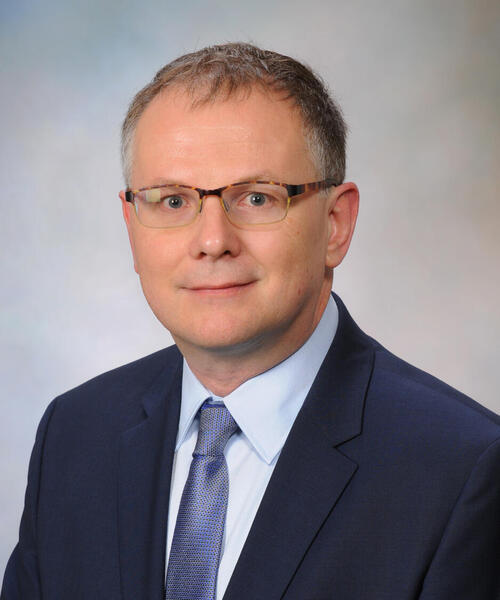
Khashayarsha KhazaieView profile
Professor
Khashayarsha Khazaie, Ph.D., is a Professor of Immunology at Mayo Clinic in Phoenix, Arizona, with a primary appointment as a Consultant in the Department of Immunology and a joint appointment in Cancer Biology, Department of Research. He leads a research laboratory focused on cancer immunology, inflammation, and the tumor-microbiota-immune axis, with emphasis on gastrointestinal and gynecological malignancies. Education: Ph.D. in Genetics/Senescence, MRC, National Institute for Medical Research Doctor of Science, University of Paris V, René Descartes BSc (Hons) in Chemistry, Biology, Physics, University of Surrey Postdoctoral Research, CNRS; EMBL; National Institute for Medical Research Research Interests: Dr. Khazaie’s lab investigates regulatory T cells (Tregs), mast cells, circadian rhythms, fibrosis, and microbial-based cancer vaccines. His work explores how immune suppression and chronic inflammation promote tumor growth, particularly in colorectal and endometrial cancers. Key areas include Treg plasticity, epigenetic reprogramming, microbiota-driven carcinogenesis, and the immunology of metastasis. Recent Research Trends: His most recent publications highlight the role of circadian disruption in colon cancer, the therapeutic potential of biomaterial-enhanced Treg immunotherapy, and the use of single-cell and spatial-omics to dissect immune-related diseases. His studies integrate molecular, cellular, and systems-level approaches to understand immune dysregulation in cancer and chronic inflammation. Scientific Leadership: Director, Federation of Clinical Immunology Societies, Mayo Clinic Center of Excellence (2018–present) Associate Editor, Journal for ImmunoTherapy of Cancer (2013–present) Editorial Board, Cancer Immunology Research (2012–present) Associate Editor, Tumor Immunity, Frontiers in Immunology and Oncology (2011–present) Visiting Professor, University of Regensburg (2016); Université Paris-Est Créteil (2016) Grants and Advising: Dr. Khazaie has led multiple NIH-funded projects, including studies on Parvimonas micra-induced carcinogenesis, β-catenin in Treg expansion, and circadian disruption in colon cancer. He mentors researchers and contributes to the education of future physicians and scientists in immunology and cancer biology. His lab collaborates with Biomed Valley Discoveries and MD Anderson on clinical trials of bacterial vaccines for metastatic cancer. Laboratory and Collaborations: His laboratory operates at the interface of basic and translational science, using mouse models, clinical specimens, and multi-omics technologies. He is deeply involved in collaborative research networks, particularly in cancer immunology and microbiota studies.