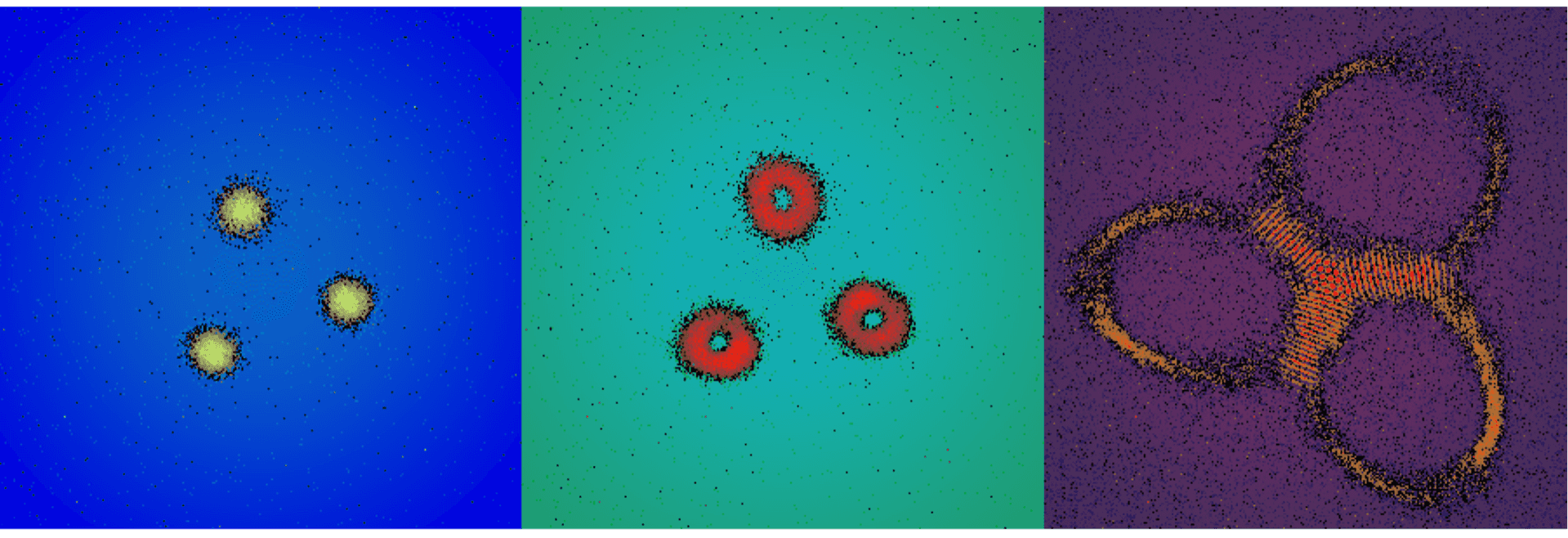
Jon Simon is the Joan Reinhart Professor and Professor of Applied Physics at Stanford University . He leads the Simon Lab , which explores the convergence of condensed matter physics , quantum optics , and quantum information science , focusing on creating synthetic materials from light and investigating topological and strongly correlated quantum systems. His research spans constructing photonic materials in quantum circuits, studying small quantum systems with strong correlations, and applying Hamiltonian engineering to realize exotic states of matter. The lab has achieved milestones like the first Mott insulator of photons and topologically insulating circuits . Collaborative projects with the Schuster Lab leverage superconducting quantum circuits for synthetic matter studies. Jon's students include Adam Shaw (PhD, now at Stony Brook) Lavanya Taneja (PhD, now at Atom Computing) Ruichao Ma (Postdoc, now faculty at Purdue) among others. The lab's recent publications focus on cavity arrays, hybrid quantum systems, and topological photonics. Research is supported by grants and affiliations with Stanford's Department of Applied Physics and interdisciplinary institutes.
Benjamin Carrison-Schafer is an Associate Professor and Assistant Dean for Graduate Student Success at the Department of Electrical and Computer Engineering, Erik Jonsson School of Engineering and Computer Science, University of Texas at Dallas. He leads the Design Automation and Reconfigurable Computing Laboratory (DARClab), focusing on systems, high-level design, and programming methodologies for VLSI computing systems and FPGAs. Education: MBA from McGill University, Canada (2012) PhD in Electrical and Electronic Engineering from University of Birmingham, UK (2003) Research Interests: His work spans modeling, analysis, synthesis, optimization, and implementation of VLSI systems. Current projects include: Approximate Computing, High-Level Synthesis Design Space Exploration, Hardware Security, Behavioral MPSoC Optimization, and Automatic Fault-Tolerant System Generation. His research blends theory and practice, using analytical and experimental techniques to solve real-world problems. Publication Trends: Recent publications demonstrate strong focus on hardware security, FPGA optimization, and automated design methodologies. Key themes include High-Level Synthesis innovations, hardware acceleration techniques, and cross-disciplinary applications of reconfigurable computing. His work frequently addresses challenges in hardware trustworthiness, energy efficiency, and design automation scalability. Professional Activities: Associate Editor: IEEE Transactions on Sustainable Computing (2022-present) Conference Chair: ICCD 2024, DCAS 2024 Program Committee: ASP-DAC, DATE, FCCM, GLSVLSI Advising & Labs: Supervises multiple PhD and Master's students at DARClab. Current research includes domain-specific architecture design, hardware security, sustainable computing, and ML for VLSI design. The lab collaborates with industry partners like Renesas Electronics and develops commercial tools through spin-off company highX Technologies.
Prof. Dr. Nikolaus A. Adams is a full professor and Chair of Aerodynamics and Fluid Mechanics at the Technical University of Munich (TUM), affiliated with the TUM School of Engineering and Design. Born in 1963, he holds a doctorate from TUM (1993) and habilitation from ETH Zurich (1999). His research focuses on numerical methods, turbulent flows, microfluidics, and multiphase systems. He has held leadership roles, including Dean of the Faculty of Mechanical Engineering since 2023 and Vice Dean (2015–2016). Education: PhD from TUM (1993), habilitation from ETH Zurich (1999) Research interests include aerodynamics, fluid-structure interaction, and numerical techniques for compressible flows. His work spans high-speed aerodynamics and computational fluid dynamics (CFD). Awards include ERC Advanced Grants (GENUFASD 2023, NANOSHOCK 2015), the Gordon Bell Prize (2013), and Fellow of the American Physical Society (2011). Grants and leadership: Spokesperson of DFG SFB/TRR 40 (2008–2020), co-author of 'Large-Eddy Simulation for Compressible Flows' (2009), and editorial roles in J. Comput. Phys.
Supratik Guha is a Professor at the Pritzker School of Molecular Engineering and Senior Advisor to Argonne National Laboratory's Physical Sciences and Engineering directorate. His work bridges industrial R&D with academic and national lab research, focusing on quantum computing , semiconductor materials , and sensor networks for water and soil monitoring. Guha leads Argonne’s quantum information science strategy and serves as Faculty Director for the University of Chicago Center in Delhi. Education: PhD in Materials Science (USC, 1991), BTech in Engineering Physics (IIT Kharagpur, 1985) Research interests span multiple domains: Quantum technologies focusing on erbium-doped oxides for quantum memory and quantum interconnects Sensor networks for soil and water quality monitoring using cyberphysical systems Nanofabrication techniques including controlled spalling for heterogeneous material integration Advanced memory technologies exploring ferroelectric and optically addressable memory at atomic scales Scientific awards include: Election to National Academy of Engineering (2015) APS Prize for Industrial Applications of Physics (2015) Vannevar Bush Faculty Fellow (2018) Fellow of Materials Research Society and American Physical Society IBM Corporate Award (2013) Advising notable students like Manish Kumar Singh (co-founder memQ ), Cheng Ji (now at Intel), and Vamsi Nittala (now at Micron Technology). His group contributes to major DOE , NSF , and USDA funded projects including: Q-NEXT - DOE National Quantum Information Center AIFARMS - NSF/USDA AI for Agriculture Institute Thoreau Project - Geospatial sensor networks Labs and teams operate across University of Chicago and Argonne National Lab , with facilities for molecular beam epitaxy , nanofabrication , and optical/electrical characterization . The group has spawned startups like memQ (quantum networking) and K1 Semiconductors (wide-bandgap material transfer).
Grégoire Ithier is a Senior Lecturer in Physics at the Department of Physics, Royal Holloway, University of London. His research focuses on quantum engineering, decoherence, thermalization, mesoscopic physics, and random matrix theory. He leads the 'TypDyn' project exploring typical dynamics of embedded quantum systems, and co-leads the Leverhulme Trust-funded 'Generation and detection of quantum signals' initiative. His work bridges theoretical and experimental domains, including superconducting circuits and cryogenic microwave engineering. Ithier's research tools include advanced numerical methods (e.g., exact diagonalization) and statistical techniques (e.g., random matrix theory). Key Projects: TypDyn: Studies typical dynamics in embedded quantum systems (2015–present) QSimFP: Quantum simulators for fundamental physics (2020–2024) A new statistical theory of disordered quantum systems (2020–2024) His experimental work involves superconducting qubits, Josephson devices, and nano-superfluidic cavities. Grants include STFC and Leverhulme Trust funding. Recent publications address quantum thermalization, many-body systems, and random Hamiltonian analysis.
Alanson Sample is an Associate Professor in the Department of Electrical Engineering and Computer Science at the University of Michigan (since 2018), leading the Interactive Sensing and Computing Lab. His research focuses on Human-Computer Interaction, Cyber-Physical Systems, and wireless technology innovations. He holds a PhD in Electrical Engineering from the University of Washington (2011), with prior postdoctoral work there developing implantable medical devices. Before academia, Sample held senior roles at Disney Research (2013-2018) as Executive Lab Director and Principal Research Scientist, leading teams in Robotics, AI, Computer Vision, and HCI. Earlier, he worked at Intel Labs (2008-2013) on energy harvesting for wearables and IoT. Key research themes include wireless power systems, embedded sensing, and privacy-aware technologies. Over 150+ publications span topics like magnetic sensing (MagDesk), acoustic gesture recognition (HandSAW), and privacy-preserving activity tracking (PrivacyMic). His work bridges academic and industry innovation, particularly in scalable interactive systems and medical technology. Notable projects include the Quasistatic Cavity Resonance wireless charging system, RFID-based sensing platforms (WISP), and wearable health monitoring devices. His lab develops hardware-software co-design frameworks for energy-efficient embedded systems. Current research emphasizes medical applications, smart infrastructure, and ubiquitous computing interfaces.
Jean-Philippe Brantut is an Associate Professor at École Polytechnique Fédérale de Lausanne (EPFL), affiliated with the School of Basic Sciences (SB), the Institute of Physics (IPHYS), and the School of Physics (SPH-ENS). He leads the Laboratory for Quantum Gases (LQG), a research group focused on quantum simulation with ultracold atomic systems. He also serves as a PhD program committee member for the Doctoral Program in Physics at EPFL. Research Interests: His work lies at the intersection of quantum optics, atomic physics, and condensed matter physics. He investigates strongly correlated fermionic systems, cavity quantum electrodynamics, mesoscopic physics, and quantum transport. His group pioneers the integration of Fermi gases with high-finesse optical cavities to simulate quantum devices and explore novel quantum matter. Recent Research Trends: His recent publications, appearing in Nature , Science , and Nature Physics , demonstrate a strong focus on engineering quantum many-body systems using photon-mediated interactions. Key themes include the realization of random spin models, observation of density-wave ordering, and the investigation of universal pair polaritons in strongly interacting Fermi gases. His earlier work laid foundations in quantum thermoelectricity and quantized transport in neutral matter. Scientific Awards: Latsis University Prize (2023) Physics Teaching Award at EPFL (2023) ERC Consolidator Grant (2022): Driven and Dissipative Quantum Simulators ERC Starting Grant (2016): Devices, engines and circuits: quantum engineering with cold atoms Fondation Sandoz Chair (2016) SNSF Ambizione Fellowship (2013) Advising and Grants: Brantut actively supervises multiple PhD students, including current students Gaia Bolognini, Tabea Bühler, Ekaterina Fedotova, Francesca Orsi, and Zeyang Xue, and has advised several successful graduates such as Victor Helson, Kevin Roux, Nick Sauerwein, and Timo Zwettler. His research is supported by major grants, most notably two European Research Council (ERC) grants, underscoring the significance and innovation of his work in quantum simulation and quantum engineering. Laboratories and Teams: He leads the Laboratory for Quantum Gases (LQG) at EPFL, which operates two main experimental setups: the Fermi gas experiment and the microscope experiment. The team includes post-doctoral researchers, PhD students, and visiting scientists, fostering a collaborative environment for advancing quantum science with ultracold atoms.
Ranjan Singh is a Professor at the Division of Physics, Nanyang Technological University (NTU) Singapore, specializing in terahertz photonics and metamaterials. He holds an elected fellowship from OPTICA (OSA) for pioneering work in ultrafast terahertz photonics, active metamaterials, and sensors. His research focuses on hybrid THz-electronic-photonic technologies for 6G communications, topological photonics, spintronics, quantum materials, and high-Tc superconductors. Education: B.Eng. in Telecommunications (Bangalore University, 2001); M.Tech in Photonics (Cochin University, 2004); Ph.D. in Photonics (Oklahoma State University, 2009). Postdoctoral research at Los Alamos National Laboratory (2009–2013). Research emphasizes on-chip THz topological photonics for next-gen communication systems, with notable achievements including a $7M grant for TERACOMM (on-chip THz topological photonics). His work integrates AI-driven beamforming, reconfigurable metasurfaces, and phase-change materials for adaptive THz systems. Key awards include the 2020 Web of Science 'Top 1% Highly Cited Researcher' distinction. His lab, TeraX Labs (founded 2013), develops cutting-edge technologies like THz brain-computer interfaces, quantum emitters, and spintronic sensors. Over $12M in competitive grants has fueled innovations in THz integrated circuits, tunable optical coatings, and ultra-sensitive biosensors. Advancing 6G/XG wireless, Singh's team designs topological beamformers, intelligent reflecting surfaces (IRS), and terahertz metamaterials for multi-link systems. His work bridges theoretical physics and applied engineering, with a focus on energy-efficient, reconfigurable photonic systems.
Dmitri N. Basov is the Higgins Professor of Physics at Columbia University, with a joint appointment as Professor of Physics at the University of California, San Diego. His research focuses on quantum materials, utilizing nano-optical techniques to investigate electronic phenomena and polaritonic systems. He leads the Basov Group at Columbia and has pioneered methods for imaging quantum materials at nanoscale resolutions. PhD in Physics, Lebedev Physics Institute (1991) Professor, Columbia University (2016–present) Professor, UC San Diego (2001–present) Postdoctoral Research, McMaster University (1992–1996) His work spans plasmonics , terahertz spectroscopy , and van der Waals heterostructures , with recent emphasis on polariton dynamics, superconductivity modulation, and moiré-driven electronic states. He employs cutting-edge tools like quantum scanning near-field optical microscopy (q-SNOM) and resonant inelastic X-ray scattering. Besides leading major grants such as the Gordon and Betty Moore Investigator award and Vannevar Bush Fellowship, Basov has received accolades like the National Academy of Sciences membership (2020), Ken Button Prize (2019), and Frank Isakson Prize (2012). His team explores novel quantum phases in 2D and topological materials.
Carlos Errando Herranz serves as an Assistant Professor in the Quantum and Computer Engineering Division at Delft University of Technology's Faculty of Electrical Engineering, Mathematics and Computer Science (EEMCS) and as a Principal Investigator at QuTech. His research focuses on developing scalable quantum photonic integrated circuits using semiconductor fabrication processes compatible with existing infrastructure for quantum internet applications. He received Bachelor's and Master's degrees from Universitat Politècnica de València (2013) and a PhD in Micro and Nanosystems from KTH Royal Institute of Technology (2018), followed by postdoctoral positions at KTH and MIT as a Marie Curie fellow. His lab investigates quantum photonics, integrated photonics, and color centers with emphasis on diamond tin-vacancy systems and silicon-based quantum emitters. Recent publications demonstrate strong expertise in tuning quantum emitters via strain engineering, heterogeneous integration of spin-photon interfaces, and MEMS-enabled reconfigurable photonics. Key advancements include cavity-enhanced quantum memories, superconducting detector integration, and spectral control of solid-state emitters for quantum networks. Dr. Herranz advises seven graduate students including PhD candidates Vicky Dominguez Tubio, Arjan Mejas, Matteo Pirro, Christian Primavera, Jan Riegelmeyer, and Elena Volkova, along with Master student Bram Zijlstra. His team comprises postdocs Lin Jin and Pat Laferriere, and interns Elsa Herranz Valiente and Ernest Staffetti Cruañas. The Errando Herranz Lab operates within QuTech's Quantum Internet Division at Delft University, maintaining specialized facilities for nanofabrication and optical characterization of quantum photonic devices. Current research directions include developing CMOS-compatible quantum memories operating at telecom wavelengths and scalable architectures for quantum repeaters.
John Davis is a Professor in the Department of Physics at the University of Alberta, Faculty of Science. He holds a PhD and MSc from Northwestern University and a Bachelor’s from Washington University. His research focuses on nanomechanics, superfluidity, and superconductivity, particularly in confined geometries and quantum properties of nanomechanical systems. His lab develops superfluid-based technologies for dark matter detection and precision measurement. He has held academic positions since 2010, including roles at the Canadian Institute for Advanced Research and postdoctoral training at the University of Alberta with Prof. Mark R. Freeman. Education: PhD in Physics (2008), Northwestern University MSc in Physics (2003), Northwestern University Bachelor’s in Physics with Honors (2001), Washington University Research Interests: Superfluid nanomechanical resonators Ultralow-temperature superfluid 3He Nanofluidic cavity quantum electrodynamics Quantum-limited torque magnetometry Applications in dark matter detection and gravitational wave sensing His recent work emphasizes magnomechanics and optomechanical transduction , integrating superfluid systems with quantum sensors. Articles highlight advancements in cryogenic devices, nonlinear dynamics, and hybrid quantum systems. Ongoing projects include the HElium-based Light Operated Superfluid (HELIOS) dark matter detector. Grants & Labs: His lab operates a cryogen-efficient low-temperature facility, focusing on microfluidic quantum fluid experiments. Collaborations involve advanced photonic crystal cavities and diamond-based optomechanical platforms.
Farhan Rana is the Joseph P. Ripley Professor of Electrical and Computer Engineering at Cornell University. He earned his BS, MS, and PhD from MIT and leads the Semiconductor Optoelectronics Group at Cornell, focusing on graphene, 2D materials, and semiconductor nanostructures. His research bridges experimental condensed matter physics and optoelectronic device engineering. Current Research Focus Ultrafast Spectroscopy Terahertz Microphotonics Quantum Optics Plasmonics and Nanostructures His group specializes in graphene optoelectronics , terahertz devices , and ultrafast semiconductor lasers . Recent work explores valley-dependent optical phenomena, exciton dynamics, and plasmon-phonon interactions in 2D materials. Key trends in his publications include graphene plasmonics , MoS2 photodetectors , and terahertz spectroscopy . He has contributed to foundational studies on carrier relaxation in graphene and quantum cascade lasers . 3× Michael A. Tien Excellence in Teaching Award (2006, 2010, 2017) NSF Career Award (2004) DARPA Young Faculty Investigator (2008) IEEE 'Most Downloaded Paper' (2008) MRS Best Paper Ribbon (2004) His students have received prestigious fellowships and awards, with alumni like Jared Strait (National Defense Science Fellowship) and Haining Wang (Cornell Best PhD Thesis). The group actively mentors graduate and undergraduate researchers.
Prof. Dr. Steffen Marburg is a Full Professor at the Chair of Acoustics of Mobile Systems within the TUM School of Engineering and Design at the Technical University of Munich. His research focuses on numerical methods in vibroacoustics, structural optimization, and acoustic modeling for applications in automotive, maritime, and musical instrument domains. Education: PhD from Technical University of Dresden (1998). Academic Career: Junior Professor at TU Dresden (2004), Chair of Technical Dynamics at University of the Federal Armed Forces Munich (2010), Full Professor at TUM (2015–present). Editorial Roles: Co-Editor-in-Chief of Journal of Theoretical and Computational Acoustics, Associate Editor of Journal of the Acoustical Society of America, Editor of Acoustics Australia and Mechanical Systems and Signal Processing. His research integrates computational acoustics, boundary element methods, and machine learning to address noise control and structural optimization challenges. Recent work explores acoustic metamaterials, viscothermal losses, and data-driven modeling. He has co-authored over 150 publications and led advancements in multifrequency solution methods and noise-insulating structures. Scientific awards include the Innovation Award of the Industrieclub Sachsen e.V. (1999). His editorial contributions and leadership in journals highlight his influence in computational acoustics and structural dynamics.
Nathan Schine is an Assistant Professor at the University of Maryland, specializing in quantum physics and quantum information science. He leads the Schine lab, which explores controlled coherent dynamics and engineered dissipation in quantum systems, particularly using optical cavities coupled to tweezer-trapped cold atoms. His research bridges atomic physics, quantum optics, and condensed matter physics. Education: B.A. in Physics, Williams College (2013) Ph.D. in Physics, University of Chicago (2019) Research interests focus on quantum many-body systems, optical cavities, and applications such as quantum information processing and ultra-coherent atomic clocks. The lab’s work includes developing state-of-the-art strontium tweezer array apparatuses for precision metrology and quantum simulation. Recent publications highlight advancements in Dicke state preparation, optical pumping of quantum Hall states, and cavity-enhanced measurements. Advising and grants involve mentoring graduate students and postbaccalaureate researchers, including Shardul Rao and Siddharth Taneja. The lab collaborates with groups like AMPED, QuICS, and RQS at UMD. Members include postdoctoral researchers and graduate students working on theoretical quantum optics and experimental setups. Labs/Teams: The Schine lab integrates atomic, optical, and condensed matter physics approaches to address fundamental and applied questions in quantum science.
Britney Schmidt is Associate Professor in Earth and Atmospheric Sciences and Astronomy at Cornell University, where she leads the Planetary Habitability and Technology Lab. She develops robotic tools like the Icefin underwater vehicle to study Earth's ice shelves and glaciers, providing insights into climate change and analogs for ocean worlds like Europa. Her research bridges glaciology, planetary science, and astrobiology. Research focuses on ocean world habitability, ice-ocean interactions, and Antarctic climate systems. Fieldwork includes extensive campaigns in Antarctica and the Arctic using robotic explorers. Recent publications explore Europa's habitability, Thwaites Glacier dynamics, microbial communities in hypersaline environments, and planetary analog studies. Technical developments include novel instrumentation for under-ice exploration. Awarded the 2024 Blavatnik National Award for groundbreaking research. Leads multiple international collaborations including NASA's Europa Clipper mission and Thwaites Glacier projects.