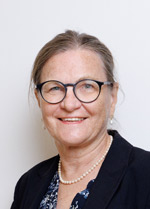
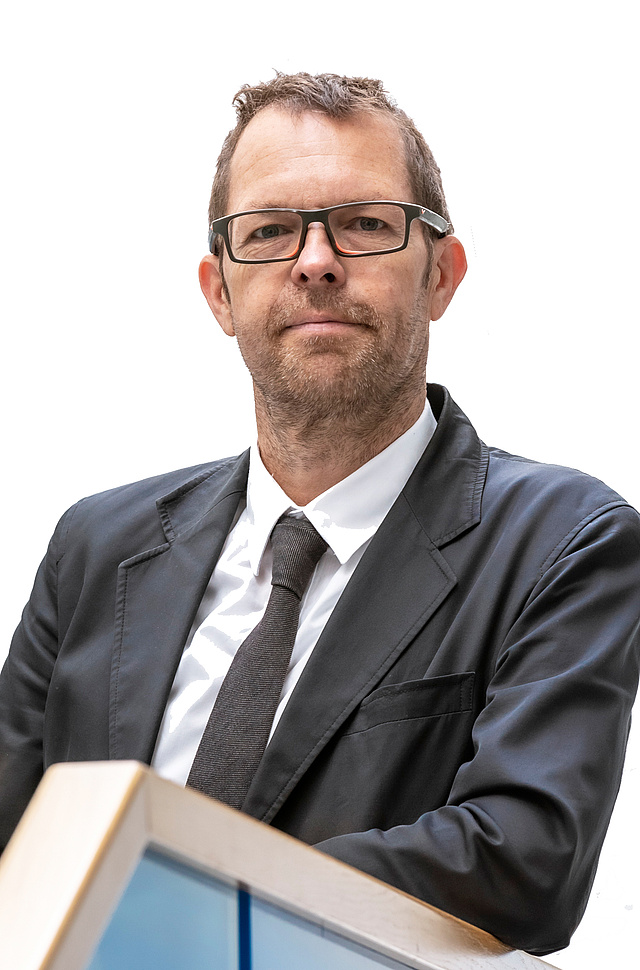
Jan Balajka is an Assistant Professor at TU Wien's Surface Physics Research Area (E134-05). His research focuses on atomic-scale characterization of oxide surfaces using advanced techniques like noncontact atomic force microscopy (ncAFM). He specializes in studying surface reconstructions of materials such as α-Al₂O₃(0001) and Fe₃O₄ in both dry and aqueous environments. Key themes include surface dynamics, adsorption mechanisms, and interfacial chemistry. Expertise: Oxide surfaces, ncAFM imaging, ab-initio force fields, surface hydration Recent studies: Alumina reconstructions, magnetite surface reactivity, water-vapor interactions His work bridges experimental surface science and computational modeling, with contributions to understanding surface structure-function relationships in catalytic and environmental contexts.
Ao.Univ.Prof. Michael Schmid is a Professor at TU Wien's Surface Physics Research Group (E134-05). His work focuses on atomic-scale surface structures of oxides, perovskites, and catalytic materials. Key research areas include scanning tunneling microscopy (STM) studies, surface reconstruction prediction, and material reactivity under environmental conditions. He has contributed significantly to understanding oxide surfaces like Al2O3, Fe3O4, and SrTiO3, exploring their functional properties through advanced characterization techniques. Recent work highlights surface interactions with water, CO adsorption dynamics on single-atom catalysts, and quasicrystalline ordering in manganites. Schmid has advised over 14 PhD and Master's students since 2014, focusing on surface science and materials engineering. His team uses computational modeling alongside experimental methods to bridge theoretical predictions and real-world material behavior.
Prof. Ulrike Diebold is a distinguished academic at TU Wien's Faculty of Physics, leading the Surface Physics research group. She holds the academic rank of Professor and has been actively involved in pioneering research on oxide surfaces, perovskites, and catalytic systems. Her work integrates experimental techniques like scanning tunneling microscopy (STM) and computational methods to study atomic-scale phenomena. Key research areas include surface chemistry of oxides, water interactions with mineral surfaces, and the development of advanced materials for energy applications. She has led major projects such as the Wittgenstein-Prize funded initiative and coordinates the SFB 'Taming Complexity in Materials Modeling'. Roles: Principle Investigator (PI) for multiple grants, Supervisor of over 15 graduate students Notable Achievements: Wittgenstein-Prize recipient, Editor of influential journals in surface science Publications span 500+ articles, emphasizing atomic-level insights into oxide surfaces, catalytic mechanisms, and novel material synthesis. Her group collaborates globally on topics like Fe₃O₄ surface reconstruction and perovskite termination control. Lab Infrastructure: State-of-the-art surface science facilities including ultra-high vacuum (UHV) systems and in-situ spectroscopy tools.
Ulrike Diebold is a University Professor at the Institute of Applied Physics, Vienna University of Technology, where she leads the Research Unit of Surface Physics. She concurrently serves as Vice President (part-time) of the Austrian Academy of Sciences (ÖAW). Her research focuses on atomic-scale investigations of oxide surfaces, catalysis, and water-oxide interactions using scanning probe microscopy and surface science techniques. Research interests span surface physics, chemical physics, and solid-state phenomena, with emphasis on TiO₂, Fe₃O₄, and perovskite oxides. Key themes include surface defects, polaron dynamics, water adsorption, and catalytic mechanisms. Her group develops advanced methodologies for surface characterization and collaborates extensively on computational modeling. She has received prestigious awards including the Wittgenstein Prize, ERC Advanced Grants (twice), and the Arthur W. Adamson Award. Major honors include memberships in the German Academy of Sciences (Leopoldina), Academia Europaea, and the American Academy of Arts and Sciences. Her laboratory utilizes STM, AFM, LEED, and PLD systems for surface synthesis and analysis. Current projects investigate single-atom catalysis, electrochemical interfaces, and oxide thin-film growth. She leads an active research group with international collaborations and extensive third-party funding.
Christian Slugovc is an Associate Professor at Graz University of Technology, Faculty of Technical Chemistry, where he leads the Slugovc Group within the Institute of Chemical Technology of Materials (ICTM). He serves as Director of the Christian Doppler Laboratory for Organocatalysis in Polymerization and is an Associate Editor of Monatshefte für Chemie (Springer Verlag). His research has established him as a leading figure in polymer chemistry and materials science, with particular expertise in catalytic polymerization processes. Slugovc's research interests center on advancing catalytic polymerization reactions through the development of more efficient catalytic processes and comprehensive mechanistic understanding at the molecular level. His group focuses on four main interconnected research areas: Olefin Metathesis (including catalyst development and polymerization mechanisms), Organocatalysis (particularly for sustainable polymer synthesis), Porous Polymers (including emulsion-templated materials and metal-organic frameworks), and Click Chemistry (especially inverse electron-demand Diels-Alder reactions). His work bridges fundamental mechanistic studies with practical applications in sustainable materials, energy storage, and sensor technologies. Analysis of his recent publications reveals a strong trend toward interdisciplinary materials research combining polymer chemistry with advanced characterization techniques. His group has increasingly focused on metal-organic frameworks (MOFs) and their applications in sensing, while maintaining core expertise in catalytic polymerization. Recent work demonstrates sophisticated integration of computational methods with experimental approaches, particularly in mechanical property characterization of porous materials. The research shows a clear commitment to sustainable chemistry principles, with growing emphasis on bio-based feedstocks and water-based synthesis methods. 3rd place in Houska prize competition 2010 for research on biocidal polymers Best Review Article Award 2023 of Monatshefte für Chemie for paper on oxa-Michael polymerization Förderpreis für Chemie for dissertation on 'Oxa-Michael Chemistry: Synthesis, Use and Reprocessability of Polyethers' Professor Slugovc has secured significant research funding through multiple European Union projects (including EC-FP6 Dentalopt, EC-FP7-SME-BIOSURF, EC-FP7-EUMET) and Austrian national programs (FFG projects LIGPOLY, LIGNOPOLY, KONZID). He has supervised numerous doctoral students and postdoctoral researchers through his leadership of the Christian Doppler Laboratory and participation in collaborative projects. His research group actively engages with industry partners to translate fundamental discoveries into practical applications. The Slugovc Group operates within the Institute of Chemical Technology of Materials at TU Graz, with laboratory facilities supporting synthetic polymer chemistry, materials characterization, and application testing. The group participates in the Porous Materials@Work for Sustainability initiative and collaborates extensively with other research groups at TU Graz and internationally, particularly in the areas of MOF research and advanced polymer synthesis.
Abbas Qamar is a researcher affiliated with the Institute of Chemical Technology of Materials at Graz University of Technology , Austria. His work focuses on electrochemistry , energy storage , and nanomaterials for sustainable technologies. Research spans supercapacitors , batteries , photocatalysis , and environmental engineering . Key interests include aqueous electrolytes , carbon-based materials , and metal oxide/sulfide composites . Recent articles highlight advancements in water-in-salt electrolytes , iodine-based electrodes , and ternary photocatalytic systems , emphasizing sustainable energy and environmental solutions. His collaborative projects often integrate graphene oxide , nanostructuring , and advanced characterization techniques . Contact: qamar.abbas@tugraz.at
Ertan Turhan is a researcher at the Faculty of Chemistry , focusing on advanced NMR techniques and biomineralization processes . Their work spans multiple subfields, including dynamic nuclear polarization (DNP), hyperpolarization , and nucleation mechanisms in calcium phosphate and carbonate systems. Institute of Functional Materials and Catalysis Institute of Organic Chemistry Institute of Biological Chemistry Research Interests : Turhan's research explores the use of hyperpolarized NMR to study short-lived intermediates in biomineralization, the role of prenucleation assemblies in material formation, and computational methods for enhancing NMR resolution. Their work bridges materials science , organic chemistry , and biophysics . Key Article Trends : Recent publications emphasize real-time monitoring of solute-to-solid transitions , cross-relaxation dynamics , and computational approaches to improve hyperpolarized NMR applications. Collaborations with Dennis Kurzbach and others highlight interdisciplinary efforts in biomineralization and radical chemistry .
Serdar Niyazi Sariciftci is a Full Professor at the Institute of Physical Chemistry, Johannes Kepler University Linz, and leads the Linz Institute for Organic Solar Cells. His work centers on sustainable energy conversion and bioelectronic interfaces, with international recognition in organic semiconductor research. His research spans Organic Solar Cells, Bioelectronics, and Artificial Photosynthesis, focusing on biodegradable materials like algal polysaccharides and DNA-based conductors. Current projects emphasize eco-friendly electronics for medical and energy applications, integrating natural compounds with organic semiconductors to reduce environmental impact. Recent publications reveal a strong shift toward biocompatible organic electronics, with innovations in flexible transistors, biodegradable nanocomposites, and low-voltage medical sensors. Key trends include merging biological materials with electronic functions and developing sustainable alternatives to conventional semiconductors. No scientific awards were mentioned in the provided text. Professor Sariciftci has supervised 58 researchers and students while leading 65 funded projects, including the EU-backed EINSTEIN Excellence initiative (2024-2028) and CO2 utilization research (2025-2027). His grants target nutrifood theranostics, organic photovoltaics, and biocompatible polymers for medical applications. He directs the Linz Institute for Organic Solar Cells, coordinating international teams on 8 active projects. Current collaborations span Europe, with recent hosting of researchers from Turkey, Slovakia, and Ethiopia to advance organic semiconductor pigments and bioelectronic interfaces.
Georg Gramse is an Associate Professor (Privatdozent) in the Department of Molecular and Membrane Biophysics at Johannes Kepler University Linz (JKU), where he leads cutting-edge research in nanoscale imaging techniques and materials characterization. His research spans: Advanced scanning probe microscopy development (scanning microwave microscopy, electrostatic force microscopy) Ion intercalation dynamics in 2D catalysts In operando charge transport imaging of nanoscale semiconductor structures Degradation mechanisms in perovskite solar cells Professor Gramse maintains an active publication record with 30 research outputs, including high-impact articles in Small and Nanoscale. His work demonstrates consistent interdisciplinary innovation bridging biophysics, materials science, and electrochemistry through sophisticated nanoscale characterization methods. He currently directs five major EU-funded research initiatives: NanoRam (2024-2028): Advanced nanoscale imaging DigiCell (2024-2026): Digital cell characterization 4D-NMR (2023-2026): Multidimensional nuclear magnetic resonance upperVISION2030 (2022-2025): Vision technology integration UNICORN Dx (2022): Diagnostic applications The research group provides state-of-the-art facilities for low-temperature microscopy and electrochemical imaging, fostering international collaborations in energy materials and biophysical systems through multiple EU projects.