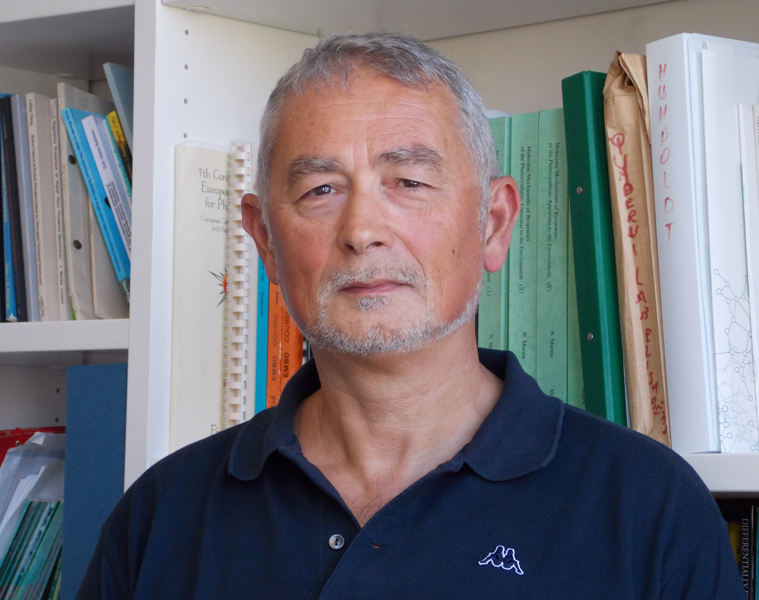
Roberto Bassi is a Full Professor of Plant Physiology and Biochemistry at the University of Verona's Department of Biotechnology. His career spans prestigious roles including Visiting Professorships at institutions like Jülich Research Centre and Chinese Academy of Sciences. He holds advanced academic positions such as Chairman of the Molecular Biotechnology PhD program and Vice-President of the International Society of Photobiology. Education: 1977: Laurea degree in Biology, University of Padua 1978-1983: Fellowships at Institute of Microbiology and Institute of Botany, University of Padua Research focuses on Photosynthesis mechanisms and light energy regulation Membrane protein folding dynamics Carotenoid biosynthesis and photoprotection Bioenergy applications in algae Awards include the Baccarini-Melandri Award (1996), Helmholtz-von Humboldt Award (2009), and membership in the Italian National Academy of Sciences (2012). He has authored 220+ papers (H-index 74) and contributed to 35 book chapters. Leadership roles: Editorial boards of journals like Molecular Plant and BMC Plant Biology Governmental biosafety committee member International conference organizer (5 events) His work bridges fundamental plant biology with applied research in sustainable bioenergy and stress-resistant crops.
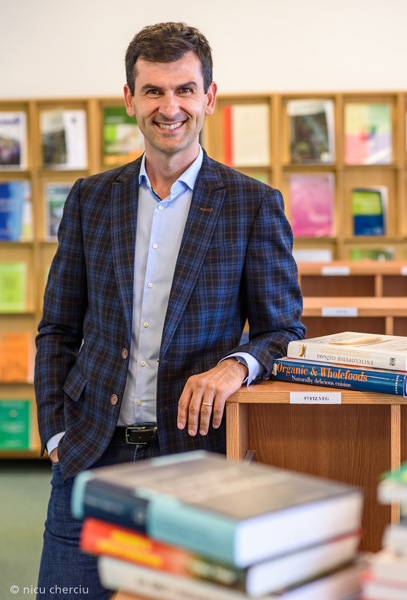
Dan Cristian Vodnar is a Professor and currently serves as Vice-rector for Research at the University of Agricultural Sciences and Veterinary Medicine Cluj-Napoca (UASVM), Romania. He also holds multiple leadership positions including Member of the faculty council, Member of the University Senate, and Manager of the Technology Transfer Centre-Biotech. Additionally, he serves as a Bio-economy Expert for the European Commission in Brussels and Scientific Manager at BIOZOON GMBH, Germany. Professor Vodnar's research focuses on bacterial, fungal and microalga fermentative bioconversions in aerobic and anaerobic systems, food science, bioeconomy and food biotechnologies, molecular gastronomy, immobilization of enzymes and microorganisms, determination of bioactivity of natural extracts and chemically synthesized compounds, microencapsulated bioactive powders, in vitro gastrointestinal digestions, and developing innovative functional foods. His work bridges the gap between fundamental biochemical research and practical food applications, with emphasis on waste valorization and sustainable production methods. His publication record shows a strong focus on food biotechnology, bioactive compounds, and sustainable production methods. The articles demonstrate expertise in microencapsulation techniques, fermentation processes, and analysis of bioactive compounds in food systems. His research shows consistent progression from fundamental biochemical studies toward applied food technology solutions with commercial potential, particularly in the areas of functional foods and food waste valorization. Top 2% of scientists worldwide in Food Science (2020 and 2021) GOLD Medal at International Exhibition of Invention, Geneva, Switzerland (2017) JCI Ten Outstanding Young Persons (TOYP) award in Scientific category (2018) Multiple GOLD Medals at PRO INVENT International Exhibition (2016-2020) Young Scientist Award from Vira International Foundation, India (2016) Danubius Young Scientist Award, Vienna, Austria (2014) Professor Vodnar has successfully led 19 major research projects totaling approximately 5.5 million EUR, including 5 international and 14 national grants. He has supervised 5 Postdocs, 9 Ph.D. students, and 22 Master's students, demonstrating strong commitment to academic mentoring. As Editor-in-Chief of the Bulletin of University of Agricultural Sciences and Veterinary Medicine, Cluj-Napoca, he contributes significantly to scholarly communication in his field. His work with the Technology Transfer Centre-Biotech demonstrates practical application of research findings to industry needs. Professor Vodnar leads the Technology Transfer Centre-Biotech at USAMV Cluj-Napoca and coordinates CDS 7 at the Life Sciences Institute. His research team focuses on translating laboratory findings into practical food technology applications, particularly in the areas of functional food development and food waste valorization. The team maintains strong connections with industry partners through the Technology Transfer Centre, ensuring research has real-world impact.
Mondher Bouzayen is a Full Professor (Classe Exceptionnelle) at the University of Toulouse's Institut National Polytechnique, specializing in plant biotechnology with a focus on fleshy fruit development. His research spans hormone signaling, fruit genomics, and transcriptional regulation in tomato and other climacteric fruits. His research interests center on deciphering molecular mechanisms underlying fruit ripening, set, and development. Key areas include ethylene and auxin signaling pathways, chromoplast differentiation, and genomic approaches to understanding fruit traits. His work bridges fundamental plant biology with agricultural applications, particularly in improving sensory and nutritional qualities of fruits. Analysis of his publications reveals consistent focus on tomato as a model system, with significant contributions to genome sequencing, hormone response factors, and metabolic regulation during ripening. His work demonstrates strong interdisciplinary integration of genomics, proteomics, and molecular genetics. Novela Award of the City of Toulouse (2013) for tomato genome sequencing Officier des Palmes Académiques (2011) - French national distinction Guangbiao Professeur Chair at Zhejiang University (2010) With 93 peer-reviewed publications (h-index: 35, g-index: 75, 4367 citations), his research has been published in top journals including Nature, PNAS, The Plant Cell, and Plant Physiology. His work on the tomato genome sequence represents a landmark contribution to plant science, providing essential resources for Solanaceae research worldwide.
Christoph Griesbeck is a Professor and Head of the Biotechnology Department at MCI - The Entrepreneurial University, leading study programs in Biotechnology & Food Engineering since 2011. He also serves as Innovation Hub Coordinator for Food, Biotechnology & Circular Economy at Ulysseus (since 2020). His career includes roles as Head of Biotechnology at MCI (2006–2011), Postdoc at the University of Regensburg (2002), and doctoral work in Biochemistry. Education: Dr. rer. nat. in Cell Biology & Plant Physiology (University of Regensburg, 2001), Dipl.-Biochem. (University of Regensburg, 1998). Research focuses on algal biotechnology, microbial protein expression systems, biodegradation of plastics, and circular economy. He has authored/co-authored over 30 peer-reviewed articles and book chapters, with recent work on Ideonella sakaiensis PET degradation and UV-enhanced carotenoid production. Notable awards include Bavarian Innovation Award nomination (2006) and Business Plan Competition victory (2006). He reviews for journals like Molecular Biology Reports and serves on DECHEMA’s Algal Biotechnology Division advisory board. Supervised over 80 students (BSc/MSc), including recent theses on AI in enzyme engineering and anti-inflammatory algal extracts. Active in conference organization (e.g., 8th Summerschool on Advanced Biotechnology) and industry collaborations.
Harald Schöbel is a Professor of MCI Group , affiliated with Venice.ai. His academic journey includes roles as a researcher, teacher, and innovator in the field of Biophotonics and Biotechnology. He currently holds the position of Professor at MCI | The Entrepreneurial School® in Innsbruck, Austria. Education: PhD in Physics from the University of Innsbruck (2011) Magister in Physics from the University of Innsbruck (2007) BSc in Management and Economics from the University of Innsbruck (2012) PostDoc at the University of Innsbruck (2011) Research Focus: Dr. Schöbel's work spans Biophotonics, LED applications in biotechnology, antimicrobial strategies using UV-C LEDs, microbial diversity analysis, and light-mediated biosynthesis . He has pioneered projects like BIOcubed (bacterial detection) and TerAGuard (antimicrobial coatings). His research integrates physics with biotechnology to address challenges in healthcare, food safety, and environmental sustainability. Awards & Recognition: Recognition Award (Eduard Wallnöfer Foundation, 2022) Ars Docendi Nomination (2019) Promotio sub auspiciis Praesidentis (2012) BMWFW Appreciation Award (2011) Grants & Projects: Lead projects such as TerAGuard (FFG), BIOcubed (FFG), and InCanPres (food packaging disinfection). His work bridges academia and industry, focusing on UV-C LED technology, bioprocess optimization, and sustainable antimicrobial solutions. Labs & Collaborations: Collaborates with institutions like K Kommunalkredit , FFG , and University of Innsbruck . His lab develops advanced optical systems for bioprocesses and environmental applications.
Mondher Bouzayen is a Full Professor at the University of Toulouse's Institut National Polytechnique de Toulouse, leading the Genomics and Biotechnology of Fruit (GBF) laboratory since 1998. His work focuses on plant biotechnology, fruit development, and genomics, with significant contributions to tomato genome sequencing and hormone signaling research. He holds prestigious awards including the Novela Award (2013) and Officier des Palmes Académiques (2011). Education & Positions: 1989: Postdoctoral Researcher 1991: Associate Professor 1999: Full Professor 2010: Full Professor Classe Exceptionnelle Research Interests: Plant biotechnology applications in fruit development Molecular mechanisms of fruit ripening and set Hormone signaling pathways (ethylene, auxin) Genomic resources for fleshy fruits Leadership & Projects: Chair of the European QualityFruit Network (COST Action FA1106) French lead in the Tomato Genome Sequencing Project Coordinator of international collaborations (China, Brazil) Administrative Roles: Director of GBF laboratory Member of INPT Governing Board Co-chair of Plant Biosciences Master's program Key Achievements: Over 93 peer-reviewed papers (h-index 35) 4 patents, including biotech applications for fruit ripening control 21 PhD students and 11 postdoctoral researchers supervised