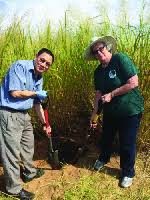
Mary K. Firestone is Professor of the Graduate School in the Department of Environmental Science, Policy and Management at UC Berkeley. Her research revolutionized understanding of soil microbial processes, particularly oak regeneration techniques and microbial mediation of carbon/nitrogen cycling in terrestrial ecosystems. Firestone's work examines microbial responses to environmental change, including drought, rewetting, and warming scenarios. Her lab develops innovative methods like quantitative stable isotope probing (qSIP) to trace microbial activity in complex soil environments. Research spans grassland, rangeland, and agricultural ecosystems. Honors include election to the National Academy of Sciences (2017), Soil Ecology Society Career Achievement Award (2017), and American Geophysical Union Fellowship (2016). She holds the Betty and Isaac Barshad Chair in Soil Sciences. Current PhD candidates and postdoctoral researchers in the Firestone Lab investigate viral-bacterial interactions in soil, mycorrhizal carbon transfer, and drought impacts on soil carbon persistence. Field studies at California's Hopland Research Center examine grassland responses to climate variability.
Matthew D. Potts is the S.J. Hall Chair in Forest Economics and Professor at UC Berkeley's Department of Environmental Science, Policy, & Management. He also serves as Associate Director for Sustainable Development at the Blum Center for Developing Economies. With interdisciplinary training in mathematics, ecology, and economics, his research focuses on nature-based climate solutions and ecosystem service co-production. Research addresses carbon sequestration through forest management, biodiversity conservation, land use planning, and sustainable development in tropical ecosystems. Recent work examines cost-effectiveness of reforestation, climate-driven migration patterns, and plantation carbon modeling. Publications demonstrate strong focus on quantitative analysis of land-use impacts, with methodological innovations in remote sensing applications and spatial modeling for carbon accounting. Awards include recognition for young faculty research and leadership in international environmental assessments. Leads the Potts Research Group, mentoring graduate students working on tropical ecology, restoration, and climate adaptation projects.
Robert M. Holt is a Professor in the Department of Geology and Geological Engineering at the University of Mississippi. His research focuses on geological CO2 sequestration, fluid transport in porous media, and hydrogeological characterization for nuclear waste disposal. Holt investigates how fluid behavior in heterogeneous geological formations impacts environmental processes ranging from carbon storage to groundwater contamination. His work examines the fundamental physics governing multiphase flow through porous and fractured geological media, with applications to contaminant transport, energy resources, and waste isolation. Holt has developed experimental methods for visualizing and modeling fluid behavior in heterogeneous subsurface environments, improving understanding of capillary processes and flow dynamics. Holt's research includes field studies of evaporite karst systems, geochemical assessments of aquifer systems, and investigations of hydraulic properties in low-permeability mudrocks. His work on CO2 injection monitoring has contributed to safer implementation of carbon sequestration technologies.
Joel S. Hayworth is an Associate Professor in the Department of Civil Engineering at Auburn University's College of Engineering. His research focuses on environmental and ecosystem restoration, particularly in estuarine, terrestrial, and freshwater systems. He leads the Estuarine Environments Research Program (EERP), which investigates the fate of endocrine-disrupting chemicals (EDCs), PFAS, and oil spill residues in coastal environments. Dr. Hayworth's educational background includes a PhD in Civil Engineering (Hydrology/Hydraulics) from Auburn University, an MS in Hydrology from the University of Nevada, Las Vegas via the Desert Research Institute, and a BS in Geophysics from the University of California, Santa Barbara. He previously worked at the Tennessee Valley Authority Engineering Laboratory and the U.S. Air Force Research Laboratory, and founded Hayworth Engineering Science in 1999 before returning to academia in 2010. His research interests span environmental engineering, hydrology, hydraulics, estuarine science, pollutant fate and transport, and chemical fingerprinting. He has developed advanced analytical methods for detecting EDCs and PFAS in water, sediment, and biota. His work integrates field studies, laboratory experiments, and environmental modeling to understand complex hydrologic, geologic, chemical, and biological processes in human-impacted ecosystems. The 15 most recent articles highlight a strong trend in environmental contaminant analysis, particularly focusing on PFAS, oil spill residues, and endocrine disruptors. His research combines analytical chemistry with environmental modeling and field monitoring, often in collaboration with interdisciplinary teams. Key themes include the development of UHPLC-MS/MS and GC-MS/MS methods, fate and transport modeling of pollutants, and ecological risk assessment in estuarine systems. Dr. Hayworth's scientific contributions are supported by funding from agencies such as the Gulf Coast Ecosystem Restoration Council (RESTORE Council). His work has led to significant publications in journals like Science of the Total Environment , Marine Pollution Bulletin , and Water . He actively mentors students and collaborates with researchers like T.P. Clement, G.F. John, and V. Mulabagal. His projects, such as the restoration assessment of Cotton Bayou and Terry Cove, demonstrate applied science for environmental problem-solving. He has developed state-of-the-art analytical laboratories and partnered with coastal communities for long-term monitoring. His laboratory, the Estuarine Environments Research Program (EERP), conducts multi-year studies on endocrine disruptors in estuaries, develops innovative sampling and analysis methods, and trains the next generation of environmental engineers and scientists. The team works across disciplines to address complex environmental challenges in the Gulf Coast region.
Valerie Thomas is the Anderson Interface Chair of Natural Systems at Georgia Tech, holding joint appointments in the H. Milton Stewart School of Industrial and Systems Engineering and the School of Public Policy. Her research focuses on energy systems, sustainability, industrial ecology, and science and technology policy. She earned a B.A. in Physics from Swarthmore College and a Ph.D. in Theoretical Physics from Cornell University, followed by postdoctoral research at Carnegie Mellon and Princeton Universities. Her work addresses low-carbon transportation, environmental impacts of food systems, and energy development in Africa. Key research areas include life cycle assessment, climate policy, and technology assessment. Thomas has contributed to over 80 technical publications and serves on advisory boards for the U.S. EPA and USDA/DOE. Education: Ph.D. in Physics, Cornell University; B.A. in Physics, Swarthmore College Awards: AAAS and APS Fellowships, Georgia Tech’s 1934 Outstanding Interdisciplinary Award Her teaching spans energy policy, lifecycle analysis, and engineering economics. She leads interdisciplinary teams at the Climate and Energy Policy Laboratory and the Technology Policy and Assessment Center, advancing sustainable systems engineering and policy solutions.
Holly Michael is a Professor and Unidel Fraser Russell Career Development Chair for the Environment at the University of Delaware, serving as Director of the Delaware Environmental Institute. She holds a BS from the University of Notre Dame (BS, 1990s) and a PhD from MIT (2000s). Her research focuses on coastal hydrogeology, saltwater intrusion, groundwater sustainability, and climate change impacts on water resources. Current projects include investigating coastal critical zones, groundwater salinization dynamics, and arsenic-safe groundwater management in Bangladesh. Dr. Michael’s work integrates field studies, modeling, and experimental economics to address water resource challenges. She leads initiatives on subterranean estuaries, tidal wetland biogeochemistry, and the interplay between groundwater and surface water systems. Her research spans disciplines such as contaminant hydrology, geostatistics, and environmental policy, with emphasis on coastal regions. Notable projects include assessing the impacts of storm surges on coastal forests and modeling groundwater responses to sea-level rise. Dr. Michael collaborates internationally on issues like sustainable groundwater use and climate adaptation strategies. Her interdisciplinary approach bridges hydrology, ecology, and socio-economic frameworks to solve complex environmental problems.
Irina Marinov is an Associate Professor in the Department of Earth and Environmental Sciences at the University of Pennsylvania. She specializes in climate science, focusing on the critical role of oceans in global climate dynamics and carbon cycling. Her research integrates Earth system models and satellite data to study phenomena such as Southern Ocean convection, phytoplankton ecology, and the impact of climate change on oceanic processes. Marinov’s research spans biogeochemical cycles, marine ecology, and climate modeling, with a particular emphasis on Southern Ocean dynamics. She explores teleconnections between tropical atmospheric systems and Southern Ocean processes, polynya variability, and the use of satellite data to understand phytoplankton biomass and carbon distribution. Her recent publications (2024-2025) highlight the Southern Ocean’s influence on multidecadal climate variability, nonlinear CO2 dynamics, and the development of the GLOBAL CLIMATE SECURITY ATLAS. These works bridge climate modeling, satellite remote sensing, and policy applications. Scientific Awards: Undergraduate Research Mentorship award First woman to be tenured in the Earth and Environmental Sciences Department at Penn
Oswald J. Schmitz is the Oastler Professor of Population and Community Ecology at the Yale University School of the Environment. His research bridges biodiversity and ecosystem services, focusing on species interactions, climate change impacts, and conservation strategies. He employs field experiments and mathematical models to study predator-herbivore-plant dynamics, nutrient cycling, and carbon sequestration. Education: B.Sc., M.Sc., University of Guelph Ph.D., University of Michigan Research areas include: Trophic rewilding for climate solutions Human-wildlife conflict dynamics Meta-ecosystem nutrient flows Animal-driven carbon cycle modifications Context-dependent conservation strategies His 2024 Bormann Prize-winning work on calving impacts in nutrient cycles and other recent publications highlight innovative ecosystem science. Schmitz mentors students like Kristy Ferraro and collaborates with alumni such as Rob Buchkowski and Julia Monk. He teaches three conservation-focused courses with an emphasis on quantitative skills and real-world applications.
Chao Wang is an Associate Professor at the Department of Chemical and Biomolecular Engineering within the Whiting School of Engineering at Johns Hopkins University. He also serves as the Director of the Nano Energy Laboratory and the department’s Master’s Admissions Director. His research focuses on sustainable energy systems and nanomaterials for CO2 capture and conversion, electrocatalysis, thermocatalysis, and green chemical engineering. Education: Bachelor’s degree, University of Science and Technology of China (2004) Doctorate, Brown University (2009) Wang’s research targets efficient energy conversion and storage via nanomaterials with tailored atomic structures, emphasizing catalytic activity, selectivity, and stability. His group explores electrochemical and thermochemical processes for reduced carbon footprints, including CO2 and methane conversion, ammonia recovery, and phosphorus/nitrogen nutrient recycling using zeolite-based systems. Recent publications (2021–2024) highlight his work in high-entropy alloys, solid-state battery materials, CO2 electroreduction, and biomedical nanotechnologies. Collaborative efforts span catalysis, nanoparticle dynamics, and environmental applications. Grants include a $1M DOE award for multi-university research, a $625K DOE grant for electrified transportation systems, and $3M in startup funding for carbon-removal technology commercialization. Alumni under his mentorship include Ph.D. graduates like Michael J. Manto (2018) and Master’s students like Mitchell Keller (2018), with notable achievements in catalyst development for ammonia/phosphorus recovery and industry placements at Grace & Co. and GEA Engineering.
Dr. Alain Bonneville is a Lab Fellow and Geophysicist at Pacific Northwest National Laboratory (PNNL) and holds a Courtesy Professor appointment at Oregon State University's College of Earth, Ocean, and Atmospheric Sciences. With extensive experience in geological storage of CO2, geothermal energy, and geophysical monitoring techniques, Dr. Bonneville leads diverse research projects that bridge fundamental science and practical applications for energy and environmental challenges. Dr. Bonneville's educational background includes: PhD in Geophysics from the University of Montpellier, France MS in Petroleum Geophysics from IFP-School, Paris, France BS in Geology from the University of Lyon, France Dr. Bonneville's research spans several critical areas in Earth sciences and energy systems. His work on geothermal energy focuses on super-hot enhanced geothermal systems (EGS), site characterization, monitoring, and stimulation fluids. In geological CO2 storage, he investigates project management, site characterization, numerical modeling, and monitoring methods using potential fields and remote sensing. His expertise in geophysical methods includes heat flow measurements, gravity surveys, muon tomography development for borehole deployment, and remote sensing applications. Additional research areas encompass marine heat flow instrumentation development, thermal monitoring of active volcanoes, and intraplate volcanism studies in the Indian and Pacific Oceans. Dr. Bonneville has received significant recognition for his contributions to science, including: Membership in the Washington State Academy of Sciences Lab Fellow position at Pacific Northwest National Laboratory Executive Committee membership on the U.S. National Risk Assessment Partnership Scientific Committee membership at IFP-Energies Nouvelles, France He also holds two U.S. patents related to electrophilic acid gas-reactive fluids for enhanced fracturing and recovery of energy producing materials. Throughout his career, Dr. Bonneville has led significant research initiatives, including the PNNL Carbon Sequestration Initiative (2009-2013) and the European Marie Curie Research Training Network on Greenhouse Gas Removal (GRASP), which involved 14 academic and industrial institutions across 7 countries and supported 35 PhD students and post-docs. His work on the FutureGen 2.0 project demonstrates his leadership in large-scale carbon storage site characterization and monitoring program design. Dr. Bonneville maintains active collaborations with research teams at PNNL's Environmental Molecular Sciences Laboratory and works closely with Oregon State University's geoscience researchers. His laboratory work focuses on developing novel instrumentation for geophysical monitoring, particularly in the areas of muon tomography for subsurface characterization and thermal monitoring systems for geothermal and carbon storage applications.
Carlos Torres-Verdín is a Professor and holds the Brian James Jennings Memorial Endowed Chair and Zarrow Centennial Professorship in Petroleum Engineering at The University of Texas at Austin's Hildebrand Department of Petroleum and Geosystems Engineering, within the Jackson School of Geosciences. He earned a B.S. in Geophysical Engineering from the National Polytechnic Institute of México (1983), an M.Sc. in Electrical Engineering from UT Austin (1985), and a Ph.D. in Engineering Geoscience from UC Berkeley (1991). His research focuses on petrophysical and geophysical characterization of subsurface regions using well logging, seismic, and multi-physics data. Key areas include borehole geophysics, rock physics, reservoir characterization, and hydraulic fracturing. He has received numerous accolades, including the 2020 Virgil Kauffman Gold Medal (SEG) and the 2017 Conrad Schlumberger Award (EAGE). His work integrates advanced numerical methods and machine learning to enhance reservoir evaluation and CO2 sequestration monitoring. Torres-Verdín teaches courses such as PGE 358 (Formation Evaluation) and directs the Formation Evaluation Joint Industry Research Consortium, fostering industry-academia collaboration. Awards & Honors 2020 Virgil Kauffman Gold Medal, SEG 2019 Anthony F. Lucas Gold Medal, SPE 2017 Conrad Schlumberger Award, EAGE 2017 Lockheed Martin Excellence in Engineering Teaching Award Research & Teaching His recent studies address challenges in unconventional reservoirs, fluid dynamics in nanoporous media, and real-time geosteering. He has published over 150 peer-reviewed articles, emphasizing innovation in inversion techniques, NMR applications, and reservoir simulation.
Elizabeth J. Wilson is a Professor of Environmental Studies at Dartmouth College and former founding Director of the Arthur L. Irving Institute for Energy and Society (2017–2022). Her research focuses on energy systems transitions, offshore wind policy, and regulatory challenges in emerging technologies. She holds a B.A. from the University of California, Santa Cruz, an M.S. from Vrije Universiteit Brussel, and a Ph.D. from Carnegie Mellon University. Her research explores gaps between policy goals and practice in offshore wind development, federal-state-local institutional dynamics, and energy transmission challenges. Notable works include Energy Law and Policy (2022, co-authored) and Smart Grid (R)evolution (2015, co-authored). She teaches courses on energy-environment intersections and offshore wind policy analysis. Her expertise spans energy system transformations, carbon sequestration, and public perception of technology. She has advised on grid modernization, regional transmission organizations, and renewable energy policy. Active in academic leadership, she collaborates with Dartmouth’s Environmental Studies Department and the Irving Institute to advance energy-society nexus research.
Eric Slessarev is an Assistant Professor at Yale University , affiliated with the Department of Ecology and Evolutionary Biology and the Yale Center for Natural Carbon Capture. His research focuses on soil biogeochemistry, particularly how soil properties influence carbon and nutrient cycling in terrestrial ecosystems, with applications to climate change mitigation strategies like enhanced rock weathering and perennial grass cultivation. Teaches Ecology of Landforms and General Ecology Labs located at KGL 318 (research) and KGL 417 (office) His recent publications highlight interdisciplinary approaches to understanding mineral-organic matter interactions, microbial controls on carbon cycling, and policy implications for soil-based carbon removal strategies. Key methodologies include global data synthesis, isotope tracing, and experimental manipulation of soil-plant systems across depth profiles. Notably, his 2025 work demonstrates drought impacts on carbon persistence, microbial harnessing for CO2 removal, and economic modeling of reversible carbon storage. 2024 studies explore deep-rooted plant effects on carbon fractions, calcium's role in mollisol formation, and policy optimization for carbon sequestration.
Jon Hawkings is an Assistant Professor in the Department of Earth and Environmental Science at the University of Pennsylvania School of Arts & Sciences. His research focuses on biogeochemical cycles in glacial environments, particularly the role of glacial meltwater in downstream ecosystems and coastal oceans. He investigates processes such as subglacial weathering, nutrient mobilization, and contaminant transport, with fieldwork conducted in the Arctic, Patagonia, Himalayas, and Antarctica. Education: PhD in Biogeochemistry (University of Bristol, 2015); MSci in Physical Geography (University of Bristol, 2009). Research Interests: Aqueous biogeochemistry and elemental cycles Chemical weathering and mineral dissolution Contaminant transport (e.g., mercury, arsenic) Glaciology and ice sheet dynamics Environmental impacts of glacial meltwater He collaborates on projects such as the Salsa-Antarctica subglacial lake drilling initiative. His work integrates field observations, electrochemical sensing, and lab analyses to address pressing questions in cryosphere science. Awards: None explicitly listed, but active in professional societies like the American Geophysical Union. Advising/Grants: No student advisees listed; funding sources include grants for fieldwork and analytical studies in glacial systems. Labs/Teams: Leads field research groups in remote polar and mountainous regions, emphasizing interdisciplinary collaborations between geochemistry, glaciology, and environmental science.
Zackary Johnson , the Juli Plant Grainger Associate Professor of Biological Oceanography and Marine Biotechnology at Duke University, leads interdisciplinary research at the intersection of marine microbiology and biogeochemical innovation. Affiliated with the Nicholas School of the Environment and based at the Duke Marine Laboratory , his work spans microbial ecology, algal biotechnology, and climate mitigation strategies. Education: Ph.D. in Marine Science (Duke University, 2004), B.S. in Biology (MIT, 1994) Research Interests focus on marine microbial communities, particularly the model phytoplankton Prochlorococcus , algal cultivation for sustainable bioproducts, and the ecological impacts of ocean acidification. His lab investigates microbial interactions across diverse environments—from coastal estuaries to open-ocean gyres—and develops technologies for carbon-negative aquaculture systems. Publications highlight expertise in microbial biogeography, algal biofuels, and climate-resilient marine food webs. Recent work explores drone-based ocean color sensing, Gulf Stream eddy microbiomes, and the role of Labyrinthulomycetes protists in carbon export. Scientific Awards: Juli Plant Grainger Associate Professorship DOE and NSF-funded projects Grants include high-profile initiatives like the Marine Algae Industrialization Consortium (MAGIC) and REU Site program for coastal research training. His lab maintains a dedicated research site for studying microbial dynamics and sustainable algal cultivation.