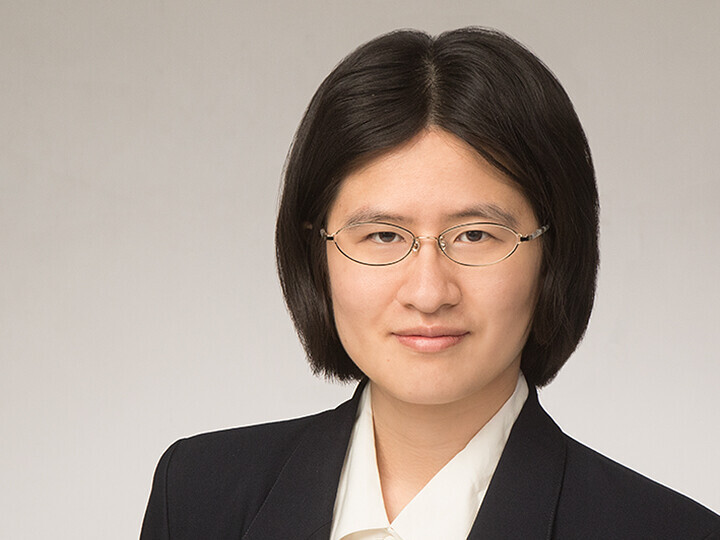
Yanghua Shi is a PhD Student in Finance and Researcher at the Chair of Finance , University of Mannheim (Business School). His research focuses on corporate finance, financial markets, quantitative finance, blockchain, and behavioral finance. He has co-authored publications on cryptocurrency design features, intraday investor behavior, and the financial implications of biodiversity-related regulatory shocks. Education Ph.D. in Finance (2019–2025), University of Mannheim Mannheim Master in Business Research (2019), University of Mannheim B.Sc. in Business Informatics (2017), University of Mannheim Research Interests Empirical asset pricing Investment analysis Cryptocurrency and sustainability Political ties in financial markets Blockchain centralization risks Collaborations He works closely with Prof. Erik Theissen, Prof. Martin Weber (University of Mannheim), Prof. Stefan Reichelstein (Stanford University), and Prof. Oliver Spalt. His job market paper in 2024 explores biodiversity legislation’s impact on municipal bond yields.
Carlos Manuel José Alves Serôdio is an Associate Professor with Habilitation at the Engineering Department of the School of Sciences and Technology, University of Trás-os-Montes and Alto Douro. He is a Senior Researcher and member of the Embedded Systems Research Group (ESRG) and Industrial Electronics R&D Group at ALGORITMI Center (University of Minho). Previously, he collaborated with CITAB from Fev. 2016 to Dec. 2023. His research expertise spans Wireless Sensor Networks, Precision Agriculture, Smart Cities, and Indoor Localization . Recent publications highlight work in Cybersecurity for Connected Vehicles, Edge AI for Anomaly Detection, and Sustainable Irrigation Systems , reflecting interdisciplinary applications of IoT, 6G, and Blockchain technologies. With an h-index of 12 and 81 citations , Serôdio has supervised 60 MSc and 5 PhD students. He has contributed to program committees of international conferences and served as a reviewer for journals. His lab affiliations include ESRG (ALGORITMI) and CITAB (UTAD) .
Henrique Manuel Dinis Santos is an Associate Professor with Habilitation at the Universidade do Minho 's Information Systems Department , affiliated with the ALGORITMI R&D Centre , specifically the Computer Communications and Pervasive Media (CCPM) R&D Group and the Urban Informatics Lab . His research focuses on Information Security (Intrusion Detection, Security Management, Biometric Technologies) and Computer Architecture (Computer Vision, Cloud Computing). He co-authored a biometric patent (2012) and leads national and international technical committees, including NATO projects under the Smart Defense initiative. Education: B.Sc. in Electric and Electronic Engineering (University of Coimbra, 1984), Ph.D. in Computer Engineering (Universidade do Minho, 1996), Habilitation Degree (2013) Leadership Roles: President of CT 136 Technical Committee for cybersecurity standardization, President of the Portuguese Association for Data Protection (APPD), and Editor-in-Chief of the EAI Endorsed Transactions on Smart Cities . His recent work explores blockchain applications in public sector tokenization, IoT security in smart campuses, and smart city infrastructure . He has served as a guest editor and technical committee member for conferences like EAI IoECon 2023 and the International Congress on Blockchain and Applications 2024 . Scientific awards include the biometric patent and leadership in national cybersecurity standardization.
Justin Rietz is an Associate Professor in the Department of Economics at San José State University’s College of Social Sciences. His research focuses on the theory of money, experimental economics, and blockchain applications, combining interdisciplinary approaches with anthropology to explore prehistoric economic systems and modern monetary policy. His recent work includes experimental studies on the origins of money, simulations of prehistoric European salt economies, and blockchain innovations like TontineCoin and SharedWealth protocols. During the pandemic, he co-developed a public economics dashboard tracking San Jose metro economic conditions, featured in media outlets like the San Jose Mercury News and Silicon Valley Business Journal. Research keywords span experimental economics, monetary theory, blockchain technology, and decentralized finance. His work bridges historical economic models with contemporary digital currency challenges, emphasizing interdisciplinary collaboration and practical policy applications.
Shenja van der Graaf is an Associate Professor in Communication Science affiliated with the Digital Society Institute. Her research spans digital inclusion, smart cities, and human-AI interaction, with a focus on societal implications of technology. PhD from London School of Economics (2009) on user creativity in digital platforms Key collaborator in EU projects like m-RESIST and Families-Share Recognized as an Artificial Intelligence Expert by UN Sustainable Development Goals Research Themes: Digital equity for impoverished households, algorithmic governance of public spaces, energy transition using blockchain/DLT, and psychological effects of climate doomscrolling. She combines qualitative methods with technical analysis of platforms. Recent Trends: 15 most recent publications (2023-2025) examine digital inclusion barriers , urban commons governance , smart city co-creation , and mental health impacts of social media . Her work bridges technical systems with human behavior. Scientific Contributions: Systematic reviews on poverty-related ICT appropriation, plus pioneering studies on prosumer business models in electricity markets. Awards include recognition as a UN Sustainable Development Goals expert in AI's societal context.
Gustavo A. Oliva is an Adjunct Professor at Queen's University in Canada, where he leads the blockchain research team at the Software Analysis and Intelligence Lab (SAIL). His research focuses on enabling cost-effective decentralized applications on programmable blockchain platforms like Ethereum, alongside empirical studies in software ecosystems, code analytics, and explainable AI. Dr. Oliva earned his PhD from the University of São Paulo (USP) in Brazil under Professor Dr. Marco Gerosa. Prior to his current role, he was a Post-Doctoral Fellow at Queen's University supervised by Professor Dr. Ahmed Hassan. His primary research spans programmable blockchains, software ecosystems (particularly npm), code analytics, and explainable AI. He employs static analysis, historical repository mining, and machine learning to investigate software evolution, dependency management, and smart contract development. Current projects address gas efficiency challenges in Ethereum, upgradeability patterns in smart contracts, and the impact of foundation models on software engineering practices. Recent publications reveal a dominant focus on blockchain systems (70% of recent work), with growing emphasis on foundation model challenges (FMware). His Ethereum research explores transaction processing, gas optimization, and technical debt, while newer work catalogs software engineering challenges in trustworthy AI-powered systems. Scientific recognition includes: Microsoft Azure for Research sponsorship Capes/CNPq scholarship for Visiting Research at Queen's University (2014) HPE scholarships for Smart Cities and Cloud Service Choreography projects European Commission FP7 funding for CHOReOS project Dr. Oliva actively mentors 8+ students across academic levels. His PhD advisees include Muhammad Ahasanuzzaman (ongoing), Amir Mohammad Ebrahimi, and Filipe Cogo (now at Huawei). Master's students Michael Pacheco and Ahmad Abdullah Zarir now work at Huawei and Amazon respectively. He also supervises visitor and undergraduate researchers in blockchain projects. His service includes program committees for ICSE, SANER, and MSR conferences, plus tutorial leadership at ASE, KDD, and FSE. As director of SAIL's blockchain research team, he manages projects on Ethereum smart contract analysis, npm dependency ecosystems, and AI-driven software engineering. Current initiatives include SPICE (automated issue labeling) and foundational work on trustworthy FMware development, with industry collaborations at Huawei and Amazon.
Dinh Emmanuel is an active Lecturer specializing in international tax law with a prolific publication record spanning over a decade. His academic work primarily appears in prominent French tax law journals including International Taxation (Fiscalité Internationale), Tax Law Review (Revue de droit fiscal), and La Semaine Juridique. His research interests focus on international tax law , particularly in the areas of cross-border taxation, dividend distribution mechanisms, interest payments, royalty taxation, and cryptocurrency tax treatment. His work frequently addresses contemporary issues in tax treaty interpretation, BEPS (Base Erosion and Profit Shifting) implementation, and EU anti-tax avoidance directives. Dr. Emmanuel's publication pattern shows consistent scholarly output with multiple articles annually, including comprehensive year-end chronicles of international tax developments. His most recent work in 2024 demonstrates ongoing active research in the field. He frequently collaborates with other tax scholars including Ardouin J. and Perrot T., suggesting participation in academic networks or research groups focused on tax law. His research demonstrates particular expertise in the practical application of tax treaties, analysis of dividend, interest and royalty flows between jurisdictions, and emerging challenges in digital asset taxation. The consistent publication in specialized tax journals indicates recognition within the tax law academic community.
Giuseppe Dari-Mattiacci is Professor of Law and Economics at the University of Amsterdam's Amsterdam Law School, where he directs the PhD Program in Legal Studies. He holds a Research Fellowship at Tinbergen Institute and is a Research Member of the European Corporate Governance Institute (ECGI). Previously, he served as Alfred W. Bressler Professor at Columbia Law School and held visiting positions at NYU, University of Chicago, and Georgetown. His research integrates law, economics, and history to study institutional evolution, property rights, and contract theory. Key interests include: The impact of formal property rights on social behavior (validated through field experiments in West Africa) Comparative analysis of legal institutions across historical contexts Design of efficient regulatory frameworks and enforcement mechanisms Economic foundations of corporate governance and business organizations His publications demonstrate a consistent focus on how legal rules shape economic incentives, with recent work exploring blockchain-based property systems and inequality-adjusted penalty structures. Honors include the Oliver Williamson Prize (2018) and Distinguished Article Prize (2014). He has secured grants from NWO, EU programs, and the Ruebhausen Fund at Yale. As President of the European Association of Law & Economics (2017–2020), he shaped continental research agendas. He leads interdisciplinary teams exploring AI's legal implications and resilient institutional design.
Dr. Tao Zhang is a Full Professor at the School of Computer Science and Engineering, Macau University of Science and Technology (MUST), Macau SAR. He serves as an Associate Editor for IEEE Transactions on Software Engineering (TSE), IEEE Transactions on Reliability (TRel), and the Journal of Systems and Software (JSS), and is an Editorial Board Member for Empirical Software Engineering (EMSE) and Science of Computer Programming (SCP). His educational background includes: Ph.D. in Computer Science from the University of Seoul B.S. in Automation and M.Eng in Software Engineering from Northeastern University, China Postdoctoral Research Fellow at Hong Kong Polytechnic University Dr. Zhang's research primarily focuses on three interconnected areas that represent the cutting edge of modern software engineering: AI for Software Engineering : Utilizing neural language models and large language models to create automated software engineering tools that help developers produce high-quality software. His work includes evaluating whether pretrained language models truly understand software engineering tasks and developing universal representations for bug reports. Software Security : Employing static analysis, AI technologies, and formal methods to detect malware, vulnerabilities, and privacy leaks in mobile apps and smart contracts. His research spans Android malware detection, smart contract vulnerability analysis, and state manipulation attacks in blockchain systems. Mining Software Repositories : Applying information retrieval and machine learning to extract meaningful insights from software artifacts to improve development efficiency. This includes work on app review analysis, change request localization, and code similarity metrics. His publications demonstrate significant impact across the software engineering community, with over 100 high-quality papers in top venues including ICSE, ESEC/FSE, ASE, TSE, TOSEM, EMSE, JSS, TIFS, and TDSC. Dr. Zhang has received numerous honors and recognitions: Distinguished Member, China Computer Federation (CCF), September 2025 Top Reviewer Award 2023, Journal of Systems and Software (JSS), April 2024 Distinguished Reviewer in 2023, ACM Transactions on Software Engineering and Methodology (TOSEM), February 2024 Senior Member of ACM (October 2020) and IEEE (February 2020) Best Paper Award, 16th Korea Conference on Software Engineering (KCSE), February 2014 As an academic leader, Dr. Zhang serves/served as General or Program Chair for numerous conferences including APSEC 2025, Internetware 2024, SANER 2023, and DSA 2021. He mentors a vibrant research group with multiple postdocs, PhD students, and master's students working on innovative projects in intelligent software engineering and security. His lab actively recruits highly motivated students interested in Data Mining, Artificial Intelligence, Software Security, and Software Engineering. Dr. Zhang leads the "Intelligent Software Data Analysis and Software Security" research team at MUST, which focuses on leveraging AI technologies to solve critical challenges in software development and security. The team maintains strong collaborations with international researchers and regularly publishes in top-tier venues.
Carl Victor von Wachter is a Research Fellow at the Department of Computer Science's Programming Languages and Theory of Computation group within the Faculty of Science at the University of Copenhagen. His research centers on blockchain infrastructure and decentralized finance (DeFi), with significant contributions to token design, equity crowdfunding mechanisms, and financial system analysis on blockchain platforms. His core research interests include: Blockchain-based token economics for financial applications Miner Extractable Value (MEV) and transaction ordering optimization Asset composability metrics in DeFi ecosystems Smart contract security and regulatory implications Decentralized financial infrastructure design von Wachter's publications demonstrate consistent focus on practical DeFi implementations, with recent work analyzing blockchain tokens for equity crowdfunding (2024) and foundational DeFi infrastructure (2023 PhD thesis). His research bridges computer science and finance, emphasizing real-world applicability of cryptographic systems. His work shows strong academic impact with over 100 citations across Scopus and significant attention from news outlets and research communities (209+ Mendeley readers). Collaborative efforts with researchers like Jensen and Ross highlight interdisciplinary teamwork in blockchain analysis. Based at Universitetsparken 5 in Copenhagen, he maintains active research output through the University of Copenhagen's Department of Computer Science, with ongoing investigations into blockchain scalability and financial integration.
Professor Jingrong (Karen) Lin serves as Professor of Accounting at the University of Massachusetts Lowell's Manning School of Business, where she teaches financial disclosure, reporting, and data analytics to undergraduate through PhD students. Her research examines accounting's role in reducing transaction costs within institutional frameworks, with specialized focus on emerging markets like China. Education: BA in Accounting from Sun Yat Sen University, Guangdong Province, China MS in Industrial Administration Accounting from Carnegie Mellon University, Pittsburgh, PA PhD in Accounting from The Chinese University of Hong Kong Research Focus: Professor Lin investigates financial reporting mechanisms, corporate governance structures, and ESG integration through the lens of agency theory. Her work frequently analyzes political connections in Chinese markets, examining how board composition, shareholder activism, and CEO characteristics influence corporate decisions. Recent research explores blockchain's impact on supply chain earnings management and gender dynamics in green investment strategies, consistently bridging theoretical frameworks with real-world institutional contexts. Publication Trends: Lin's scholarship demonstrates evolving emphasis from foundational corporate governance topics toward technology-driven accounting (blockchain applications) and ESG integration since 2020. Her China-focused empirical work maintains consistent methodological rigor while expanding into geopolitical risk analysis and Belt and Road Initiative impacts, reflecting growing interdisciplinary connections between accounting, finance, and sustainability disciplines. Award Recognition: Best Paper Award (2023) - American Accounting Association Annual Conference Teaching Excellence Award (2022) - UMass Lowell Manning School Research Award - Accounting (2021) - Manning School Multiple Teaching Excellence Awards (2019, 2017) Global Learning Grant (2015) for international research initiatives Professional Background: Prior to academia, Professor Lin gained industry experience as a tax consultant at PricewaterhouseCoopers (PwC) and Internal Audit consultant for a multinational textile corporation. She maintains active engagement through conference presentations at AAA and FMA meetings, while her Chinese CPA qualification informs cross-border research perspectives. Current projects examine employee integrity's impact on information quality and geopolitical risk transmission mechanisms in global investment decisions.
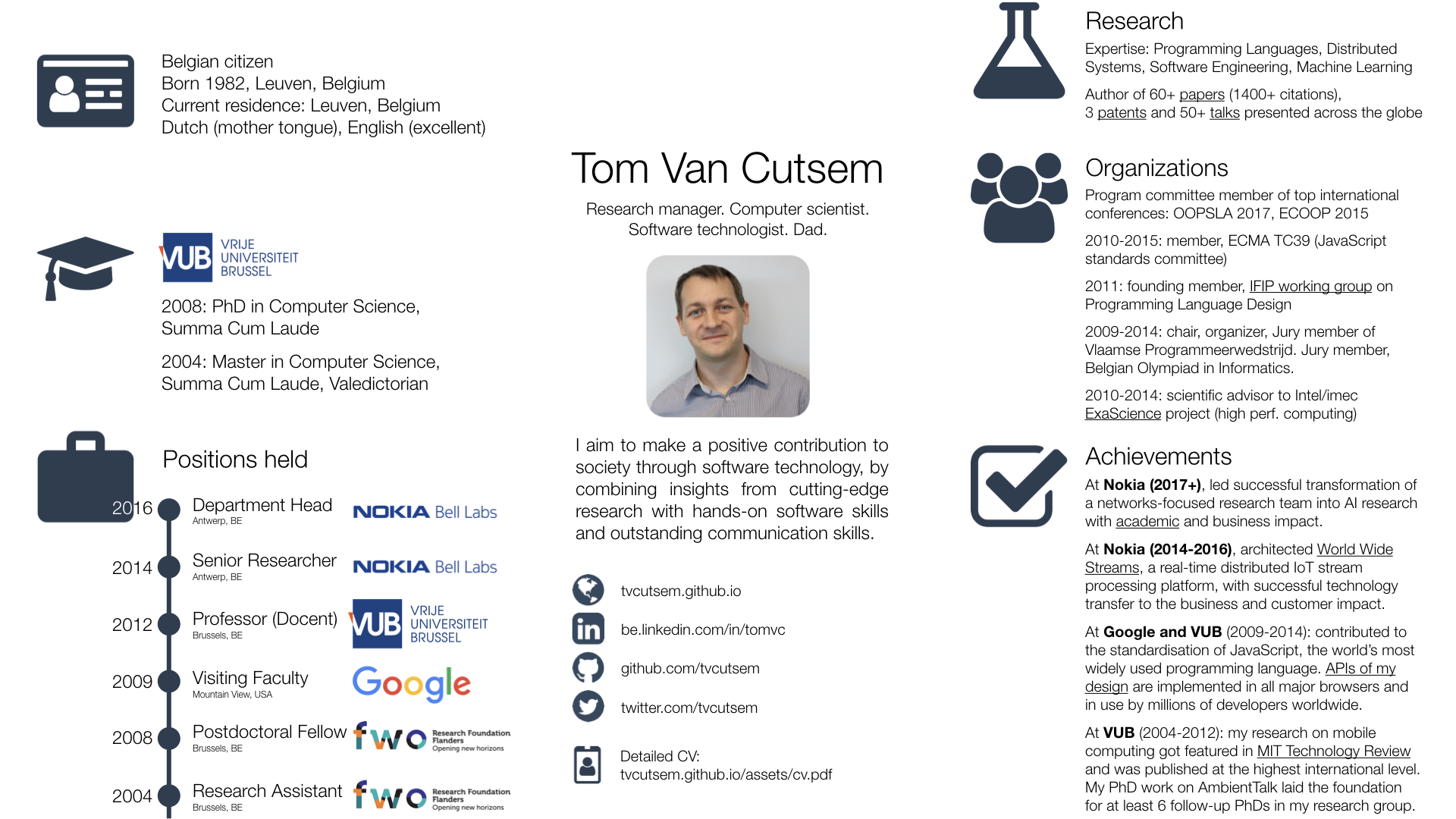
Tom Van Cutsem is an Associate Professor of computer science at KU Leuven in Belgium, where he is affiliated with the Distributed and Secure Software (DistriNet) research group within the Faculty of Engineering Science and Department of Computer Science. He also maintains an affiliation with Nokia Bell Labs, where he previously served as a Research Department Head with research interests in decentralized systems, IoT, stream processing and machine learning for software engineering. His academic career includes a previous position as Assistant Professor at Vrije Universiteit Brussel from 2010 to 2014. Dr. Van Cutsem holds a PhD in Computer Science from Vrije Universiteit Brussel. His educational background has provided the foundation for his expertise in distributed systems, programming languages, and software security. His primary research interests span Distributed Systems , Software Security , Blockchain , and Programming Language Design . With the DistriNet research group, he pursues work on decentralized systems, IoT, stream processing, and machine learning for software engineering. His research focuses on making distributed systems more secure, reliable, and accessible, with particular attention to blockchain technology and Web3 infrastructure. He is a founding member of IFIP WG 2.16 on Programming Language Design. His recent publications demonstrate a strong focus on blockchain security and infrastructure, with numerous papers on Web3, smart contracts, and decentralized systems from 2023-2025. His work addresses critical challenges in blockchain validation, smart contract security, and Web3 infrastructure, reflecting his commitment to making decentralized systems more secure and accessible to low-resource participants. Several of his current projects focus on secure middleware for smart contracts and scalable infrastructure for self-sovereign applications. Dr. Van Cutsem supervises PhD students including Weihong Wang, with whom he has co-authored multiple recent publications. He is currently leading several research projects including SODISA (Scalable Software Development and Infrastructure for Self-sovereign Applications), Secure Sandboxing for WebAssembly-based Smart Contracts, and Programming languages for privacy-preserving and verifiable computing, with funding extending through 2028-2029. He leads research within the Distributed and Secure Software (DistriNet) group at KU Leuven, which focuses on creating secure and dependable distributed systems. His team works on cutting-edge challenges in blockchain infrastructure, smart contract security, and decentralized application development, with connections to both academic and industrial partners including Nokia Bell Labs.
Prof. Björn Scheuermann is a Professor in the Department of Computer Science at Technische Universität Kaiserslautern, Germany. His research focuses on network security, decentralized systems, privacy-preserving technologies, and distributed algorithms. He has contributed to foundational work on anonymization protocols (e.g., Tor improvements), blockchain systems, and vehicular networks. His work often bridges theoretical computer science with practical implementations in domains like satellite communication and industrial IoT. Key areas of research include: Decentralized Systems: Analysis of IPFS, Bitcoin, and blockchain architectures. Anonymity Networks: Improving Tor's fairness and privacy guarantees. Network Security: Collaborative intrusion detection in SDN, firewall acceleration via FPGA. Wireless & Satellite: Optimizing data transmission for low-earth-orbit satellites and industrial sensors. Recent trends in his publications emphasize: Integration of machine learning for adaptive network security (e.g., COML-IDS framework). Dynamic routing protocols for fault tolerance (e.g., OD³R). Privacy in emerging technologies like mobile data donation apps and decentralized storage. His work has been published in top-tier venues like IEEE/ACM Transactions, IFIP Networking, and ACM SIGCOMM workshops. Collaborations span academia and industry, focusing on practical applications of secure and efficient network architectures.
Dr. Daniel Rabetti is an Assistant Professor of Accounting and Finance at the National University of Singapore (NUS) Business School, holding the S. Dhanabalan Chair in Quantitative Studies since 2023. He concurrently serves as a visiting scholar at Harvard Business School and holds courtesy appointments in Finance at NUS. His research focuses on financial economics, blockchain innovation, and regulatory challenges in decentralized finance (DeFi), with particular emphasis on cryptocurrency markets, tax policy, and cybercrime prevention. Rabetti advises fintech ventures and contributes to policy discussions through engagements with institutions like the IMF and SEC. Education: Ph.D. in Business (Tel Aviv University, 2023); M.A. in Financial Economics (Interdisciplinary Center Herzliya, 2017); B.A. in Business Administration-Finance (Interdisciplinary Center Herzliya, 2014). Research Interests: Rabetti explores blockchain's transformative impact on financial systems, including DeFi protocols, crypto-enabled cybercrimes, and tax compliance strategies. His work bridges academic rigor with practical policy implications, addressing issues like audit quality in decentralized systems and regulatory frameworks for digital assets. Key Contributions: His paper on crypto-enabled cybercrimes was awarded the Best Conference Paper and featured in major media outlets. He has presented at prestigious venues like the Western Finance Association and the Securities and Exchange Commission. His research informs global regulatory bodies and underpins tax policy recommendations for digital asset taxation. Awards: Recognized for impactful scholarship in fintech and blockchain governance. Advising & Grants: Rabetti advises fintech startups and leads research initiatives at NUS Fintech Lab and the Asian Institute of Digital Finance (AIDF). His work is supported by grants from Ripple UBRI, Israel Science Foundation, and Cornell FinTech Initiative. Labs & Teams: Active in DEFT Labs, Cornell Fintech Initiative, and the Nanyang Blockchain Conference organizing committee.
Cheng Tan is an Assistant Professor at the Khoury College of Computer Sciences, Northeastern University, and a member of the Systems Research Group. His research focuses on computer systems, with an emphasis on verifying outsourced services, including ML systems, concurrent systems, and execution on untrusted servers. Ph.D. in Computer Science from Courant Institute, NYU (2020), advised by Michael Walfish. M.S. and B.E. from Fudan University and Nanjing University, respectively. Cheng Tan's research explores verification mechanisms for systems relying on machine learning and untrusted environments. Key areas include ML system robustness , consistency models , and secure execution . His work addresses challenges in trusted computing, such as adversarial attacks, encrypted databases, and decentralized services. His recent publications span conferences like SOSP, ASPLOS, NeurIPS, and EuroSys. Common themes include neural network verification , secure systems , and concurrency control . These studies often leverage formal methods to ensure correctness in complex environments. Scientific Awards : MSR Asia StarTrack Scholar (2024), ASPLOS Distinguished Artifact Award (2023), NSF CAREER Award (2023), NYU Janet Fabri Prize (2021), SOSP Best Paper Award (2017). Cheng Tan advises PhD students Jian Zhang, Brent Zhao, Shuyi Lin, and Zikai Wang. He has taught courses such as LLM systems (CS7670), Operating Systems Implementation (CS6640), and Computer Systems (CS3650, CS5600). He also serves on program committees for conferences like OSDI, MLSys, and ATC.