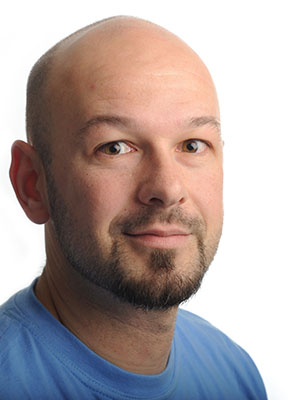
Jishnu Das is a PhD Research Fellow at the Department of Information Systems, University of Agder. His work focuses on e-health, ontology & semantics, and AI-driven health data analysis. He actively contributes to interdisciplinary research in healthcare technologies. Research Keywords: Health Information Systems Machine Learning Data Visualization Clinical Decision Support Das specializes in integrating statistical analysis, semantic ontologies, and AI methods to analyze public lifestyle datasets and develop health monitoring frameworks. His recent publications emphasize knowledge management in clinical practice and wearable sensor applications. Research collaborations include contributions to population-level gene regulatory network analysis and pandemic response systems. He is affiliated with the Centre for e-health at UiA.
Koen Gerard Alois Vervaeke is a Professor at the University of Oslo in the Faculty of Medicine , leading the Vervaeke Lab . His research focuses on understanding how brain circuits transform complex sensory inputs into coherent perceptions, with emphasis on dendritic integration and cortical network dynamics. 2011-2014: Janelia Farm Research Campus – Junior Fellow (Mentors: Karel Svoboda, Jeff Magee) 2007-2011: University College London – Postdoctoral Researcher (Angus Silver Lab) 2002-2007: University of Oslo – PhD in Physiology (Johan Storm Lab) Research Themes Neocortical processing of sensory information Dendritic integration of internal and external inputs Computational modeling of neural circuits Optogenetic manipulation in perceptual tasks In vivo two-photon imaging and electrophysiology Article Trends (2007-2025): Focus on hippocampal spatial coding (VIP interneurons, place cells), neocortical sensory integration, gamma oscillations, and astrocytic Ca 2+ signaling. Methodologies include in vivo imaging, dynamic clamp, and computational modeling. Scientific Awards ERC Starting Grant (2015) FRIPRO Young Research Talents Grant (2014) The lab combines experimental (mice behavioral studies, two-photon imaging) and computational approaches to model neural circuit operations. Their work aims to establish frameworks for understanding brain dysfunction in neuropsychiatric disorders.
Ole Jakob Elle is a Professor II at the University of Oslo's Department of Informatics, affiliated with the Research Group for Robotics and Intelligent Systems (ROBIN) and the Strategic Research Initiative in Multimodal Medical Imaging and Image Analysis (MEDIMA). His work focuses on advancing medical robotics, computer-aided surgery, and AI-driven solutions for healthcare. Key areas include cardiac monitoring, holographic surgical planning, and robotic systems for minimally invasive procedures. Research interests span artificial intelligence, medical imaging, surgical navigation, and adaptive systems. Notable contributions include developing HoloPatch for intracardiac surgery planning and algorithms for real-time echocardiography guidance. His interdisciplinary approach integrates robotics, computer vision, and clinical applications to enhance surgical precision and patient outcomes. Publications highlight advancements in neural networks for valve detection, mixed reality applications in surgery, and AI-based medical data structuring. Collaborations involve clinicians, engineers, and computer scientists to address challenges in cardiac defects, laparoscopic surgery, and remote medical mentoring. Elle’s work is published in journals like Scientific Reports , European Heart Journal , and Computer Methods and Programs in Biomedicine , reflecting his impact on translational medical research and technology development.
Valeria Vitelli is an Associate Professor in Statistics at the Oslo Centre for Biostatistics and Epidemiology, University of Oslo, where she has been faculty since 2018. Her research spans high-dimensional and functional data analysis, Bayesian methods, clustering, and preference learning. As a Principal Investigator, she leads projects within the Norwegian Centre for Knowledge-driven Machine Learning (Integreat), funded by the Norwegian Research Council. Education: PhD in Statistics, Politecnico di Milano, Italy (2012) MSc in Mathematical Engineering (cum laude), Politecnico di Milano, Italy (2008) Bachelor in Mathematical Engineering (cum laude), Politecnico di Milano, Italy (2006) Dr. Vitelli's research focuses on developing statistical methods for complex high-dimensional data, with applications spanning biomedical research, cancer genomics, and precision medicine. Her work integrates Bayesian inference, machine learning, and functional data analysis to address challenges in modern biostatistics. She has made significant contributions to ranking models, clustering algorithms, and methods for analyzing curves and intrinsically smooth processes. Her publication record demonstrates strong interdisciplinary collaboration across medicine, particularly in cancer research, ophthalmology, and neurology. Recent work shows a clear trend toward developing novel statistical frameworks for integrating complex datasets in precision medicine applications, with emphasis on Bayesian approaches and high-dimensional data analysis. Scientific Recognition: Principal Investigator for the Norwegian Centre for Knowledge-driven Machine Learning (Integreat) Awarded major FRIPRO grants from the Research Council of Norway Dr. Vitelli actively mentors students and researchers in statistical methodology development. Her grant portfolio includes significant funding from the Norwegian Research Council for projects focused on Bayesian clustering methods for high-dimensional omics data. She teaches courses including "Introduction to Machine Learning in Biomedical Research" and "Statistical Principles in Genomics" for medical students and PhD candidates. She leads a research group focused on statistical models for high-dimensional and functional data within the Oslo Centre for Biostatistics and Epidemiology, collaborating closely with medical researchers across various specialties to develop and apply advanced statistical methods to biomedical challenges.
Asma Belhadi is a Postdoctoral Fellow at Oslo Metropolitan University's Faculty of Technology, Art and Design, Department of Computer Science. Her research focuses on Applied Artificial Intelligence, bridging domains like Neuroscience, Medical Technology, and Intelligent Transportation Systems through innovative methodologies such as Visual Transformers, Federated Learning, and Graph Algorithms. Primary affiliation: Oslo Metropolitan University Academic discipline: Computer Science Research areas: Deep Learning, Explainable AI, Biomedical Signal Processing, Sustainable Systems Her recent work explores cross-domain applications including: EEG classification using enhanced visibility graphs Medical imaging with ensemble fuzzy deep learning Secure pattern mining for Medical Internet of Things Knowledge-enhanced object detection for agriculture Metaverse security using transformer models and GANs
Pål Halvorsen is a Professor at the Department of Computer Science within the Faculty of Technology, Art and Design at Oslo Metropolitan University. He works at the intersection of computer science and applied domains, with a particular focus on multimedia systems, distributed computing, and healthcare applications. Specializes in distributed multimedia systems Active in AI-driven forensic psychology applications Conducts research on medical imaging and diagnostics Develops sports analytics datasets and tools Works on communication and distributed systems His research spans several key areas of computer science, particularly focusing on multimedia systems and their applications in healthcare, sports analytics, and forensic psychology. He leads projects involving AI-driven child avatars for investigative interview training, develops datasets for medical and sports applications, and explores innovative approaches to image analysis and time-series data processing. Recent publications demonstrate strong activity in applying computer vision and deep learning to medical diagnostics, particularly in gastrointestinal tract analysis and ophthalmology. His work on sports analytics includes creating comprehensive datasets for ice hockey and soccer, while his forensic psychology research focuses on AI-enhanced interview training for child abuse investigations. Halvorsen collaborates extensively across disciplines, working with researchers in psychology, medicine, and sports science. His projects often involve developing novel tools for data analysis, including approaches to multimodal data handling, visual deep learning verification, and AI-enhanced prompt generation techniques.
Leiv Rønneberg is a Postdoctoral Fellow in Statistics and Data Science at the University of Oslo (UiO), with a primary affiliation at the Department of Mathematics. His research focuses on Bayesian statistical methods, machine learning, and data science, particularly applied to biomedical and astrophysical domains. Key research trends in his publications include: Development of flexible Bayesian models (FlexKnot, bayesynergy) for complex datasets Applications in 21 cm cosmological signal processing and drug combination analysis Creation of bioinformatics tools (screenwerk) for experimental design Interdisciplinary work spanning astrophysics, pharmacology, and sports science Scientific Awards: No awards explicitly mentioned in the provided text. Students: No advisees or students listed in the current description.
Hilda Bø Lyng is an Associate Professor in Health Service Safety at the University of Stavanger's Faculty of Health Sciences and Department of Quality and Health Technology. Her work focuses on resilience engineering, healthcare management, and knowledge transfer across industries. Current role: Associate Professor Primary affiliation: University of Stavanger Research domains: Healthcare resilience, adaptive capacity, knowledge transfer Her research explores how healthcare systems develop resilience through leadership strategies, digital technologies, and collaborative learning. She investigates adaptive capacity in hospital teams, knowledge boundaries in quality improvement, and mental wellbeing support for aged care workers. Recent publications analyze resilience operationalization frameworks, pandemic response strategies, and tools for translating resilience into practice. These works span journals like Applied Ergonomics , BMC Health Services Research , and International Journal of Health Governance . Collaboration networks include researchers from Norway, Australia, and European institutions working on resilience programs. She contributes to policy development through empirical studies and theoretical frameworks. Techniques like analogical objects and cross-industry innovation models appear in her methodology, addressing knowledge integration challenges between healthcare and other sectors.
Marius Causemann is a Postdoctoral Researcher in the Numerical Analysis and Scientific Computing department at Simula Research Laboratory , focusing on computational modeling of brain mechanics and fluid dynamics. His work bridges mathematics, neuroscience, and biomedical simulation through high-fidelity numerical methods. Research Interests include: Computational Neuroscience Biomechanics of Gliovascular Systems Poroelastic and Fluid-Structure Interaction Models Numerical Methods for Multi-Physics Problems Mathematical Physiology His recent publications emphasize in-silico modeling of molecular clearance in intracranial spaces, dual-poroelasticity solvers, and high-resolution meshing of brain tissues. These works contribute to understanding glymphatic pathways, neurovascular coupling, and cerebrospinal fluid dynamics.