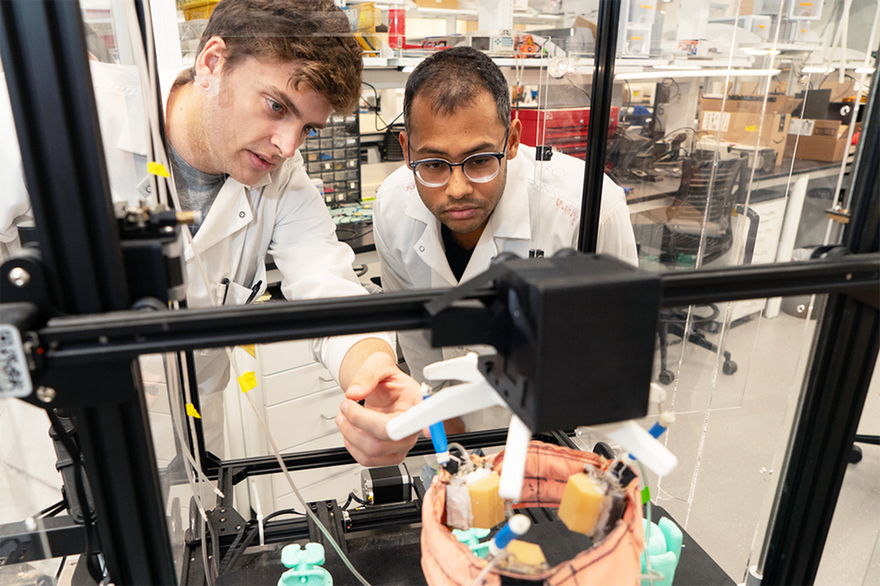
Victoria Webster-Wood is an Associate Professor at the College of Engineering , Carnegie Mellon University , where she leads the Biohybrid and Organic Robotics Group (B.O.R.G) . Her research integrates organic materials into robotics as structures, actuators, sensors, and controllers for biohybrid robots and prosthetics. Education: Ph.D., Mechanical Engineering, Case Western Reserve University (2017) M.S., Mechanical Engineering, Case Western Reserve University (2013) B.S., Mechanical Engineering, Case Western Reserve University (2012) Research Interests focus on biohybrid robotics , biologically inspired systems , soft robotics , additive manufacturing , biomechanics , and computational modeling . Her work spans applications in medical robotics , micro/nano manufacturing , and environmental monitoring . Scientific Awards include being named to ASME’s 2025 MechE Watch List and awarded MIT Technology Review’s 35 Innovators Under 35 (2023) . Collaborations involve projects like neurodegenerative disease therapy tools and soft robotic tactile sensors for manufacturing , supported by the Manufacturing Futures Institute and NextManufacturing Center .
Victoria Webster-Wood is an Associate Professor of Mechanical Engineering at Carnegie Mellon University, with courtesy appointments in Biomedical Engineering, Materials Science and Engineering, and the Robotics Institute. She leads the Biohybrid and Organic Robotics Group (B.O.R.G.), focusing on developing robots using organic materials for applications in biohybrid prosthetics and medical devices. Her research bridges robotics, biomechanics, and materials science, emphasizing sustainable and biocompatible systems. Education : Ph.D. in Mechanical Engineering (2017), Case Western Reserve University (NSF Graduate Research Fellow, GAANN Fellow) M.S. in Mechanical Engineering (2013), Case Western Reserve University B.S. in Mechanical Engineering (2012), Case Western Reserve University Research Themes : Her work spans biohybrid robotics, soft robotics, and advanced manufacturing, with a focus on neuromechanical systems and bioinspired actuators. Recent projects include fungal-based robotics, 3D-printed biocompatible materials, and ethics in biohybrid technology. Lab & Affiliations : Biohybrid and Organic Robotics Group (B.O.R.G.) at CMU Affiliated with the Manufacturing Futures Institute and NextManufacturing Center Impact : Her research has been highlighted in CNN and Carnegie Mellon Engineering for innovations like mushroom-powered robots and ethical frameworks for living machines.
Sarah Bergbreiter is a Professor in the Department of Mechanical Engineering at Carnegie Mellon University (CMU), with a courtesy appointment in Electrical and Computer Engineering. She specializes in robotics, particularly in microrobotics, bioinspired systems, and soft robotics. Her research focuses on developing tiny, high-performance robots and understanding principles of energy-efficient, rapid mechanical systems. Education: B.S.E. in Electrical Engineering from Princeton University (1999), M.S. and Ph.D. in Mechanical Engineering from UC Berkeley (2004–2007). She joined CMU in 2018 after faculty positions at the University of Maryland. Key awards include the NSF CAREER Award (2011) and PECASE (2013). Research Interests: Microrobotics, bioinspired design (e.g., trap-jaw ants, spiders), legged/aerial robotics, soft materials for robotics, and sensor integration. Notable projects include the picotaur hexapedal robot and airflow sensors for micro aerial vehicles. She emphasizes interdisciplinary approaches, blending mechanical, electrical, and biomimetic engineering. Awards: DARPA Young Faculty Award (2008), Best IEEE ICRA Paper (2010), and leadership in NSF/NCS grants. Her work bridges fundamental science and applied robotics, addressing challenges in energy efficiency, miniaturization, and autonomy. Advising/Grants: While specific student names aren't listed, her research teams focus on robotics innovation. Grants include NSF-funded studies on sensorimotor control and microscale systems. She collaborates with CMU’s Robotics Institute and other institutions. Labs/Teams: Engages with CMU’s robotics community and leads projects in microrobotics, soft sensing, and biohybrid systems. Her lab develops novel fabrication techniques (e.g., 3D printing of actuators) and explores environmental sensing for small robots.
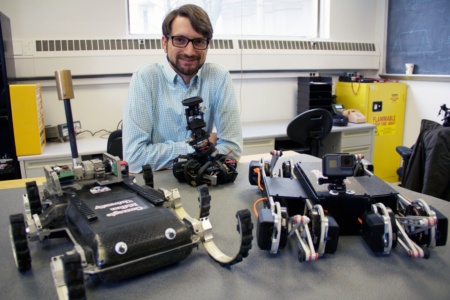
Aaron Johnson is a Professor in the Department of Mechanical Engineering at Carnegie Mellon University's College of Engineering, where he directs the Robomechanics Lab . He also holds courtesy appointments in the Robotics Institute and the Department of Electrical & Computer Engineering. His research focuses on enabling robots to operate robustly in complex, real-world environments through innovations in robot design, control, and interaction dynamics. Ph.D., Electrical & Systems Engineering, University of Pennsylvania (2014) B.S., Electrical & Computer Engineering, Carnegie Mellon University (2008) Johnson’s research interests lie at the intersection of legged robotics, adaptive control, bioinspired design, and physics-based planning . He investigates how robots can intelligently interact with unstructured environments—such as rocky terrain, cluttered homes, or industrial sites—by integrating mechanical design, sensor feedback, and intelligent control. His lab develops platforms like Zippy (the world’s smallest bipedal robot) and Picotaur , and works on dynamic behaviors including climbing, jumping, and navigating entanglements. The most recent publications highlight a strong trend in hybrid dynamical systems, robust state estimation, terrain-aware navigation, and ethical considerations in robotics . His group advances techniques in contact-implicit control, MPC, Kalman filtering for hybrid systems, and field deployment of autonomous robots for environmental monitoring. Themes of scalability, energy efficiency, and bioinspiration recur across the work. Johnson has received several prestigious awards: NSF CAREER Award (2020) Army Research Office Young Investigator Award (2019) Best Workshop Paper Award at ICRA 2022 (Quad-SDK) David Thuma Laboratory Project Award (2008) Honorable mention, CRA Outstanding Undergraduate Award (2008) He actively mentors students through his graduate course 24-775 Robot Design & Experimentation and lab outreach programs, including partnerships with Gwen’s Girls. He has secured grants for fielding legged robots in real-world applications, such as soil contamination sampling and hill climbing. Johnson co-organizes the CMU Locomotion Seminar and is committed to diversity, equity, and inclusion in robotics, co-authoring the Black in Robotics Reading List and advocating for ethical research practices. The Robomechanics Lab emphasizes ethical research, academic reform, equitable access, and community support. It develops full-stack frameworks like Quad-SDK and conducts field experiments in diverse environments—from deserts to power plants—pushing the boundaries of where robots can go and what they can do.