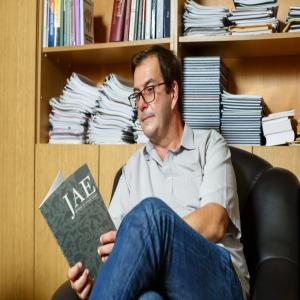
Boris BakotaView profile
Professor
Boris Bakota is a full Professor at the Faculty of Law, Josip Juraj Strossmayer University of Osijek, where he is affiliated with the Department of Administrative Law and Science. He has been an active faculty member since 1998 and has held leadership roles including Dean of the Faculty (2015–2017). He teaches courses in Administrative Science, Animal Rights, Comparative Public Administration, and Good Governance across multiple academic levels. His educational background includes a PhD in Law (2005) from the Faculty of Law in Osijek, a Master's degree (2001), and a law degree (1997), all from the same institution. His early professional experience includes roles in Croatian government agencies related to reconstruction and legal mediation. Bakota's research centers on public administration, local self-government, subsidiarity, and animal rights. He has made significant contributions to the understanding of EU integration impacts on Croatian governance and has emerged as a leading voice in animal ethics within legal academia. His work bridges comparative law, administrative science, and ethical philosophy, particularly in the treatment of animals in legal and institutional contexts. His recent publications show a strong trend toward interdisciplinary research, combining legal analysis with ethical and linguistic inquiry, especially in the area of animal rights and governance reform. He frequently publishes on subsidiarity, decentralization, and administrative innovation, often in international comparative contexts involving the EU and neighboring countries. Vukovar Memorial Medal Fellow of the Oxford Centre for Animal Ethics Bakota has supervised numerous academic works and has been active in editorial and advisory roles, including as Consultant Editor of the Journal of Animal Ethics . He has been involved in multiple international projects and networks, particularly through the Council of Europe and ENTO, where he served as President from 2012 to 2016. He has not been awarded major research grants in the text, but his leadership in professional networks indicates strong collaborative and advisory engagement. He is affiliated with several research and policy bodies, including the Croatian Academy of Legal Sciences, the Scientific Council of HAZU, the Croatian Institute of Local Self-Government, and the Group of Independent Experts for the European Charter of Local Self-Government at the Council of Europe. His international affiliations include the Cambridge Centre for Animal Rights Law.