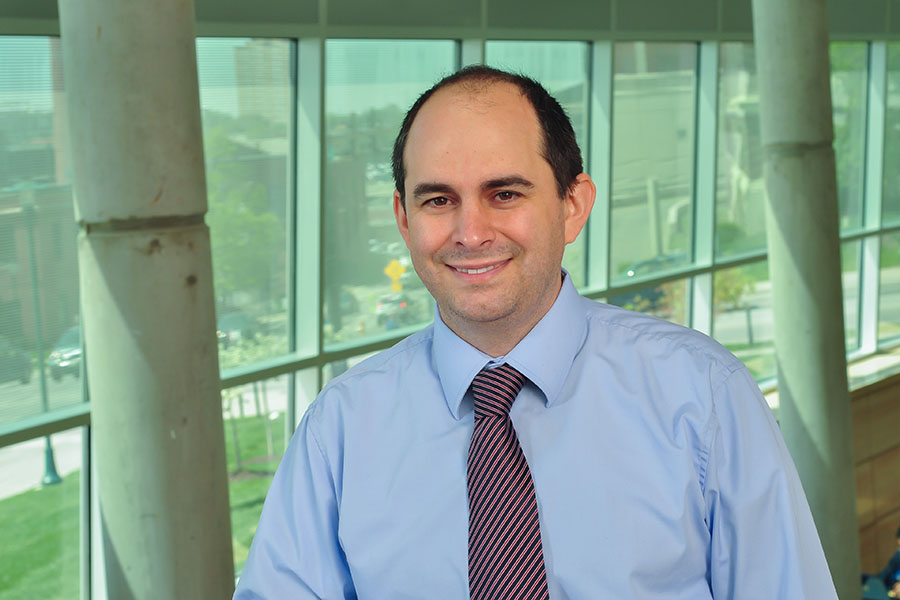
Martin Conda-SheridanView profile
Associate Professor
Martin Conda-Sheridan, PhD is an Associate Professor in the Department of Pharmaceutical Sciences within the College of Pharmacy at the University of Nebraska Medical Center (UNMC). His research program bridges medicinal chemistry and material sciences with a focus on developing novel therapeutic approaches for cancer and infectious diseases. Dr. Conda-Sheridan's research interests center on the design of complex multifunctional biomaterials and bioactive small molecules for medicinal applications. His laboratory focuses on two primary areas: the preparation of self-assembling biomaterials with therapeutic potential against cancer and infectious diseases, and computer-aided rational drug design and synthesis of heterocyclic small molecules to treat bacterial infections and cancer. These research efforts involve designing peptide amphiphiles, nanocarriers for targeted drug delivery, and novel antibacterial compounds targeting pathogens like Chlamydia trachomatis. His publication record demonstrates strong expertise in developing peptide-based therapeutics, nanoantibiotic systems, and structure-based drug design approaches . Recent work has focused on fine-tuning peptide-amphiphile nanostructures, developing covalent inhibitors for bacterial enzymes, and creating species-specific antimicrobial agents. His research integrates organic synthesis, computational chemistry, and biological evaluation to develop novel therapeutic strategies. Dr. Conda-Sheridan has contributed to significant scientific advancements including: Structural optimization of covalent inhibitors targeting Chlamydia trachomatis Engineering nanoantibiotic systems with dual mechanisms of action Developing urea-modified peptide amphiphiles for biomedical applications Designing stapled peptides targeting viral proteins His teaching interests include Medicinal Chemistry, Organic Synthesis, Biomaterials, and Drug Delivery, reflecting the interdisciplinary nature of his research program. Students in his laboratory gain skills in computer-aided drug design, organic synthesis, medicinal chemistry, and material sciences, along with analytical techniques including HPLC, NMR, and various microscopy methods.