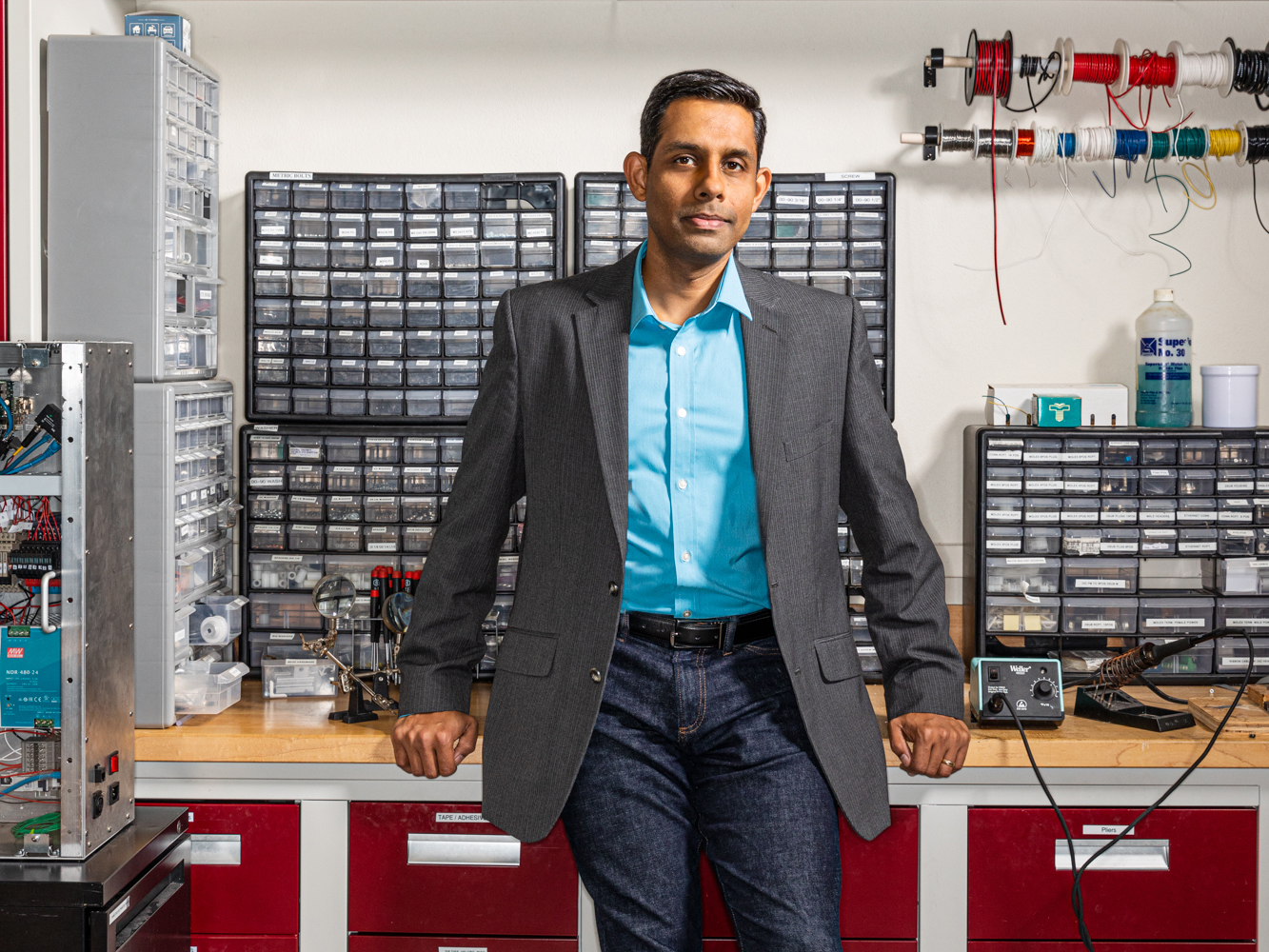
Ashish Deshpande is a Professor at the University of Texas at Austin, holding the Carroll D. Simmons Centennial Teaching Fellowship and Cockrell Family Regents Chair in Engineering. He is affiliated with the Department of Mechanical Engineering within the Cockrell School of Engineering. His research focuses on Robotics and Intelligent Mechanical Systems, Biomechanical Engineering, and Advanced Manufacturing, emphasizing exoskeleton design, human-robot interaction, and rehabilitation robotics. His work integrates biomechanical principles with robotic systems to enhance rehabilitation therapies, particularly for stroke patients and individuals with neuromuscular impairments. Key projects include the Harmony exoskeleton, BaRiFlex gripper, and novel bio-inspired actuators. He explores topics like stiffness modulation, kinematic control, and energy efficiency in wearable robotics. Recent publications (2023–2025) highlight advancements in exoskeleton design, control algorithms for multi-joint systems, and human-centric robotic interfaces. His research bridges engineering and clinical applications, aiming to improve motor recovery and functional independence through innovative robotic solutions. Dr. Deshpande's contributions also include frameworks for adaptive motor learning, curriculum design in robotic training, and methodologies for assessing human-robot interaction dynamics. His work addresses challenges in variable stiffness actuation, soft robotics, and sensor integration for precision control.
Ophelia Bolmin is an Assistant Professor in the Department of Mechanical Engineering at Carnegie Mellon University (CMU), within the College of Engineering. She leads the Mechanisms Inspired by Nature for Dynamics (MIND) Lab, where her research focuses on bio-inspired mechanical systems for dynamic tailoring with applications in aerospace, micro-robotics, and prosthetics. Her research interests include structural dynamics, biomechanics, physiology, multi-scale modeling, design, and manufacturing. She applies biology-oriented insights to engineering problems to accelerate technological innovation. Key areas of focus include: Additive manufacturing Finite-element modeling Vibrations and dynamic systems Bio-inspired design Systems modeling and simulation Nanoparticles and biological engineering Ophelia Bolmin's work is inherently interdisciplinary, bridging mechanical and aerospace engineering with biological systems. Although no publications are listed in the source text, her research direction emphasizes dynamic behavior in biological systems and the translation of these principles into engineered solutions. She has not been mentioned as receiving any scientific awards in the provided material. Ophelia mentors students through her MIND Lab and is actively involved in research grants and development, though specific grants and advisees are not listed. Her lab, the MIND Lab, serves as the central hub for innovation in bio-inspired dynamics, combining experimental and computational approaches to discover new science and develop advanced technologies.
Qian Mao is an Assistant Professor in the Department of Math/Computer Sci. at Whitworth University, joined in 2020. Specializes in Deep Learning, Cyber Security, and Wireless Networks. Holds dual Ph.D.s in Electrical Engineering (University of Alabama) and Traffic Information Engineering & Control (Tongji University). Research focuses on intelligent wireless networks, network coding, UAV communication systems, and steganography. Active in publishing on topics like deep learning applications, jamming countermeasures, and UAV protocols. Education: Ph.D. in Electrical Engineering (UA), Ph.D. in Traffic Information Engineering (Tongji), M.S. (Shanghai Ship & Shipping Research Institute), B.S. (Nanjing University of Aeronautics and Astronautics) Research interests blend machine learning with network systems, particularly in optimizing UAV swarm networks and securing wireless communications. Key contributions include adaptive transport layer control strategies and steganographic techniques. Over 20 peer-reviewed publications since 2015, with recent work exploring bio-inspired multi-beam transmission and ARMA model-based social media forecasting. Publications highlight interdisciplinary approaches to network security, data hiding, and autonomous systems. Current focus includes DL-driven network traffic analysis and UAV protocol design for computation-heavy applications.
David Gruber is a Distinguished Professor of Biology and Environmental Sciences at the City University of New York, with affiliations at Baruch College and the CUNY Graduate Center. He is also the Founder and President of Project CETI, a nonprofit interdisciplinary initiative focused on decoding sperm whale communication using advanced machine learning and robotics. His work bridges marine biology, climate science, animal communication, and bio-inspired technology. Education and Professional Background: Ph.D. in Biology (specific institution not mentioned in text) Postdoctoral training likely in marine molecular biology or biophysics (inferred from research) National Geographic Explorer and Emerging Explorer (2014) Principal Investigator, Project CETI (Audacious Project, 2020) Research Interests: David Gruber's research is deeply interdisciplinary, focusing on the intersection of marine life and technology. He investigates biofluorescence and bioluminescence across diverse species—from corals and eels to sharks and sea turtles—discovering over 200 glowing organisms. His lab explores the molecular basis of these phenomena, identifying novel fluorescent proteins with potential biomedical applications. A major focus is animal communication , particularly in sperm whales, where he applies AI and natural language processing to decode vocalizations. He also studies coral resilience to climate change and deep-sea ecosystems. Recent Research Trends: Gruber’s recent publications reveal a strong shift toward integrating artificial intelligence with marine bioacoustics. His team uses convolutional neural networks to classify sperm whale clicks and identify individuals with high accuracy. There is a growing emphasis on unsupervised machine translation to interpret non-human communication, suggesting a future where interspecies dialogue may be possible. His work increasingly combines soft robotics, genomics, and real-time underwater sensing to enable non-invasive study of fragile deep-sea life. Scientific Awards and Recognition: National Geographic Emerging Explorer (2014) Multiple National Geographic Grants (2010–2020) Audacious Project Funding for Project CETI (2020) Leader in the global movement for ocean conservation and interspecies communication Advising and Grants: As a principal investigator and professor, Gruber mentors students and early-career scientists in marine biology, genomics, and bio-inspired technology. He has secured significant funding from National Geographic and other sources to support deep-sea exploration, coral research, and whale communication studies. His grants emphasize innovation in wildlife technology , including the development of gentle, on-whale sensors and soft robotic samplers. These projects often involve collaboration with engineers, computer scientists, and conservationists, reflecting his commitment to interdisciplinary science. Labs and Teams: Gruber leads a multidisciplinary research group that collaborates with the Harvard Microrobotics Laboratory, the Dominica Sperm Whale Project (led by Shane Gero), and institutions worldwide. His lab develops cutting-edge tools such as the 'shark-eye camera' and soft robotic grippers for delicate marine organisms. Project CETI brings together over 50 scientists from more than 15 institutions, forming one of the largest collaborative efforts in cetacean communication research.
Dr. Carlo Tiseo is an Assistant Professor in Engineering (Engineering and Design) at the School of Engineering and Informatics, University of Sussex, UK, where he has been faculty since October 2021. His research lies at the intersection of robotics, control systems, and computational neuroscience, with applications in medical and industrial domains. He previously held postdoctoral research positions at the University of Edinburgh and Nanyang Technological University. He earned his PhD in 2018 from Nanyang Technological University, Singapore, and both his Laurea (BSc) and Laurea Magistrale (MSc) in Biomedical Engineering from Università Campus Bio-Medico di Roma, Italy, in 2009 and 2012, respectively. He is a licensed professional engineer in Italy (since 2013). His research interests include: Human-robot interaction and collaboration Adaptive and bioinspired control systems Teleoperation and haptic feedback Legged and dexterous robotics Rehabilitation and assistive technologies Impedance and passive control frameworks His recent publications (2021–2024) reflect a strong focus on robust, safe, and dexterous robot control in uncertain environments. Key themes include fractal impedance control, dual-arm tele-cooperation, motion adaptation, and locomotion stability. His work combines theoretical control frameworks with practical implementation in medical and industrial robotics, emphasizing model-free and adaptive methods to enhance robustness. He has not received any named scientific awards or fellowships as per the provided information. Dr. Tiseo has been actively involved in teaching at the University of Sussex, delivering courses such as Mechanics of Mechanisms & Robots , Wearable Technologies , and Engineering Mechanics . He has collaborated with numerous researchers but no formal advisees are listed. He leads research in robot interaction control and is developing frameworks for safer, more adaptive robotic systems in unstructured environments. He is affiliated with research groups including TRL@Sussex and previously ECR@UoE and RRIS@NTU. His lab focuses on developing controllers for human-like robotic behavior, including projects on fractal impedance, locomotion planning, and multi-contact teleoperation.
Lino Marques is an Associate Professor at the Department of Electrical and Computer Engineering , University of Coimbra, with a Senior Researcher position at the Institute for Systems and Robotics (ISR-UC) . He leads the Field Robotics group and has supervised 8 PhD students and over 60 MSc students. 1994–Present: Faculty at University of Coimbra 2005: PhD in Electrical and Computer Engineering 2023: Habilitation in Robotics His research focuses on mobile robot olfaction , multi-robot systems , sensor data fusion , and hazardous environment robotics . Recent projects emphasize UV-C disinfection robots , precision agriculture , and energy-efficient path planning . Key applications include pollutant monitoring , maritime surveillance , and mine detection . He has participated in major projects like FP7-TIRAMISU (mine removal) and FP6-GUARDIANS (scent-based navigation). His editorial roles include Editor-in-Chief for Mobile Robots and Multi-Robot Systems in the International Journal of Advanced Robotic Systems. With an h-index of 33 , he has published 16 book chapters, over 40 journal articles, and 150+ conference papers. His work spans robotic clusters , wireless sensor networks , and cyber-physical systems .
Nitzan Cohen is a Professor of Product Design and Dean of the Faculty of Design and Art at the Free University of Bozen-Bolzano. He founded the Design Friction Lab (DFL), a multidisciplinary research initiative focused on sustainable innovation at the intersection of science, industry, and speculative design. His work emphasizes critical design approaches to address environmental challenges through projects like DIYR (Do-It-Yourself Revolution), bioreactors for microbial materials, and biodegradable electronics. Research interests include crafted electronics, open-source production, circular design, nano-electronics, and regenerative design. The DFL collaborates with scientists, artisans, and corporations to translate experimental concepts into real-world applications, prioritizing aesthetics and ethics in sustainable solutions. Recent articles highlight advancements in biodegradable sensors, laser-induced paper-based electronics, and microbial cellulose fabrication. Awards include recognition in international design collections, though specific prizes are not listed. Cohen teaches in the Bachelor of Design program and has advised on projects ranging from smart textiles to fermentation-based biomaterials. Labs/Teams: The Design Friction Lab (DFL) serves as a hub for interdisciplinary innovation, blending design, engineering, and biology to prototype future-oriented solutions. Current projects explore distributed manufacturing, nano-technologies, and circular production systems.
Dr. Fang-Cheng Liang is a Lecturer in the Department of Materials Science and Engineering at the National University of Singapore (NUS), joining in 2024. Previously, he served as a Research Assistant Professor at the Research and Development Center for Smart Textile Technology, National Taipei University of Technology (NTUT), Taiwan, where he advised PhD and Master’s students. He holds dual Ph.D. degrees in Organic Chemistry and Polymer Science & Engineering from Université Grenoble Alpes and NTUT (2019). His interdisciplinary research focuses on sustainable self-healing soft materials, reconfigurable liquid crystal elastomers, and metal particle applications for 3D-printed micro/nanostructures, soft robotics, and wearable electronics. Key research interests include: Self-healing polymers tailored for electronic skin and underwater devices Functional liquid metal composites for soft wearable electronics Perovskite-based optoelectronics with enhanced stability MXene-reinforced piezoelectric nanogenerators for energy harvesting Notable achievements include: Featured journal cover articles in Advanced Materials (2023) and Advanced Science (2021) Member of the Materials Horizons Community Board Over 20 peer-reviewed publications in top journals like Advanced Functional Materials and Chemical Engineering Journal His research group emphasizes synergistic material design, with recent breakthroughs in underwater self-healing polymers for soft electronics and laser nanophotonics applications. Projects often bridge polymer science, nanotechnology, and device engineering to address challenges in environmental sustainability and wearable technology.
Miguel P. Eckstein is a Professor in the Department of Psychological & Brain Sciences at the University of California, Santa Barbara (UCSB). His research focuses on computational human vision, visual attention, and perceptual learning, with applications in medical imaging and bio-inspired computer systems. He holds affiliations with the Vision and Image Understanding Lab and has served on editorial boards for journals like Journal of Vision and Journal of the Optical Society of America A . Education: Bachelor's Degrees in Physics and Psychology, UC Berkeley Doctoral Degree in Cognitive Psychology, UCLA Research interests integrate behavioral psychophysics, EEG, fMRI, and computational modeling to understand visual perception and decision-making. Applied work includes improving diagnostic accuracy in medical imaging and developing bio-inspired AI systems. Awards & Recognition: National Academy of Sciences Troland Award (2019) Guggenheim Fellowship (2021) National Science Foundation CAREER Award He has published over 170 articles across interdisciplinary journals, including Proceedings of the National Academy of Sciences , Nature Human Behavior , and Neural Information Processing Systems (NIPS) .
Hamed RAHIMI NOHOOJI is a Postdoctoral researcher at the University of Luxembourg's Interdisciplinary Centre for Security, Reliability and Trust (SnT), specifically within the Automation department under Prof. Holger Voos's research group. He holds a Ph.D. from Curtin University (Australia, 2018) and has held research positions at the National University of Singapore, UC Louvain, University of Pisa, and the University of Birmingham. His research focuses on soft robotics , adaptive control systems , and human-robot interaction , with notable contributions to projects like the EU H2020 CYBERLEGs Plus Plus initiative and Singapore's A*STAR-funded soft gripper development. His work spans neuroadaptive control , reinforcement learning , and fault-tolerant systems , with applications in space robotics, wind turbine control, and collaborative robotics. With over 900 citations and an H-index of 18 (Google Scholar, 2023), his publications appear in top journals like Mechanical Systems and Signal Processing (IF 8.934) and Neurocomputing (IF 5.779). He has authored four Springer book chapters and served as a guest editor for journals including Frontiers in Robotics and AI and IEEE Transactions on Industrial Electronics . Research interests include: Soft Robotics : Design of compliant actuators, jamming grippers, and topology-optimized soft mechanisms Control Systems : Barrier Lyapunov functions, Nussbaum gain techniques, and neuroadaptive methods Human-Machine Collaboration : Adaptive trajectory optimization for safe human-robot interaction Space Applications : Soft robotics for extraterrestrial missions and compliant systems for space environments His recent articles emphasize constrained control systems , reinforcement learning for robotics , and lightweight gripper design for aerial platforms . His work often bridges theoretical control principles with practical robotic implementations in dynamic environments. Scientific achievements include a Student Travel Award at the 2016 Australasian Conf on Robotics and Automation. He has edited topical collections on Human-Robot Interaction and Soft Robotics , reflecting his leadership in shaping the field's research directions. Labs/Teams: Member of the Automation & Robotics Research Group at SnT, collaborating with Prof. Holger Voos and international partners on EU-funded projects.
Mark Minor is a Researcher in the Department of Mechanical Engineering at the University of Utah. His research focuses on wearable robots, virtual reality, soft robotics, haptics, and automated ground vehicles. He has contributed to projects like the MeLLO Data Library and developed haptic terrain display technologies. Key articles include work on augmented RF propagation modeling and digital spectrum twins, reflecting his interdisciplinary approach spanning robotics, control systems, and human-robot interaction. His recent work emphasizes autonomous vehicle control systems, soft robotic materials, and safety mechanisms in human-robot collaboration. Collaborations include contributions to the POWDER platform for radio dynamic zones and advancements in multi-sensory VR interfaces. Notable research themes include terrain modeling for robotics, bio-inspired mechanisms, and improving mobility technologies for assistive devices. His work integrates both hardware development and algorithmic innovation, particularly in haptic feedback and modular robotic systems.
Pamela Abshire is a Professor in the Department of Electrical and Computer Engineering and the Institute for Systems Research at the University of Maryland, College Park. She holds the rank of Fischell Institute Fellow and is affiliated with the Maryland Robotics Center, Brain and Behavior Institute, and Robert E. Fischell Institute for Biomedical Devices. Her work bridges VLSI circuit design and bioengineering, focusing on performance-resource tradeoffs in natural/engineered systems. Education: B.S. Physics (Caltech, 1992), M.S. and Ph.D. in Electrical Engineering (Johns Hopkins University, 1997 and 2001). Pre-UMD career included R&D roles at Medtronic (1992-1995). Research focuses on CMOS biosensors, low-power microsystems, and bio-inspired designs for applications like cell-based sensing, robotics, and medical devices. Notable projects include nose-on-a-chip odor detection systems, ant-like microrobots, and lab-on-CMOS platforms for real-time cell monitoring. Awards include IEEE Fellow (2018), NSF CAREER Award (2003), and 2021 University Distinguished Scholar-Teacher honor. Active in academic leadership roles including ADVANCE Professor (2020-2021) and editorial work for IEEE Transactions on Circuits and Systems. Grants include NSF funding for olfactory sensing, AFOSR bio-inspired flight tech, and DARPA CogniSense initiatives. Her Integrated Biomorphic Information Systems Lab collaborates on semiconductor innovation through partnerships like the Mid-Atlantic Semiconductor Collaborative. Labs/Teams: Leads the Integrated Biomorphic Information Systems Lab and contributes to Microelectronics at Maryland group. Co-develops biohybrid systems integrating CMOS, MEMS, and biological components.
Elio Tuci is a Professor at the Faculty of Computer Science , University of Namur , Belgium (since 2022). Prior roles include Senior Lecturer at Middlesex University London (2016–2018) and Lecturer at Aberystwyth University (2010–2016). He holds a PhD in Computer Science and Artificial Intelligence from the University of Sussex (2004) and a Master in Experimental Psychology from Sapienza University of Rome (1996). His research lies at the intersection of bio-inspired robotics , computational intelligence , and collective decision-making . He designs control mechanisms for autonomous agents to operate in complex environments, drawing inspiration from biological systems. Key themes include agent-environment interaction, communication in multi-robot systems, and the relationship between morphological structure and behavior. Recent work involves robot swarming models for Caenorhabditis elegans behavior; synchronization mechanisms in e-puck2 robots; evolutionary dispersal strategies under information costs. He co-organizes the WIVACE workshops and leads projects like BABOTS (swarming biological robots) and AUTOMATic (urban traffic management). His research has been featured in media outlets discussing robotics and self-driving technology. He advises PhD students and collaborates with teams at the Namur Digital Institute (NADI) and Namur Institute for Complex Systems (naXys) . Grants and projects focus on autonomous systems, transgenic organisms, and complex network synchronization.
Ludovico Minati is a multidisciplinary researcher with appointments as a Specially-Appointed Associate Professor at Tokyo Institute of Technology (Japan) and Visiting Researcher at the University of Trento's Center for Mind/Brain Sciences (CIMeC). He holds concurrent positions as Visiting Professor at the Institute of Nuclear Physics – Polish Academy of Science and serves as a contract lecturer at the Free University of Bolzano. Education: PhD in Neuroscience, Brighton & Sussex Medical School (2012) Dr. Hab. in Physics, Institute of Nuclear Physics – Polish Academy of Science (2017) MSc in Applied Cognitive Neuroscience, University of Westminster (2008) MSc in Medical Physics, The Open University (2009) MSc in Science, The Open University (2006) BSc in Physical Science, The Open University (2009) BSc in Information Technology, The Open University (2004) Research Focus: Minati investigates emergent synchronization phenomena in nonlinear electronic and neural systems, developing bio-inspired electronic circuits to model brain dynamics. His work bridges experimental physics, neural network theory, and robotics, emphasizing chaotic oscillators, brain connectivity analogs, and hardware implementations of neural-like dynamics across multiple scales. Publication Trends: Recent articles (2015-2019) demonstrate consistent focus on nonlinear synchronization phenomena, experimental chaos in electronic circuits, and neural-electronic analogies. Research evolves from fundamental oscillator networks toward applications in robotics control systems and multi-scale brain modeling, with increasing complexity in hardware implementations. Honors & Recognition: Chartered Engineer (CEng), UK Engineering Council Chartered Physicist (CPhys), UK Institute of Physics Chartered Scientist (CSci), UK Science Council IEEE Senior Member Editorial Leadership: Holds editorial positions for Chaos Solitons & Fractals , IEEE Access , Frontiers in Physiology , Entropy , and Complexity , contributing to special issues on nonlinear systems and neural engineering.
Kirstin Hagelskjaer Petersen is an Assistant Professor and Aref and Manon Lahham Faculty Fellow at Cornell University's School of Electrical and Computer Engineering , while also serving as Visiting Professor at Germany's Cluster of Excellence IntCDC (University of Stuttgart). She directs Cornell's Collective Embodied Intelligence Lab , pioneering bio-inspired robotics solutions. B.S. in Electro-technical Engineering (Odense University College of Engineering, 2005) M.S. in Computer Systems Engineering (University of Southern Denmark, 2008) Ph.D. in Computer Science (Harvard University, 2014) Her research focuses on collective robotic systems that emulate natural swarms (ants, bees, termites), emphasizing hardware-software co-development , human-swarm interaction , and bio-hybrid collectives . By integrating environmental dynamics into design, her work addresses scalable autonomy, error tolerance, and physical interaction optimization. Publications demonstrate expertise in soft robotics , swarm coordination , and biological-behavior translation across disciplines like entomology and architecture. Her ShadowSense technology (2020) enables touch detection through shadow imaging, reducing sensor complexity while maintaining privacy. Packard Fellowship for Science and Engineering (2019) Elisabeth Schiemann Kolleg Fellow (2016) Science Magazine Top 10 Scientific Achievement (2014) She leads NSF-funded projects on inflatable social robots for emergency guidance, collaborating with entomologists and plant scientists. Her lab develops bio-inspired solutions for digital agriculture and autonomous construction, with applications in emergency response and environmental monitoring.