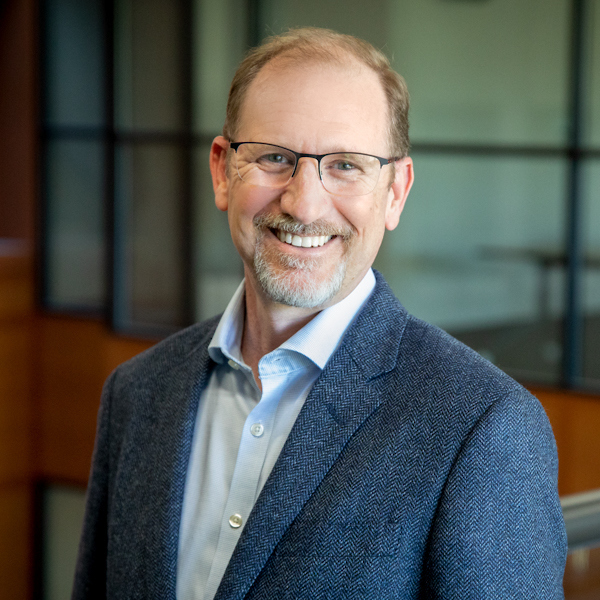
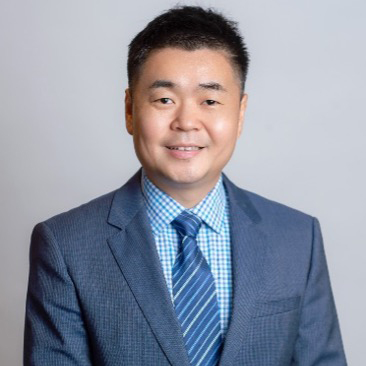
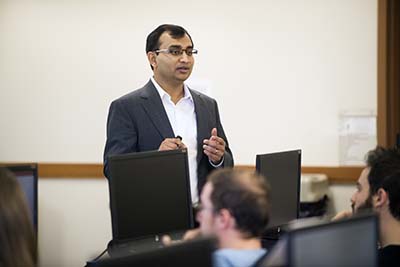
David Williamson Shaffer is the Sears Bascom Professor of Learning Analytics and Vilas Distinguished Achievement Professor of Learning Sciences at the University of Wisconsin-Madison's Department of Educational Psychology. He is also a Data Philosopher at the Wisconsin Center for Education Research. His work focuses on merging statistical and qualitative methods to model complex human collaboration. Shaffer holds an AB in History and East Asian Studies from Harvard University (1987), and MS/PhD in Media Arts and Sciences from MIT (1996/1998). Before academia, he was a teacher, curriculum developer, and game designer. His research emphasizes Quantitative Ethnography —a methodology combining big data analysis with cultural interpretation. Key contributions include Epistemic Network Analysis (ENA) and over 250 publications, including influential books like How Computer Games Help Children Learn (2006) and Quantitative Ethnography (2017). Awardees of the EU Marie Curie Fellowship (2008) and Spencer Foundation Fellowship (2003), Shaffer's work has been presented globally at conferences like Learning Analytics & Knowledge and Computer Supported Collaborative Learning. His interdisciplinary approach bridges education, data science, and humanities, addressing challenges in authentic STEM experiences, collaborative learning analytics, and culturally responsive pedagogy.
Sean Cao serves as Associate Professor (with tenure) at the Robert H. Smith School of Business, University of Maryland, where he is Director and Co-founder of the AI Initiative for Capital Market Research. He also holds an affiliation as professor at Harvard Business School's D 3 Institute. His academic journey began with a Ph.D. from the University of Illinois at Urbana-Champaign. Dr. Cao's research focuses on the intersection of artificial intelligence and capital markets, with particular expertise in how machine learning transforms financial analysis, corporate disclosure practices, and investment decision-making. His work examines the evolving relationship between human analysts and AI systems, blockchain applications in financial reporting, and the strategic adaptation of corporate communications for machine readership. He has pioneered research on the "AI divide" among investor groups and developed frameworks for human-AI collaborative stock analysis. His publication portfolio spans top journals including Journal of Financial Economics, Review of Financial Studies, Journal of Accounting Research, and Management Science. The research demonstrates consistent thematic progression toward increasingly sophisticated AI applications in finance, with recent work exploring distributed ledger technologies for auditing, machine learning for extracting private information from disclosures, and the economics of greenwashing in ESG funds. His studies frequently combine textual analysis with traditional financial metrics to uncover novel market insights. Fama-DFA Prize from Journal of Financial Economics for best paper in capital markets and asset pricing Michael J. Brennan Award from Review of Financial Studies Deloitte Initiative for AI and Learning award for developing trustworthy AI for social equity PanAgora Asset Management's Dr. Richard A. Crowell Memorial Prize Multiple best paper awards from Midwest Finance Association, Global AI Finance Conference, and Asian Finance Association Dr. Cao has delivered over 200 invited research talks at major institutions including the Central Bank of Japan, Central Bank of Thailand, and U.S. Securities and Exchange Commission. He serves as Guest Associate Editor for Management Science and has co-chaired Review of Financial Studies conferences on FinTech and Machine Learning. His educational initiatives include a widely adopted free AI textbook for finance and accounting that has been implemented at universities worldwide including Indiana University, UT Dallas, and University of Minnesota. As Director of the AI Initiative for Capital Market Research, Dr. Cao leads a multidisciplinary team exploring practical AI applications in finance. The initiative has secured significant funding including a $150,000 grant from GRF CPAs & Advisors. His research group maintains strong industry connections through partnerships with regulatory bodies, financial institutions, and technology companies, facilitating the translation of academic research into practical financial applications.
Dr. Amin Keramati is an Assistant Professor of Supply Chain Management at Widener University’s School of Business Administration. He holds a PhD in Transportation & Logistics from North Dakota State University and previously served as a graduate research assistant at the Upper Great Plains Transportation Institute. His work includes federally funded projects like the Mountain-Plains Consortium’s MPC-550 project, focusing on highway-rail grade crossing safety. Dr. Keramati teaches courses in enterprise resource planning, decision analytics, database management, transportation/logistics, project management, and data analytics. Education: PhD in Transportation & Logistics, North Dakota State University Graduate Research Assistant at Upper Great Plains Transportation Institute Research Focus: Dr. Keramati develops mathematical, statistical, and machine learning approaches to solve complex problems in transportation, supply chain, and logistics. Key areas include data mining, big data decision support, transportation network analytics, project scheduling, smart manufacturing, and accident analysis. His interdisciplinary work bridges supply chain optimization with emerging technologies like blockchain for healthcare and clinical trials. Awards & Recognition: Student Paper Award, American Association of State Highway and Transportation Officials (2017) Grants & Projects: Lead researcher on the Mountain-Plains Consortium’s MPC-550 project, which expanded his dissertation work on safety systems for highway-rail crossings. Collaborates on federally funded transportation safety initiatives and supply chain optimization for bioethanol and pharmaceutical industries. Labs/Teams: Active in Widener’s School of Business research groups focusing on supply chain innovation and interdisciplinary projects combining logistics with emerging technologies.
Philip S. Yu is a Distinguished Professor in the Department of Computer Science at the University of Illinois at Chicago and holds the Wexler Chair in Information Technology. Previously, he led the Software Tools and Techniques department at IBM Thomas J. Watson Research Center. Education: B.S. in Electrical Engineering, National Taiwan University M.S. and Ph.D. in Electrical Engineering, Stanford University M.B.A., New York University His research spans data mining , big data , social networks , privacy-preserving data publishing , graph/network mining , recommender systems , and deep learning . He has authored over 970 papers with 74,500+ citations and an H-index of 127. Recent work focuses on heterogeneous graph representation, quantum walks in network analysis, and federated unlearning. Scientific Honors: ACM SIGKDD 2016 Innovation Award IEEE Computer Society 2013 Technical Achievement Award IEEE ICDM 2003 Research Contributions Award IEEE Region 1 Award (1999) UIC Research of the Year (2013) IBM Master Inventor with 300+ patents AI 2000 Most Influential Scholar Honorable Mentions (2024-2025) He served as Editor-in-Chief for ACM Transactions on Knowledge Discovery from Data and IEEE Transactions on Knowledge and Data Engineering , and on steering committees for ACM KDD and IEEE Data Mining. His work bridges theoretical advances in graph neural networks , deep learning , and privacy-preserving systems with applications in healthcare, social media, and enterprise analytics.
Mohammad Saifur Rahman is the Daniels School Chair in Management and a Professor of Management Information Systems at the Mitch Daniels School of Business, Purdue University. Previously, he was an Associate Professor at the Haskayne School of Business, University of Calgary. His academic journey includes significant leadership roles such as co-chairing the Conference on Information Systems and Technology (CIST) in 2013 and serving as president of the INFORMS eBusiness Society in 2014. Currently, he serves as an associate editor for both Management Science and Information Systems Research (ISR). Ph.D. in Management Information Systems, Krannert School of Management, Purdue University (2008) MBA in Management Information Systems, Southern Illinois University (2004) BS in Computer Science, Southern Illinois University (2002) Rahman's research primarily focuses on the economic implications of digital transformations. His work examines how digitization affects consumer behavior, market structures, and business strategies across various industries. He investigates the value of digital traces in driving consumer behavior and improving decision-making, particularly in omnichannel retail environments. His research on the sharing economy has revealed important insights about economic disparities, showing how platforms like Airbnb provide economic benefits to predominantly white neighborhoods while failing to generate similar spillover effects in predominantly Black or Hispanic neighborhoods. His recent publications reveal a consistent focus on the intersection of technology, economics, and social impact. Rahman's work frequently examines how local market structures interact with digital platforms to create or exacerbate economic inequalities. His research spans multiple disciplines including information systems, economics, marketing, and operations management, with a particular emphasis on empirical studies using real-world data from major companies like Walmart and Cisco. CICP Faculty Commercialization Award (2020) INFORMS Sandy Slaughter Early Career Award (2018) World's Top 40 Business School Professors Under 40 by Poets and Quants (2017) Jay N. Ross Young Faculty Scholar Award (2015) Dean's Award for Outstanding Research Achievement (University of Calgary, 2014) Rahman has secured substantial research funding from organizations including Social Sciences and Humanities Research Council (SSHRC), Adobe Systems ($50,000 grants in 2017 and 2020), Trask Innovation Fund ($21,218), and NSF I-Corps ($50,000). He has advised numerous PhD students and collaborated with industry partners to translate research into practical applications. Rahman co-founded RightFit Analytics, a precision health analytics solution that utilizes AI to learn success patterns in healthcare. He has organized significant academic events including the Krannert-Walmart Data Dive (believed to be the first data dive on a college campus) and the Dawn or Doom Data Dive in cooperation with Cisco. Rahman actively engages with industry through consulting and collaborative research projects. His work with Walmart, Cisco, and other major corporations demonstrates his ability to bridge academic research with practical business applications. He has been particularly active in studying how AI and big data analytics can be leveraged to improve business decision-making while addressing potential negative consequences like algorithmic bias and economic inequality.
Yu-Ru Lin is an Associate Professor at the School of Computing and Information, University of Pittsburgh, and serves as Research & Academic Director at the Institute for Cyber Law, Policy and Security (Pitt Cyber). She leads the Pitt Computational Social Dynamics Lab (PICSO Lab) and holds secondary appointments in Political Science, Computer Science, and the Intelligent Systems Program. PhD in Computer Science from Arizona State University Postdoctoral research at Harvard University and Northeastern University Her research focuses on computational approaches for: Networked social dynamics High-dimensional social information summarization Trust and distrust propagation Misinformation detection Policy diffusion analysis Recent publications span 2014-2020, covering: Social media crisis response Graph visualization techniques Policy diffusion patterns Misinformation mitigation Temporal topic modeling Scientific support includes: National Science Foundation (NSF) awards Minerva/ONR funding AFOSR grant for distrust modeling DARPA Understanding Group Biases program As director of PICSO Lab, she leads interdisciplinary research teams on: Digital accountability Urban mobility patterns Health informatics via crowdsourcing Trust-influence dynamics
Joseph Felter is a Research Fellow at the Hoover Institution (Stanford University) and the William J. Perry Fellow at the Center for International Security and Cooperation. His career bridges academia, military service, and policy advising, with expertise in counterinsurgency, national security, and US-China relations. He coauthored the influential book Small Wars, Big Data: The Information Revolution and Modern Conflict (2018) and developed the Hacking for Defense curriculum to connect military needs with Silicon Valley innovation. Military Background: Former US Army Special Forces officer with combat deployments in Panama, Iraq, and Afghanistan. Served as commander of the COMISAF Counterinsurgency Advisory and Assistance Team. Academic Roles: Assistant Professor at West Point’s Department of Social Sciences, Adjunct Associate Professor at Columbia University’s School for International and Public Affairs, and current codirector of Stanford’s Empirical Studies of Conflict Project. Research Focus: Politically motivated violence, economic development in conflict zones, and defense innovation. His work appears in top journals like American Economic Review and Journal of Conflict Resolution . Policy Engagement: Key advisor on US defense strategy (2017–2019) and founder of BMNT, a Silicon Valley defense technology incubator. Currently serves on Spirit of America’s board. Scientific Awards: Recognized as a William J. Perry Fellow and US Army War College Fellow. His empirical conflict research informs both academic and policy debates.
Shane G. Henderson is the Charles W. Lake, Jr. Professor in Productivity at Cornell University's School of Operations Research and Information Engineering (ORIE). His research focuses on the intersection of optimization and simulation, with applications to complex systems such as bike-sharing networks, medical scheduling, and ambulance deployment. He emphasizes practical societal relevance, addressing challenges in healthcare, transportation, and parallel computing environments. Education: B.Sc. (Mathematics), University of Auckland (1992) M.S. (Statistics), Stanford University (1995) Ph.D. (Operations Research), Stanford University (1997) Research Interests: Structured simulation optimization, parallel computing applications, applied probability, and case-driven problem-solving. Recent work includes MRI scheduling, radiation treatment planning, and land/air ambulance systems. He advocates for methodologies that leverage convexity or quasi-convexity to enhance algorithmic efficiency and robustness. Awards and Recognition: 2016 Tau Beta Pi Professor of the Year 2014 Sonny Yau '72 Excellence in Teaching Award 2011 Hess Research & Education Award NSF CAREER Award (1999) Teaching & Service: Courses in probability, simulation, and mathematical modeling using case-based learning. Served on award committees for INFORMS Nicholson Prize, Pierskalla Prize, and Impact Prize. Organized major conferences including the 2009 INFORMS Applied Probability Society conference and multiple Winter Simulation Conferences. Currently co-edits simulation-optimization testbeds for experimental comparisons. Labs & Collaborations: Active in Cornell's collaborative research environment, focusing on interdisciplinary projects with industry partners like Motivate (bike-sharing systems). Engaged in advancing methodologies for complex systems through data-driven approaches.
Lyle Ungar is a Professor at the Department of Computer and Information Science at the University of Pennsylvania . He is affiliated with multiple graduate groups, including Genomics and Computational Biology in the School of Medicine , Operations, Information and Decisions in the Wharton School , and Psychology in the School of Arts and Sciences . His research focuses on explainable machine learning , deep learning , and natural language processing for psychology and medical research , analyzing social media and sensor data to understand well-being, empathy, and stress. His work spans bioinformatics , applied economics , and group decision-making . Recent publications examine LLM-based tutoring , cross-cultural translation , and AI in palliative care , showing trends in reinforcement learning , mobile health , and health data analytics . He has contributed to Google Scholar , PubMed , and DBLP with over 15 papers since 2023. Scientific Awards : 2019 Alan I. Leshner Leadership Institute Public Engagement Fellow His students include Vitoria Aquino Guardieiro , Yihao Li , and co-advised researchers like Shreya Havaldar with Eric Wong. He leads projects at interdisciplinary centers such as the Annenberg Public Policy Center , Center for Cognitive Neuroscience , and Institute for Translational Medicine .
State University of New York at BuffaloUnited States
Zhuoyue Zhao is an Assistant Professor in the Department of Computer Science and Engineering at the University at Buffalo, School of Engineering and Applied Sciences. His office is located at 338I Davis Hall, Buffalo, NY 14260, and he can be reached at zzhao35@buffalo.edu or by phone at (716) 645-4735. Dr. Zhao received his PhD in Computer Science from the University of Utah in 2021, where he was advised by Prof. Feifei Li and Prof. Jeff Phillips. Prior to that, he earned his BS in Computer Science from Shanghai Jiao Tong University in 2016, where he was part of the prestigious ACM Class. During his undergraduate studies, he conducted research under Prof. Kenny Zhu and spent Fall 2015 as a research assistant at Hong Kong Polytechnic University supervised by Prof. Eric Lo. Dr. Zhao's research focuses on database management systems, with specific emphasis on traditional and approximate query processing, query optimization, database systems on modern hardware, transaction processing, indexing, and storage. His work bridges theoretical foundations with practical implementations, often resulting in systems that address real-world database challenges. He has made significant contributions to probabilistic query processing, transaction scheduling, and learned indexing techniques. His recent publications demonstrate a clear trajectory toward optimizing database performance in hybrid transactional/analytical processing environments. His research increasingly integrates systems techniques with machine learning approaches, particularly in the area of learned indexes. There's also a strong focus on making database operations more efficient through innovative scheduling mechanisms and query processing techniques that can handle concurrent updates. Google PhD Fellowship (2019-2021) Best Paper Award at SIGMOD 2016 for "Wander Join: Online Aggregation via Random Walks" Best Paper Award at SIGMOD 2025 for "Low-Latency Transaction Scheduling via Userspace Interrupts" Dr. Zhao currently advises several PhD students including Yunnan Yu, Congying Wang, Gaoxiang Liu (co-advised with Prof. Ziming Zhao), and Zhuoran Li. He has successfully guided MS student Nithin Sastry Tellapuri to graduation (Fall 2023), who is now employed at AirPay. His research is supported by significant funding including an NSF CAREER award (#2339596) totaling $599,977 for research on "Speedy and Reliable Approximate Queries in Hybrid Transactional/Analytical Systems" (2024-2029) and an unrestricted Google gift of $30,000 (2021). Dr. Zhao leads the ADBLab research group at UB, where students work on cutting-edge database systems research. His lab focuses on building practical database systems that address real-world challenges in query processing, transaction management, and indexing. The lab maintains strong connections with industry partners and regularly contributes to open-source database projects.
Subodha Kumar is the Paul R. Anderson Distinguished Chair Professor of Statistics, Operations, and Data Science at Temple University’s Fox School of Business. He serves as the Founding Director of the Center for Business Analytics and Disruptive Technologies and has a secondary appointment in Information Systems. His roles include Ph.D. Program Concentration Director for Operations and Supply Chain Management. With over 240 publications, he ranks #1 globally in Information Systems Research publishing and holds a robotics patent. His research focuses on AI, blockchain, healthcare analytics, and cybersecurity, with notable contributions to digital transformation and operations management. Awards include the INFORMS ISS Distinguished Fellow and POMS Fellow. He advises major journals like Production and Operations Management and organizes conferences like POMS 2018. Media mentions span NYT, WSJ, and CBS. Education: University of Washington faculty Texas A&M University faculty Research Interests: Dr. Kumar explores AI applications, blockchain in fintech, healthcare system optimization, and supply chain analytics. He investigates cybersecurity’s operational impacts and data mining strategies. His work bridges theory and practice, addressing challenges in digital transformation and platform economies. Publications Trends: Recent work emphasizes digital platforms (e.g., blockchain adoption, telemedicine impact), organizational behavior (real-time feedback systems), and healthcare operations (personalized treatment algorithms). He frequently collaborates internationally, with studies appearing in Management Science, Information Systems Research, and Decision Sciences. Awards & Recognition: Changjiang Scholars Chair (China) ISB Visiting Professorship POMS Executive Editor Grants & Labs: Secured NIH grants for health analytics projects. Leads Temple’s analytics center fostering industry partnerships. Active in editorial roles (e.g., Production and Operations Management Journal Deputy Editor). Teaching: Offers courses in data science, optimization methods, and innovation entrepreneurship at graduate/undergraduate levels.
Jae Eun Chung is a Professor in the Department of Communication Studies at Howard University's School of Communications. Her research focuses on new media technologies, their psychosocial impacts, and health communication, with a particular emphasis on community engagement and digital discourse. Ph.D. in Communication from the University of Southern California M.A. in Telecommunications from Indiana University at Bloomington Dr. Chung's work explores the intersection of social media and health, analyzing how digital platforms influence public health perceptions, patient-doctor interactions, and health equity. She has published extensively in journals like Journal of Communication , Computers in Human Behavior , and Health Communication , often employing community-based participatory research (CBPR) to address disparities in asthma care, maternal health, and HPV-associated cancer awareness. Recent publications highlight trends in leveraging social media for health interventions, examining misinformation dynamics during crises like the COVID-19 pandemic, and analyzing digital ecosystems. Her methodological approaches include network analysis, narrative studies, and assessments of digital engagement metrics. Howard University RCMI Grant: Enhancing recruitment of African-Americans and Hispanics in health research NSF HDR Grant: Collaborative research on data analytics for community enrichment PACRI Grant: Improving health outcomes for asthmatic children in public housing Bezos Earth Fund: Indoor environmental quality disparities in underserved communities Dr. Chung collaborates with interdisciplinary teams, including public health experts and data scientists, to advance health communication strategies. She has mentored students and researchers in projects analyzing social media's role in health promotion, digital privacy, and community-academic partnerships.
Susan Davidson is the Weiss Professor in the Department of Computer and Information Science at the University of Pennsylvania, where she co-directs the Data Science Program. She currently serves as Deputy Dean of the School of Engineering and Applied Science and chairs the Computing Research Association's Board of Directors. Her research focuses on databases, bioinformatics, data management, and provenance-based systems. Co-founder, Greater Philadelphia Bioinformatics Alliance Founding co-director, Center for Bioinformatics Fulbright Scholar and Hitachi Chair, INRIA-GEMO Key research areas include data citation, trust management in collaborative systems, workflow provenance, and privacy in data analysis. Her recent publications explore explainability frameworks, sub-table selection for data exploration, and security in distributed training systems. 2023 Lindback Award for Distinguished Teaching 2021 VLDB Women in Databases Award 2021 AAAS Fellow 2020 Spira Award for Teaching & Mentoring 2017 IEEE TCDE Impact Award She has advised numerous PhD students and postdocs, including Sudeepa Roy (Duke University) and Julia Stoyanovich (NYU). Courses taught recently include CIS550 (Database Systems) and CIS545 (Big Data Analytics).
Grant Ho is an Assistant Professor in the Computer Science Department at the University of Chicago. His research focuses on computer security, particularly at the intersection of data and security. Prior roles include a CSE Postdoctoral Fellowship at UC San Diego, a Visiting Researcher position at Corelight Labs, and a PhD in Computer Science from UC Berkeley (advised by Vern Paxson and David Wagner). He holds a B.S. in Computer Science from Stanford University. **Research Interests**: Enterprise security, AI/ML applications in security, large-scale threat analysis, and data-driven cybersecurity practices. His work spans detecting attacks (e.g., phishing, ransomware), improving security measures, and evaluating the efficacy of security policies. **Awards**: 2023 IEEE Euro S&P Best Paper Award, 2019 and 2017 USENIX Security Distinguished Papers, 2017 Internet Defense Prize, NSF and Facebook Fellowships, and the 2015 IEEE S&P Distinguished Practical Paper Award. **Advising & Teaching**: Current advisees include Aniket Anand (PhD), Christiana Marchese (PhD), and Robert Liu (B.S.). Taught courses include Introduction to Computer Security (CMSC 23200) and seminars on AI/ML and NLP in cybersecurity. Collaborates with industry partners like Barracuda Networks and Dropbox. **Labs & Teams**: Leads a research group focused on enterprise security challenges, emphasizing practical impact and interdisciplinary approaches.
Allison Koenecke is an Assistant Professor of Information Science at Cornell Tech and a field faculty member in Computer Science at Cornell University. Previously, she was a postdoctoral researcher at Microsoft Research New England and completed her PhD at Stanford University’s Institute for Computational & Mathematical Engineering. Her research focuses on algorithmic fairness, computational social science, and causal inference in public health, addressing disparities in automated systems like speech recognition and policy decision-making. Education : PhD, Stanford Institute for Computational & Mathematical Engineering MA/MS, Stanford University BA/BS, Massachusetts Institute of Technology Research Interests : Dr. Koenecke’s work bridges economics and computer science, emphasizing equity in AI systems. Key areas include: Algorithmic bias in speech recognition (e.g., racial disparities in voice assistants) Fairness in policy tools like environmental justice data systems Causal analysis in public health interventions Ethical implications of large language models in education Media & Impact : Her research has been featured in outlets like New York Times , Science , and Scientific American . Notable studies include exposing racial gaps in speech-to-text systems and advocating for inclusive dataset development. She also explores societal impacts of AI in education and governance. Awards : Sloan Research Fellow in Computer Science Forbes 30 Under 30 in Science NSF Awards Cornell CIS Teaching Excellence Award (2024) Teaching & Outreach : She teaches courses like Designing Fair Algorithms and Data Science for Global Development , emphasizing interdisciplinary collaboration. Her PhD Professionalization course addresses hidden curricula in academia. She advises on AI ethics for nonprofits, tech companies, and government agencies.