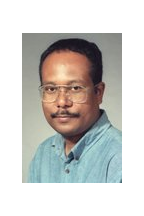
Ioannis Tsaknakis is an Associate Professor at the Department of Electrical & Computer Engineering, School of Engineering, University of Peloponnese. He holds a PhD in computational geometry and multidimensional data structures from the University of Patras (2004) and has been actively involved in software systems research since 2004. His work spans Database Information Management , Big Data Systems , and Knowledge Mining , with a focus on data structures and computational geometry. Research Interests : Information Management in Databases Big Data Management Systems Computational Geometry Knowledge Mining in Databases/Web Publications highlight his contributions to IoT-driven educational frameworks, machine learning applications, and cryptographic systems for data security. He has taught courses on software design and data management since joining the University of Peloponnese in 2019. Contact : jtsaknakis@uop.gr . Office hours are in Building K (Monday & Tuesday, 8:00-9:00).
Nicolas Lachiche is a Professor in Computer Science at the University of Strasbourg, where he serves as Deputy Head of the SDC (Data Science and Knowledge) team within the Engineering, Computer and Imaging Sciences Laboratory (ICube - UMR 7357). His research focuses on machine learning and data/knowledge management across various application domains. Professor Lachiche's primary research interests include data science, relational data mining, sequential and temporal data mining, anomaly detection, and NoSQL databases. His work spans healthcare applications (ICU with Vincent Castelain), high-performance computing (with Florina Ciorba), materials science (with Yves-André Chapuis), and smart factories (with Technology & Strategy). His research trajectory shows evolution from early foundational work in scope classification (94-97) and the PRIMUS family of systems (97-04) to current cutting-edge projects addressing modern data challenges across multiple sectors. Professor Lachiche maintains an extensive service record in the scientific community, having organized numerous workshops and conferences including the MODA series (2020-2024), PFIA 2023 (as Local chair), and various international workshops on data mining and machine learning. He has served on program committees for prestigious conferences such as AAAI (2018, 2020-2024), ECAI, ICDM, and SDM. Additionally, he has reviewed for top journals including Artificial Intelligence Journal, Machine Learning Journal, and IEEE Transactions. His teaching portfolio includes data science, data mining, and machine learning; big data technologies, business intelligence and data warehouses; advanced databases (OLAP, NoSQL, GIS); and foundational courses on databases, data persistence, web programming, and user interfaces.
Kirsty Kitto is an Associate Professor at the University of Technology Sydney in the Learning Design and Technology Unit. With a background in theoretical physics and computer science, her research focuses on developing quantum-inspired models of contextuality to understand complex human behavior in educational systems. She explores the intersection of Artificial Intelligence (AI) , Learning Analytics , and Educational Theory , seeking to bridge the divide between big data and pedagogical frameworks. Current Appointments : Associate Professor (2020-present), Senior Lecturer (2017-2020) Past Academic Roles : Senior Research Fellow (QUT), Senior Lecturer (QUT), Associate Lecturer (Flinders University) Her funded research includes projects on: Quantum models in cognitive systems (ARC Fellowship DP1094974) AI literacy in digital workplaces (IEEE Transactions study) Contextual learning analytics (DVC Education and Students Division) Skills passports for lifelong learning (UMAP 2024 paper) Kitto's recent work examines human-AI interaction in writing assessment, data storytelling for teacher-centered analytics, and causal modeling to strengthen educational theory-data connections. She actively supervises Masters and PhD students and contributes to policy debates through government submissions on generative AI in education. Her methodology combines mathematical formalism with sociotechnical analysis to address educational complexity.
Arnoldo Frigessi is Professor of Statistics at the University of Oslo, where he leads the Oslo Center for Biostatistics and Epidemiology and serves as director of BigInsight—a Centre of Excellence for Research-Based Innovation. This consortium unites industry, business, public actors, and academia to develop model-based machine learning methodologies for big data, with strong emphasis on health applications. His research centers on statistical methodology driven by real-world scientific challenges, specializing in stochastic models for complex dependence structures and computationally intensive inference algorithms. Core application domains include: Genomics and personalized cancer therapy (particularly breast and lung cancer) Infectious disease modeling (including pandemic response) eHealth, sensor data analysis, and recommender systems Personalized marketing and viral diffusion dynamics Analysis of his 15 most recent publications (2024-2025) reveals dominant themes in cancer systems biology , where he integrates multi-omics, single-cell transcriptomics, and computational modeling to decode tumor evolution under therapy. Parallel work advances infectious disease epidemiology through time-varying reproduction number estimation and mobility-based transmission modeling, while methodological innovations span synthetic data generation (TVineSynth), causal inference via target trial emulation, and Bayesian ranking models for recommender systems. Scientific Awards: No specific awards mentioned in source materials Frigessi actively supervises graduate students, including a Department of Informatics project on "Utilizing covariate information in recommender systems." His leadership of BigInsight—funded as a Research-Based Innovation Centre by the Research Council of Norway—secures major grants supporting interdisciplinary collaborations with industrial partners (e.g., Telenor, DNB) and public health institutions. Current projects integrate real-world clinical data with mechanistic models for treatment optimization. He directs BigInsight's multidisciplinary team of statisticians, computer scientists, and domain experts, while leading the Oslo Center for Biostatistics and Epidemiology's efforts in developing statistical frameworks for complex health data. These initiatives drive Norway's national strategy for data-driven health innovation.
Yu Fujimoto is a Professor at Waseda University's Advanced Collaborative Research Organization for SmartSociety. Previously, he served as an Associate Professor at Waseda University's Advanced Collaborative Research Organization for Smart Society (2015-2023) and Institute for Nanoscience & Nanotechnology (2012-2015), and as an Assistant Professor at Aoyama Gakuin University's Department of Integrated Information Technology (2009-2012). He holds a Doctorate from Waseda University's Graduate School, Division of Science and Engineering and is a member of IEEE and the Information Processing Society of Japan. His research focuses on statistical science applied to energy systems, with specific interests in renewable energy forecasting, statistical data analysis for energy management systems, and statistical machine learning theory. Fujimoto has published 109 papers with 1,191 citations and maintains an h-index of 16, demonstrating significant impact in his field. His recent publications show a strong trend toward integrating machine learning techniques with power system applications, particularly focusing on renewable energy integration, electric vehicle charging optimization, smart grid technologies, and carbon reduction strategies. His work frequently addresses the challenges of grid stability with high renewable penetration and develops innovative solutions using advanced data analytics. Best Paper Award for Big Earth Data (2025) for wind generation dataset research Best Paper Award in International Conference on Power, Energy and Electrical Engineering (2025) Second Best Paper Award in International Conference on Renewable Energy Research (2024) Top Downloaded Article in IET Smart Cities (2023) Top Downloaded Article in IEEJ Transactions (2022) Fujimoto's research bridges theoretical statistical methods with practical energy system applications, contributing significantly to Japan's efforts in smart grid development and renewable energy integration. His work often involves collaboration with industry partners and government research organizations to address real-world power system challenges.
Darko Etinger is an Associate Professor and currently serves as the Dean of the Faculty of Informatics at Juraj Dobrila University of Pula in Croatia. His academic career spans over two decades with significant contributions to the fields of information systems, educational technology, and artificial intelligence. He teaches undergraduate courses including Artificial Intelligence, Business Information Systems, Business Process Management, ICT Fundamentals, Information Systems, Introduction to Artificial Intelligence, and Multimedia Systems. At the graduate level, he teaches Development of IT Solutions, IT Management, Modelling and Simulation, and Project Management. He also supervises doctoral research in Management of Information Technologies in Education. Dr. Etinger's research interests span several key areas in computer science and education technology. He has made significant contributions to understanding how information and communication technologies can support children with special educational needs, as evidenced by his 2024 and 2025 books on the topic. His work also focuses on business process management, educational data mining, and the application of artificial intelligence in educational contexts. His 2024 book 'Introduction to R and RStudio' demonstrates his commitment to data science education. Analysis of his recent publications shows a strong focus on practical applications of technology in education and business. His work spans educational robotics, learning management systems analysis, business process modeling, and the application of large language models in healthcare. He has a particular interest in how technology can be made accessible and beneficial for diverse learner populations, including those with special needs. His research often takes a human-centered approach, examining not just the technology itself but how it's adopted and used by end users. His 2025 bibliometric analysis of metaverse security demonstrates his ability to tackle emerging technological challenges. Associate Professor at Faculty of Informatics, Juraj Dobrila University of Pula Current Dean of Faculty of Informatics Author of multiple publications on educational technology and information systems Supervisor for numerous graduate theses on educational technology topics Active participant in EDIH Adria project as evidenced by 2025 publications Researcher in educational robotics implementation in Croatian schools Dr. Etinger has advised numerous students completing their theses, with a focus on educational technology applications. His research has been published in various international conferences and journals including IEEE Engineering Management Review, Procedia Computer Science, and System Dynamics Review. His current research appears to be heavily focused on the EDIH Adria project, which is a European Digital Innovation Hub initiative focusing on technology transfer and business innovation. He maintains an active research program with publications spanning from 2003 to the present, demonstrating sustained scholarly contribution to his fields of expertise.
Thomas Olsson is a **Professor in Human-Centered Design** at Tampere University, affiliated with the Faculty of Information Technology and Communication Sciences and the Computing Sciences department. He leads the *Technology x Social Interaction Research Group* and the *Digital and Sustainability Transitions in Society* research platform. His work focuses on designing ICT systems that prioritize digital ethics, social sustainability, and environmental responsibility. **Research Interests**: Social technologies, sustainable design of ICT, AI-driven recruitment systems, cultural integration through technology, and the ethical implications of digital media. He employs qualitative methods and design-through-research approaches, often collaborating across disciplines like computer science and behavioral/social sciences. Current roles: Academic Director of Digital/Sustainability Transitions Platform; Head of Master's Program in Computing Sciences and Electrical Engineering Key projects: AIdience (AI in Journalism), Trust-M (Migrant Services), Big Match (Team Assembly), Emotions in Digital Media Teaching: Coordinates Human-Technology Interaction studies and develops courses like *Sustainable Design* and *Ethics of Technology* **Lab/Team**: Leads the *Technology x Social Interaction* group (collaboration opportunities available). Active in the *Rajapinta* interdisciplinary research community.
Ivan Vladimirovich Arzhantsev serves as Dean of the Faculty of Computer Science and Professor at the Department of Big Data and Information Retrieval at the National Research University Higher School of Economics (HSE University). He also heads the Research Laboratory of Algebraic Transformation Groups and is a member of the Academic Council of HSE University. Having joined HSE in 2011, he has over 20 years of scientific and teaching experience in mathematics and computer science. Dean: Faculty of Computer Science Professor: Faculty of Computer Science / Department of Big Data and Information Retrieval Leading Researcher, Head of Laboratory: Faculty of Computer Science / Research Laboratory of Algebraic Transformation Groups Member of the Academic Council of the National Research University Higher School of Economics Arzhantsev's educational background includes a Specialist degree in Mathematics and Applied Mathematics from Moscow State University (1995), a Candidate of Physical and Mathematical Sciences degree (1998), and a Doctor of Physical and Mathematical Sciences degree (2011), all from Moscow State University. He was awarded the academic title of Associate Professor in 2009 and Professor in 2020. His research focuses on Algebraic Geometry, Transformation Groups, Algebraic Groups, and Geometric Invariant Theory. Arzhantsev's work explores homogeneous spaces, flexible varieties, infinite transitivity, locally nilpotent derivations, and algebraic monoids. His research has significant implications for understanding the structure and classification of algebraic varieties and their automorphism groups. He has developed important connections between algebraic geometry and combinatorial methods, particularly in the context of toric varieties and group actions. His work on the pigeonhole principle demonstrates applications to geometric problems, bridging discrete mathematics with algebraic geometry. Arzhantsev's recent publications demonstrate a consistent focus on affine varieties, transformation groups, and geometric structures. His work shows a progression from foundational studies of homogeneous spaces to more complex structures involving flexible varieties and infinite transitivity. The research spans both theoretical developments and practical applications in algebraic geometry, with several papers exploring connections between different mathematical structures through group actions. Medal 'Recognition - 10 years of successful work' of HSE University (July 2025) Honorary Certificate of the Ministry of Science and Higher Education of the Russian Federation (December 2024) Honorary Certificate of HSE University (March 2024) Letter of Gratitude from the Rector of HSE University (February 2023) Best Teacher - 2019, 2015 Laureate of the All-Russian Prize 'Dean of the Year' in Physical and Mathematical Sciences (2024) Arzhantsev has supervised numerous PhD students, including Y. I. Zaitseva, I. S. Beldiev, and K. V. Shakhmatov, among others. He leads multiple research grants, including the Russian Science Foundation grant 'Demazure Roots and Root Subgroups' (2025-2027) and the Russian-Indian grant 'Study of Affine Spaces and Related Objects Using Algebraic Transformation Groups and Locally Nilpotent Derivations' (2022-2024). His research has been supported by various prestigious funding sources including the Russian Foundation for Basic Research and the 'Basis' Foundation. He directs the Research Laboratory of Algebraic Transformation Groups at HSE University, which organizes the annual 'Algebraic Groups: White Nights Season' conference in St. Petersburg. The laboratory focuses on advanced research in algebraic transformation groups, homogeneous spaces, and related geometric structures, fostering international collaboration and training the next generation of mathematicians.
Amin Mesmoudi serves as Associate Professor in Data Engineering at the University of Poitiers' IUT (Institut Universitaire de Technologie), with dual laboratory affiliations at LIAS-ENSIP (Poitiers campus) and LIAS-ISAE-ENSMA (Chasseneuil campus). His research bridges theoretical database systems with practical large-scale data engineering challenges, particularly in semantic web technologies and machine learning applications. The laboratory maintains physical presences at both ENSIP's Bâtiment B25 in Poitiers and ISAE-ENSMA's Téléport 2 facility in Chasseneuil, facilitating cross-institutional collaboration. Mesmoudi's research program centers on scalable data management systems, with three interconnected pillars: (1) RDF and graph-based query optimization techniques for billion-triple datasets, (2) machine learning integration for spatial query performance and anomaly detection, and (3) explainability frameworks for complex black-box models. His work demonstrates consistent evolution from foundational database systems (2011-2016) toward contemporary AI-driven data engineering, particularly evident in his 2023-2025 publications on temporal dependency preservation and co-selection explainability. The Data Engineering team within LIAS laboratory provides the primary research context for these investigations. Publication analysis reveals strong methodological continuity in addressing scalability bottlenecks across database paradigms. Early work focused on SQL-on-MapReduce benchmarking for astronomy databases (2015-2016), transitioning to specialized RDF processing frameworks (2019-2021), and culminating in current hybrid approaches combining temporal modeling with machine learning (2023-2025). Key technical themes include fragmentation strategies for distributed data, optimizer feedback mechanisms, and graph-based query acceleration - all targeting real-world performance constraints in big data environments. As a core member of LIAS laboratory's Data Engineering team, Mesmoudi contributes to France's national research infrastructure in computer science and automation systems. The laboratory's dual-university structure enables unique cross-pollination between University of Poitiers' academic programs and ISAE-ENSMA's engineering specialization, with Mesmoudi's work exemplifying this synergy through applications spanning astronomy databases to wireless sensor networks.
Yannis Theodoridis is a Professor at the Department of Informatics, University of Piraeus, leading the Information Systems Laboratory (InfoLab). He specializes in spatiotemporal databases, mobility analytics, and maritime data science. His research focuses on trajectory analysis, location-based services, and big data frameworks for transportation and maritime surveillance. Key projects include the MOD (Moving Objects Databases) initiative, the ARGOS framework for real-time trajectory prediction, and contributions to the HERMES trajectory database engine. He has advised 7 PhD students and co-authored numerous papers in IEEE and ACM venues. His work addresses challenges like vessel collision risk assessment, urban mobility optimization, and maritime event detection. He serves on the editorial board of the International Journal of Data Warehousing and Mining and contributes to conferences like PCI and ECML PKDD. His labs emphasize interdisciplinary approaches to mobility data science, integrating machine learning with domain-specific analytics.
Albert Yoon is a Professor and holds the Michael J. Trebilcock Chair in Law and Economics at the University of Toronto Faculty of Law. He previously served as Associate Dean (Research & Curriculum) from 2018–2020 and has held academic positions at Northwestern University. His research focuses on labor markets in legal professions, legal ethics, and applications of AI to law. He co-founded Blue J, an AI startup aiding tax and legal professionals. Education: BA from Yale, JD and PhD (Political Science) from Stanford. Professional experience includes clerkship at the U.S. Court of Appeals for the Sixth Circuit. Fellowships include the Pierre Elliott Trudeau Fellowship (2022), Princeton University, and Robert Wood Johnson Foundation. Research interests span legal economics, judicial behavior, and technology's impact on law. Notable awards include the Ronald H. Coase Prize and American Law Institute membership. His work bridges empirical legal studies and computational methods, addressing topics like Supreme Court clerkships, AI-driven legal predictions, and tax law analytics. Publications include over 47 scholarly articles in top journals like Chicago Law Review , Stanford Law Review , and Journal of Law & Economics . Recent work examines AI in legal practice, gender disparities in M&A legal teams, and judicial decision-making dynamics.
Babak Akhgar serves as Professor of Informatics and Director of CENTRIC (Centre of Excellence in Terrorism, Resilience, Intelligence and Organised Crime Research) at Sheffield Hallam University's College of Business, Technology and Engineering, with additional affiliation to the Culture and Creativity Research Institute. Recognized as a Fellow of the British Computer Society (FBCS), he maintains active leadership in security informatics research and education. His academic foundation includes a Software Engineering degree from Sheffield Hallam University, complemented by a Master's degree with distinction in Information Systems in Management and a PhD in Information Systems. This academic trajectory followed substantial industry experience as a Strategy Analyst and Methodology Director for multiple organizations. Professor Akhgar's research program bridges theoretical knowledge management with practical security applications, focusing on cyber security, counter-terrorism, intelligence frameworks, and big data analytics for national security. His scholarly output demonstrates consistent evolution from foundational knowledge management systems toward contemporary security challenges including cryptocurrency tracing, AI accountability in law enforcement, and smart city security frameworks. Recent work shows particular emphasis on ethical considerations, citizen acceptance of security technologies, and practical implementation of security solutions. Fellow of the British Computer Society (FBCS) Co-editor of influential security publications including 'Intelligence Management: Knowledge Driven Frameworks for Combating Terrorism and Organised Crime' Member of editorial boards for three international journals Chair and program committee member for numerous international security conferences As a doctoral supervisor, Professor Akhgar has guided research on cyber situational awareness, digital music ontology, and e-government services. His leadership extends to major EU-funded security initiatives including the MIICT project for migrant integration and development of the AP4AI accountability framework for artificial intelligence in security contexts. Through CENTRIC, he directs a research ecosystem that connects academic inquiry with real-world security challenges while addressing ethical, legal, and societal implications of security technologies.
Anton Berg is a Postdoctoral Researcher at the University of Helsinki, affiliated with the Department of Digital Humanities within the Faculty of Arts and the Helsinki Institute for Social Sciences and Humanities (HSSH). He is also a member of the methodological unit at HSSH, focusing on interdisciplinary research at the intersection of cognitive science, religious studies, and artificial intelligence. His educational background spans computer science, cognitive science, and religious studies, enabling him to bridge technical and humanistic approaches to AI. His research primarily investigates how commercial image recognition systems interpret and categorize religious content, exploring issues of bias, representation, and the datafication of religion. Berg's research interests include computer vision systems, automatic image recognition, machine and deep learning, large language models, and the relationship between religions, worldviews, and values related to AI technologies. He particularly focuses on inequality issues, the datafication of religion, the datafication of societies, the social scientific study of religion, and the cognitive science of religion. His work combines technical analysis of AI systems with social scientific perspectives on religion and technology. His recent publications demonstrate a strong focus on examining biases in commercial image recognition services, particularly regarding religious content, with significant contributions to understanding representational silence and racial biases in these systems. He has also conducted important work on pandemic psychology, contributing to large-scale international studies on COVID-19 responses across 69 countries. Berg has been actively involved in numerous academic activities, including presentations at international conferences on topics such as computer vision in religious studies, mediatized religious populism, and biases in image recognition services. His research has been presented at venues including the International Association for the Cognitive Science of Religion. His teaching areas include religious studies, cognitive science, data science, and religion and technologies, reflecting his interdisciplinary approach to understanding the relationship between digital technologies and religious phenomena.
Kshirasagar Naik is a Professor in the Department of Electrical and Computer Engineering at the University of Waterloo, Ontario. He is actively involved in graduate research supervision and has been a member of IEEE since 1994. His academic career spans decades, with a focus on wireless communication, energy efficiency, and cybersecurity. 1992, Doctorate in Computer Engineering from Concordia University, Ontario 1988, Master of Mathematics in Computer Science from University of Waterloo, Ontario 1983, MTech in Computer Engineering from Indian Institute of Technology, Kharagpur, India 1981, BScEng in Electronics and Telecommunication from Sambalpur University, India His research interests include Mobile and Ad Hoc Networks , Cybersecurity , Internet of Things (IoT) , and Intelligent Transportation Systems . He has published extensively on energy optimization in wireless devices, delay-tolerant networks, and security protocols for vehicular systems. Recent publications highlight the integration of Machine Learning and IoT in environmental monitoring, particularly forest fire detection and prediction. Other works focus on cybersecurity , vehicular networks , and energy optimization in data centers and handheld devices. Professor Naik is currently accepting graduate students for research in mobile systems, network protocols, and green computing at the University of Waterloo.
Peter Haas is a Professor at the Manning College of Information and Computer Sciences at the University of Massachusetts Amherst, with an adjunct role in Industrial Engineering. Previously, he spent 30 years as a Principal Research Staff Member at IBM Research and held a consulting professorship in Management Science and Engineering at Stanford University. His research focuses on applying probability and statistics to data management, simulation of complex systems, and machine learning scalability. Education : PhD, Operations Research, Stanford University, 1986 MS, Statistics, Stanford University, 1984 MS, Environmental Engineering, Stanford University, 1979 SB, Engineering and Applied Physics, Harvard University, 1978 Research Interests : Haas’s work spans stochastic systems, probabilistic databases (e.g., MCDB and SimSQL), sampling techniques, and simulation optimization. He pioneered methods for managing uncertain data and scalable machine learning, including compressed linear algebra for declarative systems. His recent focus includes in-database decision support and hybrid simulation metamodeling with neural networks. Key Contributions : He developed the Online Aggregation framework (SIGMOD 1997), which earned a Test-of-Time Award in 2007. His work on matrix factorization and distributed stochastic gradient descent (DSGD) revolutionized large-scale machine learning. He also advanced techniques for estimating distinct-values and correlation discovery in databases. Awards : A six-time recipient of IBM’s Pat Goldberg Memorial Award, he is an ACM and INFORMS Fellow. His honors include the VLDB Best Paper Award (2016), EDBT Best Paper (2018), and recognition in Communications of the ACM. Advising & Grants : He advises four current PhD students and has graduated Matteo Brucato. His IBM career included over 30 patents, including foundational work for DB2’s sampling capabilities and IBM Watson analytics. He leads the DREAM Lab, focusing on data systems for exploration and analytics. Labs/Teams : Directs the Data systems Research for Exploration, Analytics, and Modeling (DREAM) Lab, advancing projects like Splash (health system simulation) and SuDocu (document summarization by example).