Dr. Erik-Jan van Kesteren is an Assistant Professor in the Methodology and Statistics department at Utrecht University , where he leads the ODISSEI Social Data Science (SoDa) team. His work bridges statistical methodology with computational social science, with a focus on synthetic data, Bayesian inference, and open research infrastructure. Current research initiatives include: Developing privacy-preserving synthetic data frameworks Improving computational approaches to structural equation modeling Addressing geospatial sampling bias in volunteer-collected datasets Exploring text-based personality computing and language association tools He maintains the department's compute server infrastructure and contributes to open-source projects like ArtScraper and osmenrich. Contact via e.vankesteren1@uu.nl or erikjanvankesteren@pm.me
Walter Dempsey is an Associate Professor of Biostatistics at the University of Michigan School of Public Health and Assistant Research Professor at the Institute for Social Research. His research develops statistical methods for digital health, focusing on experimental design for multi-stage decision making, modeling of complex longitudinal data, and analysis of relational network structures. Education: Ph.D. in Statistics, University of Chicago (2015) B.Sc. in Mathematics, Statistics and Economics, University of Chicago (2009) Research Focus: Dr. Dempsey's work integrates statistical theory with health applications, particularly in mobile health (mHealth) technologies. His methodological research spans three interconnected areas: (1) Designing adaptive trials for health decision-making; (2) Developing hierarchical latent variable models for intensive longitudinal data from wearables and sensors; (3) Creating statistical frameworks for analyzing interaction networks that satisfy invariance principles while capturing empirical behavior patterns. Publication Trends: His recent work demonstrates strong emphasis on network modeling, mobile health interventions, and causal inference methods. Publications frequently appear in top statistics and machine learning venues including JASA, Biometrika, ICML, and NeurIPS, with consistent focus on developing interpretable models for health applications. Student Advising: Hera Shi (PhD, 2023) - Time-varying treatment effects in micro-randomized trials Yuhua Zhang (PhD, 2023) - Statistical methods for network data Madeline Abbott (Current PhD) - Latent variable models for intensive longitudinal data Easton Huch (Current PhD) - Robust Bayesian methods for causal inference Laboratory: Leads the Dempsey Lab developing statistical methodologies for digital health, with projects spanning network analysis, survival modeling, and adaptive intervention design.
Xiaoquan Wen is a Professor in the Department of Biostatistics at the University of Michigan School of Public Health, where he joined the faculty in 2011 after earning his PhD in Statistics from the University of Chicago. His research focuses on developing advanced Bayesian and computational statistical methods for genetics and genomics applications. His educational background includes a PhD in Statistics (2011) from the University of Chicago, an MS in Computer Science (2002), and an MS in Mathematics (2001), both from the University of Illinois. His research spans Bayesian model comparison, multiple hypothesis testing, probabilistic graphical models, and molecular QTL analysis, with applications in genetics and functional genomics. Wen's publication trends reveal consistent contributions to statistical genetics methodology, particularly in false discovery rate control, eQTL discovery, and integrative genomic analyses. His work increasingly emphasizes multi-omics integration and causal inference for complex traits, as evidenced by recent publications on metabolome-wide Mendelian randomization and multi-resolution genomic clustering. He is an active participant in the NIH GTEx project and affiliated with the Center of Statistical Genetics at the University of Michigan. His software contributions include BLIMP for imputation, SLAT for gene-level testing, and STRUCTURE for population genetics analysis. Wen teaches advanced courses including BIOS 699 (Design and Analysis of Biostatistical Investigations), BIOS 680/MATH 627 (Applications of Stochastic Processes), and BIOS 830 (Methods and Applications of Statistical Learning), demonstrating his commitment to statistical education.
Rong Chen is an Associate Professor in the Department of Diagnostic Radiology and Nuclear Medicine at the University of Maryland School of Medicine. He serves as Associate Vice Chair of AI and leads the Biomedical Data Mining Laboratory, focusing on integrating machine learning, computational neuroscience, and neuroimaging to decode brain-behavior relationships. His work spans clinical and translational research for disorders like Alzheimer’s, Parkinson’s, autism, and HIV, and he develops open-source software (GAMMA suite, Advanced Connectivity Analysis) for neuroimaging data analysis. Education: BS in Biomedical Engineering, Southeast University, China (1996) MS in Electrical Engineering, The Graduate School of Chinese Academy of Sciences (1999) PhD in Electrical and Computer Engineering, Washington State University (2003) Postdoctoral Researcher in Radiology, University of Pennsylvania (2005) MTR in Translational Research, University of Pennsylvania (2012) Research Interests: Computational modeling of neural activity and behavior Development of machine learning frameworks for neuroimaging Brain-inspired AI and therapeutic concepts Longitudinal analysis of brain disorders Distributed data mining for heterogeneous databases Software tools for biomarker detection and functional connectivity Scientific Contributions: 20+ years of advanced modeling and algorithm development Two open-source neuroimaging software packages (GAMMA suite, ACA) NIH and BRAIN initiative-funded research Editorial roles in journals like Frontiers in Computational Neuroscience Honors: Senior Member of IEEE Labs & Collaborations: Dr. Chen collaborates with institutions like NIH and Oracle, and his lab has developed tools used in studies on sickle cell disease, autism, and traumatic brain injury.
Brennan Klein is an Assistant Teaching Professor in the Department of Physics at Northeastern University, with dual affiliations at the Network Science Institute and the Institute for Experiential AI. He concurrently serves as Data for Justice Fellow at Harvard University's Institute on Policing, Incarceration, and Public Safety within the Hutchins Center for African and African American Research. As director of the Complexity & Society Lab (&-Lab), he leads interdisciplinary research bridging network science, complex systems theory, and social justice applications. Education: PhD in Network Science, Northeastern University (2020) BA in Cognitive Science & Psychology, Swarthmore College (2014) Dr. Klein's research program integrates two complementary strands: developing theoretical frameworks for characterizing dynamics, structure, and scale in complex networks, and applying these tools to analyze systemic inequalities in public health and criminal justice systems. His work combines information theory, Bayesian inference, and network science to uncover emergent mechanisms driving social phenomena while developing practical interventions for more equitable systems. Analysis of his recent publications reveals a strong trajectory connecting fundamental network theory with real-world societal challenges. His work spans sports analytics, pandemic response modeling, criminal justice reform, and consciousness studies, demonstrating both methodological innovation and practical impact across diverse domains. The publications consistently feature interdisciplinary collaboration and emphasize both theoretical advancement and social application. Scientific Recognition: Best paper award for 'Spin glass systems as collective active inference' (2023) Dr. Klein actively mentors PhD students and postdoctoral researchers through the Complexity & Society Lab, fostering collaborations across physics, data science, sociology, and public policy. His research has secured funding for projects addressing criminal justice reform, public health infrastructure, and sports analytics applications, demonstrating the practical relevance of his theoretical work. The Complexity & Society Lab operates at the intersection of theoretical network science and social impact, with current projects examining urban infrastructure networks, criminal justice disparities, sports performance analytics, and neural network structures. This integrative approach reflects Dr. Klein's commitment to advancing both scientific understanding and social progress through network science.
Conor Mayo-Wilson is an Associate Professor in the Department of Philosophy at the University of Washington , specializing in formal epistemology, logic, and philosophy of science. His research spans interdisciplinary methodologies bridging philosophy with statistics, game theory, and causal inference. Education: Ph.D., Philosophy, Carnegie Mellon University (2012) M.S., Logic and Computation, Carnegie Mellon University (2009) M.S., Mathematics, Carnegie Mellon University (2009) B.S., Mathematics, Stanford University (2006) B.A., Philosophy, Stanford University (2006) His research focuses on the intersection of epistemology , statistics , and causal inference , with notable contributions to robust Bayesianism, causal discovery algorithms, and the philosophical foundations of statistical methods. Recent articles address computational philosophy, measurement theory, and severe testing frameworks. Mayo-Wilson has taught courses including Introduction to Logic, Seminar in Epistemology, and Statistics and Philosophy of Voting. He is affiliated with the Center for Statistics in the Social Sciences at the University of Washington. Scientific Awards: Best Paper Award, 2014
Tomoyuki Yamamoto is a Professor at the Faculty of Science and Engineering, Waseda University , Japan. He holds a Doctor of Engineering from Waseda University and has extensive experience in computational materials science, particularly focusing on electronic structure analysis, crystal field effects, and optical properties of doped materials.
Clélia de Mulatier is an Assistant Professor at the University of Amsterdam , affiliated with both the Institute for Theoretical Physics and the Informatics Institute . She leads research at the intersection of statistical physics, information theory, and computer science , focusing on theoretical and numerical methods for complex systems . Her work spans collaborations with experimentalists in neuroscience and biology , and she actively participates in educational programs across multiple Dutch universities. Research Labs : Computational Soft Matter Lab, Computational Science Lab Affiliations : Dutch Institute for Emergent Phenomena (DIEP), Netherlands Platform Complex Systems (NPCS) Her research develops minimally complex spin models for high-order data analysis , applying exact Bayesian model selection to uncover hidden variable communities in binary datasets. This work has produced open-source tools like MinCompSpin and MinCompSpin_Greedy for different system sizes. Publications demonstrate expertise in tensor networks for dimensional reduction , epidemic modeling , and branching random walks in confined environments . Teaching includes Python programming , complex systems theory , and statistical inference for physics students across multiple institutions. She serves as program committee member for International Conference on Computational Science and organizes academic discussions through initiatives like Behind the CV: story from a Physicist .
Matt J. Kusner is an Associate Professor in the Department of Computer Engineering and Software Engineering at Polytechnique Montréal. He holds additional affiliations as a Senior Academic Member at Mila - Quebec Artificial Intelligence Institute and as a Member at the Institute for Data Valorization (IVADO). Previously, he served as an Associate Professor at University College London and the University of Oxford. Professor Kusner's research spans machine learning, with particular focus on causal inference, fairness in algorithms, representation learning, and domain adaptation. His work bridges theoretical foundations with practical applications in natural language processing, algorithmic fairness, and scientific computing domains including plasma physics and renewable energy systems. His research interests include Pattern Analysis and Artificial Intelligence, Algorithms, and Learning and Inference Theories. His publication record shows consistent output across top machine learning venues including NeurIPS, ICML, and ICLR, with recent work trending toward causal machine learning methods and applications in scientific domains. Professor Kusner has 42 publications spanning from 2014 to 2025, demonstrating sustained research productivity. Turner Dissertation Award for best doctoral dissertation in Computer Science & Engineering Professor Kusner received his PhD in Computer Science from Washington University in St. Louis in 2016 under Kilian Weinberger. His work has been featured in major media outlets including The Guardian, Forbes, and the Harvard Business Review, and he has presented at prestigious institutions including the Federal Reserve Banks, Cambridge Centre for Mathematical Sciences, and the Royal Society.
Dr. Borysław Paulewicz is an Assistant Professor in the Department of Experimental Psychology at Jagiellonian University's Faculty of Philosophy. Previously taught cognitive psychology and psychometrics at SWPS University for a decade. His work bridges cognitive psychology, mathematical methodology, and meta-theoretical foundations of psychology, with a focus on metacognition and causal inference. Current affiliations: Jagiellonian University, Faculty of Philosophy, Department of Experimental Psychology Past affiliations: SWPS University of Social Sciences and Humanities Research Interests: Specializing in causal/Bayesian inference applications, development of hierarchical generalized linear models, and formal definitions of measurement invariance. His projects explore metacognition, consciousness, and placebo mechanisms through National Science Centre grants (MAESTRO, HARMONIA, SONATA BIS/SONATA programs). Academic Contributions: Created R libraries for psychometric models, formulated causal-theoretical measurement frameworks, and authored a GitHub-hosted book on mathematics for psychologists. Published extensively in metacognition, signal detection theory, and causal modeling. Projects: Key investigator in studies on pain unlearning, metacognitive mechanisms, and cognitive control. Collaborated with Agata Blaut on emotional disorder biases, Michał Wierzchoń on consciousness, and Marta Siedlecka on metacognition.
Antonio Salmerón Cerdán is a Professor in the Mathematics Department at the University of Almería, where he has established himself as a leading researcher in probabilistic artificial intelligence and Bayesian networks. With over 25 years of academic experience, he leads the 'Análisis de datos' research group and serves as Principal Investigator for multiple nationally and internationally funded projects, including the current 'Hacia una Inteligencia Artificial Probabilística Confiable (TOPAI-UAL)' project (2023-2026). His research expertise spans theoretical and applied aspects of probabilistic graphical models, with particular focus on Bayesian networks, causal inference, and their applications across diverse domains. His work demonstrates a consistent trajectory from foundational theoretical contributions to practical implementations in software engineering, genomics, sports analytics, and trustworthy autonomous systems. Professor Salmerón's publication portfolio reveals a strong emphasis on methodological innovations in probabilistic reasoning, with recent work exploring divide-and-conquer approaches for causal computation, noise-robust classification methods, and the integration of observational and randomized data sources. His research shows increasing interdisciplinary reach, connecting computer science methodologies with applications in plant genomics, software maintenance, and healthcare. Journal Publications: 105 articles in high-impact venues including Ecological Informatics (Q1), International Journal of Approximate Reasoning (Q2), and ACM Transactions Research Funding: Principal Investigator for 9 major projects since 2001 totaling over €800,000 in funding Thesis Supervision: Director of 7 doctoral theses on probabilistic graphical models and their applications Metrics: h-index 22 (Web of Science), i10 index 59 His research program demonstrates a unique combination of theoretical rigor in probabilistic reasoning with practical applications across diverse scientific domains, positioning him at the forefront of reliable probabilistic AI development.
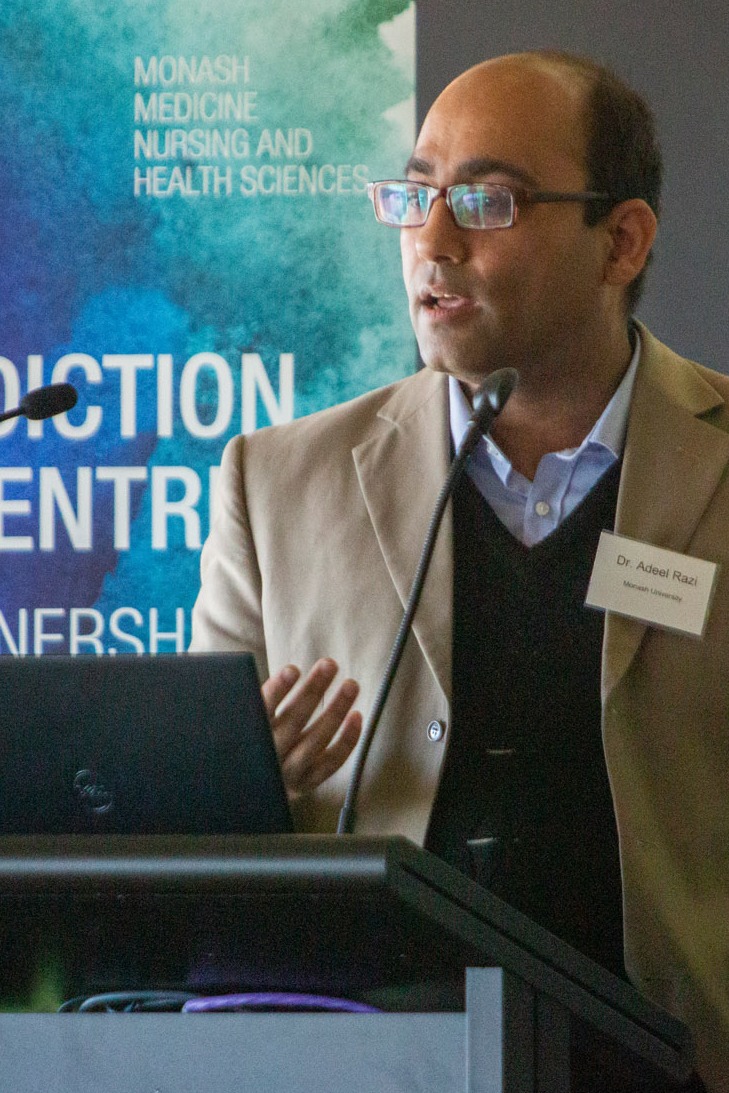
Professor Adeel Razi serves as Principal Investigator of the Computational Neuroscience Laboratory at Monash University's Turner Institute for Brain and Mental Health within the School of Psychological Sciences. He holds prestigious fellowships including ARC Future Fellow, NHMRC Investigator (Emerging Leadership), and CIFAR Azrieli Global Scholar in the Brain, Mind & Consciousness program. His research focuses on developing next-generation generative models of brain function through three integrated themes: 1) Creating multi-modal Bayesian methods (Dynamic Causal Modeling) to characterize brain network dynamics in pathologies; 2) Using biological neural network principles to inform artificial neural network design via active inference; 3) Employing classical psychedelics with computational modeling to understand consciousness mechanisms and therapeutic applications for psychiatric conditions. Razi's recent work includes the largest neuroimaging study of psilocybin to date, revealing how context structures psychedelic brain states, and novel Bayesian approaches for training binary and spiking neural networks. His research bridges engineering, physics, machine learning, and neurobiology to advance understanding of brain computation. ARC Future Fellow NHMRC Investigator (Emerging Leadership) CIFAR Azrieli Global Scholar, Brain, Mind & Consciousness program Professor Razi leads multiple clinical trials exploring psychedelic therapeutics and maintains active collaborations with Wellcome Leap on addiction research. His laboratory develops computational frameworks that integrate multimodal neuroimaging data to model brain network dynamics across various states of consciousness and pathological conditions. Current projects include psilocybin clinical trials for mental health conditions and developing neuroAI approaches based on active inference principles.